
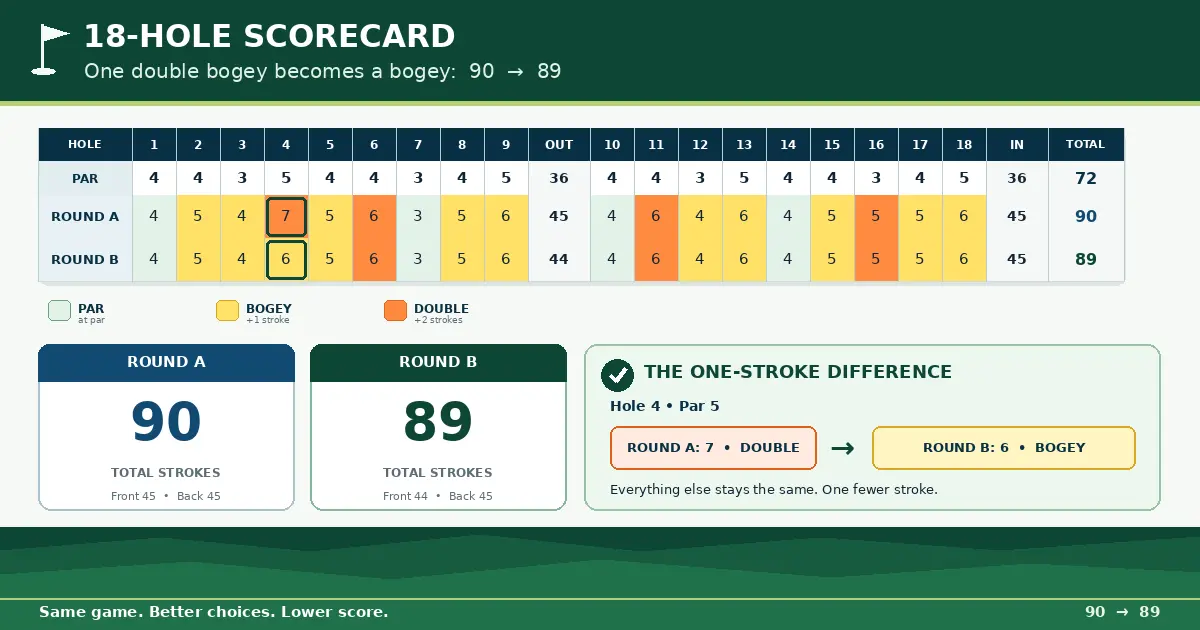
To break 90 on a par-72 course, you need to shoot 89 or better. That’s 17 over par. Eighteen bogeys adds up to 90, so bogey golf alone falls one stroke short.
The count that closes that gap is simple. Your pars have to outnumber your double bogeys. This guide shows how that count works, where 15-handicap golfers lose strokes according to shot-tracking data, and how to cut the big numbers that keep a score stuck in the low 90s.
What breaking 90 actually takes
Treat every hole as a bogey by default. A par saves you a stroke against that default. A double bogey costs you one. A birdie saves two, and a triple bogey costs two.
On a par 72, you break 90 when the strokes you save beat the strokes you give back by at least one. With no birdies and no triples, that means more pars than doubles. If a birdie or triple does show up, count the birdie as two pars and the triple as two doubles.
The table below shows three hypothetical rounds built to show the arithmetic. They aren’t real scorecards.
| Hypothetical round | Pars | Bogeys | Doubles | Score |
|---|---|---|---|---|
| A | 5 | 8 | 5 | 90 |
| B | 5 | 9 | 4 | 89 |
| C | 3 | 14 | 1 | 88 |
Rounds A and B differ by one hole. One double became a bogey, and 90 became 89. Round C breaks 90 with only three pars because it has a single double.
The count shifts a little on other courses. On a par 71, pars only need to match doubles. On a par 70, you can afford one more double than you have pars.
The typical 15-handicap sits close to the line
Shot Scope collects shot data from golfers who use its trackers. Its figures for 15-handicap players, published by GolfLink, show an average of 18.41 strokes over par. That’s just over 90 on a par 72. The same data splits their holes into 2% birdies, 27% pars, 45% bogeys and 26% double bogeys or worse.
Convert that to a round and you get roughly five pars, eight bogeys and almost five doubles or worse. That looks a lot like round A. The percentages are rounded, so treat the conversion as a ballpark.
The distance to break 90 is about 1.4 strokes per round. Turning two doubles into bogeys would cover it.
How common is breaking 90?
You may have seen the claim that about three in four golfers break 90. Golf Monthly explains where it comes from. USGA data shows 73.4% of golfers with a handicap hold an index of 17.9 or better. Add 17.9 to par 72 and you get 89.9. The claim assumes everyone plays exactly to their index on a par 72, every round. That isn’t how scoring works.
Golf Monthly also cites a National Golf Foundation figure that puts regular sub-90 golfers at around 26%. Neither number is perfect, but they agree on one point. Breaking 90 on a good day is not the same as breaking it regularly.
If you want a handicap shorthand, an index near 17.9 or lower is the usual threshold on a par 72 of average difficulty. Treat it loosely, because your Handicap Index reflects your better rounds, not your average. The 15-handicap golfers above show why. They average a little over 90.
Where the strokes go
Mark Broadie’s strokes-gained research began with a question close to yours. Where do the ten strokes between a 90 shooter and an 80 shooter come from? Columbia Business School describes how he built shot-level data to answer it. As Practical Golf summarizes his work, the long game explains about two-thirds of the scoring gap between golfers. That means tee shots and approach shots. Putting explains about 15%.
Another cut of Shot Scope data points at doubles. Practical Golf reports that almost every handicap level averages fewer than one birdie per round. Going from a 26 handicap to an 8 means about four fewer double bogeys per round.
The two findings can fit together, with a step of interpretation here. Many doubles probably start with a poor tee shot or approach, which would link long-game quality to big numbers. Neither source tests that link directly, so read it as a reasonable guess.
Coaches also disagree about where to start. A coach writing for GolfLink recommends working backward from the hole, because short-game gains come fastest. Practical Golf describes the short game as a quick win with a ceiling, while the long game drives the larger gap over time. For breaking 90, your own scorecard can settle it.
Tally your big numbers for a few rounds
Before you change anything, find out what creates your doubles. You don’t need a tracker, though a shot-tracking app makes it easier. A pencil works.
For the next few rounds, mark every hole where you made double bogey or worse. Beside each mark, write one letter for the first avoidable mistake on that hole:
- T: a tee shot that ended in a penalty area, out of bounds or somewhere you had no real shot
- A: an approach or layup that missed badly and left a hard recovery
- R: a recovery that made things worse, such as a second failed attempt from trouble
- S: a short-game miss, such as a chunk, a thin shot or a chip that never reached the green
- P: a hole where three putts produced the double
The typical 15-handicap above makes close to five doubles or worse per round. Five rounds would give you roughly 20 to 25 holes to sort. Your own count will differ.
This tally is a practical suggestion, not a researched method. Its value is simple. It points practice time at your own problems instead of generic tips.
Cut the big numbers by cause
Tee shots: keep the ball playable
In the Shot Scope data for 15-handicaps, the average hole finished about 0.9 over par after a fairway tee shot. After a fairway bunker it finished about 1.4 over. Misses to the left or right landed between 1.1 and 1.2.
If T marks dominate your card, the fix is usually target and club choice rather than a swing change. The common advice to club down for accuracy deserves a second look. In the 15-handicap tee-shot data, 3-wood found the fairway 46% of the time against 47% for driver. A separate Shot Scope analysis, reported by Practical Golf, found 3-wood raised fairway accuracy by about one percentage point while costing about a third of a stroke in distance.
Averages hide individual holes, though. If out of bounds or water sits within driver range, play the club that can’t reach it and aim away from the trouble.
The Rules add a reason for care. A ball that is lost or out of bounds costs one penalty stroke, and you replay from the previous spot. Rule 18 lets you play a provisional ball when a ball might be lost outside a penalty area or out of bounds. You have to announce it first. A provisional saves time, not strokes.
Approach shots: miss long more often
In the same data, 54% of 15-handicap approach shots finished short of the green and 5% finished long. That’s roughly ten short misses for every long one. Those figures cover all approach distances, so they include long shots that never had much chance. The direction of the miss is still clear.
Two moves follow. First, know how far each club really carries, not how far your best shot went. Log your real carry distances before you pick a target. Second, aim for the middle or back-middle of the green and take the club that gets there. The exception is a hole with water or a severe drop behind the green. That’s a judgment call for each hole, not a rule.
Around the green: choose the simpler shot
Inside 50 yards, the 15-handicap group got up and down 34% of the time and saved par from bunkers 18% of the time. Golfers who putted from just off the green got up and down 71% of the time. Wedge and short-iron results ranged from 17% to 30%.
Part of that gap is selection. People reach for the putter when the lie is clean and the path is clear, so the shots aren’t equal. Still, the putter is a legal option that many golfers overlook when the ground allows it.
When it doesn’t, decide between a bump and run and a pitch before you choose a club. If chunks and thin shots show up as S marks on your card, fix chunked and bladed chips at the setup level first.
Putting: avoid the three-putt
The 15-handicap group three-putted 11% of holes, which is about one hole in ten and roughly two per round. Their first putts averaged 17 feet. That points to lag speed more than to holing long putts. Work on putting distance control so your first putt finishes close enough for a tap-in.
After trouble: take the exit
A double often becomes a triple on the next shot. When your ball is in trouble, choose the widest opening back to playable ground rather than the shot that reaches the green. If the ball sits under branches, hit a low punch shot under the branches toward open fairway.
When you can’t play the ball at all, the Rules offer a way out. Under Rule 19, only you can decide a ball is unplayable, and you can do it anywhere except in a penalty area. There are three options, each costing one stroke:
- Replay from the previous spot.
- Drop back on a line from the hole through the ball.
- Drop within two club-lengths, no closer to the hole.
In a bunker, the second and third drops must stay inside the bunker. A two-stroke option lets you go back on the line outside it.
Whether the penalty is worth taking is a judgment, not a measured rule. A second failed attempt from the same spot costs another stroke and leaves you where you started. That’s the case for taking the penalty early.
Pick tees that fit your drive
On a course that’s too long for you, strokes slip away before technique matters. The 2011 PGA of America and USGA Tee It Forward guidelines match your average drive to a total course length. A 200-yard average points to 5,200 to 5,400 yards. A 225-yard average points to 5,800 to 6,000, and 250 yards points to 6,200 to 6,400. The chart is hosted by Mass Golf.
Treat it as a starting point. The chart is more than a decade old. Course Rating and Slope also change from tee to tee. An 89 from shorter tees is a real score, and the handicap system adjusts for tee difficulty. It just isn’t the same test as an 89 from the back tees.
Where this plan falls short
The tally assumes a par-72 course, 18 holes and honest scoring, with every stroke and penalty counted. The benchmarks come from a 15-handicap group of golfers who use shot-tracking devices, and they may not mirror every golfer.
If you’re closer to a 20 handicap, the gap is wider. In the same Shot Scope data, 20-handicap players made doubles or worse on 37% of holes, about seven per round. That calls for bigger changes than a tweak. Frequent mishits can also point to a swing problem that strategy won’t fix, and a lesson may help more than another round of tallying.
Your next step
Keep a running pars-minus-doubles count on your scorecard and check it at the turn. Mark each double with its cause letter. After a few rounds, work on whichever letter shows up most. When your pars outnumber your doubles, you’re on pace to break 90.