
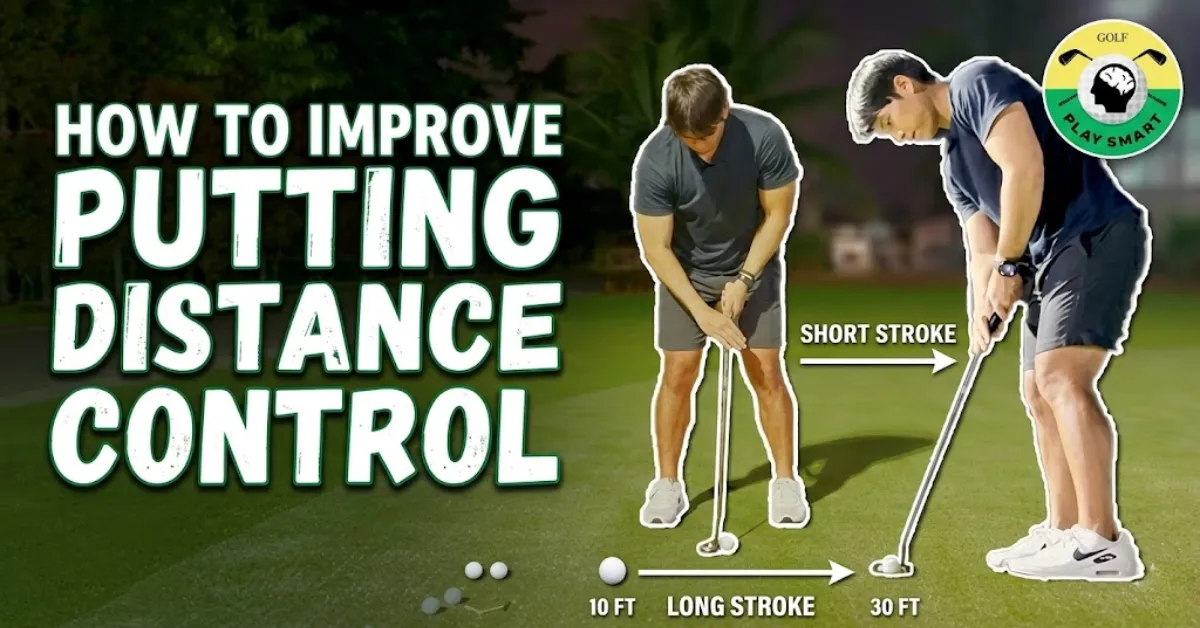
Poor putting distance control is the single biggest reason most golfers waste shots on the green. You leave long putts three feet short. And you blast short ones five feet past. You walk off the green shaking your head — and your score suffers for it.
Golf coach Danny Maude struggled with this exact problem for a full year. He tried going to the course more often, hoping his stroke would sort itself out. It never did. He finally broke the slump using a three-step system from an old coach — and the results were immediate.
Here is that exact putting system. It covers your setup posture, eye line, and stroke rhythm — the three things that control every single putt you hit.
Putting Stats Every Golfer Should Know
This means your number one job on a long putt is NOT to hole it. It is to leave the ball within 3 feet so your next putt is a tap-in.
The Putting Matrix
Putting Setup: How to Build a Repeatable Mini Arc
A natural putting stroke works on a mini arc around your body. The putter face must return to square on every single stroke. Your posture controls this arc — which is why two bad posture habits kill putting distance control before you even pull the club back.
Putting Posture Analytics
Level Shoulders
Check your setup from the front. If you tilt your shoulders up, you hit the ball on the way up. Level shoulders fix this immediately.
Primary Gaze
Look straight down at the golf ball. Do not tilt your head up. This rounds your shoulders and lets your arms hang beautifully.
Forearm Alignment
With your arms hanging loose, make sure the club shaft seamlessly points straight up your forearm for a natural stroke.
Film Your Setup
It’s hard to feel these angles. Have a friend film your setup from both angles to visually check these specific points.
Check Your Setup From the Front
Keep your head straight down your spine, placed right behind the golf ball. Your shoulders must stay completely level. Many golfers tilt their lead shoulder up at address. This makes the putter swing upward through impact and ruins the roll of the ball — which wrecks your distance control immediately. Level shoulders fix this in one practice session.
Check Your Setup From Down the Line
Look straight down at the golf ball — not tilted up like a normal golf swing. This is called a primary gaze. When you look straight down, two things happen at once: your shoulders round naturally at the top, and your arms hang with complete freedom. This creates the arc that brings the putter back to square every time. It also makes reading the line of a putt significantly easier.
Finally, check that the shaft of the putter points straight up your forearm when you address the ball. Have a friend film your setup from both angles to confirm these positions.
The 2-Minute Eye Line Fix That Saves Putts Immediately
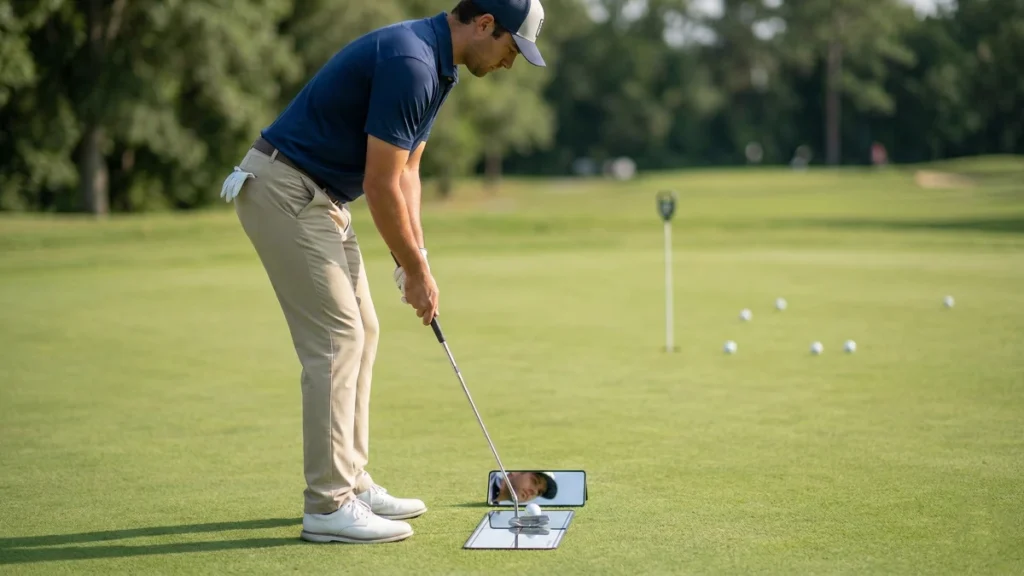
Good mechanics mean nothing if your eye line is wrong. Grab a putting mirror for your pre-round warm-up. This takes two minutes but sets your entire posture up correctly before you play a single hole.
Place the mirror on the practice green. Get into your setup posture. The most common trap is letting your eyes drift too far outside the golf ball — this opens your stroke path before you even pull the putter back.
Use the mirror to get your eyes directly over the ball. Tuck your chin in. Look straight down over the top of the ball. Use the alignment lines on the mirror to confirm your shoulders are perfectly square to your target line.
Eye Line Solution
Pre-Round Routine
Grab a putting mirror for your warmup. It takes just two minutes but sets your posture up to win.
Stop the Drift
A common trap is letting your eyes drift too far outside the golf ball, ruining your stroke immediately.
Perfect Alignment
Get your eyes directly over the ball and use the mirror lines to ensure your shoulders are perfectly square.
Even Weight Distribution
Balance evenly in your feet. Do not put too much weight on your toes or your heels before striking.
Balance your weight evenly across both feet. Not on your toes. Not on your heels. When your weight is centered and your eyes are over the ball, your body is in the correct position to control distance.
The 4-Step Putting Rhythm That Fixes Distance Control
Once your setup and eye line are locked in, keep things simple. Putting distance control is destroyed when golfers overthink mechanics while standing over the ball. A basic counting rhythm stops this completely.
Rhythmic Precision
Clean Center Strike
Great mechanics mean nothing if you miss the center. You must focus intensely on a clean, centered strike.
Counting Rhythm
Keep things simple. Look at the hole (1), back to ball (2), take it back (3), and follow through (4).
Natural Collision
Let the club simply collide with the golf ball. Do not try to force a hit. Consistent strikes fix distance control.
Zero Anxiety
Adopt a mindset with zero anxiety. Commit to the four steps, give your best effort, and accept the result.
Look at the hole. That is one. Look back to the ball. That is two. Take the club back. That is three. Follow through. That is four.
Let the putter simply collide with the ball — do not force a hit. The rhythm does the work. Commit to all four steps on every single putt, give your best effort, and accept the result. This is how you stop the anxious jabbing stroke that ruins so many short putts.
Backstroke Length Is Your Real Distance Controller
Here is something most golfers never hear: the length of your backstroke is your primary distance controller — not how hard you hit the ball. A longer backstroke produces a longer putt. A shorter backstroke produces a shorter putt. The tempo stays the same every time.
Trying to hit the ball harder to make it go further is one of the biggest distance control mistakes in golf. Hitting putts harder actually makes the hole smaller — the ball carries more speed and skips over the edge instead of dropping in. Match your backstroke length to the putt distance and let the stroke do the work.
3 Putting Drills to Fix Distance Control Before Your Next Round
Reading about putting mechanics is useful. But you only fix putting distance control by practicing with a specific drill. Here are three drills that work. Pick one and spend ten minutes on it before your next round.
| Drill Name | How To Do It | What It Fixes |
|---|---|---|
| Ladder Drill | Place 5 balls at 3-foot increments from 6 to 18 feet. Putt each one. Goal: every ball finishes within 18 inches of the hole. | Trains your brain to match backstroke length to putt distance automatically. |
| Tee Peg Gate Drill | Push two tee pegs into the green — one 8 inches behind the ball, one 8 inches in front. Swing the putter through without touching either tee. | Builds a smooth, even-tempo stroke and removes the jerky hit that kills distance control. |
| Blindfold Drill | Set up over a 10-foot putt. Look at the hole, then close your eyes. Putt from feel alone. Check where the ball finishes. | Forces your body to develop touch and feel instead of relying purely on mechanics. |
Start with the Ladder Drill if you struggle with long putts. Move to the Tee Peg Gate Drill if your stroke feels jerky and inconsistent. Use the Blindfold Drill once a week to build pure feel across all distances.
How Your Gaze Affects Putting Distance Control and Green Reading
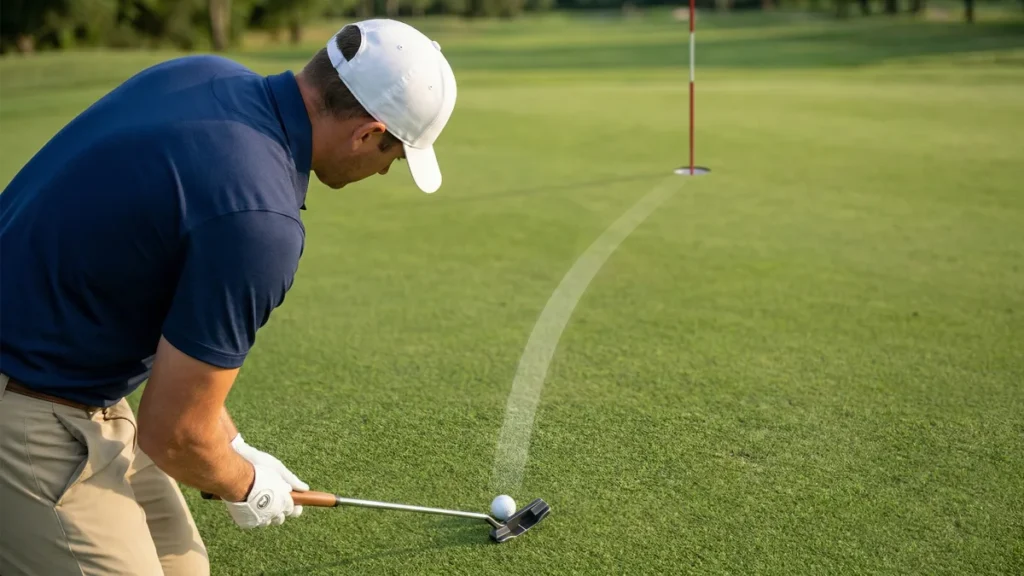
Many golfers struggle to see the correct line on the green. Danny Maude explains that this often comes from using a secondary gaze — tilting your head up the way you would in a full golf swing. When you look at the ball this way, your view of the green is distorted. You cannot see the true break or slope of the putt.
Switching to a primary gaze — looking straight down at the ball — solves both problems at once. It rounds your shoulders into the correct position and gives you a clear, undistorted view of the green from that one spot.
If you have ever stood over a putt and felt unsure which way it breaks, a wrong head position is often the reason. Fix the gaze first. The read becomes clearer immediately.
Why Every Golfer Needs a Putting Distance Control System
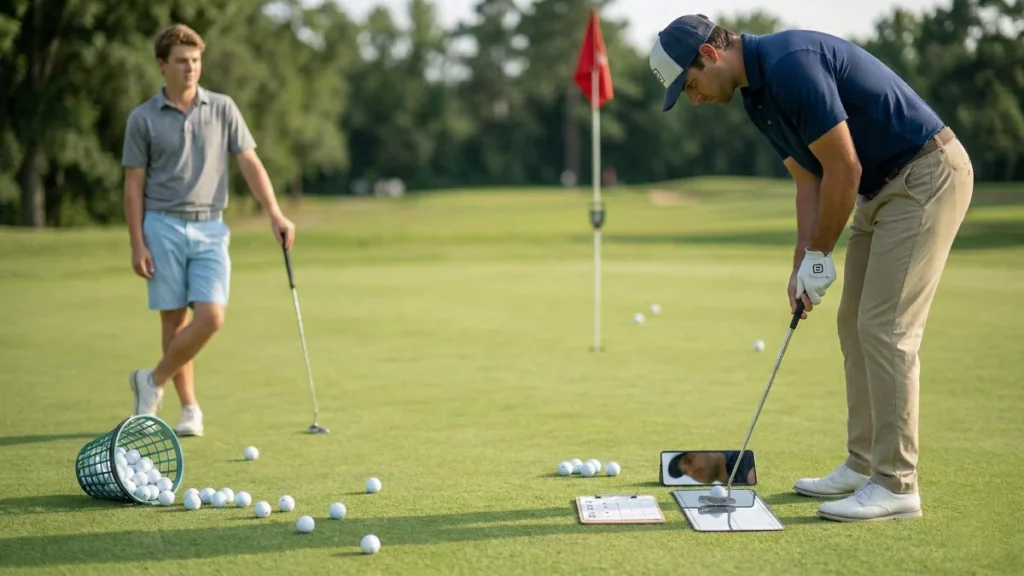
Danny Maude spent an entire year hoping his putting would improve by just going to the golf course. It never did — because hope is not a system. His putting stayed inconsistent until he went back to a specific process with clear checkpoints.
A system removes the guesswork. Instead of wondering why you missed a putt, you check three things: your spine angle and shoulder level, your eye line over the ball, and your stroke rhythm. If one of those three is off, you know exactly what to fix.
This is the difference between practicing with a purpose and simply going through the motions. One builds a repeatable stroke. The other builds nothing.
Putting Distance Control Checklist
| Putting Step | What To Do | Why It Matters |
|---|---|---|
| Face-On Setup | Keep head straight down your spine. Keep shoulders perfectly level. | Stops you hitting up on the ball and losing distance control. |
| Down the Line Setup | Look straight down at the ball. Let your arms hang naturally. | Creates a proper stroke arc and makes green reading easier. |
| Pre-Round Mirror | Place a putting mirror on the green. Get eyes directly over the ball. | Forces shoulders to stay square before you step onto the course. |
| 4-Step Counting Rhythm | 1: Look at hole. 2: Look at ball. 3: Take club back. 4: Strike. | Focuses your mind on center contact with zero anxiety. |
| Backstroke Length Control | Match backstroke length to putt distance. Longer putt = longer backstroke. | The backstroke is your primary distance controller — not force. |
Putting Distance Control — Frequently Asked Questions
The fastest improvement comes from two things: fixing your eye line over the ball using a putting mirror, and doing the Ladder Drill during your warm-up. Most golfers see a difference within one or two practice sessions because both fixes are immediate and physical — not theoretical.
The most common reason is a backstroke that is too short. Golfers then try to compensate by hitting harder at the ball — but this creates an inconsistent strike every time. Match your backstroke length to the distance of the putt instead. Longer putt, longer backstroke. Same tempo every time.
The Ladder Drill is the most effective starting point for most golfers. Place balls at 6, 9, 12, 15, and 18 feet from the hole. Putt each one with the goal of finishing within 18 inches. This trains your feel for different distances far better than hitting the same putt repeatedly from the same spot.
Yes — and it affects it more than most golfers realise. When your eyes are outside the ball, your stroke path opens slightly, which affects both direction and the quality of the roll. A mis-rolled putt loses pace faster and finishes short more often. Eyes directly over the ball produces a truer roll and more consistent distance every time.
A putting mirror is one of the most cost-effective practice tools in golf. It takes two minutes to use before a round and immediately shows you whether your shoulders are square and your eyes are over the ball. Used consistently, it builds a setup routine that becomes automatic on the course.
Conclusion: Build a System and Start Holing More Putts
Poor putting distance control is not a talent problem — it is a system problem. Danny Maude proved that even a year-long putting slump disappears when you follow a repeatable process.
Check your posture from two angles. Use a putting mirror to lock in your eye line. Follow the four-step counting rhythm on every single putt. And spend ten minutes on the Ladder Drill before your next round.
These three steps — setup, eye line, and rhythm — are the foundation of every consistent putter at every level of the game.
Grab your smartphone today. Film your setup from the front and from down the line. Fix your shoulders and your gaze. Spend two minutes with a putting mirror before your next round. You will start holing more putts and shooting lower scores.