
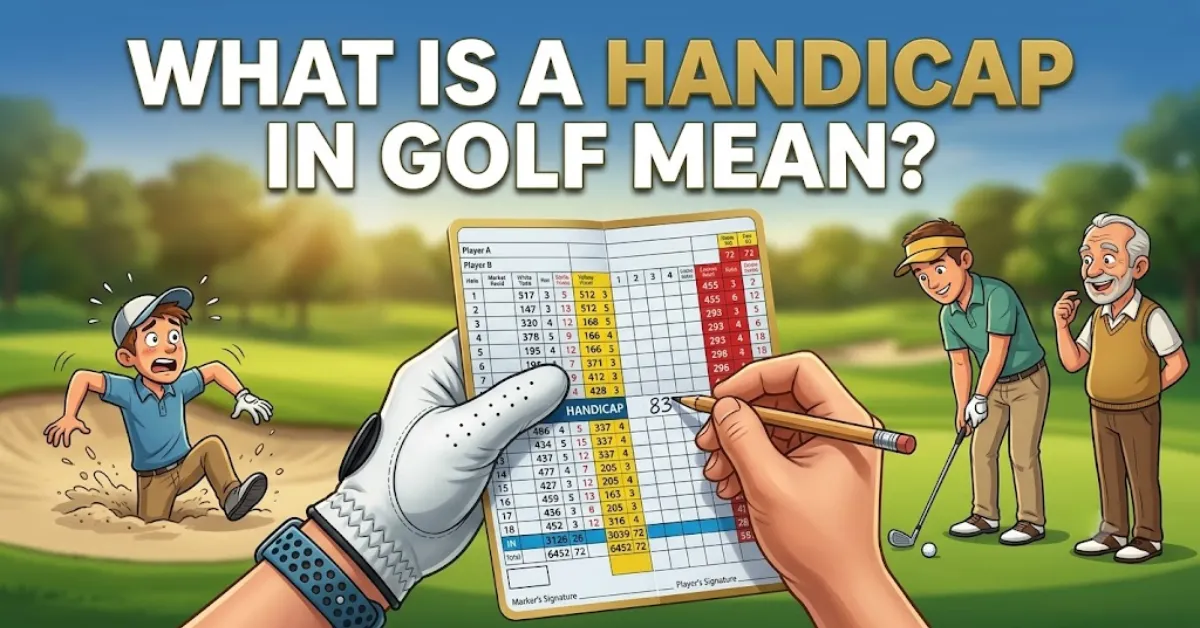
My first attempt at calculating my own handicap happened on the drive home from a course in the Midwest, somewhere around my 12th round of golf. I’d just shot 102 on a par-72, and a playing partner mentioned that was roughly a 30 handicap. The phrase meant almost nothing to me. I nodded and said “right, yeah” like someone who definitely understood, then spent 45 minutes searching for a real explanation that night. What I found was either too technical to parse or too vague to use.
That’s what this guide fixes. Whether you’re trying to understand what a handicap in golf means, figure out what your specific number actually tells you, or get your first official index – here’s everything, without the fluff.
Quick Answer: A golf handicap is a number that represents your skill level – specifically, how many strokes above par you’re likely to shoot on your best days. Lower is better. Beginners typically start around 36–54. A 14 handicap is average for men; 28 is average for women. The World Handicap System governs it globally.
What a Golf Handicap Actually Means (In Plain English)
A golf handicap is a number that represents your potential playing ability – specifically, how many strokes above par a golfer is capable of shooting when playing their best. The key word there is potential. The USGA notes that most golfers only actually play to their handicap about 20–25% of the time. It’s not your average. It’s your ceiling.
Here’s what it means in practice: if your Handicap Index is 18, it means the system expects you to shoot around 90 on a standard par-72 course when you’re on your game. Subtract your handicap from your gross score (the total strokes you actually took), and you get your net score. Your net score is what determines who wins a handicap competition.
Two golfers can shoot completely different gross scores and still tie on net – which is exactly the point. A 5-handicap shooting 79 and a 22-handicap shooting 96 could finish with identical net scores. That symmetry is why golf is one of the only sports where a beginner and an advanced player can play a meaningful, competitive round together in the same afternoon.
The official term for your handicap number is your Handicap Index. It’s a portable figure — it adjusts to whatever course you’re playing, through a calculation that accounts for each course’s specific difficulty. Your Handicap Index lives in the World Handicap System (WHS), which launched in 2020 and now operates in 131 countries as of May 2025, according to WHS.com. Before 2020, each country ran its own system. A British golfer’s handicap didn’t translate cleanly to a US one. WHS fixed that.
What Do Handicap Numbers Actually Mean? A Complete Breakdown
This is the section that practically nobody else writes. Most guides explain how a handicap works without explaining what your specific number tells you. Here’s the full breakdown:
| Handicap Range | Skill Level | Typical Gross Score (Par 72) | % of Registered Golfers |
|---|---|---|---|
| +3 and below | Tour-level amateur | 69 or better | Top 1–2% |
| 0 (scratch) | Elite amateur | 72 (par) | ~5% |
| 1–5 | Skilled club golfer | 73–77 | ~10% |
| 6–10 | Low handicapper | 78–82 | ~15% |
| 11–18 | Mid-handicapper | 83–90 | ~40% |
| 19–28 | High handicapper | 91–100 | ~25% |
| 29–36 | Developing golfer | 101–108 | ~8% |
| 37–54 | Beginner / new | 109 and above | ~5% |
One column you won’t find in any competitor’s table: the percentage of registered golfers at each level. The average registered male golfer in the US carries a Handicap Index of 14.0. The average registered female golfer carries 28.0, according to GolfNow data citing USGA statistics. Those averages aren’t “good” or “bad” — they’re exactly the midpoint of the entire golfing population.
What Is a Low, Mid, and High Handicap?
The three standard categories are low (0–10), mid (11–18), and high (19+). This breakdown is recognized globally under WHS and used by most golf clubs when setting up handicap competitions and flights.
A low-handicap golfer consistently breaks 80 and controls their misses well. They don’t make a lot of pars — they rarely make big numbers either. A mid-handicapper shoots in the 83–90 range, plays in regulation maybe 4–6 times per round, and usually has one solid area of their game anchoring their score. A high handicapper is still working on consistency, tends to have 3–4 blow-up holes per round, and benefits most from the stroke system in competitive play.
What Is a Scratch Golfer?
A scratch golfer has a Handicap Index of 0.0 — meaning they’re expected to shoot par on any rated course from the standard set of tees. These players receive no strokes when competing against other scratch golfers. Only about 5% of registered golfers reach scratch. Most club golfers will never get there, and that’s fine — it takes years of serious practice and regular competition to get close.
What Is a Plus Handicap in Golf?
A plus handicap (written as +1, +2, +3, etc.) means a golfer is so good they’re expected to shoot below par. A player with a +5 handicap doesn’t receive strokes — they give strokes back in competition. Tour professionals, if they had official handicaps, would typically carry indices above +5. Rory McIlroy or Scottie Scheffler at their best would likely be in the +8 to +10 range. A plus handicap is rare and seriously impressive. Fewer than 1% of registered golfers ever reach it.
How a Golf Handicap Is Calculated (Step-by-Step)
The formula sounds complex, but the calculation follows the same logic every time. Here’s exactly how it works under the World Handicap System.
Step 1: Calculate your Score Differential after each round. The formula: (Adjusted Gross Score − Course Rating) × 113 ÷ Slope Rating = Score Differential
Using real-ish numbers: You shoot 94 on a course with a Rating of 70.1 and a Slope of 125. (94 − 70.1) × 113 ÷ 125 = 21.59
Your Score Differential for that round is 21.6.
Step 2: Cap each hole at “net double bogey” before you enter your score. You can’t submit a score with an 11 on one hole. For handicapping purposes, your maximum score per hole is a net double bogey – that’s a double bogey plus any handicap strokes you’re entitled to on that hole. The app handles this automatically.
Step 3: Accumulate at least 54 holes (any mix of 9- and 18-hole rounds). The WHS requires 54 holes to establish your first Handicap Index. That’s three 18-hole rounds, or any combination of 9- and 18-hole scores that totals 54 holes.
Step 4: The system takes the best 8 of your last 20 Score Differentials. Once you have 20 rounds on record, your Handicap Index uses only your 8 best differentials — not the average of all 20. This is why your handicap reflects your potential, not your average. If you have fewer than 20 rounds, the system uses a proportionally scaled number of your best differentials (see the WHS tables on usga.org for the full breakdown).
Step 5: Average those 8 differentials and round to one decimal place. That average becomes your Handicap Index. There’s no 0.96 “bonus for excellence” multiplier anymore under WHS – that was a USGA-specific feature from the old system. Under WHS, the 8-best average is your number.
Step 6: Daily updates. Your Handicap Index updates the day after you post a new score. Post on Saturday, wake up Sunday with a new number.
The resulting Course Handicap you use on a specific course is calculated as: Handicap Index × (Slope Rating ÷ 113) + (Course Rating − Par). Most courses have a chart at the first tee, and every handicap app calculates this automatically.
Course Rating, Slope Rating, and Stroke Index – What They Mean on Your Scorecard
Three numbers on every golf scorecard do work that most golfers never fully understand.
Course Rating is the score a scratch golfer (Handicap Index of 0.0) would be expected to shoot on that course under normal conditions, from a specific set of tees. On a par-72 course, it typically falls between 67 and 77. A Rating of 72.5 means scratch players expect to shoot about 72–73 on their good days. Higher than par = harder than standard.
Slope Rating is how much harder the course plays for a bogey golfer compared to a scratch golfer. The standard is 113. A Slope of 145 means the course significantly punishes higher handicappers more than scratch players – narrow fairways, severe rough, forced carries over water all drive the Slope up. The range runs from 55 to 155. Courses at 155 are the hardest in the world.
Stroke Index is the number printed next to each hole (usually labeled SI or Hdcp on the scorecard). It ranks the 18 holes from 1 to 18 in terms of where a high handicapper is most likely to benefit from an extra stroke. Stroke Index 1 is the hardest hole for a high handicapper. If you carry a Course Handicap of 12, you receive one stroke on the 12 holes ranked SI 1 through SI 12. Those are the holes where your net score benefits from the system. This is why understanding Stroke Index turns handicap golf from theory into strategy.
What Is a Good Handicap in Golf?
“Good” depends entirely on where you’re starting from, how long you’ve been playing, and who you’re comparing yourself to.
A good handicap for a beginner is anything under 36 in your first season. Most brand-new golfers score around 108–115 for 18 holes, which translates to roughly a 36–43 Handicap Index. If you’re entering your first registered round averaging around 100, you’re already performing better than the majority of new players. Don’t measure yourself against scratch golfers – measure yourself against your previous round.
For men who’ve been playing seriously for a few years, reaching a single-digit handicap (below 10) puts you in roughly the top 15–20% of all registered golfers. That’s legitimately good. Breaking 90 consistently enough to post a mid-teen handicap puts you right at the average, which most casual golfers never reach. For women, a handicap below 20 is considered strong, and the national average of 28.0 reflects the fact that most female golfers have less access to practice time and formal instruction than their male counterparts – not less talent.
Here’s an honest limitation worth stating: if you only play twice a month and never practice between rounds, a 20-something handicap isn’t a failure of ability. It’s a reflection of time invested. Handicap rewards consistency, and consistency requires repetition. Golfers who practice short-game specifically – putting and chipping within 50 yards – tend to lower their handicap faster than those who only grind on the driving range hitting drivers, because the short game directly eliminates blow-up holes.
How to Get an Official Golf Handicap (Including Cost)
Getting a Handicap Index is straightforward and less expensive than most people assume.
In the United States:
- Download the GHIN app (free) on iOS or Android – the official USGA tool
- Sign up through your local Allied Golf Association or a member club. Search usga.org/getahandicap for your nearest option.
- Pay the annual fee. Costs vary by state and club: most fall between $30–$60 per year. The Golf Association of Philadelphia charges $45; Minnesota clubs run around $50–$54. The USGA’s own direct enrollment option is approximately $60.
- Post 54 holes of scores (any combination of 9- and 18-hole rounds)
- Your Handicap Index is calculated automatically and updates daily after each new score
Outside the US: WHS operates in 131 countries (as of May 2025). In the UK, register through England Golf, Scottish Golf, or your home club. In Australia, use the Golf Australia GHIN system. And most countries, the fee structure is similar – annual dues through a club or national association.
Free alternatives: Apps like The Grint offer unofficial handicap tracking at no cost. The number won’t be an official WHS Handicap Index — you can’t enter USGA-sanctioned events with it — but it tracks your score differentials accurately and gives you a meaningful working number while you decide whether to go official.
The Golf Channel’s 18Birdies and Shot Scope also offer handicap-adjacent tracking features.
Why Is It Called a Handicap in Golf?
The word “handicap” traces back to a 17th-century British betting game called hand-in-cap, in which a neutral arbitrator (the handicapper) determined how much money each of two participants needed to add to equalize the value of items they were trading. Each player would put their hand into a cap containing the agreed contribution, then reveal simultaneously whether they accepted the deal. The concept – using an adjustment to level unequal parties – transferred directly to horse racing in the 1850s, where heavier weights were assigned to faster horses.
Golf adopted the term in the late 19th century, first documented in practice in the 1860s–1880s in Scotland and England. The earliest recorded golf handicapping dates to a diary kept by Thomas Kincaid in Edinburgh in the late 17th century – though the word “handicap” itself didn’t appear in golf until decades later. By 1911, the USGA had introduced the first national handicapping system in the US, making golf one of the few sports where the term retained its original meaning: a deliberate adjustment to make competition fair.
Frequently Asked Questions
For a brand-new golfer, anything under 36 in your first full season is a solid starting point. Most beginners start around 40–54 before their first official index is established. After a year of regular play – roughly 20+ rounds – most recreational beginners settle into the 28–36 range. Getting below 20 within your first two years of serious play is genuinely impressive and puts you ahead of most casual golfers.
A 20 handicap means you’re expected to shoot around 92 on a standard par-72 course on your best days. In a handicap stroke-play competition, you subtract 20 strokes from your gross score to get your net score. If you shoot 94, your net score is 74 – competitive against a scratch golfer who shot 75 net. A 20 handicap puts you in the upper range of the “high handicap” category and right at the edge of where most recreational golfers play.
A plus handicap means a golfer is expected to play below par. A player with a +3 handicap adds 3 strokes to their gross score in competitions – not subtracts. They’re so skilled that they give strokes to the field rather than receiving them. Tour professionals, if they carried official indexes, would typically be +6 or better. Reaching a plus handicap as an amateur requires consistently shooting in the 60s.
The letter “M” next to your Handicap Index on your GHIN card means your handicap has been Modified by your club’s Handicap Committee. Committees can modify a handicap when they believe the calculated index no longer accurately reflects a player’s current ability – for example, if a player has been improving faster than the system can react, or if they’ve posted several away scores that have pushed the index unrealistically high. The committee must give the player an opportunity to explain their circumstances before modifying. Other letters you might see: “L” means Local handicap (above the WHS maximum); “R” means the index was automatically Reduced after exceptional tournament scoring; “N” means a nine-hole Handicap Index.
A beginner female golfer typically starts with a Handicap Index in the 40–54 range. The WHS maximum for all golfers regardless of gender is 54.0. The average registered female golfer in the US carries a Handicap Index of 28.0, according to USGA data – so getting below 28 puts a woman golfer above the national average. A beginner female golfer reaching a handicap in the 30s after her first full season is doing well and improving at a healthy pace.
The “best” (lowest) handicap in competitive amateur golf is a scratch (0.0) or plus handicap. A plus handicap means you’re expected to shoot under par, which puts you in the top fraction of 1% of all registered golfers globally. Among Tour professionals, handicap equivalents would typically be +5 to +10 — though they don’t carry official indexes. The WHS doesn’t have a minimum below zero; professional amateurs routinely operate at +4 or +5. For a recreational golfer, reaching single digits (below 10) is an achievement that most players who take the game seriously spend years working toward.
Your Number Is a Starting Point, Not a Verdict
Every golfer with a handicap has the same thing in common: they started somewhere, posted the rounds, and watched the number move. My 102 on that Midwest course translated to a differential of around 28. A year later, after working primarily on lag putting and stopping trying to bomb every drive, it was sitting at 19. Not impressive by club standards, but a 9-shot improvement feels transformational from the inside.
Get your official index through GHIN if you haven’t – it costs roughly $30–$60 a year and turns every round into data you can use. Understand what your number actually represents (potential, not average), learn the Stroke Index on your home course, and stop treating your handicap as a measure of how good you are. It’s a measure of where you are right now.
That’s a very different thing.