
Last Updated: September 2026 | By Lucas Hayes – PGA-certified instructor
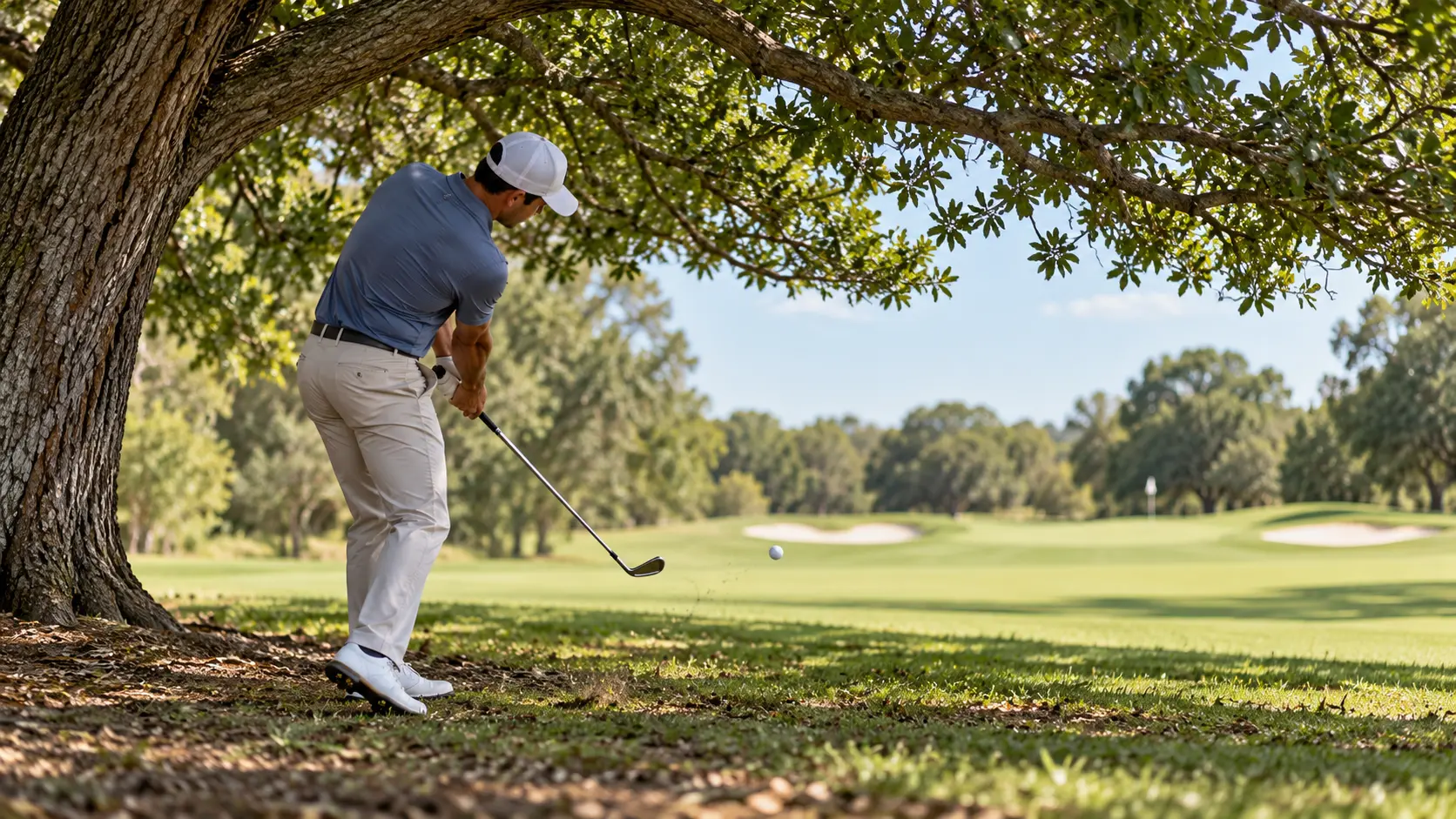
Quick Answer: To hit a low punch shot under tree branches, choose a club with enough loft to escape the lie but little enough loft to stay below the branches. Play the ball slightly back of center, grip down, keep more pressure on your lead foot, and make a compact swing with a low finish. Plan where the ball will roll before you swing.
A drive into the trees rarely ruins a hole by itself. The next decision often does.
You find a narrow opening, see part of the green through the branches, and start thinking about how much distance you can recover. That is usually the wrong starting point.
A useful punch shot starts with one question: where can I send the ball with a large margin for error?
I use a simple way to think about these recoveries. Check the ceiling, corridor, and runway before you choose the club.
That decision takes a few seconds and tells you far more than the distance to the flag.
Check the ceiling, corridor, and runway
Treat the space between you and safety like a three-dimensional window.
The ceiling is the lowest branch the ball must stay under.
The corridor is the width of the opening between trunks, bushes, and hanging branches.
The runway is the ground available after the ball lands.
You need all three.
A huge opening with a low ceiling calls for a different shot than a narrow opening with plenty of height. A low shot toward dry fairway can also run much farther than the same shot into soft rough.
Before pulling a club, make these three checks:
- Find the lowest branch that matters. Then give yourself extra clearance below it rather than trying to miss it by inches.
- Choose the widest corridor that gets you back into playable ground. The flag does not need to sit inside that corridor.
- Look at the runway. Decide where you want the first bounce and where the ball can finish without creating another problem.
This is the part many golfers skip.
They calculate carry distance while standing under a tree. A punch shot often depends more on launch height and rollout than carry.
Pick the landing area before thinking about the green
Your target for a recovery shot is usually a patch of ground, not the hole.
Find a landing area that gives the ball room to release. Ten extra yards of fairway can matter more than getting 20 yards closer to the green.
Suppose you have 145 yards to the pin but only need to move the ball 55 yards to reach open fairway. Trying to hit a 120-yard punch through a small gap adds risk without solving a bigger problem.
Hit the 55-yard shot.
The safest punch shot is often the best punch shot.
You can attack the green with the next swing from a normal stance instead of trying to manufacture a perfect shot from underneath branches.
Which club should you use for a low punch shot?
There is no single punch-shot club.
Your choice depends on four things: branch height, lie, required carry, and available rollout.
For many golfers, a 5-, 6-, or 7-iron gives a useful starting range from a decent lie.
A 5-iron launches lower and usually runs farther. A 7-iron gives you more help getting the ball out of light rough but starts higher. A 6-iron often sits between those two jobs.
Use the club that produces the flight your escape window allows.
| Situation | Starting club choice | What to expect |
|---|---|---|
| Very low branches, clean lie, lots of fairway ahead | 4- or 5-iron | Lowest flight and most rollout |
| Normal punch window from short grass | 5- or 6-iron | Low flight with useful carry |
| Higher branch window or shorter rollout | 7-iron | Easier launch with less release |
| Ball sitting down in rough | More loft than usual | Better chance of clean contact |
| Poor lie with little margin | Wedge or sideways chip | Shorter escape with more control |
Do not choose a 4-iron just because it flies lower.
If the ball sits down and you cannot strike the back of it cleanly, the low-lofted club creates another problem. A 7-iron that reaches fairway beats a 4-iron that stays underneath the tree.
Set up for a low flight without exaggerating anything
You do not need an extreme setup to hit a useful punch.
Start with the ball about one ball-width behind the position you would normally use for that iron. Grip down roughly an inch and narrow your stance slightly.
Favor your lead side at address. Around 60 percent of your pressure forward gives you a good reference without forcing your upper body toward the target.
Set your hands slightly ahead of the ball.
Now stop making adjustments.
Golfers often ruin the shot by stacking too many low-flight ideas together. They move the ball near the back foot, push the hands far forward, lean heavily toward the target, and choose a 4-iron.
That combination can produce a shot that barely leaves the ground.
The goal is controlled launch, not zero launch.
Make the swing shorter, not weaker
A punch swing should feel compact.
Take the club back somewhere around hip to waist height for a basic recovery. Turn through the ball and let the finish stay shorter than your normal iron finish.
Do not slow everything down at impact.
You still need enough speed to strike the ball cleanly. A golfer who tries to “baby” the ball often decelerates, hits the turf first, or leaves the face open.
Think short backswing and committed strike.
A full swing from underneath a tree is usually a bad bargain. More swing length gives you more speed, more launch variation, and less control over where the club bottoms out.
If you need significantly more distance, first ask whether the extra yards are worth the smaller margin.
Keep the finish low naturally
Many golfers hear “finish low” and force their arms toward the ground after impact.
That is not the goal.
Your finish should stay lower because the swing is shorter and the club exits around your body. You do not need to hold the clubhead down.
Turn your chest through the shot and keep your arms moving.
A useful checkpoint is simple. If a half swing turns into a full shoulder-high finish, you probably added more swing than the escape required.
Let the lie change your plan
The same branches do not require the same shot from every lie.
Clean fairway or closely cut grass
This gives you the most control.
You can use less loft, expect cleaner contact, and plan for more rollout. Keep the strike simple and avoid driving the club steeply into the turf.
Light rough
Check how much grass sits between the clubface and ball.
You may need one club more lofted than you would choose from fairway grass. Your first goal is getting the ball out cleanly.
Expect less predictable rollout.
Deep rough
Do not assume a low-lofted iron is automatically the low-shot solution.
If heavy grass prevents clean contact, take enough loft to get the ball moving. Your best play may be a short shot sideways.
Hard or bare ground
Avoid digging.
Grip pressure can become tight because the lie looks uncomfortable. Keep the motion compact and focus on contacting the ball before taking much ground.
Roots near the ball
Protect yourself first.
If a normal strike brings the clubhead or your hands dangerously close to a root, trunk, rock, or other hard object, do not force the shot. Choose the safest legal option available.
One saved stroke is not worth a damaged wrist.
Use three different punch shots instead of one
Building one “punch swing” for every situation limits your options.
Think about three windows.
The low runner
Use this when the branches sit low and you have plenty of clear ground ahead.
Choose less loft, make the shortest swing of the three, and expect the ball to spend more of the shot rolling than flying.
The standard escape
This should become your default.
A 5-, 6-, or 7-iron with a half swing can give you enough carry to clear the immediate trouble without sending the ball high into the canopy.
Focus on starting direction and landing area.
The soft punch
Sometimes you have branch clearance but very little room after the landing point.
Use slightly more loft and a shorter target. Do not try to manufacture extra spin from under a tree. Your goal is simply reducing rollout enough to keep the next shot manageable.
Learning these three flights gives you more options than trying to force one club through every opening.
Why your punch shot keeps hitting branches
A branch strike does not always mean you chose too much loft.
The problem can start somewhere else.
| What happened | Likely cause | Adjustment |
|---|---|---|
| Ball launches much too high | Ball too far forward or too much loft | Move it slightly back or change club |
| Ball starts low but curves into trouble | Clubface control or poor alignment | Choose a wider corridor and shorten swing |
| Ball barely gets airborne | Setup became too extreme | Add loft or move ball closer to center |
| Heavy contact | Excessive forward lean or steep strike | Reduce setup changes and stay centered |
| Thin shot | Trying to lift or avoiding the ground | Keep chest moving through the strike |
| Ball runs through fairway | Landing point too aggressive | Land it shorter or add loft |
The last mistake deserves attention.
Many golfers judge a punch shot only by whether it clears the branches. The shot is not finished when it passes the tree.
Your rollout is part of the shot.
Try the 15-ball branch-window test
You should learn this shot on the range before you need it during a round.
You do not need an actual tree.
Pick a visual height somewhere downrange. A range sign, distant hedge line, or another safe visual reference works. Never place a hard object directly in front of your hitting area.
Take a 5-iron, 6-iron, and 7-iron.
Hit five balls with each club using the same basic punch setup and similar swing length.
Track three things for every club: approximate launch window, carry distance, and total distance after the ball stops.
You are looking for patterns, not perfect yardages.
Perhaps your 5-iron stays comfortably below your chosen window but runs too far. Your 7-iron might land perfectly but fly too high. The 6-iron may give you the most useful combination.
That becomes information you can use on the course.
Repeat the test from light rough when your practice facility allows it. The club that works best from a clean mat or fairway lie might not give you the best escape from grass.
Use a rehearsal to check your swing space
Trees can interfere with more than the ball flight.
- Check your backswing.
- Check the club’s path after impact.
- Check where your hands travel.
A golfer can have a completely open flight window while a branch behind them blocks the backswing. A trunk beside the ball can also make a normal follow-through impossible.
Make a slow rehearsal without disturbing anything around the ball.
If the swing feels cramped, shorten it.
If you cannot make the motion safely, choose another direction.
When you should not try the punch shot
This shot is not for every tree situation.
A sideways chip makes more sense when your opening is only slightly wider than the ball’s expected starting line.
Take the easy exit when the lie is poor, your swing space is restricted, or the landing area slopes toward more trouble.
You should also abandon the punch when the only successful result requires several things to go perfectly at once.
That is too many conditions for a recovery shot.
Golf becomes easier when your bad shots stop creating a chain of bad decisions.
A simple pre-shot routine for tree trouble
When your ball finishes under branches, do not reach for a club immediately.
Walk behind the ball and find the ceiling.
Then find the widest corridor.
Next, identify the runway and pick the landing area.
Only then choose the club.
Make one rehearsal to confirm you have enough physical space for the swing. Set up with small adjustments, make a compact motion, and commit to the opening you selected.
That routine gives your attention somewhere useful.
Instead of thinking, “Don’t hit the branch,” you are thinking about a clear launch window and a piece of ground where the ball should land.
FAQ
How do you hit a golf ball low under tree branches?
Use a lower-lofted iron that you can strike cleanly from the lie. Play the ball slightly back of center, grip down, favor your lead side, and shorten the swing. Pick a landing area before you hit because the ball will usually roll farther than a normal iron shot.
What is the best club for punching out of trees?
A 5-, 6-, or 7-iron gives many golfers a useful starting point. Choose less loft when the branch window is very low and you have plenty of rollout. Choose more loft when the lie is poor or you need the ball to stop sooner.
Should the ball be in the back of the stance for a punch shot?
Move it slightly back from your normal iron position rather than automatically placing it beside your trail foot. An extreme back-ball position can make contact too steep and launch the ball lower than you need.
How hard should you swing on a punch shot?
Use a shorter swing rather than trying to hit the ball softly. A hip-to-waist-high backswing gives you a useful starting point for many recovery shots. Keep turning through impact so the club does not slow down into the ball.
Why does my punch shot go too high?
Check your club loft, ball position, handle position, and swing length. Too much loft or a ball position too far forward can raise launch. A long swing can also create more speed and trajectory than the branch window allows.
How do I know where a punch shot will finish?
Practice carry and rollout with several clubs. Hit five balls each with a 5-, 6-, and 7-iron using the same punch motion. Record where each ball lands and where it finishes. Those patterns give you a much better on-course reference than guessing.
Build a recovery shot you actually trust
A low punch shot under tree branches becomes much easier when you stop treating it as a miniature full iron shot.
Read the ceiling. Find the corridor. Choose the runway.
Then pick a club that fits those three conditions and make a compact swing you know you can control.
Spend one range session testing your 5-, 6-, and 7-iron. Learn which one stays under your normal branch window and how far each club rolls.
The next time your drive finishes beneath a tree, you will have a decision system instead of a guess.