
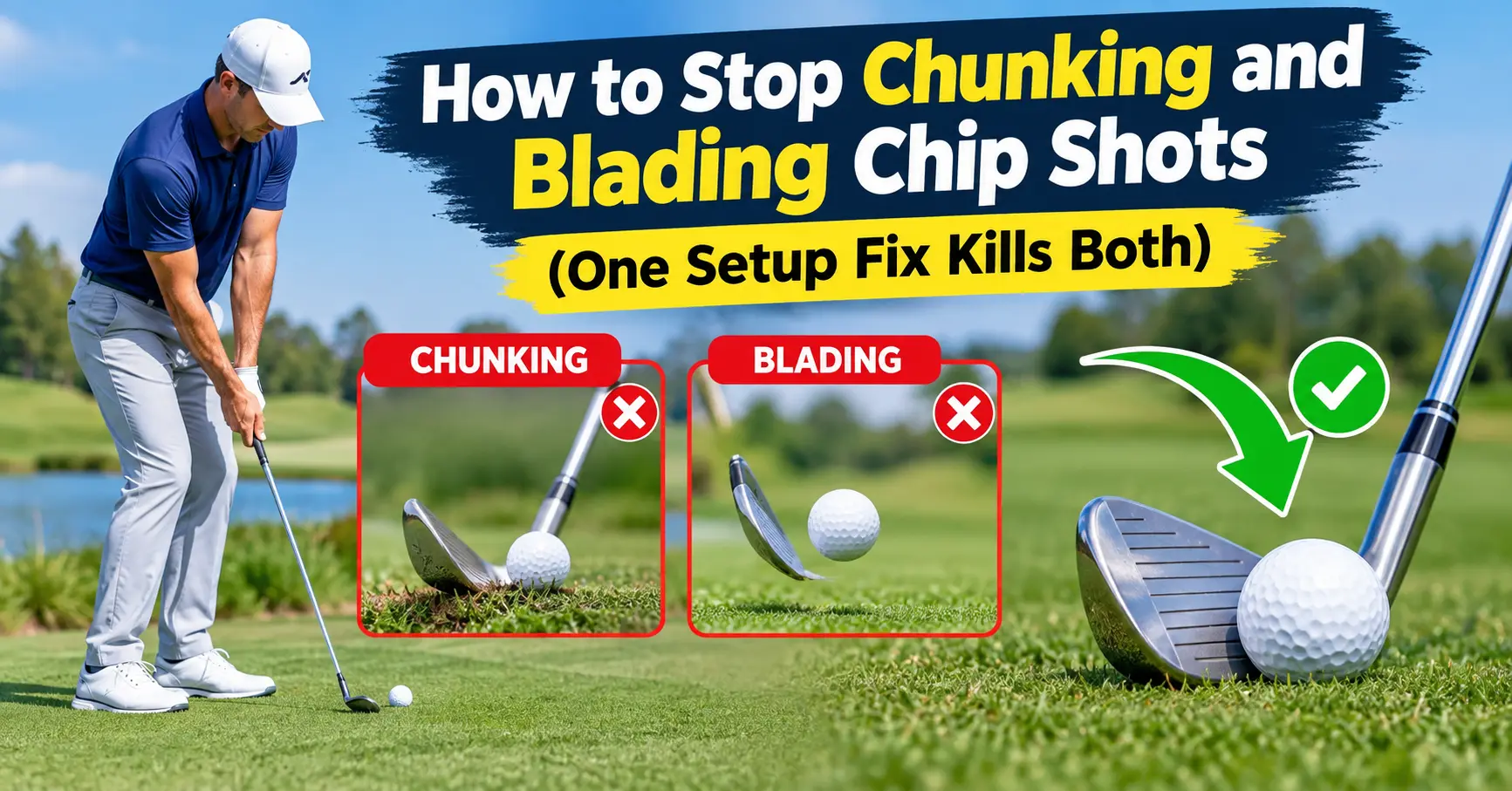
Chunking chip shots and blading chip shots feel like opposite misses. One shot travels two feet. The other flies fifteen yards over the green. Fix the real cause behind both, and they disappear together, not one at a time.
Most instruction treats chunking and blading as two separate problems, each with its own fix. That’s backwards. Both misses come from the same broken piece of the swing: an unstable low point. Get the low point right, and you stop needing separate advice for two shots that were never actually different problems.
Quick Answer: Chunking and blading chips share one root cause: an unstable low point. Set 60 to 70 percent of your weight on your lead foot, play the ball back of center, and lean the shaft toward the target. That fixes both misses at once.
Chunking and Blading Are the Same Fault Wearing Two Different Masks
Every golf swing has a low point, the spot where the clubhead reaches the bottom of its arc and starts moving back up. On a full swing with an iron, that low point sits just in front of the ball, which is why good iron players take a divot after the ball. On a chip shot, the low point needs to sit right underneath the ball or just past it.
Chunking happens when the low point arrives too early, behind the ball. The leading edge digs into the turf first, the club decelerates on contact, and the ball squirts out weakly or not at all. Blading happens when the low point never arrives at all before the club reaches the ball, usually because the body rises up or the wrists flip to compensate for a feared chunk. The leading edge catches the ball above its middle, the ball takes off low and fast, and it doesn’t stop until it hits something.
Here’s the part nobody explains well: fear connects these two faults. A golfer who chunks one chip gets scared of hitting it fat again, so on the next swing they lift up or flip their hands to help the ball into the air. That lift causes a blade. One bad shot creates the fear that causes the next one.
This isn’t a fringe theory, either. GOLF Magazine’s Top 100 Teachers panel keeps coming back to the same two culprits, weight distribution and low-point control, when amateurs ask about either miss.
Quick Self-Check: Are You Chunking or Blading Your Chips?
Some golfers know exactly which miss they’re fighting. Plenty of others chunk one hole and blade the next without noticing the pattern. Run through the table below after your next few misses and you’ll usually spot which fault is driving your shots.
| Sign | Chunking (Fat) | Blading (Thin/Skulled) |
|---|---|---|
| Sound at impact | Dull thud, sometimes a divot | Sharp, metallic click |
| Ball flight | Low, weak, often short of the green | Low, fast, flies well past the target |
| Where the club struck first | Ground, an inch or more behind the ball | The ball’s equator or higher, before the ground |
| What it feels like in your hands | Club stops or twists in your grip | Club feels light, almost like it missed everything |
| Root cause | Low point sits behind the ball | Low point never gets there, body rises or wrists flip |
| First thing to check | Weight stuck on your back foot | Head or chest lifting through impact |
The Chip Shot Setup That Fixes Chunking and Blading Together
Three setup changes handle most of both misses before you even start your backswing. None of them require rebuilding your motion. Get these right and the fear cycle above stops feeding itself.
Weight: 60 to 70 Percent on Your Lead Foot
Set up with 60 to 70 percent of your weight on your lead foot and keep it there. Most amateurs do the opposite. They hang back on their trail foot, which pushes the low point of the swing behind the ball and guarantees a chunk unless the wrists bail them out into a blade instead. Lean your sternum slightly toward the target at address and you’ve already fixed the single biggest cause of both misses.
Ball Position: Back of Center, Not Forward
Play the ball just inside your back heel for a standard chip, not in the middle of your stance and never forward of it. Playing it too far forward asks the club to keep descending long after the low point has already passed, and that’s a chunk waiting to happen. Move the ball back and the strike happens earlier in the swing, while the club is still moving down into the turf instead of already rising out of it.
Hands and Shaft: Lean Forward, Don’t Scoop
Your hands should sit ahead of the clubhead at address, with the shaft leaning 10 to 15 degrees toward the target. That forward lean delofts the face slightly and removes the temptation to scoop the ball into the air with flipping wrists. If the ball sits behind your hands at address, you’re set up correctly. If it sits ahead of them, you’ve built a blade into your setup before you’ve even swung.
The Swing Fix: Stop Decelerating, Stop Flipping Your Wrists
Match Your Backswing and Follow-Through Length
Chipping strokes fail the most right at impact, the moment golfers slow the club down out of fear. Keep your backswing and your follow-through roughly the same length and never let the clubhead lose speed as it nears the ball. A slower, shorter backswing with acceleration through impact beats a long, decelerating one every time. Practice swings away from the ball, going back and forth without stopping, until accelerating through the strike zone feels normal instead of scary.
Keep Your Lead Wrist Flat Through Impact
Your lead wrist should stay flat, or very slightly bowed, all the way through contact. The moment it breaks down and extends, the clubhead passes your hands, the leading edge rises, and a blade follows. Feel your trail hand support the shot rather than flip it. A quiet lead wrist is worth more to your short game than any drill involving alignment sticks or towels.
Use the Bounce on Your Wedge (Most Golfers Fight It Instead)
Bounce is the angle on the sole of your wedge that keeps the leading edge from digging into the ground. Fighting the bounce, by leaning the shaft too far forward or gripping down while hooding the face, cancels out the one design feature that’s supposed to save you from a chunk. Let the sole do its job instead of overriding it with your hands.
| Wedge | Typical Loft | Typical Bounce | Best Turf | Risk If You Skip the Setup Fix |
|---|---|---|---|---|
| Gap wedge | 50–52° | 6–10° | Tight, firm fairway lies | Low bounce digs fast if weight hangs back |
| Sand wedge | 54–56° | 10–14° | Standard rough and fairway chips | Excess forward lean still cancels the bounce |
| Lob wedge | 58–60° | 4–10° | Soft, fluffy lies where you need height | Thin sole invites a blade on tight turf |
Getting the right wedge in your hand matters just as much as the setup. Our guide to gapping your wedges by loft and bounce walks through building a three or four-wedge setup that actually matches the lies you face.
None of these numbers matter if your hands lean too far forward at address. Forward shaft lean cancels bounce no matter which numbers the manufacturer stamps on the sole. Set your hands correctly first, then let the wedge do the rest.
Match the Fix to the Lie You’re Actually Standing On
The three setup changes above work from almost any lie, but the risk shifts depending on what’s under the ball. A tight, bare lie punishes even a small mistake in either direction. Wet or fluffy turf forgives more than most golfers expect, right up until thick grass tangles around the clubhead.
| Lie | Bigger Risk | Adjustment |
|---|---|---|
| Tight, firm fairway | Blading (thin margin for error) | Ball slightly further back, less bounce, trust the setup |
| Standard rough | Chunking (grass grabs the hosel) | Steeper backswing, sand or lob wedge with more bounce |
| Wet or soggy ground | Chunking | Same weight-forward setup, expect a slightly softer release |
| Downhill lie | Blading | Match your spine angle to the slope, ball position moves back further than usual |
| Uphill lie | Chunking | Ball position moves slightly forward of your usual back-of-center spot |
Loft plays a role here too. Our breakdown of how loft changes the way a wedge interacts with turf covers exactly which club to grab when the lie looks ugly.
3 Drills That Fix Chunking and Blading at the Same Time
These three drills train the setup fix into muscle memory instead of leaving it as something you think about mid-swing. Do them enough times and good contact stops needing conscious thought under pressure.
1. The Coin Drop Drill
Place a coin or a tee two inches behind the ball, in line with your swing path. Set up with your weight forward and the ball back of center like you practiced above. Try to clip the coin’s back edge without ever touching the ground before it. Catching the coin square-on means you’re chunking, and never getting close to it means your body is rising into a blade.
2. The Trail-Hand-Off Drill
Grip the club with your lead hand only, and let your trail hand rest on the shaft without squeezing it. Hit soft chips this way, focusing on your chest turning the club through impact instead of your wrists doing the work. This single-hand grip exaggerates any flip immediately, so if the club twists or flies out of your grip, you just found your fault. Ten reps with this drill teaches your body more about wrist control than an hour of full-grip chipping ever will.
3. The Three-in-a-Row Count
Pick a target 15 feet away and chip three balls at it without a chunk or a blade. Miss on ball two, and you restart the count from zero instead of moving on to ball three. That restart pressure is uncomfortable on purpose. Getting three clean strikes in a row builds the exact setup discipline you’ll need on the course, where you don’t get to reset your stance mid-shot.
What to Do Mid-Round When You Don’t Have Time to Fix Your Swing
Standing over a chip on the 14th hole is not the time to rebuild your setup from scratch. You need one thing you can actually execute under pressure, right now, with a golf buddy waiting on you. Grip down half an inch, choke down your stance a touch, and make a three-quarter length, unhurried practice swing before you step in. That shorter, slower motion is far easier to accelerate through than a full-length chipping stroke you’re not trusting in the moment.
Pick the shot that needs the least precision to succeed. A low, running chip with an 8-iron or 9-iron off a clean lie asks far less of your hands than a high, soft lob wedge shot, and it’s much harder to chunk or blade because there’s almost no loft to manipulate. Save the delicate, high-spin chip for the range, not for a shot that decides your score on that hole.
When This Fix Won’t Save You
This setup change fixes most chunks and blades, but not every miss on the course comes from bad weight distribution. A ball buried in wet rough or sitting on hardpan with the bounce fighting you needs a completely different strategy, sometimes just accepting a bogey instead of forcing a hero shot. If you’re already using a textbook setup and still catching it heavy from a downhill lie, the slope is fighting your low point more than your technique is, and that’s a shot that takes real practice from that specific slope, not a five-minute setup tweak.
Honestly, if your chipping motion includes a big, disconnected lunge at the ball built up over years, three setup tips from an article won’t undo that by themselves. Get a lesson, video your swing from the side, or spend real range time on the drills above before you expect the fix to hold up when the round is on the line.
Frequently Asked Questions
What causes chunked chip shots?
Chunked chips almost always come from weight hanging back on your trail foot at impact. That moves the low point of your swing behind the ball, so the leading edge digs into the turf before it ever reaches the ball. Fixing your weight distribution, not your swing plane, solves most chunking problems.
What causes bladed chip shots?
Blading happens when your body rises up or your wrists flip through impact, usually because you’re trying to avoid hitting it fat. The leading edge catches the ball above its middle instead of brushing the turf underneath it. It’s frequently an overcorrection for a chunk you hit on a previous shot.
What’s the difference between chunking and blading a chip shot?
Chunking means the club hits the ground before the ball, producing a short, weak shot. Blading means the leading edge hits the ball above its equator before the club reaches the ground, producing a low, fast shot that flies too far. Both come from an unstable low point in your swing.
Where should the ball be positioned to stop chunking?
Play the ball just inside your back heel for a standard chip, with your weight already leaning 60 to 70 percent onto your lead foot. Playing the ball too far forward asks the club to keep descending after the low point has already passed, and that’s a common cause of chunking.
Does wedge bounce help stop chunking and blading?
Yes. Bounce is the angle on the sole of your wedge that keeps the leading edge from digging into the turf. A sand wedge with 10 to 14 degrees of bounce forgives a slightly early strike far better than a low-bounce wedge on the same lie, but bounce can’t fix a setup problem by itself.
Why do I chunk some chips and blade others in the same round?
Fear connects the two misses. Chunk a chip, and fear of doing it again makes you lift up or flip your wrists on the next one, which produces a blade. The fix for both is the same setup: weight forward, ball back, hands ahead, so neither miss gets a chance to start the cycle over.
Stop Choosing Between the Two Misses
Chunking and blading are not two different swing flaws you need two different fixes for. They’re the same broken low point showing up on opposite sides of the ball, and the setup that fixes one fixes the other every time. Move your weight forward, play the ball back, lean your hands ahead of the clubhead, and trust the bounce on your wedge to do its job.
Take these three changes to the chipping green before your next round, not into it cold. Clean contact around the greens does more for your scorecard than almost anything else you can practice, which is exactly why our breakdown of how consistent short game work lowers your handicap keeps circling back to wedge play first.