
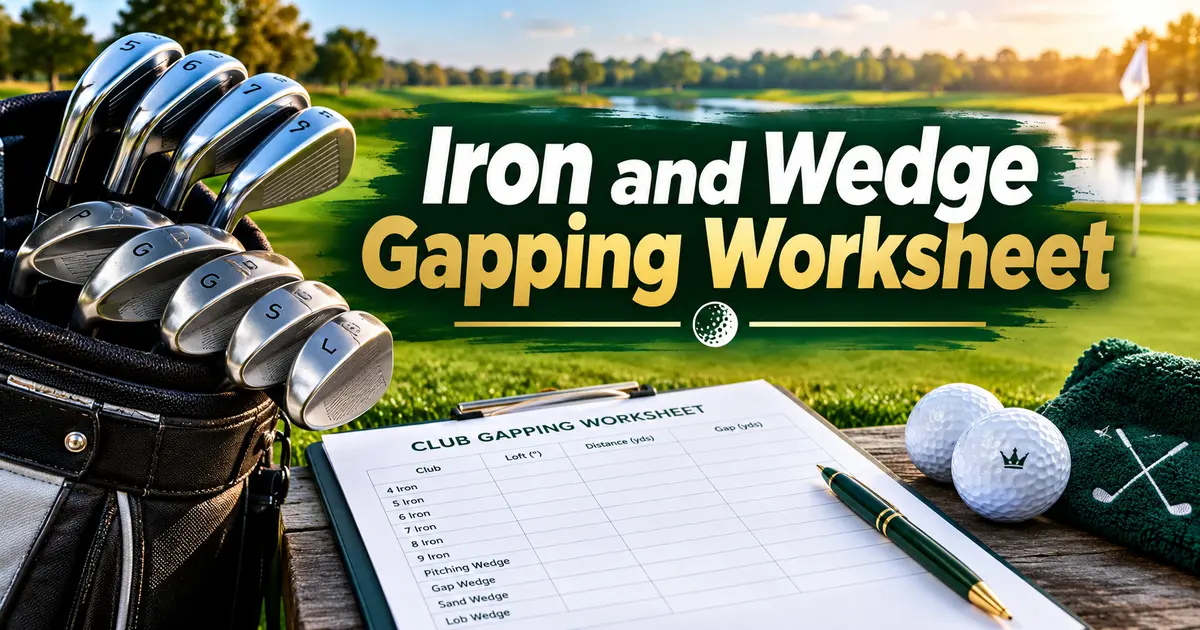
Last season a 14-handicap student stood 150 yards from a front pin, pulled his 7-iron, and watched the ball drop into the front bunker 12 yards short. He’d sworn that club carried 150. On a launch monitor the next week it carried 138, and the 150 turned out to be one flush shot from 2023. That’s the whole case for an iron and wedge gapping worksheet: your bag runs on remembered yardages, and remembered yardages lie. Below you’ll find four fill-in sheets, a test that separates real holes from bad contact, and a worked example you can copy.
Quick Answer: A gapping worksheet lines up every iron and wedge in your bag by average carry, then subtracts neighbors to expose the gaps. Aim for 10 to 15 yards between scoring clubs. Gaps over 15 yards are holes, and gaps under 8 yards are wasted slots.
The Worksheet: Copy This First
Most pages on this topic hand you a table of averages and stop there. Averages tell you what other golfers hit. They can’t tell you what your 8-iron does on a cold Tuesday morning. So the sheets below start blank.
Here’s the iron and wedge gapping worksheet I give students before a fitting. Paste it into a notes app or a spreadsheet, or print this page and use it as a printable gapping chart. Fill in Sheet 1 first, then carry the trimmed averages over to Sheet 2.
Sheet 1: Carry Log
| Club | Loft (check it) | Carry, shots 1–10 | Trimmed avg | Spread |
|---|---|---|---|---|
| 4-hybrid | ___ | ___ ___ ___ ___ ___ ___ ___ ___ ___ ___ | ___ | ___ |
| 5-iron | ___ | ___ ___ ___ ___ ___ ___ ___ ___ ___ ___ | ___ | ___ |
| 6-iron | ___ | ___ ___ ___ ___ ___ ___ ___ ___ ___ ___ | ___ | ___ |
| 7-iron | ___ | ___ ___ ___ ___ ___ ___ ___ ___ ___ ___ | ___ | ___ |
| 8-iron | ___ | ___ ___ ___ ___ ___ ___ ___ ___ ___ ___ | ___ | ___ |
| 9-iron | ___ | ___ ___ ___ ___ ___ ___ ___ ___ ___ ___ | ___ | ___ |
| Pitching wedge | ___ | ___ ___ ___ ___ ___ ___ ___ ___ ___ ___ | ___ | ___ |
| Wedge 2 | ___ | ___ ___ ___ ___ ___ ___ ___ ___ ___ ___ | ___ | ___ |
| Wedge 3 | ___ | ___ ___ ___ ___ ___ ___ ___ ___ ___ ___ | ___ | ___ |
| Wedge 4 | ___ | ___ ___ ___ ___ ___ ___ ___ ___ ___ ___ | ___ | ___ |
Sheet 2: Gap Ladder (longest club first)
| Club | Trimmed avg | Gap to club above | Spread | Gap bigger than spread? | Verdict | Slot job |
|---|---|---|---|---|---|---|
| ___ | ___ | — | ___ | — | ___ | ___ |
| ___ | ___ | ___ | ___ | ___ | ___ | ___ |
| ___ | ___ | ___ | ___ | ___ | ___ | ___ |
| ___ | ___ | ___ | ___ | ___ | ___ | ___ |
| ___ | ___ | ___ | ___ | ___ | ___ | ___ |
| ___ | ___ | ___ | ___ | ___ | ___ | ___ |
| ___ | ___ | ___ | ___ | ___ | ___ | ___ |
| ___ | ___ | ___ | ___ | ___ | ___ | ___ |
| ___ | ___ | ___ | ___ | ___ | ___ | ___ |
| ___ | ___ | ___ | ___ | ___ | ___ | ___ |
Sheet 1 is your golf club distance worksheet. Sheet 2 is your golf club gapping chart. Spread and Slot job are the two columns that turn the list into a decision tool: Spread tells you whether a gap is real, and Slot job forces every club to earn its place with one word (tee, long approach, scoring iron, partial wedge, sand, or putt). Verdict gets one of four labels: OK, Hole, Overlap, or Flip.
Work in meters if your range marks them. The 10-to-15-yard target becomes roughly 9 to 14 meters.
How to Fill In Sheet 1 Without Fooling Yourself
Here’s how to fill out a golf gapping worksheet so the numbers hold up. A sloppy session builds a confident-looking ladder of wrong numbers, and that’s worse than having no ladder.
- Warm up on balls you don’t record. Twenty swings with mixed clubs, nothing written down.
- Play your gamer ball. Range balls rarely fly like it, and no two buckets match. Gapping off them wastes the afternoon.
- Hit ten shots per club and write down carry distance, not total. Carry is where the ball first lands. Roll belongs to the ground, not your swing.
- Cross out your best shot and your worst. Average the other eight. That’s your trimmed average, or stock yardage.
- Subtract the lowest remaining carry from the highest. That’s your spread.
- Finish the whole bag in one session. A March number and an August number come from two different golfers.
- Test the clubs you avoid. The 5-iron you hate hitting is the club most likely to sit in the wrong slot.
Book an hour on a launch monitor if you can, and here’s how to read the numbers it gives you. No monitor? Hit to a practice green or a marked target, have a partner watch where each ball first lands, and laser that spot. That method carries a few yards of error, so don’t trust any gap under 6 yards that came from it.
When I run this with a spotter and a laser, students discover what the 14-handicap did. The number in their head is the best shot they ever hit, not the average one.
How Big Should the Gaps Be?
Aim for 10 to 15 yards between consecutive irons and wedges. Under 8 yards, two clubs do the same job and waste a slot. Over 15 yards, a distance has no full-swing club, so you’ll decelerate or force a shot. Gaps at the top of the bag can run wider.
The 10-to-15-yard window for yardage gaps comes from loft spacing. Clubs sitting four degrees apart usually land 10 to 12 yards apart on a moderate swing, so even loft steps produce even yardage steps. Sheet 3 below converts that rule into your own number.
| Gap between neighbors | Label | What’s happening | First move |
|---|---|---|---|
| Shorter club carries farther | Flip | One club isn’t using its loft | Hit 30 more shots with both and check strike |
| Under 8 yards | Overlap | Two clubs doing one job | Keep both only if they fly differently from real lies |
| 8 to 15 yards | Working range | Every yardage has a club | Leave it alone |
| Over 15 yards | Hole | A distance with no full-swing club | Verify lofts, then pick a fix |
Gaps at the top of the bag run wider, and that’s fine. Nobody attacks a pin from 230 yards. Spend your precision where the flag’s in play, which for most golfers starts around the 6-iron and gets more expensive with every club below it.
The Gap-vs-Spread Test: Is That Hole Real?
A 17-yard gap looks like a hole on paper. It isn’t one if your 8-iron wanders across 20 yards of carry. That’s why Sheet 2 has a Spread column.
Here’s the rule I use. Compare each gap to the larger spread of the two clubs. If the gap’s bigger, the difference is real and the bag needs attention. If it’s smaller, you’re staring at noise, and better contact fixes it faster than new clubs.
Say your 7-iron spread is 9 yards and your 8-iron’s is 8, with a 13-yard gap between them. Thirteen beats nine, so that gap is real, and it’s a healthy one. Now take a 9-iron with a 16-yard spread and a 12-yard gap down to your pitching wedge. Twelve loses to sixteen. You’ve got a contact problem, not a gapping problem, and no new club will fix it.
Why Your Pitching Wedge Probably Created Your Wedge Hole
Pitching wedges used to sit in the high 40s. Many modern game-improvement sets stamp them in the low 40s, while the sand wedge you bought separately still sits at 54 to 56. Do the subtraction: a 43-degree pitching wedge next to a 56 leaves 13 degrees between neighboring clubs, which usually means a hole of roughly 30 yards that nobody warned you about.
The letters on the sole are a job title, not a loft. Clubs I’ve checked with “PW” on the sole ranged from the low 40s to the high 40s. Sheet 1 has a Loft column for exactly this reason. Start with the manufacturer’s spec, then ask a fitter to read the real number, because heads leave the factory a degree or so off and hard use bends them further.
Wedge gapping starts with that subtraction. So what gap wedge loft do you need? What loft gap wedge do I need is the question I hear most, and the answer depends on one number: the loft difference between your pitching wedge and your next wedge.
| Loft difference, PW to next wedge | Add | Resulting loft steps |
|---|---|---|
| 6° or less | Nothing | One step of 6° or less |
| 7° to 10° | One wedge at the midpoint | Two steps of 3.5° to 5° |
| 11° to 15° | Two wedges, evenly spaced | Three steps of roughly 4° to 5° |
A “gap wedge” is a job, not a number. It’s whatever loft splits your hole evenly.
Sheet 3: Calculate Your Own Yards per Degree
Loft gapping only works once you know what a degree costs you in yards. The formula is simple: yards per degree equals carry difference divided by loft difference. Use the nearest pair of clubs, not a bag average, because the rate tends to shrink as lofts climb.
Sheet 3: Yards per Degree
| Pair | Loft difference | Carry difference | Yards per degree |
|---|---|---|---|
| Pitching wedge to wedge 2 | ___ | ___ | ___ |
| Wedge 2 to wedge 3 | ___ | ___ | ___ |
| Wedge 3 to wedge 4 | ___ | ___ | ___ |
Through the wedges, expect something between 2 and 3 yards per degree. A reading of 4 or more? Suspect strike or a bent loft before you trust it.
Now you can predict a club you don’t own. Start from your nearest wedge, then multiply the loft difference by your yards per degree. Subtract that from the carry for a higher loft, or add it for a lower one.
A Worked Example: One Bag, Two Problems, One Trade-Off
Here’s how to find gaps in your golf bag, using a sample I ran through the iron and wedge gapping worksheet. I made these numbers up to show the method; they’re not averages and not targets. A driver, 3-wood, 5-wood, and putter fill the other four slots, so this bag’s full.
| Club | Loft | Avg carry | Gap | Spread | Verdict |
|---|---|---|---|---|---|
| 4-hybrid | 22° | 176 | — | 10 | Top of bag |
| 5-iron | 25° | 171 | 5 | 9 | Overlap with the hybrid |
| 6-iron | 28° | 158 | 13 | 8 | OK |
| 7-iron | 32° | 146 | 12 | 8 | OK |
| 8-iron | 36° | 135 | 11 | 7 | OK |
| 9-iron | 40° | 123 | 12 | 8 | OK |
| Pitching wedge | 44° | 112 | 11 | 7 | OK |
| 52° wedge | 52° | 91 | 21 | 8 | Hole |
| 56° wedge | 56° | 80 | 11 | 7 | OK |
| 60° wedge | 60° | 69 | 11 | 9 | OK |
Problem one is the overlap. The 4-hybrid and 5-iron sit 5 yards apart with spreads near 10, so you can’t tell them apart on a normal swing. Problem two is the hole: 21 yards between the pitching wedge and the 52, against a spread of 8. That one’s real.
One move fixes both. Swap the 5-iron for a 48-degree wedge. From Sheet 3, 21 yards over 8 degrees is 2.6 yards per degree, and the 48 sits 4 degrees below the pitching wedge. So it should carry about 112 minus 10, or roughly 102 yards, which splits the hole into steps of 10 and 11. The 5-iron was a duplicate; the 48 fills a 21-yard hole. I’d make that swap without a second thought.
There’s a cost. The gap from the 4-hybrid at 176 down to the 6-iron at 158 becomes 18 yards. If you often face 165 yards into a green, that hurts, so check your last ten rounds before you commit.
Sheet 4: The Wedge Matrix
Full swings give you one number per wedge. Partial swings give you three, and that’s how three wedges can cover what a fourth would. How many wedges should you carry? This sheet answers it.
Sheet 4: Wedge Matrix
| Wedge | Loft | Half swing (hands hip-high) | Three-quarter (hands chest-high) | Full | Ball flight (low / mid / high) |
|---|---|---|---|---|---|
| Pitching wedge | ___ | ___ | ___ | ___ | ___ |
| Wedge 2 | ___ | ___ | ___ | ___ | ___ |
| Wedge 3 | ___ | ___ | ___ | ___ | ___ |
| Wedge 4 | ___ | ___ | ___ | ___ | ___ |
Hit ten shots at each swing length, trim the best and worst, and average the rest. Then stack all the yardages in one column, longest to shortest, and run the Sheet 2 rules on them. If no step exceeds about 12 yards from your pitching wedge down to your shortest half swing, a fourth wedge adds nothing.
Three-quarter shots come in lower and release more than full ones, so plan the landing spot short of where a full shot would land. Skip partial swings in the middle irons, though. A three-quarter 7-iron is harder to repeat than a full 8-iron, and this sheet is for wedges only.
Keep, Swap, or Add: Fixing What the Sheet Found
Once the iron and wedge gapping worksheet shows a real hole or an overlap, you’ve got five moves. Here they are, cheapest first.
- Cover it with a partial swing. Free. Works at the wedge end and fails in the middle irons.
- Bend a loft. A fitter can move an iron a degree or two, which at roughly 2.5 yards per degree is 2 to 5 yards. It closes small gaps, can’t close big ones, and shifts the bounce on a wedge.
- Swap a slot. The cheapest real fix for an overlap. Cut the duplicate and add the club that fills the hole.
- Add or replace a wedge. If the hole’s 20 yards or more, buy the wedge. Bending won’t get you there.
- Get fitted for the top of the bag. At the long end, the problem is usually launch and spin, not loft. Here’s what a club fitting actually covers.
The Rules of Golf cap you at 14 clubs (Rule 4.1b), so every slot is expensive. Check the Slot job column on Sheet 2. A club with no job is the one to cut. If you shoot over 90, the 60-degree wedge is the first club to leave your bag, and it isn’t close.
When the Sheet Doesn’t Fit You
The 10-to-15-yard target assumes a moderate swing. If your 7-iron carries under 120 yards, expect gaps of 7 to 9 yards through the irons even with perfect loft spacing. Judge your bag by even steps instead of chasing 10.
The sheet can’t fix a big spread either. If most of your clubs show spreads above 15 yards, book a lesson before you spend a dollar on equipment.
When to Redo the Worksheet
Distances drift, which is why this worksheet carries no table of average yardages. Any table I printed today would be stale for your swing by next season. Redo the sheets at the start of each season, after new clubs or a shaft change, after a swing change, and after two months away. Keep every old copy, because the change between seasons tells you more than any single number.
Frequently Asked Questions
How many yards should there be between golf clubs?
Aim for 10 to 15 yards through your scoring clubs, roughly the 6-iron down to your lob wedge. Wider gaps at the top of the bag cost you little, since you’re not firing at pins from 200 yards. Slower swings produce tighter spacing: if your 7-iron carries under 120 yards, 7 to 9 yards between irons is normal.
What is a golf club gapping chart?
A gapping chart is the finished output of an iron and wedge gapping worksheet: every club listed longest to shortest, with its average carry and the gap to the next club. It exists to answer one question. For any yardage you’ll face, do you own a club that covers it with a normal swing?
Should a gapping chart use carry distance or total distance?
Carry. Total distance includes roll, and roll depends on firmness, slope, and last night’s rain, none of which your swing controls. Carry’s the number that clears the bunker or lands on the green, and it’s the only figure that repeats from course to course.
What counts as an overlap in a golf bag?
Two clubs less than 8 yards apart, with spreads bigger than that gap, are doing the same job. Keep both only if they fly differently from lies you actually face, like a hybrid out of light rough against an iron off the tee. Otherwise one club wastes a slot.
Can I fix a yardage gap without buying a new club?
Often, yes. Verify the lofts first, because a bent or off-spec club can create a gap on its own. Then build a partial-swing matrix for the wedges, or swap a duplicate club already in your bag for one that fills the hole. Holes of 20 yards or more usually need a new wedge.
How many degrees of loft should be between wedges?
Four to five degrees for most golfers. At roughly 2.5 to 3 yards per degree, that yields 10 to 15 yards between wedges. Calculate your own rate on Sheet 3 before you buy, because a degree costs a slow swing fewer yards than a fast one.
Print It, Fill It, Then Go Play
Print the iron and wedge gapping worksheet, book an hour with a launch monitor or a spotter and a laser, and fill in Sheet 1 before your next round. The numbers will sting a little; they always do. Check every hole against its spread, fix contact first, and shop second. Then take your finished ladder to a fitter, or start with our wedge loft.