
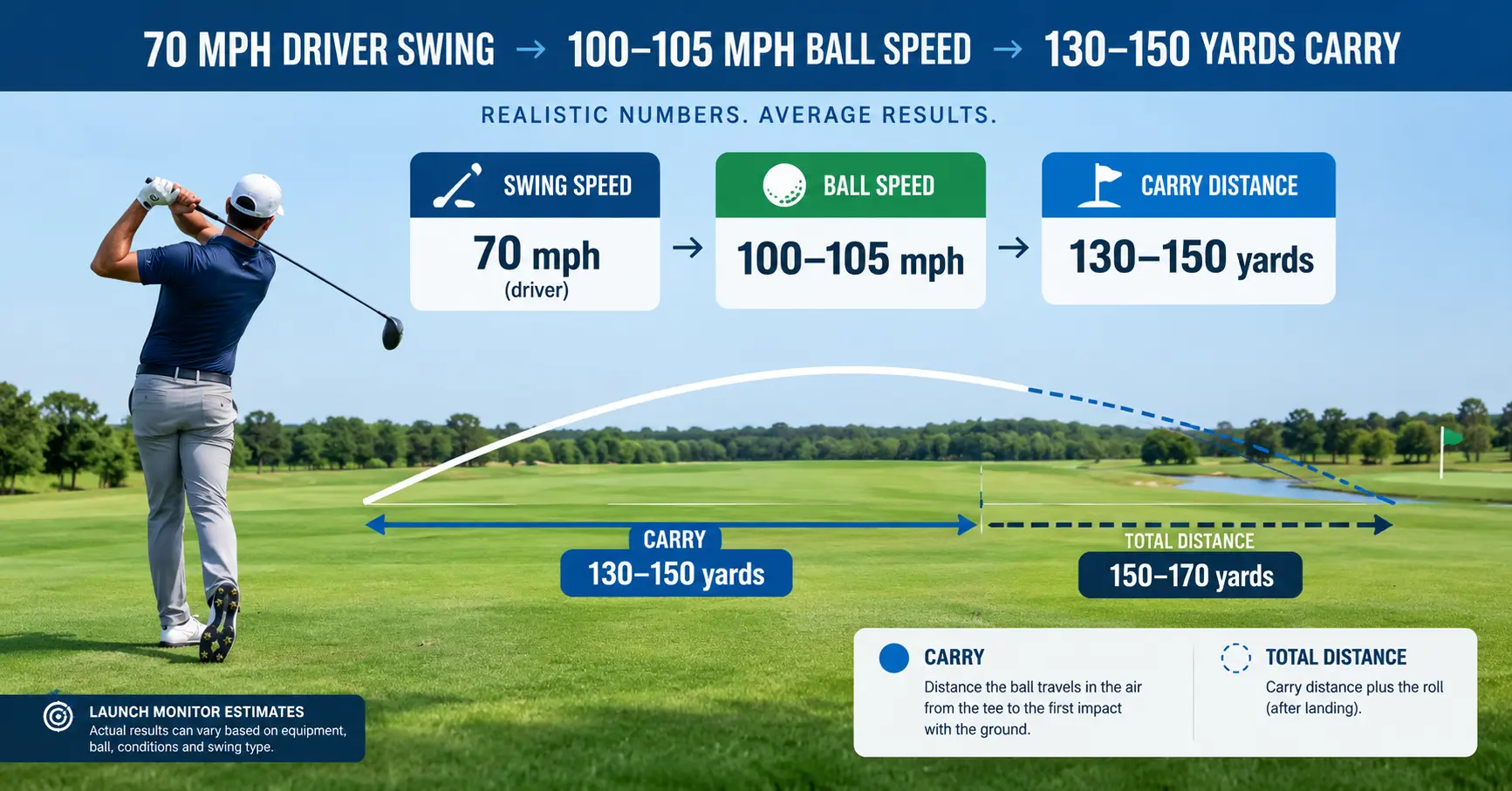
If your driver swing speed is around 70 mph, a sensible target is roughly 130 to 150 yards of carry with reasonably efficient contact and launch. Your total distance may finish somewhere around 150 to 180 yards, but rollout is too dependent on turf, slope and weather to use as the main benchmark.
That range is more useful than saying a 70 mph swing “should go 170 yards,” because clubhead speed only tells us how much distance is available. It does not tell us how efficiently the ball was struck or how well it was launched.
TrackMan defines club speed as the speed of the clubhead immediately before impact and describes it as determining a golfer’s potential distance. Its data also shows that ball speed, launch and strike efficiency determine how much of that potential turns into actual yardage.
So if you swing 70 mph and only carry the ball 125 yards, you do not automatically need a faster swing. And if you carry it close to 150, you may already be getting quite a lot from the speed you have.
How Far Does a 70 MPH Swing Speed Go With a Driver?
There is no official single yardage attached to 70 mph because the same club speed can create different ball speeds and trajectories.
A published reproduction of TrackMan’s Driver Fitting Chart provides a useful nearby reference. At 75 mph club speed, TrackMan’s carry optimizer produces about 143 yards of carry with a 5-degree downward attack angle, 154 yards with a level attack angle and 164 yards with a 5-degree upward attack angle, when launch conditions are optimized for each delivery.
Because that chart begins at 75 mph rather than 70 mph, any 70 mph figure requires an estimate. Extrapolating cautiously from the 75 and 80 mph rows puts a 70 mph golfer roughly in the 125-to-150-yard carry window, depending particularly on attack angle, impact efficiency and launch.
That is why I would use the following numbers as practical benchmarks rather than promises:
| Measurement | Useful benchmark at 70 mph |
|---|---|
| Driver club speed | 70 mph |
| Ball speed | About 100–105 mph |
| Carry distance | Roughly 130–150 yards |
| Total distance | Roughly 150–180 yards in ordinary conditions |
| Main number to track | Carry, not rollout |
The upper end assumes a solid strike and a flight that stays airborne efficiently. A low-face strike, heel contact or badly mismatched launch can put you below that range even though the launch monitor still says 70 mph.
Your Ball Speed Tells You More Than Swing Speed Alone
This is the first number I would check if a 70 mph golfer thinks the driver is going nowhere.
TrackMan defines smash factor as ball speed divided by club speed. It reports about 1.44 for its average male amateur driver data and 1.43 for bogey golfers, while saying a golfer can hope to approach 1.50 with the driver.
At exactly 70 mph, the maths looks like this:
| Smash factor | Ball speed at 70 mph |
|---|---|
| 1.40 | 98 mph |
| 1.44 | 101 mph |
| 1.48 | 104 mph |
| 1.50 | 105 mph |
That gives you a much better way to diagnose your distance.
If you swing 70 mph but only create 94 or 95 mph of ball speed, launch angle is not the first thing I would chase. Too much energy is disappearing at impact. Contact location, delivered loft and face-to-path relationship deserve attention first.
If you are already producing 102 to 105 mph ball speed, then the strike is doing its job. At that point, launch, spin and attack angle become much more interesting.
TrackMan gives a useful example of why this matters: two golfers can both swing the driver at 100 mph, yet a change from 1.40 to 1.50 smash factor creates a 10 mph difference in ball speed and roughly 20 yards of distance.
You do not have to swing harder to improve that number.
Why Two Golfers at 70 MPH Can Be 20 Yards Apart
Swing speed tends to get all the attention because it is easy to understand. Faster normally means farther.
But at slower driver speeds, getting the ball launched efficiently becomes especially important because there is less ball speed available to keep a poor trajectory in the air.
Strike quality can waste speed before the ball even launches
A drive struck near the center of the face transfers energy more efficiently than one caught badly on the heel, toe or low on the face.
At 70 mph, that matters because you do not have a huge reserve of speed to compensate for a poor strike. Losing several mph of ball speed can turn a perfectly adequate 70 mph swing into a shot that behaves like one struck with considerably less speed.
Before changing the driver or trying to swing harder, use face spray, impact tape or a launch monitor to see where the ball is actually contacting the face.
The goal is not a prettier impact pattern. The goal is more ball speed from the club speed you already own.
Launch angle cannot be considered by itself
You will sometimes see one “ideal driver launch angle” recommended to everybody. That is not how driver optimization works.
TrackMan’s own launch-angle material notes that its optimizer changes the desired launch according to club speed and attack angle. Even its published 94 mph example assumes a specific club speed and a level attack angle rather than treating one launch number as universally correct.
The reproduced TrackMan fitting chart makes the relationship clearer. At 75 mph, the carry-optimized launch changes from about 14.6 degrees with a downward attack to 19.2 degrees with a positive five-degree attack angle.
That is a big difference at essentially the same swing speed.
For a golfer around 70 mph, the practical lesson is not “launch it at exactly X degrees.” It is that a very low, flat drive deserves investigation. More usable launch can matter more than trying to manufacture another two or three mph with a harder swing.
Carry and total distance are different problems
Carry is where the ball first lands. Total distance adds everything that happens after that.
For comparing your driver with a launch-monitor benchmark, carry is the cleaner number.
A 145-yard carry might finish at 148 yards on a wet winter fairway or run much farther across baked ground. Neither result means your swing suddenly became better or worse.
This is also why comparing your launch-monitor carry with the longest drive you remember hitting on a course can be misleading. That memorable drive may have caught a downslope, firm turf, a tailwind or some combination of all three.
If you want broader real-world context rather than a swing-speed model, MadKnows also breaks down average golf driver distance by age and handicap.
What If You Only Carry the Driver 110 to 120 Yards?
A 110- or 120-yard carry at a measured 70 mph does not prove anything is wrong with your swing speed.
It tells you that you should look at the numbers around the swing speed.
If ball speed is well below 100 mph, contact efficiency is the obvious first check. A golfer creating only 94 mph ball speed from 70 mph of club speed has a smash factor of about 1.34, leaving substantial speed at impact.
If ball speed is already close to 100–105 mph but the carry remains unusually short, look at the flight instead. A shot that launches very low and falls quickly has a different problem from one that climbs too steeply and appears to stall.
Launch angle and spin rate together will tell you considerably more than swing speed alone.
This is where a basic launch-monitor session becomes valuable. You do not need twenty metrics. For this question, club speed, ball speed, smash factor, launch angle, spin and carry are enough to find the obvious leak.
Should a 70 MPH Golfer Use More Driver Loft?
Often it is worth testing, but “70 mph equals 12 degrees” is too simplistic.
The correct driver loft is the loft that gives your particular delivery a useful launch and spin window. Static loft printed on the sole is only the starting point; attack angle and delivered dynamic loft affect what the ball actually experiences at impact.
A golfer hitting substantially upward could need a different head setting from another 70 mph player who delivers the club downward.
That is why I would test loft rather than buy loft by a chart.
Hit several shots at the current setting, record ball speed and carry, then test additional loft without consciously changing your swing. If carry improves without creating an obviously ballooning flight, the extra loft is doing useful work.
If nothing improves, adding still more loft is unlikely to solve the underlying problem.
The same caution applies to shaft flex. Clubhead speed helps narrow the options, but tempo, shaft weight, delivery and strike consistency also matter. A flex label on its own cannot tell you which shaft will produce your best driver.
Can You Reach 170 Yards With a 70 MPH Swing?
A 170-yard total drive is certainly plausible at 70 mph when contact is good and there is some rollout.
A 170-yard carry is a much more demanding claim.
The TrackMan optimizer reference is useful here because even at 75 mph, its optimized carry ranges from 143 to 164 yards depending on attack angle.
That does not make a 170-yard carry at 70 mph impossible under every circumstance. Altitude, wind, unusually favorable launch conditions and measurement differences can all affect the outcome.
It does make 170 carry a poor number to treat as the normal standard for a 70 mph golfer.
If your launch monitor shows 140 yards of carry at 70 mph with approximately 100–105 mph ball speed, do not assume you are 30 yards short of where you belong. You may be much closer to an efficient result than a generic distance chart suggests.
What Should You Improve First?
At this speed, I would chase efficiency before extra effort.
If smash factor is low, work on finding the center of the driver more often. Even a modest improvement in ball speed can produce visible yardage without changing your physical swing speed.
If strike is already efficient but the flight is low, test launch conditions and driver setup.
Only after those two pieces look healthy would I make increasing clubhead speed the main project.
TrackMan notes that adding 1 mph of club speed can add up to about 3 yards with a driver, but the wording “up to” matters. The extra speed still has to be transferred to the ball and launched efficiently.
So going from 70 to 75 mph can absolutely be worthwhile. It simply makes more sense after you know that 70 mph is already being used well.
If adding speed is the actual bottleneck, MadKnows has a separate guide on how to increase club head speed without wrecking your swing rather than trying to squeeze speed training into a distance article.
How to Find Your Real 70 MPH Driver Distance
Do not base the answer on your best drive.
Hit a session of normal drives while using the same ball and normal tee height. Once you have enough shots to see a pattern, look at your typical club speed, ball speed and carry rather than selecting the longest result.
If the club-speed readings cluster around 68–72 mph, you can reasonably call yourself a 70 mph driver swinger.
Then look at ball speed. Around 100 mph says you are converting a fair amount of that speed into the ball. Moving toward 104–105 mph indicates extremely efficient impact for that club speed.
Finally, look at carry.
That number becomes your playing benchmark. If your measured carry is 138 yards, knowing that number is considerably more useful on the course than believing a chart that says you “should” hit it 170.
A bunker 145 yards from the tee does not care what your longest drive was last summer.
The Bottom Line
For driver distance at 70 mph swing speed, think approximately 130–150 yards of carry as a realistic working range, with total distance commonly moving into roughly the 150–180-yard area depending on rollout and conditions.
More important than the exact yardage is whether your numbers make sense together.
A 70 mph swing producing roughly 100–105 mph of ball speed is transferring speed reasonably well. If the ball still flies short, investigate launch and spin. If ball speed is much lower, fix the strike before blaming your swing speed.
That distinction is what turns a distance chart into something you can actually use: speed establishes the potential, impact creates the ball speed, and launch determines how much of that ball speed becomes carry.