
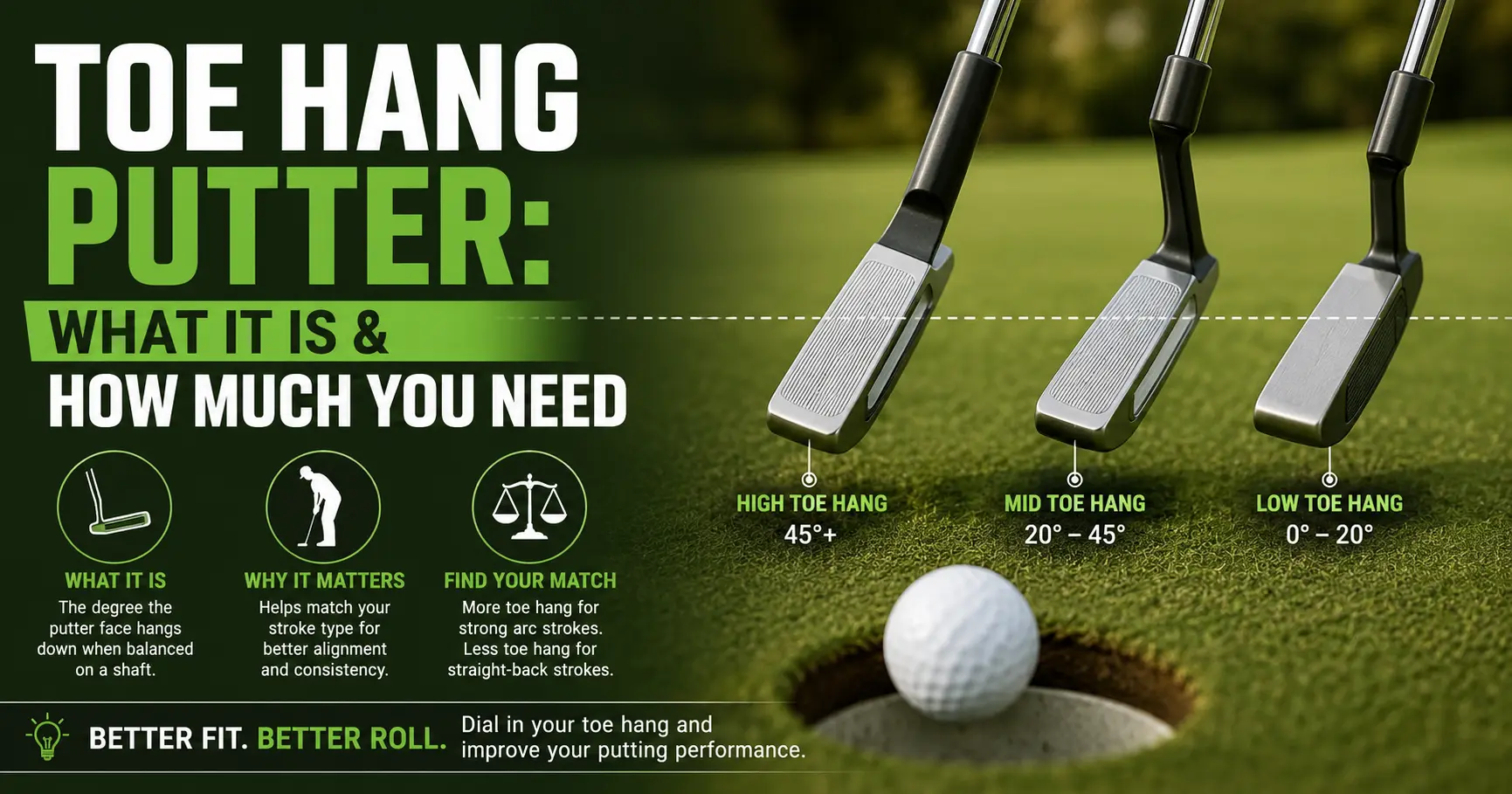
Quick Answer: Toe hang is how far a putter’s toe drops when you balance the shaft on your finger, and it tells you how much the face naturally opens and closes during your stroke. Face-balanced putters run 0° and suit a straight-back-straight-through stroke. Most golfers with any arc in their stroke play better with 20° to 45°+ of toe hang, matched to how far their putter swings inside the line.
Grab any putter in your bag and balance the shaft flat across your finger. Watch where the head settles. If the face points straight up at the sky, you’re holding a face-balanced putter.
A dropped toe means something different: you’re holding a toe hang putter, and the amount it drops tells you more about how that club will perform on the green than almost any other spec on the sheet. Most golfers never run this test. They buy a putter because a friend has one, because it’s the model a tour pro carries, or because it looked good in the pro shop, and toe hang doesn’t care about any of that.
What Toe Hang Actually Means (And What It Doesn’t)
Toe hang comes from where the shaft enters the putter head relative to the head’s center of gravity. Bend the neck toward the heel and the head’s weight sits further from the shaft axis, so gravity pulls the toe down when you let the club hang freely. Keep the shaft centered over the head’s balance point and nothing pulls, so the face stays parallel to the ground. That’s face balance.
Manufacturers measure this in degrees now, though older charts still use fractions like 1/4 or 1/2 toe hang. A putter at 0° is fully face-balanced. One at 45° or higher hangs almost straight down. Nothing about this changes how the putter looks at address, and two blades can look nearly identical while sitting 30 degrees apart, which you’d never know without doing the hang test yourself.
Here’s the part most guides skip: toe hang doesn’t make a putter better or worse. It makes a putter suited to a specific kind of stroke, and buying a toe hang putter because of how it looks at address, without checking the number first, is the single most common mistake golfers make in this category. Not close.
How to Measure Putter Toe Hang in 10 Seconds
You don’t need a launch monitor to measure putter toe hang at home. Balance the shaft on one finger, roughly where your hands would grip it, and let the head hang loose.
- Hold the putter shaft horizontal, balanced across your index finger a few inches below the grip.
- Let go with your other hand and let the head settle on its own.
- Watch the face. If it points at the ceiling, you’re face-balanced. If the toe drops, note how far.
- Compare it against a straight edge. A toe that drops past 45 degrees from horizontal is heavy toe hang. Anywhere from 20 to 35 degrees is moderate. Anything under 15 is close to face-balanced.
One mistake trips up almost everyone doing this at home. You have to balance the shaft where your hands actually sit during the stroke, not right below the grip cap. Get that spot wrong and the reading lies to you.
Balance it too high and every putter reads more face-balanced than it really is. Go too low, near the hosel, and you’ll see exaggerated toe hang on a club that plays much more neutral. Use the spot roughly six to eight inches down from the top of the grip, close to where most golfers’ bottom hand sits at address.
Matching Toe Hang to Your Putting Stroke
Nearly every putting stroke has some arc in it, because the shaft doesn’t come out of the ground straight up and down. Standard lie angle sits around 70 to 72 degrees, and that geometry alone pulls the club head slightly inside the target line on the backswing and follow-through. A true straight-back-straight-through stroke has to fight that geometry on purpose, and most players don’t bother.
Set up a phone on a tripod behind the ball and record a few putts from directly behind the line. Watch how far the putter head travels inside the target line on the backswing.
- Under an inch of inside movement: minimal arc. Look for 0° to 15° of toe hang, closer to face-balanced.
- One to two inches: moderate arc. A putter in the 20° to 35° range matches this stroke.
- More than two inches: strong arc. You’ll want 40° or more toe hang to let the face open and close in sync with your hands.
Guessing your arc type from memory doesn’t work nearly as well as fifteen seconds of video. Golfers consistently think they putt straighter than they do, mostly because address position hides how much the club actually swings inside going back. That’s really the whole exercise behind finding the best putter for your arc stroke: match degrees to inches, not looks to logo.
The Toe Hang Chart Most Putter Guides Skip
Every putter’s toe hang traces back to its hosel or neck design, and that relationship stays remarkably consistent across brands. Bend the shaft toward the heel and hang increases. Center it over the head and hang drops to zero. Here’s how the common neck styles line up, based on where manufacturers position the shaft relative to the head’s balance point.
| Neck / Hosel Style | Typical Toe Hang | Best Match |
|---|---|---|
| Center shaft | 0° | Straight-back-straight-through |
| Full shaft offset / plumber’s neck | 15° to 25° | Minimal to slight arc |
| Half shaft offset / flow neck | 25° to 40° | Slight to moderate arc |
| Slant neck | 30° to 40° | Moderate arc |
| Long or crank hosel | 40° to 55°+ | Strong arc |
If you’re asking which putter neck has the most toe hang, it’s the long or crank hosel design, easily pushing past 45 degrees. These ranges aren’t guesses. They line up with real product specs from current putters on the market, which most buying guides never actually pull.
Real Toe Hang Numbers From Putters You Can Buy Right Now
Specs on a manufacturer’s product page rarely make it into buying guides, and that’s a gap worth closing. Here’s exact toe hang data, straight from current 2026 spec sheets, spanning three different neck styles and price points.
| Putter | Head Type | Neck / Offset | Toe Hang | Loft / Lie | Price |
|---|---|---|---|---|---|
| Odyssey 2-Ball Eleven Tour Lined CH | Mallet | Full shaft offset | 20° | 3° / 70.0° | $299.99 |
| Odyssey Microhinge Seven S | Mallet | Half shaft offset | 37° | 3° / 70.0° | $229.99 |
| Odyssey Ai-ONE #1 CH | Blade | Crank hosel | 47° | 3° / 70.0° | $249.99 |
Notice the pattern. All three run the same 3° loft and 70° lie, standard across the category, but toe hang swings by 27 degrees just from changing the neck. That’s the whole story of putter fitting in one table. Two putters can share a price bracket, a brand, and a loft spec, and still play completely differently on the green because of a bend in the hosel most golfers never look at twice.
If you’re shopping blade vs. mallet putter shapes specifically, don’t assume the shape decides your toe hang. The Ai-ONE #1 CH is a blade with heavy toe hang, and the Eleven mallet above it carries less than half as much. Head shape and toe hang are independent decisions, and our full blade vs. mallet putter breakdown covers the rest of that choice.
Toe Hang Isn’t What Fixes a Push or a Pull
A lot of putter buying advice treats toe hang like a cure for a specific miss, claiming it stops you from pulling putts left or fixes a push to the right. That’s backwards, and worth correcting.
Toe hang doesn’t fix a miss pattern on its own. It matches a putter to a stroke that already rotates the face naturally. Give a golfer with a strong arc stroke a face-balanced putter, and they have to manually square the face themselves through impact, because the putter won’t do it for them. Miss that timing by a fraction and the face stays open or closes too early, which shows up as a push or a pull depending on which way you missed it.
Hand a straight-stroke golfer a heavy toe hang putter instead, and now the club is trying to rotate a face that their hands aren’t rotating with it, fighting their mechanics on every single stroke. A mismatched toe hang costs golfers more strokes on the green than a bad grip or a slow tempo ever will. The fix isn’t toe hang itself. It’s the match between toe hang and what your stroke is already doing.
Who Shouldn’t Buy a Toe Hang Putter
Not every golfer needs one, and it’s worth saying directly. If you already putt with a genuine straight-back-straight-through stroke and you’re rolling the ball well with a face-balanced mallet, switching to heavy toe hang gives you nothing to fix and adds a variable you don’t need. The same goes for anyone who got properly fit for their current putter through a real fitting session rather than a guess. Toe hang matters most when there’s an actual mismatch costing you strokes, not as a blanket upgrade.
Toe Hang vs. Zero-Torque Putters
The newest wrinkle in putter design skips the toe hang question entirely. Zero-torque putters use extra weighting, usually low and to the heel and toe, to resist face rotation no matter where the shaft enters the head. The L.A.B. Golf RS1 is one of the most talked-about examples of this approach, and our RS1 review covers how it actually performs against a traditional toe hang blade.
It’s a different philosophy, not an upgrade over toe hang. A strong-arc putter with heavy toe hang lets the face rotate on purpose, in sync with your hands. A zero-torque design tries to remove rotation from the equation altogether instead. If you’re weighing both approaches, our full zero-torque putters guide is worth reading before you decide which philosophy actually matches how you putt.
Frequently Asked Questions
What does toe hang do for putters?
Toe hang lets the putter face open on the backswing and close naturally through impact, matching the face rotation of an arcing putting stroke. The more toe hang a putter has, the more the face rotates during the swing. A face-balanced putter, with no toe hang, keeps the face square throughout instead.
Do pros use toe hang putters?
Yes, and the split among tour players roughly mirrors the split in strokes generally, with a meaningful share of pros gaming face-balanced mallets and another meaningful share playing blades or mallets with real toe hang. Tour players go through individual fittings, so their putter choice tracks their measured stroke arc rather than trend or brand loyalty.
What is the typical toe hang on a putter?
Most mainstream putters fall somewhere between 20° and 45°, with true face-balanced mallets at 0° and heavy-toe-hang blades running 45° to 55° or more. The spec table above shows three real current examples spanning that full range.
What is the best putter for toe hangs?
There’s no single best putter, because the right toe hang depends entirely on your stroke arc, not on the club. A strong-arc golfer does better with 40°+ toe hang like a crank-hosel blade, while a slight-arc golfer usually plays better with 20° to 35°, and a straight-stroke golfer should look at a face-balanced mallet instead.
Is toe hang more important than putter weight?
Toe hang generally matters more for stroke matching, since it directly affects face rotation, while head weight mostly influences feel, distance control, and forgiveness on off-center hits. Get toe hang wrong and you’re fighting the putter’s natural motion on every stroke. Get the weight wrong and you’re mostly adjusting your tempo.
What’s the difference between toe hang and toe flow?
They describe the same thing. Toe flow is the term some manufacturers use for the same relationship between the neck, the head’s center of gravity, and how much the face opens and closes through the stroke.
Bottom Line
Toe hang is one of the few putter specs you can actually test yourself in your living room, worth doing before you spend $250 on a new mallet based on how it looks. Balance the shaft, watch how the toe drops, film your stroke, and match the two. If you’re deciding between shapes first, our blade vs. mallet putter breakdown is a good next stop, and if a square face through impact sounds more appealing than matching your arc, the case for zero-torque putters is worth fifteen minutes of your time. Either way, the putter that matches your stroke will always outperform the one that just matches your eye, and for most golfers with any arc, that means a toe hang putter chosen by degree, not by looks.