
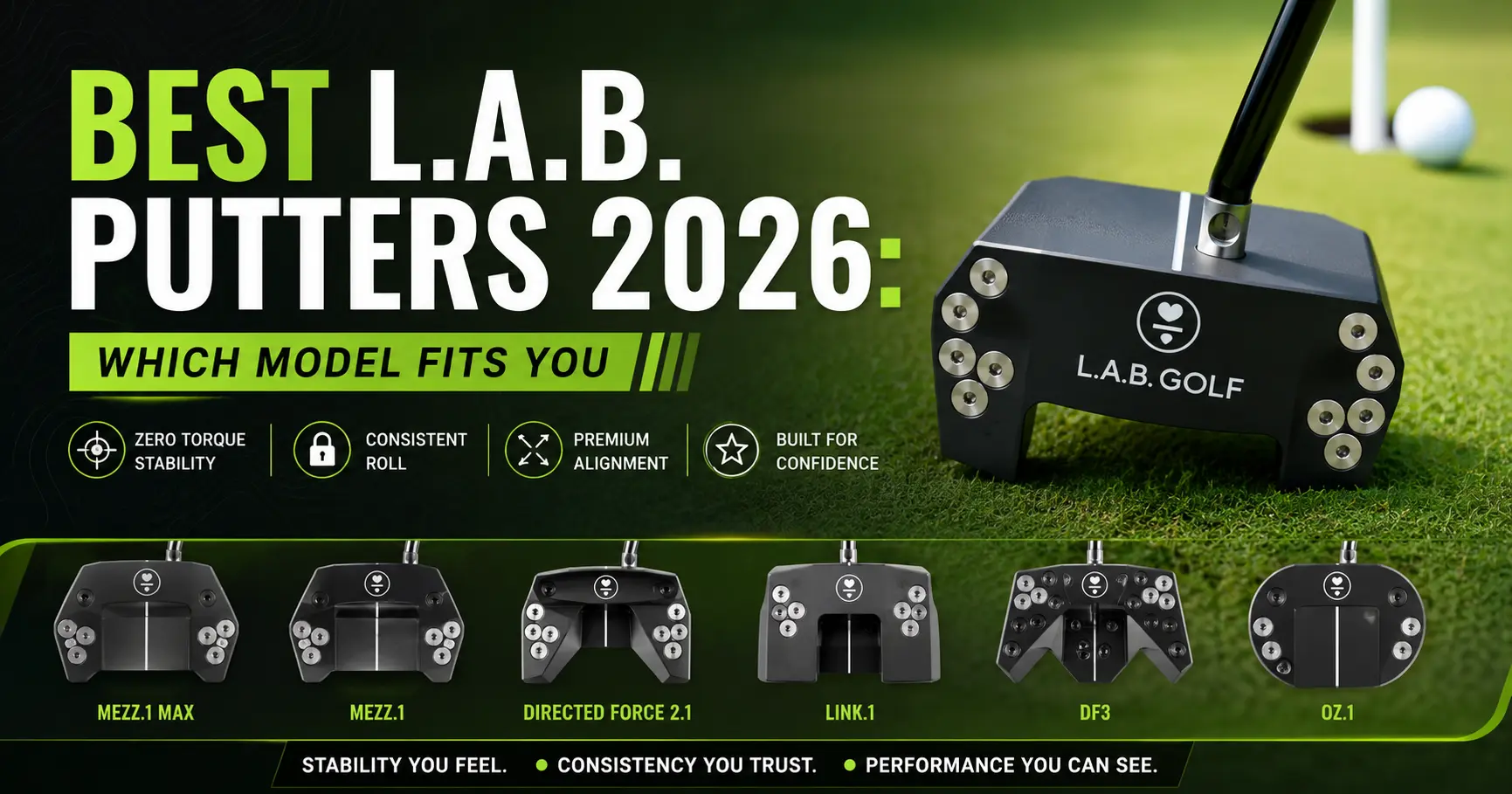
Quick Answer: The L.A.B. DF3 is the most forgiving model and the best starting point for most golfers, though the OZ.1i suits players who want a smaller, more traditional head. Stock models run $399 to $499, and skipping the custom fitting means you’re leaving most of the technology’s benefit on the table.
Five L.A.B. Golf putters currently sit at retail, and picking the wrong one is an expensive mistake at $399 and up. Lie Angle Balance technology works. That part isn’t in question anymore, not after Will Zalatoris, J.J. Spaun, and Adam Scott all put one in the bag and started winning with it.
What nobody tells you clearly enough is that the five models don’t behave the same way, and the one your buddy swears by might do nothing for your stroke. This guide breaks down every current L.A.B. putter by price, head shape, and who it actually suits, plus what the fitting process really involves and what these putters are worth once you’re ready to sell.
What Lie Angle Balance Technology Actually Does
Every putter has some amount of torque, the tendency of the head to twist open on the backswing and closed through impact. L.A.B. Golf’s engineers built a device called the Revealer specifically to measure that twist, and what they found led to a completely different way of building a putter head. Instead of balancing the putter at its midpoint like almost every other manufacturer does, L.A.B. balances each model at the exact point where torque cancels out. The result is a head that resists rotation through the stroke instead of fighting it.
You’ll notice it most on short putts. Face rotation is what turns a good stroke into a pulled or pushed putt from four feet, and a putter that stays square removes that variable almost entirely. Longer putts benefit less from the technology and more from touch, so don’t expect a L.A.B. putter to fix bad speed control. That part’s still on you.
The Current L.A.B. Putter Lineup at a Glance
| Putter | Stock Price | Head Style | Best For | Best Stroke Type | Used Market Range* |
|---|---|---|---|---|---|
| DF3 | $399–$449 | Oversized mallet | Maximum forgiveness | Straight-back-straight-through | $275–$425 |
| OZ.1i | $499 | Compact mid-mallet | All-around, first L.A.B. putter | Slight arc to straight | $350–$475 |
| Link 2.1 | $499.99 | Heel-shafted blade | Blade purists | Slight arc | $325–$430 |
| Mezz.1 Max | $499+ | Fanged mallet | Alignment struggles | Straight-back-straight-through | $300–$400 |
| VZN.1i | $499 | 6-sided mallet | Softer feel, easy alignment | Slight arc to straight | Limited data, recent release |
*Used prices reflect active and recently completed listings on eBay and similar secondhand marketplaces as of August 2026, not official L.A.B. Golf retail pricing.
L.A.B. DF3: The Forgiveness King
The DF3 is the model most golfers picture when they hear the word L.A.B. Its head looks like it escaped from a spaceship, wide, hollow, and nothing like a normal putter. That shape exists for a reason. A larger head means a higher moment of inertia, and a higher MOI means mishits on the heel or toe still come out close to true. Rick Shiels and Peter Finch made this putter famous on YouTube, and J.J. Spaun has gamed a DF model on tour.
Stock DF3 pricing has moved around over the past year, landing anywhere from $399 to $449 depending on retailer and shaft configuration. Broomstick and armlock versions cost more, often $200 or higher on top of stock. The face is firmer than most golfers expect coming from a milled putter, and that shows up most on lag putts, where distance control takes a round or two to dial in.
If you already roll the ball beautifully from 20 feet and just want a touch more consistency inside 8 feet, the DF3 is overkill. Save the money and look at the OZ.1i or Link 2.1 instead.
L.A.B. OZ.1i: The All-Rounder
Adam Scott helped design the OZ.1, and the family has become one of L.A.B.’s best-selling lines since release. The compact mid-mallet head is a deliberate step away from the DF3’s alien profile, and it works. Golfers who wrote off L.A.B. entirely because of the DF3’s looks tend to come around once they see the OZ.1i in person.
The “i” version adds a fly-milled stainless steel insert for a firmer, crisper sound at impact. Drop the insert and go with the standard OZ.1, and you get a softer, more muted feel that plenty of golfers actually prefer once they’ve hit both back to back. Stock pricing sits at $499 across most major retailers as of mid-2026.
Here’s the strong opinion: for a golfer trying L.A.B. for the first time, the OZ.1i is the smarter buy over the DF3, not because it performs better, but because you’re actually going to put it in play instead of leaving it in the garage since the head looks less like a fax machine.
L.A.B. Link 2.1: For Golfers Who Refuse to Play a Mallet
Blade loyalists avoided L.A.B. for years because every early model was a mallet. The Link 2.1 fixed that problem directly. It’s CNC milled from 303 stainless steel, heel-shafted, and finished in black PVD, and at address it reads as a normal blade to anyone standing six feet away.
The shaft still enters with a forward lean, so golfers coming from a true toe-hang blade should expect a short adjustment period. Once it clicks, the feel off the face is soft and the roll holds up especially well on longer putts. Pricing runs $499.99 stock, making it the most expensive putter in the standard lineup by a few dollars.
This isn’t the most forgiving L.A.B. putter, and it was never built to be. Blade players accept less forgiveness in exchange for feel and workability, and the Link 2.1 keeps that trade-off intact rather than trying to be everything at once.
L.A.B. Mezz.1 Max: Built for Golfers Who Struggle to Aim
Alignment, not stroke mechanics, is the Mezz.1 Max’s entire pitch. The fanged design and face-groove pattern give your eyes more to lock onto at address than any other L.A.B. model offers. It’s roughly 20 percent larger than the standard Mezz.1, trading a bit of compactness for a noticeably easier setup.
Pricing starts at $499 and climbs with custom options like a counterbalanced shaft. If setup uncertainty is what’s costing you strokes rather than the stroke itself, this is the model worth testing first.
L.A.B. VZN.1i: The Newest Model, Still Finding Its Footing
L.A.B. released the VZN.1i most recently among the current lineup, built around a 6-sided head shape with a deeper-milled insert for a softer feel than the OZ.1i or DF3. Parallel and perpendicular alignment lines plus a T-bar sightline make it one of the easier L.A.B. putters to square at address.
Stock pricing lands at $499, with custom builds starting around $599. Because it’s newer, secondhand listings are still thin, so don’t expect to find a used VZN.1i at a discount the way you can with an OZ.1 or DF3 right now.
How Much a L.A.B. Putter Actually Costs (New, Custom, and Used)
Stock L.A.B. putters range from $399 for the DF3 up to $499.99 for the Link 2.1, and that’s before a fitting. Custom builds, which change shaft options, lie angle, color, and grip, start around $599 and can climb past $1,000 with premium shaft upgrades like an Accra or LA Golf shaft.
Used pricing tells its own story, and it’s the number nobody else covering this keyword actually publishes. Recent eBay and secondary market listings show DF3 putters trading between roughly $275 and $425 depending on condition and shaft, OZ.1 models landing between $350 and $475, and Link putters around $325 to $430. That range matters more than it would with a normal putter, because a custom L.A.B. build is fit to one golfer’s specific length and lie angle. Buy one used and there’s a real chance you’re playing someone else’s specs instead of your own.
L.A.B. Putters vs. Other Zero-Torque Options
L.A.B. didn’t invent the toe-up, zero-torque concept alone, and it doesn’t own the category anymore either. Odyssey’s Ai-One Square 2 Square line, TaylorMade’s Spider ZT, Bettinardi’s Antidote series, and Evnroll’s Zero range all chase the same basic goal of a face that resists twisting through the stroke.
The practical difference shows up in price and fitting. Odyssey and TaylorMade sell their zero-torque models off the shelf for roughly $350 to $400 without requiring a custom fitting, which appeals to golfers who don’t want to deal with measurements and wait times. L.A.B. still leads the category on raw stability numbers in independent testing, and data from outlets like MyGolfSpy’s PuttView testing consistently ranks L.A.B. models such as the OZ.1i near the top of head-to-head comparisons. What you’re paying the L.A.B. premium for is that extra bit of engineering precision, plus a mandatory fitting most competitors treat as optional.
If budget is the deciding factor and you can live without a formal fitting, a Bettinardi Antidote or an Odyssey Square 2 Square is a reasonable way to test whether zero-torque technology suits your stroke before committing to L.A.B. prices.
Getting Fit: What the Process Actually Involves
L.A.B. doesn’t sell these putters off the rack the way most brands do, not really. Remote fitting through L.A.B. Golf’s own site is free and takes two steps. Record a video of your stroke with a putter close to your current length, then measure that putter from the top of the grip to the bottom center of the face. Send both in, and a certified fitting technician calculates your ideal length and lie angle from there.
Remote fitting gets most golfers 85 to 90 percent of the way to correct, which covers the majority of players just fine. An in-person fitting closes that last gap and explains why a certain model suits your particular miss, whether that’s leaving putts short or racing them past the hole. Build times run longer than an off-the-shelf blade from Odyssey or Ping, sometimes several weeks for custom orders, so plan ahead if you need a putter before a specific event.
Who Should Skip a L.A.B. Putter Entirely
Not every golfer benefits from Lie Angle Balance, and it’s worth saying plainly. Players with a pronounced arc stroke, the kind that opens the face significantly on the backswing and closes it hard through impact, sometimes fight the technology instead of working with it, because L.A.B.’s design assumes a stroke that stays closer to square throughout. If you’ve built your entire feel around manipulating the face through impact, a putter engineered to resist that manipulation can work against you instead of for you.
Golfers who prioritize the sound and feel of a forged, milled blade over rock-solid consistency should also think twice. A Scotty Cameron Newport or a Bettinardi BB series still delivers a softer, more traditional impact feel than anything L.A.B. currently makes, insert or no insert. L.A.B. is chasing consistency first and feel second. If that priority order is backward for your game, you’ll likely be happier, and probably putt better, with a traditional blade.
Frequently Asked Questions
Do any pros use L.A.B. putters?
Yes, and the list keeps growing. Will Zalatoris, J.J. Spaun, Adam Scott, Charles Howell III, Lucas Glover, and Byeong Hun An have all played and won using L.A.B. Golf putters, mostly in armlock and broomstick configurations rather than standard length.
What are the downsides of L.A.B. putters?
Price and looks are the two real objections. These putters start at $399 and climb from there, well above budget options from Odyssey or Cleveland. The head shapes, especially the DF3 and DF 2.1, look unconventional next to a standard blade or mallet, and that visual adjustment period turns some golfers away before they ever hit a putt with one.
How much do L.A.B. putters cost?
Stock models run $399 to $499.99 depending on the putter. Custom fitted builds start around $599 and can exceed $1,000 with premium shaft and finish upgrades. Used models on the secondary market typically sell for $275 to $475.
Are L.A.B. putters worth it?
For golfers who miss short putts because of face rotation, yes, and the tour results back that up. For golfers whose main issue is speed control or green reading, a L.A.B. putter won’t fix a problem it wasn’t built to solve, and that money is better spent on lessons or time on the practice green.
Which L.A.B. putter is the best?
The DF3 wins on pure forgiveness, the OZ.1i wins on all-around usability, and the Link 2.1 wins if you refuse to play anything but a blade. There isn’t one best L.A.B. putter, only the one that matches your stroke and your eye at address.
How does Lie Angle Balance technology work?
Every putter has a balance point where it naturally wants to sit when it hangs freely. Traditional putters are built around a face-balanced or toe-hang design, both of which let the head twist during the stroke. L.A.B. balances the head so it hangs toe-up, at the point where torque cancels out, which keeps the face square through impact without the golfer needing to manipulate it.
Final Word
Five current L.A.B. putters exist, and every one of them does the same basic job of keeping the face square through the stroke. Where they differ is head size, feel, and how much of a visual jump you’re willing to make from a traditional blade or mallet. Get the remote fitting done before you buy anything, because the length and lie angle numbers matter more with this brand than with almost any other putter maker on the market. If you’re deciding between the DF3 and the OZ.1i specifically, [link to companion head-to-head comparison] breaks down that exact matchup in more detail.