
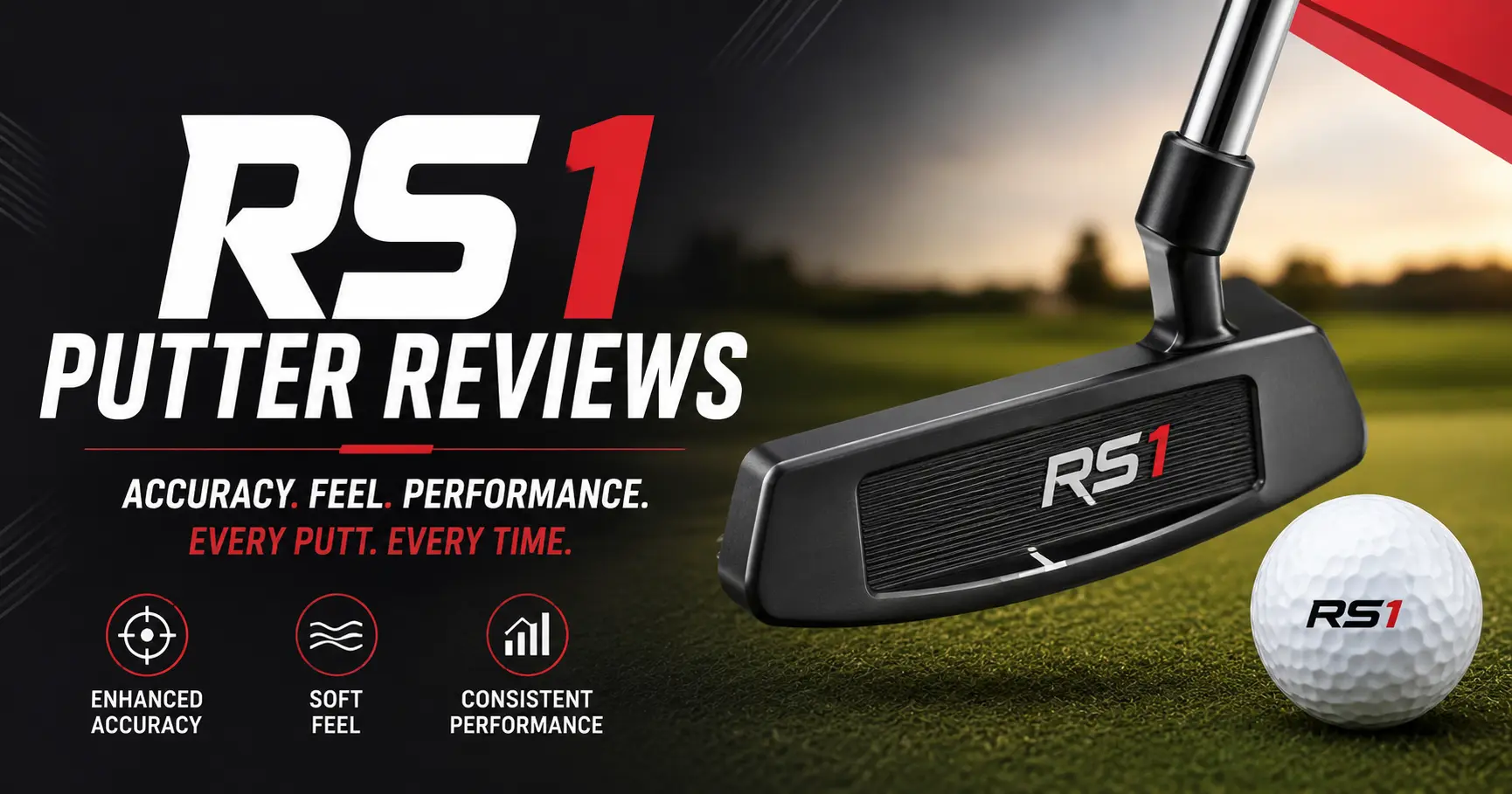
Quick Answer: The Performance Golf RS1 putter uses Forward Axis Weighting, 75% of its 360g head sits ahead of the shaft, to fight face drift through the stroke. Independent testers report fewer three-putts and strong short-range confidence. It runs $399 in steel or $429 in graphite, backed by a 365-day return window.
Search “RS1 putter reviews” right now and you’ll find three or four solid write-ups, each from a single tester who spent a few rounds with one specific build. None of them puts the testers side by side. None of them lines up the RS1’s actual specs against the putter everyone compares it to, LAB Golf’s DF3 lineup. That’s the gap this article fills.
We pulled together what three independent reviewers reported after real testing, cross-checked it against Performance Golf’s own spec sheet, and built the price comparison nobody else bothered to run. If you’re trying to decide whether the RS1 deserves a spot in your bag, here’s everything you need in one place.
What Three Independent Reviewers Actually Found
Matt Saternus wrote the Performance Golf RS1 review for Plugged In Golf and tested it head-to-head against the LAB DF3i, the putter he calls the current king of forgiveness. Indoors, using a launch monitor, he found the RS1 matched the DF3i on smash factor consistency across a large sample of putts. Outdoors, the DF3i pulled slightly ahead on badly mishit long putts, stopping a few inches shorter than the RS1 on the same miss.
Sean Ogle at Breaking Eighty played three rounds with the graphite RS1 and reported zero three-putts across his final two rounds. He’d been gaming a PXG Bat Attack ZT before switching, and he admitted the RS1 doesn’t match that putter’s soft feel. He still called it good enough to make him reconsider his longtime gamer, which is a bigger statement than most reviewers make about a brand-new putter.
Paul Liberatore at Golfers Authority ran a similar test and needed three or four practice sessions to dial in lag putting distance. Once that adjustment clicked, he went two consecutive rounds without a three-putt, a result he called borderline miraculous for a 10-handicapper. All three testers landed on the same conclusion from completely different angles: the technology helps most inside 10 feet, and it needs a short runway on longer putts before it clicks.
Three separate golfers, three separate testing windows, and the same two takeaways every time. That’s the side-by-side most RS1 putter reviews skip, and it’s exactly why the pattern matters more than any single write-up.
How Forward Axis Weighting Actually Works
Most putters put weight behind the shaft or spread it evenly around the shaft axis. That’s how zero-torque putters like the LAB DF3 stay square. They balance the head so there’s no rotational force pulling the face open or closed, a passive design built to neutralize what’s called toe flow, the tendency for a putter’s toe to swing open on the backstroke.
The RS1 does something different. Performance Golf puts 75% of the head’s 360-gram weight in front of the shaft instead of behind it. Gravity pulls that forward mass down and through the stroke, which actively resists the tendency of the face to drift open.
Zero-torque putters neutralize rotation. The RS1 actively corrects it. Here’s the distinction that matters for your buying decision. A zero-torque putter asks you to swing normally and trust the balance.
The RS1 asks less of you technically. Its physics do more of the face-control work on their own. If you’ve fought an open face your whole putting life, that difference is the whole sales pitch.
The Dual Pistol Grip rounds out the system. It’s shaped to encourage your hands to sit in a downward position, which reduces grip pressure and works across conventional, cross-hand, and claw setups without needing a different grip for each style. It’s a small piece next to the weighting story, but every reviewer we checked mentioned it as part of why the putter feels controlled rather than gimmicky.
Chris McGinley designed the RS1, and his resume carries real weight in this category. He’s built putters for major brands and worked with multiple world number-one-ranked players across three decades in the industry. This isn’t a first-time equipment company chasing a trend. It’s a veteran designer building the putter he apparently always wanted to make.
RS1 Putter Specs: The Full Breakdown
None of the reviews we found lists every spec in one place. Here’s the complete sheet. We pulled every number directly from Performance Golf’s product pages.
| Spec | RS1 (Steel) | RS1 (Graphite) |
|---|---|---|
| Price | $399 | $429 |
| Head weight | 360g | 360g |
| RS1 putter lie angle | 74° | 74° |
| Loft | 3.5° | 3.5° |
| Length | 35″ | 35″ |
| Face | CNC-machined stainless steel | CNC-machined stainless steel |
| Crown | Carbon composite | Carbon composite |
| Tail | CNC-machined aluminum T-Wing | CNC-machined aluminum T-Wing |
| Grip | Dual Pistol rubber | Dual Pistol polyurethane |
| Hands available | RH, LH | RH, LH |
| Return window | 365 days | 365 days |
That 74-degree lie angle is worth pausing on. A standard putter runs 70 to 71 degrees. Four extra degrees puts your eyes more directly over the ball and tightens your stroke arc, which gives the face fewer chances to open or close on the way through.
Construction-wise, Performance Golf builds the RS1 from what it calls a 10-piece “Hammerhead” assembly: a CNC-machined face, a woven carbon composite crown, and an aluminum tail shaped to glide across the turf instead of catching in it. It’s more parts than most putters bother with, and it’s a big part of how the company hits 360 grams while keeping 75% of that weight up front.
RS1 vs LAB Golf DF3: Price and Spec Comparison
Every RS1 vs LAB putter comparison online mentions the technology difference. Few show the prices side by side. Here’s what that actually looks like as of August 2026.
| Putter | Price | Weighting Approach | Face |
|---|---|---|---|
| RS1 (steel) | $399 | Forward Axis (active) | Stainless steel |
| RS1 (graphite) | $429 | Forward Axis (active) | Stainless steel |
| LAB DF3 Stock | $399 | Lie Angle Balance (passive) | 6061 aluminum |
| LAB DF3i Stock | $499 | Lie Angle Balance (passive) | 6061 aluminum |
| LAB DF3 Custom | $499 | Lie Angle Balance (passive) | 6061 aluminum |
| LAB DF3i Custom | $599 | Lie Angle Balance (passive) | 6061 aluminum |
At the base price, the RS1 and the DF3 Stock cost exactly the same. Once you want the insert version or a custom fitting, LAB gets considerably more expensive. That’s not a small detail if budget plays any role in your decision.
The mechanism is genuinely different, not just marketing language. LAB neutralizes torque so the face has no reason to rotate at all. The RS1 uses forward mass and gravity to actively pull the face back to square during the stroke.
Neither approach is objectively better. They solve the same problem from opposite directions, and which one suits you comes down to whether you want passive stability or active correction.
Where Reviewers Agree It Falls Short
Every strong review admits where a product doesn’t work for everyone, and the RS1 coverage does that consistently on a few specific points.
Sound and feel split opinion hardest. The stainless steel version produces a bright, high-pitched “tock” at impact that more than one tester called harsh compared to a soft insert putter. If you want a muted, buttery feel off the face, the steel RS1 won’t give it to you. The graphite shaft softens things, but it doesn’t fully solve it.
Fit on the headcover is a real, specific complaint. One tester found it fits snugly enough to be genuinely annoying to put back on after every hole, and eventually just stopped using it mid-round. It’s a minor issue in the grand scheme, but if you care about keeping your putter covered on the course, keep it in mind before you buy.
Lag putting takes an adjustment window. Every tester who mentioned distance control on 30-plus foot putts needed a few practice sessions before the forward weighting felt natural. That’s not a flaw exactly, but it’s not instant either, and a golfer expecting immediate improvement on long putts might get frustrated before it clicks.
Price, Editions, and Current Availability
The RS1 putter price breaks down cleanly: $399 for the steel shaft, $429 for graphite, and both currently ship through Performance Golf’s own site. A separate Founders Edition ran $449 for a graphite build with a 303 stainless steel face and a premium leather headcover, limited to 500 units. As of this writing, the Founders Edition shows sold out.
If you want the RS1 and the Founders Edition isn’t available, the standard graphite build gets you the same core technology (Forward Axis Weighting, the 74-degree lie angle, the 360-gram head) for $20 less. You’re not losing much beyond the limited-edition finish and the leather cover.
Performance Golf backs every RS1 purchase with a 365-day return window. That’s not a typo. A full year to decide if the putter earns a permanent spot in your bag is far more generous than the 30-day window most golf equipment brands offer, and it meaningfully lowers the risk of trying something this different from a traditional blade or mallet.
Who the RS1 Putter Is Actually Built For
If your miss on the greens comes from an open or closed face at impact rather than bad speed control, the RS1 is worth real consideration. Golfers who’ve never quite trusted a zero-torque putter’s robotic feel but still want help squaring the face get a genuinely different option here, not just a LAB clone with a new paint job.
Short putts are where this putter earns its price tag. Every independent test we found flagged the same result: inside 10 feet, the forward weighting makes the face feel locked in, and confidence over short putts goes up fast.
I’ll say this plainly. For a golfer who fights face rotation and has already tried, and disliked, a zero-torque design, the RS1 is the most interesting alternative on the market right now, and it’s not close.
Who Should Skip the RS1 Putter
Not every putter fits every stroke, and the RS1 is no exception. If your putting problem is speed control rather than face angle, forward weighting doesn’t address your actual miss, and you’re better off spending $400 on lessons or a proper fitting instead.
Feel-first players who need a soft, muted response off the face should think twice about the steel version specifically. The bright “tock” at impact isn’t for everyone, and no amount of marketing changes that.
Golfers who already putt well with a low-MOI blade and a strong arc stroke won’t see enough benefit to justify the switch. The RS1’s upright lie angle and forward weighting are both built around minimizing arc, not enhancing it.
Frequently Asked Questions
Does the RS1 putter come with a headcover?
Yes, it ships with a headcover. Testers describe it as a snug fit that can be frustrating to reattach after every hole, so budget an extra few seconds per green if that detail matters to you.
What is the RS1 putter’s return policy?
Performance Golf offers a 365-day, no-questions-asked return window on the RS1, branded as the “Roll STR8 Guarantee.” That’s roughly twelve times longer than the standard 30-day policy most golf retailers use.
How is the RS1 different from a zero-torque putter like LAB?
Zero-torque putters balance the head so there’s no rotational force acting on the face at all. The RS1 puts 75% of its weight in front of the shaft so gravity actively pulls the face back to square during the stroke. One is passive neutrality. The other is active correction.
RS1 putter graphite vs steel: which shaft should you get?
Go graphite if feel and sound at impact matter to you. It costs $30 more but softens the hot, pingy feel that the stainless steel version produces, especially on center-face contact.
Is the RS1 putter good for a straight-back-and-through stroke?
Yes. Both the 74-degree lie angle and the forward weighting tighten your arc and encourage a straighter path, which suits a straight-back-and-through stroke better than a strong arc.
How long does RS1 putter shipping take?
The standard build runs an estimated 4 to 6 weeks from order to delivery, according to Performance Golf’s own product page. That’s a pre-order situation, not next-day shipping, so factor the wait into your timing if you want it in the bag for a specific event.
Can you customize the RS1 putter’s shaft length or lie angle?
Not through a standard dropdown menu. The Dual Pistol Grip and stock lie angle come fixed at checkout, though Performance Golf has handled length and lie requests on a case-by-case basis for buyers who contact them directly.
The Bottom Line on RS1 Putter Reviews
Three independent testers agree on the core story behind these RS1 putter reviews: the RS1 controls face rotation better than almost anything else at this price, and short putts get noticeably more automatic once you adjust to the feel. It’s not for golfers chasing a soft, traditional feel, and it’s not a magic fix for bad speed control.
At $399 to $429, backed by a 365-day return window, the risk of trying it is about as low as putter shopping gets. If face control is genuinely your miss, the RS1 belongs on your short list.