
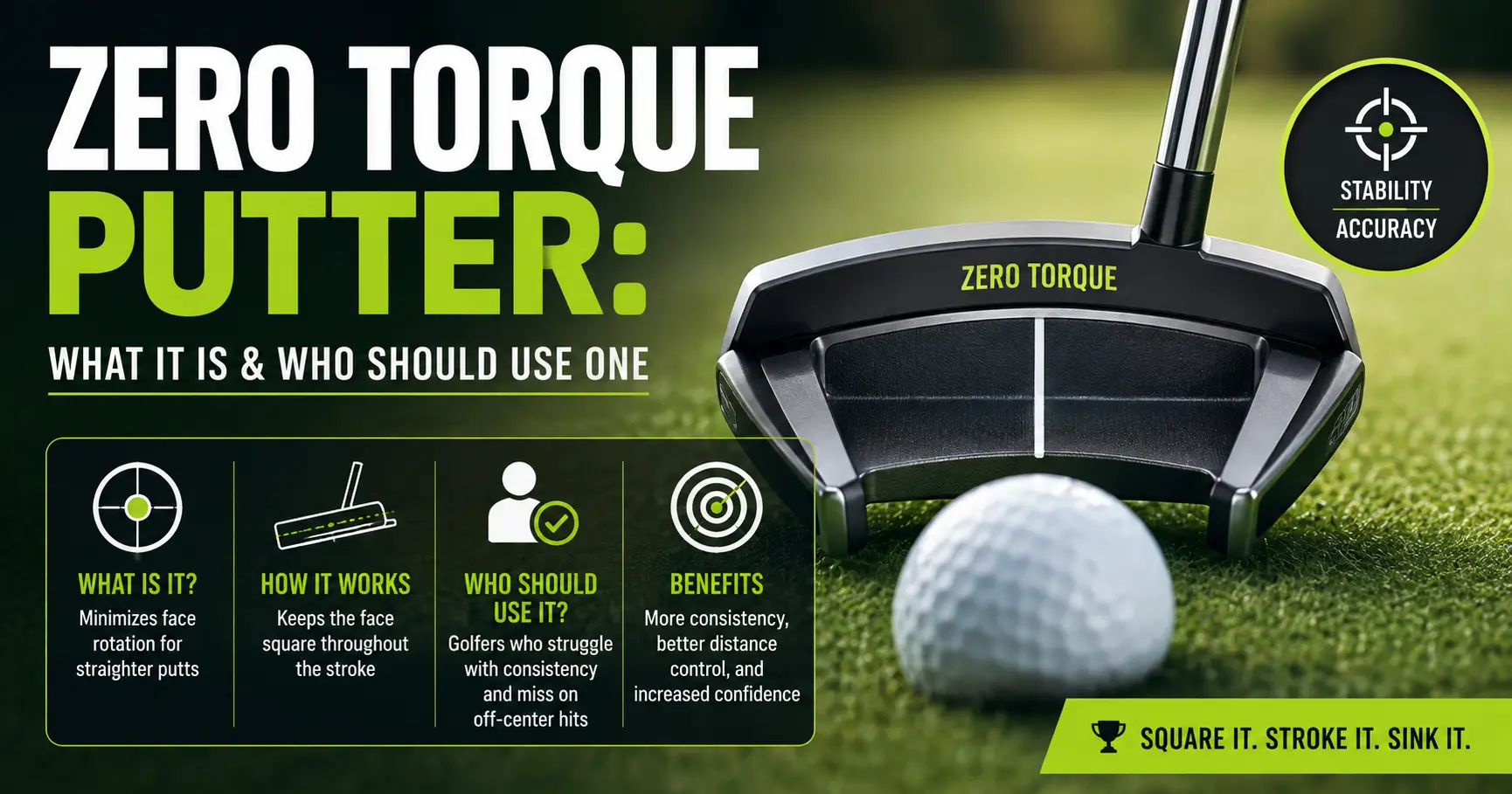
A zero torque putter places the head’s center of gravity directly under the shaft axis, removing the rotational force, or torque, that makes traditional putters twist during the stroke. The face stays square without you having to time a release. It suits golfers who fight face rotation or inconsistent strikes, though it takes an adjustment period and isn’t essential for every player.
What “Zero Torque” Actually Means
Every putter head has weight spread around it. Swing that head back and through, and any weight sitting off to one side of the shaft’s line of rotation creates a twisting force. In physics terms, that twisting force is torque.
A zero torque putter is built so the center of gravity sits directly beneath the shaft axis instead of off to one side. With no offset weight fighting the swing, there’s nothing for the stroke to twist against.
Compare that to a standard blade, where the shaft usually enters near the heel while most of the head’s mass sits toward the toe. That offset is what makes a traditional putter rotate open on the backswing and closed coming through impact, a behavior golfers call toe hang. You’ve probably felt it without knowing the name.
L.A.B. Golf gets credit for popularizing the modern version of this idea through its Lie Angle Balance putters, first launched in the mid-2010s and carried into the mainstream by players like Adam Scott. PXG, Evnroll, Odyssey, TaylorMade, and even Scotty Cameron now build their own versions, which is how “zero torque” went from a niche oddity to a recognized putter category in under a decade.
Why Putters Twist in the First Place
Picture a wrench with a heavy weight taped near the end of the handle, off to one side. Swing that wrench and the offset weight resists your effort to keep it pointed straight, pulling toward wherever gravity and momentum carry it. A traditional putter head behaves the same way once its center of gravity sits away from the shaft.
Skilled putters learn to time that rotation so the face just happens to be square exactly at contact. That timing, not green reading or speed control, is the actual skill a lot of golfers quietly struggle with.
A zero torque design removes the need for that timing by eliminating the offset weight that caused the rotation in the first place. This isn’t just marketing language, either.
Pick up a true zero torque putter and gently twist the head in your hands. It rotates with almost no resistance, because there’s no offset mass creating a restoring force. Do the same with a traditional toe-hang blade and you’ll feel it want to snap back toward one position, the same effect that rotates the face open and closed during a real stroke.
Zero Torque vs. Face-Balanced vs. Toe Hang
Golfers throw these three terms around like they’re interchangeable. They’re not, and mixing them up is the easiest way to end up with the wrong putter.
| Design | Where the weight sits | What happens during the stroke | Best suited to |
|---|---|---|---|
| Toe hang | CG well toward the toe, shaft near the heel | Face rotates open on the backswing, closes through impact | Golfers with a natural arced stroke who release the putter like a swinging gate |
| Face-balanced | CG closer to the shaft axis, face sits level when balanced on a finger | Reduced rotation, but not fully eliminated | Golfers with a straight-back, straight-through stroke |
| Zero torque | CG directly under the shaft axis | Minimal rotation to manage at all | Golfers who fight face rotation regardless of stroke shape, or who want one less variable under pressure |
Face-balanced putters get lumped in with zero torque constantly, and the confusion is understandable since both are marketed around stability. The difference still matters. A face-balanced putter reduces torque compared to a heavy toe-hang blade, but it doesn’t remove it the way a true zero torque design does. If a listing calls something “zero torque,” check whether the shaft axis genuinely runs through the CG rather than just whether the face looks level on a finger.
It’s also worth separating torque from moment of inertia (MOI), since marketing copy often blurs the two. Torque is about what happens to the face’s orientation as you swing the putter, the twisting force a zero torque design eliminates. MOI is about what happens on a mis-hit, how much a strike away from the center of the face still twists the head and costs you distance or direction. A putter can be high-MOI without being zero torque, and plenty of modern mallets now combine both properties in one head.
Who Actually Benefits From a Zero Torque Putter
Zero torque putters make the most sense for golfers who fight face rotation during the stroke, whether that shows up as pulls, pushes, or simply inconsistent starting lines on putts that should be routine. If your misses scatter left and right rather than land consistently short or long, a more stable face is often a more useful fix than another stroke drill.
They also suit golfers moving over from a face-balanced putter, since that transition tends to be smaller than jumping straight from a heavy toe-hang blade. And for anyone who wants one less thing to manage under pressure, not having to time a release can genuinely lighten the mental load on a three-footer that matters.
For golfers who fight a twisting putter face, zero torque is one of the more sensible equipment changes available right now. It solves a specific, identifiable problem instead of promising a vague overall improvement, which is more than most putter marketing can honestly claim.
Who Should Stick With a Traditional Putter
Not every putting problem is a torque problem, and a zero torque putter won’t fix speed control, green reading, or nerves over a short putt.
Golfers with a strong natural arc who like feeling the putter release through impact often find zero torque designs feel dead or overly controlled by comparison. Plenty of accomplished putters have built their whole game around feeling that rotation rather than removing it, and that preference is legitimate rather than a flaw to be corrected.
The heads on many zero torque putters also run larger and heavier than a classic blade, which changes both the look at address and the feel on shorter putts. If you love a compact blade silhouette, a big mallet-style zero torque head may never feel like “your” putter, no matter how well it performs on a launch monitor.
Budget matters too. Several zero torque models sell in the $500 to $700 range once you factor in premium shafts or counterbalance options, and I wouldn’t buy one purely because the marketing promises a square face. If you’re already putting well with what’s in your bag, a new putter category isn’t an obvious upgrade.
The Real-World Evidence: Tour Adoption and What It Means
Zero torque putters stopped being a fringe experiment the moment J.J. Spaun won the 2025 U.S. Open at Oakmont using an L.A.B. Golf DF3. He closed with a 64-foot, 5-inch birdie putt on the 72nd hole to seal a two-shot win, the longest putt made by anyone in the field all week, and multiple golf outlets noted it made him the first man to win a men’s major with a zero torque putter in play.
Adam Scott has played L.A.B. designs since well before that win, and Scotty Cameron entering the category with its Fastback OC and Phantom OC models is arguably the bigger long-term signal. Scotty Cameron rarely chases trends. When a brand built almost entirely on tradition and hand-milling adds a low-torque option to its lineup, that’s a strong hint the underlying engineering holds up rather than fading as a passing fad.
None of this guarantees a zero torque putter fixes your putting specifically. Tour pros find the center of the face far more often than most amateurs do, so the forgiveness and stability benefits showing up in independent testing may matter even more for a mid or high handicapper than for a scratch player. Treat tour usage as evidence the technology genuinely works as designed, not as a promise about your own scorecard.
What to Check Before You Buy One
A zero torque putter isn’t a drop-in replacement you grab off the rack and expect to perform like your old gamer on day one.
Length and lie angle. Because the shaft often enters closer to the center of the head rather than the heel, standing over a zero torque putter can feel different even at your usual length. Get measured rather than assuming your old specs carry over directly.
Weight and stroke tempo. Many zero torque heads run heavier than a traditional blade to help stabilize the design. That extra mass can smooth out a jabby stroke, but it can also feel sluggish on fast greens if you’re used to a lighter head.
Grip style. A lot of zero torque putters ship with a built-in forward-press grip to help set your hands ahead of the ball at address, which matches the shaft geometry. If you already use a claw or left-hand-low grip, check that the stock grip doesn’t fight your setup.
The adjustment period. Reviewers and fitters who’ve spent real time with these designs consistently mention a transition window before the putter starts performing at its best. Give it more than a couple of range sessions before deciding it isn’t for you.
Getting fit. Every major zero torque brand offers in-person or remote fitting, and it’s worth using. Lie angle in particular affects how these putters sit and aim more than it does with a conventional blade.
Current Zero Torque Putters Worth Knowing
Prices below reflect what current retailers were listing at the time of writing. They shift with sales and regional availability, so treat this as a guide rather than a guarantee.
| Putter | Type | Typical price (USD) | Best fit |
|---|---|---|---|
| Sub 70 001z / 005z / 009z Mini | Blade and mini-mallet | $199 | Golfers who want zero torque in a smaller, more traditional-looking head, bought direct from the manufacturer |
| Wilson Infinite Zero Torque Lakeview | Mallet | $199.99 | Budget-conscious golfers who miss more short putts than they’d like |
| Vice Golf VGP03 / VGP04 ZT | Blade and mallet | $199 to $239 | Golfers who want a stable, no-frills option without a big-brand price tag |
| Sub 70 011-SQ | High-MOI mallet | $229 | Golfers who want maximum forgiveness on mis-hits at a mid-budget price |
| Odyssey Ai-Dual Square 2 Square #7 | Fang-style mallet | roughly $300 to $400 depending on retailer | Golfers moving from a face-balanced Odyssey who want a recognizable, tour-proven shape |
| L.A.B. Golf DF3 | Center-shafted mallet | roughly $400 to $450 | Golfers who want the original Lie Angle Balance design and are willing to get properly fitted |
| Evnroll ZERO (Z2 / Z5 / Z1cs) | Blade and mallet | around $449 | Golfers who value milled feel and Evnroll’s face-groove technology alongside torque stability |
| TaylorMade Spider 5K-ZT | High-MOI mallet | $449.99 to $549.99 depending on configuration | Golfers who already like a Spider-style mallet and want it in a zero torque build |
| Scotty Cameron Fastback OC / Phantom OC | Milled mallet | around $549.99 | Golfers who want zero torque engineering without giving up Scotty Cameron looks and milling |
This list isn’t exhaustive. New models arrive from most of these brands every year, and smaller manufacturers keep entering the space, so check current listings before you buy.
How Much Zero Torque Putters Cost
The category spans roughly $200 at the budget end to $650 or more once you add custom shafts, counterbalance weighting, or a premium milled finish. That’s a wider range than most other putter styles, largely because direct-to-consumer brands and legacy premium manufacturers entered the space at the same time.
Paying more doesn’t automatically buy better stability. The core zero torque principle, CG aligned under the shaft axis, works the same whether the putter costs $200 or $600. What the extra money typically buys is milling quality, insert technology, alignment-aid design, and brand fitting support, not a fundamentally different level of face control.
Frequently Asked Questions
Is a zero torque putter guaranteed to fix my putting?
No. It addresses face rotation specifically. If your main issue is speed control, green reading, or nerves under pressure, a zero torque putter won’t solve those on its own.
Do zero torque putters cost more than regular putters?
Not necessarily. Sub 70 and Wilson both sell zero torque models under $230, in line with mid-range traditional putters. Premium versions from L.A.B. Golf, Evnroll, and Scotty Cameron run higher, generally $400 and up.
How is a zero torque putter different from a face-balanced putter?
A face-balanced putter reduces face rotation compared with a heavy toe-hang blade, but its center of gravity still sits slightly off the shaft axis. A true zero torque putter aligns the CG directly under that axis, removing rotation almost entirely rather than just reducing it.
Can a zero torque putter help with the yips?
It may help golfers whose yips show up as inconsistent face control, since it removes one variable from the stroke. It won’t address yips rooted in nerves or the mental side of putting, which is a different problem entirely.
Should I get fit for a zero torque putter instead of buying off the rack?
Yes, if possible. Lie angle and length affect how these putters sit at address more than they do with a conventional blade, and most zero torque brands offer free or low-cost fitting, in person or remotely.
Do any pros actually use zero torque putters?
Yes. J.J. Spaun won the 2025 U.S. Open with an L.A.B. Golf DF3, and Adam Scott has played L.A.B. designs for years. Scotty Cameron’s entry into the category with its OC models is a further sign of mainstream acceptance.
The Bottom Line
A zero torque putter solves one specific problem well: a face that won’t stay square through the stroke. If that’s genuinely your issue, the technology is sound, tour-proven, and available at nearly every price point from around $200 up. If your putting struggles come from speed control, green reading, or nerves, spending on a new putter category won’t move the needle nearly as much as time spent on the practice green will. Try one at a fitting before you commit, since the difference in feel from a traditional blade is bigger than any spec sheet suggests.