
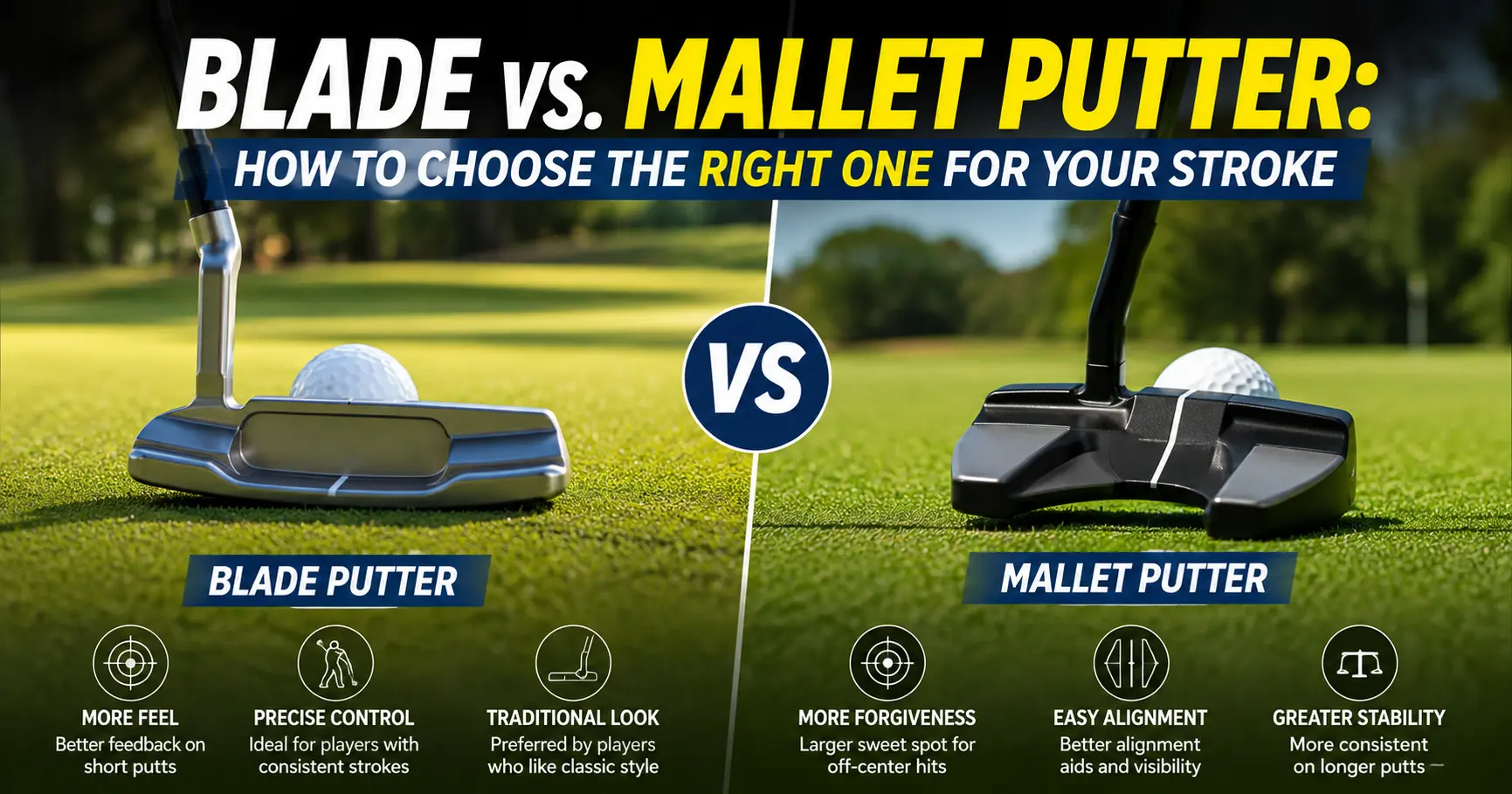
Quick answer: A mallet’s higher MOI and bolder alignment help most golfers hole more short putts, while a blade rewards golfers who already strike the ball consistently and want more feedback on longer putts. Your stroke type (arc versus straight-back-straight-through) and your typical miss pattern matter more than your handicap number.
Golfers usually walk into this decision backwards. They pick a putter because it looks fast in a pro shop, then spend a season fighting a head shape that works against how their hands actually move.
The blade vs. mallet question isn’t about which one is “better.” It’s about which design matches the way your putter face behaves during your stroke, and which one hides the misses you actually make.
This guide breaks down what a blade and a mallet actually do differently at impact, what real putting data says about each, how tour pros have shifted between the two in 2026, and how to figure out which one fits you without booking a full fitting session.
What Is a Blade Putter?
A blade putter is the classic, narrow-headed design most golfers picture when they think “putter.” The head typically runs about 2.5 to 3.5 inches from face to back, and most of the mass sits close to the heel and toe rather than spread across a wide footprint.
The shape traces back to Karsten Solheim’s original Ping Anser, introduced in 1966, which set the template that most blades still follow today. Many are still milled from a single billet of steel, which is part of why golfers associate blades with a soft, direct feel at impact.
Because the mass sits close to the shaft axis, a blade has a comparatively low moment of inertia (MOI), the property that resists twisting when you don’t strike the exact center of the face. That’s the tradeoff at the heart of the whole blade vs. mallet debate: a blade gives you more feedback about where you struck the ball, but it’s less forgiving when you don’t strike it in the middle.
Most blades also have some degree of toe hang, meaning the toe drops when you balance the shaft on a finger. That’s a byproduct of hosel design, not a rule, and it matters more than the “blade” label itself. More on that below.
What Is a Mallet Putter?
A mallet putter has a larger, deeper head, often extending well behind the face, with the extra material used to push weight toward the perimeter. Modern mallets frequently mix materials (aluminum or polymer bodies with tungsten weights, for example) specifically to move mass as far from the center as the rules allow.
That perimeter weighting raises MOI substantially compared to a blade. In plain terms, a mallet resists twisting more when you catch the ball off the toe or heel, so the face stays closer to square and the ball keeps more of its intended speed and line.
Many mallets are also face-balanced, meaning the face points straight up when you balance the shaft on a finger. Face balance tends to suit a stroke with minimal face rotation. That’s a common pairing, not a fixed rule. Plenty of modern mallets use slant-neck or plumber’s-neck hosels that build in real toe hang, so don’t assume a big head automatically means face-balanced.
The larger surface also gives designers room for bold sightlines, contrasting colors, or geometric alignment aids, which is a big part of why mallets have a reputation for being easier to aim.
One thing that doesn’t change between the two styles: loft. Almost every modern putter, blade or mallet, sits between 2 and 4 degrees, the same small window we cover in our full breakdown of loft across every club in the bag. Head shape changes forgiveness and alignment. It doesn’t change the loft that gets the ball rolling.
The Real Difference: MOI, Toe Hang, and Face Balance
Shape is what you see. Balance and mass distribution are what actually change your outcomes, and they’re worth understanding properly instead of taking on faith.
MOI
MOI is the putter head’s resistance to twisting around its vertical axis when the strike isn’t perfectly centered. A higher-MOI head, which is almost always a mallet, keeps the face closer to square on a mis-hit. On a 5-foot putt, a face that’s a couple of degrees open at impact can be the difference between center-cut and a lip-out. That’s why forgiveness shows up most on short putts, where the margin for face error is smallest.
Toe hang
Toe hang describes how much the toe drops when you balance the putter. More toe hang generally pairs with an arcing stroke, where the face naturally opens on the backswing and closes through impact, because the hanging toe wants to rotate with that motion instead of against it. Less toe hang (face-balanced) pairs better with a straighter, less rotational stroke.
This isn’t just a marketing talking point. A study published in the peer-reviewed journal Proceedings by researchers Sasho MacKenzie and Erik Henrikson measured golfers hitting 8-foot putts with a toe-hang design versus a face-balanced design. The toe-hang putter required significantly more twisting force (torque) at the grip, produced a higher angular velocity around the shaft, and finished with a more open face at impact than the face-balanced putter did.
That’s the mechanical reason a stroke-to-putter mismatch feels like work. If your stroke naturally rotates the face but you’re using a face-balanced mallet, you’re fighting the design every time to keep it square. If your stroke barely rotates but you’re using a heavy toe-hang blade, the head wants to close on you, and you end up manipulating the face by hand to compensate. Neither compensation holds up under pressure.
Here’s an opinion worth stating plainly: your handicap index is a weak predictor of which putter you should play. Miss pattern and stroke shape predict it far better than handicap does, which is why “beginners should use a mallet” is true often enough to be common advice, but wrong often enough to waste a good putter on the wrong golfer.
Blade vs. Mallet Putter Comparison Table
| Factor | Blade | Mallet | What It Means for You |
|---|---|---|---|
| Head size and mass | Compact, heel-toe weighted, 340-360g typical | Larger, deeper, perimeter or wing-weighted | A mallet spreads its weight farther from center, which is the entire source of its extra forgiveness |
| MOI (forgiveness) | Lower | Higher | A mallet keeps the face more stable when you miss the sweet spot, especially inside 6 feet |
| Typical balance | Often toe hang | Often face-balanced (not always) | Match balance to your actual stroke rotation, not the head shape label |
| Feel and feedback | More direct, easier to sense a mis-hit | Softer, more muted, absorbs vibration | Blades reward golfers who use feel to control speed |
| Alignment aids | Minimal, usually a single line or dot | Bold lines, rails, or shapes across a wide surface | Mallets help golfers who struggle to start putts on line |
| Best fit for stroke | Arcing strokes with natural face rotation | Straight-back, straight-through strokes | Fighting your stroke’s natural rotation is where most bad putter fits come from |
| Where it tends to win in data | Slightly better lag proximity and longer putts | Higher make rate and fewer three-putts inside 6 feet | See the data section below for the actual numbers |
What the Putting Data Actually Shows
Two different, credible data sources speak to this question, and they measure different things. Reading them together gives a clearer picture than either one alone.
Shot Scope, which tracks real rounds from thousands of amateur golfers, published a comparison of 15-handicap golfers using blades versus mallets. Blade users made 75 percent of putts inside 6 feet, averaged 7.3 feet of proximity on lag putts, and three-putted 2.6 times per round. Mallet users made 82 percent inside 6 feet, averaged 7.7 feet on lag putts, and three-putted 2.3 times per round.
That’s real-world tracking data, not a controlled experiment. Golfers chose their own putters before Shot Scope ever measured them, so some of that gap likely reflects golfers who were already better fits for a mallet picking one, not the putter itself creating the entire difference. Treat it as a meaningful signal, not proof of causation.
MyGolfSpy’s equipment lab ran a more controlled test, hitting 23,000 putts with each style from three fixed distances. Mallets won clearly from 5 feet. Blades won at 10 feet, and blades won again at 20 feet.
Put those two data sets together and a coherent story emerges. Mallets earn their reputation on the putts where face stability under pressure matters most, the ones inside 6 feet that decide whether a round has a good back nine or a frustrating one. Blades hold their edge as distance increases, where touch, tempo, and speed feel start to matter more than raw forgiveness. Neither data set contradicts the other. They’re measuring different parts of your putting.
Blade vs. Mallet Putter on Tour in 2026
Tour trends won’t fit your stroke to your putter, but they’re a useful window into where equipment engineering is heading, and the shift over the past decade has been dramatic.
Research published by GolfWRX found that 44 percent of the OWGR top 50 used mallet putters in 2018. By 2022, that number had climbed to 62 percent. The move accelerated further from there: as the PGA Tour’s own 2025 season wrapped, 35 of the year’s 47 tournament winners had used a mallet putter, compared to just 12 blade winners, and every player in the top 10 of the Official World Golf Ranking was using a mallet, following a late-season switch by Ben Griffin.
LPGA players have moved the same direction. Lydia Ko’s Scotty Cameron putter is a face-balanced mallet built specifically for her straight-arc stroke, the same pairing this guide recommends for most straighter-stroke golfers.
Biggest Names on the PGA Tour
Several of the sport’s biggest names on the PGA Tour made the jump mid-career and saw their Strokes Gained: Putting rankings move with them. Scottie Scheffler ranked 162nd in SG: Putting the year before switching to a mallet, then jumped to 77th the year after. Rory McIlroy went from 66th to 16th. Tommy Fleetwood went from 92nd to 20th the year he switched, a change that coincided with his first PGA Tour win and a FedExCup title. Justin Thomas jumped from 174th to 27th.
TaylorMade’s tour putter fitter, who works with several top-10 players, has described the appeal in two different ways depending on the player: for some it’s the added MOI and more consistent launch off the face, and for others it’s simply that the larger footprint sits flatter and more repeatably on the green at address.
None of this means you should copy a tour pro’s bag. Tour players get truck-level custom fitting and hit thousands of putts a week under tournament pressure. Their putter choice is optimized for their specific stroke, not a blanket recommendation for yours.
It’s also worth noting who’s still winning with a blade. Ludvig Åberg remains the highest-ranked player who regularly plays one, finishing 2025 ranked 86th in SG: Putting with an Odyssey blade. Harry Hall, also a blade user, actually led the entire PGA Tour in Total Putting, Putting Average, and Putts per Round for the 2025 season. A well-fit blade in skilled hands is still a very real weapon on tour. It’s the exception that proves the trend isn’t a universal rule.
Blade vs. Mallet Putter for Beginners and High Handicappers
If you’re new to golf or carrying a higher handicap, a mallet is a sensible default, but it’s a default, not a mandate.
Consistent center-face contact and stable face control take time to develop. A mallet’s higher MOI reduces the penalty while you’re still building that consistency, and its bolder alignment aids remove one more variable while you’re learning to read a line and set up square to it.
That said, handicap alone isn’t the deciding factor. Some newer golfers already have naturally good touch and a repeating stroke, and a blade won’t punish them the way it would a golfer who’s still fighting inconsistent contact. If you’re not sure which camp you’re in, the miss-pattern test later in this guide takes five minutes and tells you more than your handicap ever will.
A mallet also won’t fix a setup problem by itself. If your alignment at address is consistently off, no amount of head stability solves that. Stability helps you survive a mis-hit. It doesn’t correct a putter face that was never aimed at the target to begin with.
Wide Blades and Double-Wide Blades: The Middle Ground
If you like a blade’s profile and sightline but want more forgiveness than a traditional blade offers, the wide blade (sometimes called double-wide) category exists specifically to bridge that gap.
A wide or double-wide blade keeps the compact, traditional silhouette at address but adds depth and width behind the face, which lets designers push more mass toward the perimeter than a standard blade allows. Models like the Odyssey Ai-DUAL and Ai-ONE Double Wide, the MacGregor MT Milled 001 Double Wide, and the Cleveland HB Soft #8 all follow this approach, and testers at outlets that run robotic putter data have found double-wide blades gaining roughly 10 percent more MOI than a narrower blade in the same family, without the visual bulk of a full mallet.
It’s a genuinely useful middle option for golfers who’ve decided their eyes need a blade-like look at address but their data or their miss pattern says they’d benefit from more stability. Just note that most double-wide blades are built face-balanced with minimal toe hang, so they still fit a straighter stroke better than a strong arc.
Blade vs. Mallet vs. Zero-Torque Putters
Zero-torque putters, popularized by L.A.B. Golf’s Lie Angle Balance technology, complicate the blade-or-mallet framing on purpose. They’re not really a third head shape. They’re a different approach to balance that can be built into a blade-like, mallet-like, or unconventional profile.
The idea is to align the putter’s center of gravity directly with the shaft axis, which minimizes the torque that makes a conventional putter want to twist open or closed during the stroke. Instead of relying on you to time a face rotation, or on perimeter weighting to resist a twist after it’s already happening, a zero-torque design tries to remove the twisting tendency at its source.
The category moved from niche curiosity to mainstream fast. Zero-torque putters gained serious traction on tour around Lucas Glover’s FedEx Cup Playoff wins in 2023, and JJ Spaun won the 2025 U.S. Open gaming an L.A.B. DF3. Our own breakdown of Lucas Glover’s bag covers how the switch to a Lie Angle Balance putter helped him work through a long stretch of the yips, which is about as strong a real-world data point for the category as exists.
Zero-torque isn’t automatically better than a well-fit mallet or blade. Some golfers who lean on feel to control speed on long putts find the extra stability comes with a slightly muted, less tactile sensation, especially compared to a soft-milled blade. It’s worth trying before you commit a few hundred dollars to one, the same as any other putter category.
How to Find Your Stroke Type Without a Fitting
You don’t need a SAM PuttLab session to get a reasonable read on your own stroke. This takes about ten minutes on a practice green.
- Film your stroke from directly down the target line. Prop a phone on a small tripod or a headcover, roughly a foot behind the ball, and hit five putts. Watch whether the putter head tracks inside the line on the backswing and returns inside on the through-swing (an arc), or stays close to the line the whole way (straighter).
- Check your balance point at home. Rest the shaft across a flat finger about 6 inches up from the head. If the toe drops noticeably, that’s toe hang. If the face points straight up, that’s face-balanced. Compare that to what your putter actually is versus what your stroke shape suggests you need.
- Run a gate drill for start line. Set two tees just wider than your putter head, about a foot in front of the ball, aimed at a hole from 6 feet. If you can’t roll ten putts through the gate consistently, alignment and face control are probably your bigger issue, not distance control.
- Track your misses for one round with a single word. Every putt inside 6 feet you miss, write down whether it went left or right of the hole. A consistent pattern in one direction points to a face-angle problem that added MOI or a bolder alignment aid can genuinely help.
Decision Framework: Which Putter Should You Choose?
Choose a blade if:
- You have a naturally arcing stroke and a blade’s toe hang matches it
- You already strike the ball near the center consistently
- You rely on feel and feedback to control distance, especially on faster greens
- You’ve tested your miss pattern and it’s speed-related rather than face-angle related
Choose a mallet if:
- You have a straight-back, straight-through stroke
- Your misses inside 6 feet tend to be pushes or pulls (face-angle errors)
- You want more visual help getting the putter face aimed correctly
- You’re newer to the game and still building consistent contact
Consider a zero-torque design if:
- You’ve tried both a blade and a mallet and still fight face rotation under pressure
- You want stability without relying purely on a large head shape
- You’re comfortable trading a bit of tactile feedback for a calmer, more repeatable stroke
None of these categories are absolute. Ludvig Åberg and Harry Hall are proof that a blade can still win at the highest level, and plenty of accomplished amateurs putt beautifully with head shapes that “shouldn’t” fit their stroke on paper. Use this framework as a starting point, then confirm it by actually hitting putts with both styles before you buy.
Frequently Asked Questions
Do PGA Tour pros use blade or mallet putters more?
Mallets, by a wide and growing margin. Every player in the top 10 of the Official World Golf Ranking used a mallet putter by the end of the 2025 season, and 35 of the year’s 47 PGA Tour winners had a mallet in play. Blades haven’t disappeared. Ludvig Åberg and Harry Hall both had strong 2025 seasons with one.
Is a mallet putter better for beginners and high handicappers?
Often, yes, mainly because a mallet’s higher MOI reduces the penalty for the inconsistent contact most newer golfers are still working through. It’s a sensible default rather than a rule. Some newer golfers already have good touch and a repeating stroke, and would putt just as well or better with a blade.
Can a low handicapper or scratch golfer still use a mallet?
Absolutely. Scottie Scheffler and Rory McIlroy are both mallet users who rank among the best putters in the world. Mallets aren’t a training-wheel category. They’re simply a design philosophy built around forgiveness and alignment that plenty of elite players have adopted for those exact benefits.
What’s the difference between a mallet and a zero-torque putter?
A mallet gets its stability from a larger head with weight pushed to the perimeter. A zero-torque putter gets its stability from aligning the center of gravity with the shaft axis to reduce twisting force at the source. Some putters combine both approaches, since zero-torque balance can be built into a mallet-shaped head or a more compact profile.
What is a wide blade or double-wide blade putter?
It’s a blade with extra depth and width added behind the face, which raises its MOI closer to mallet territory while keeping a more traditional, compact look at address. It’s a good option for golfers who prefer how a blade looks but want more forgiveness than a standard blade provides.
What do golfers on forums like Reddit usually say about switching from blade to mallet?
The recurring theme in golfer forum discussions is that the switch matters less than actually testing both before buying, and that alignment comfort at address often ends up mattering as much as the raw forgiveness numbers. Plenty of golfers report success going either direction, which lines up with the broader point of this guide: stroke fit and testing beat following a trend.
How can I figure out my stroke type without getting fitted?
Film yourself from down the target line to see whether your stroke arcs or stays straight, check your current putter’s balance by resting it on a finger, and run a simple two-tee gate drill to see how consistently you start putts on your intended line. The step-by-step version of this is above in the stroke-type section.