
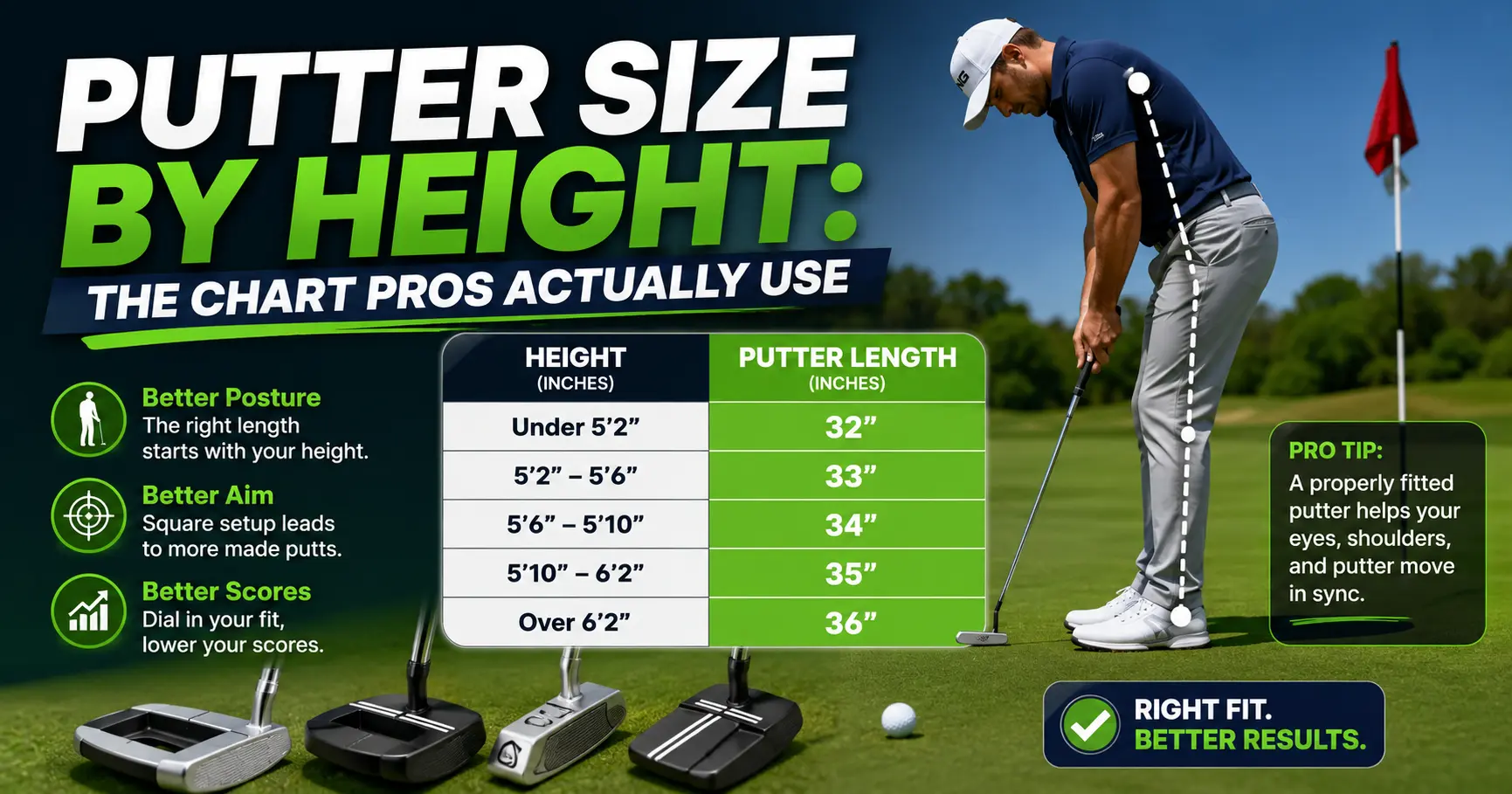
Quick Answer: Most golfers need a 33 to 35 inch putter based on height: under 5’2″ fits 32 inches, 5’6″ to 5’8″ fits 34 inches, and 6’0″ or taller fits 35 inches. But wrist-to-floor measurement matters more than height alone, which is why PGA Tour pros average just 33.5 inches despite standing 6 feet tall.
Walk into any pro shop and grab a putter off the rack. It’s almost certainly 34 or 35 inches. That’s not because 34 or 35 inches fits most golfers. It’s because that length is cheapest to mass-produce.
The average PGA Tour player stands 6 feet tall and plays a putter that measures 33.5 inches, a full inch and a half shorter than the “standard” length sold to amateurs of the same height. Getting your putter size by height right starts with a chart, but it doesn’t end there. Below is the height and wrist-to-floor breakdown that actually accounts for arm length, plus what to do if you land between sizes.
Standard Putter Length: What “Normal” Actually Gets Wrong
Manufacturers build most putters in three lengths: 33, 34, and 35 inches. For decades, 35 inches was the default length nearly every brand shipped, and a lot of that inventory still fills store shelves today.
Here’s the problem. PGA.com, the official site of the PGA of America, reports that the average PGA Tour player stands 6 feet tall and plays a 33.5 inch putter. Recreational golfers of the same height are still buying 35 inch putters off the rack, a gap that changes posture, eye position, and where the putter head sits at address.
Shorter isn’t automatically correct either. A 5’2″ golfer gaming a 35 inch putter stands far too upright to see the line properly, and that mismatch shows up as pushed putts and inconsistent distance control long before anyone thinks to blame the putter. Height sets the range. Your own measurements narrow it down.
Putter Size by Height and Wrist-to-Floor: The Full Chart
Any putter length by height chart gets you in the right neighborhood. Wrist-to-floor measurement gets you to the right house.
| Height | Recommended Putter Length | Typical Wrist-to-Floor Range |
|---|---|---|
| Under 5’0″ | 31 to 32 in. | Under 28 in. |
| 5’0″ to 5’2″ | 32 to 32.5 in. | 28 to 29 in. |
| 5’2″ to 5’4″ | 33 in. | 29 to 30 in. |
| 5’4″ to 5’6″ | 33.5 in. | 30 to 31 in. |
| 5’6″ to 5’8″ | 34 in. | 31 to 32 in. |
| 5’8″ to 5’10” | 34.5 in. | 32 to 33 in. |
| 5’10” to 6’0″ | 34.5 to 35 in. | 33 to 34 in. |
| 6’0″ to 6’2″ | 35 in. | 34 to 35 in. |
| Over 6’2″ | 35.5 to 36 in. | Over 35 in. |
Wrist-to-floor is the more reliable number because it accounts for arm length, not just how tall you are. Two golfers who are both 5’10” can have wrist-to-floor measurements that differ by two inches depending on whether their arms run long or short for their frame. When your wrist-to-floor number and your height point to different rows, trust the wrist-to-floor number.
How to Take Your Wrist-to-Floor Measurement
Here’s how to measure putter length yourself, without booking a fitting:
- Wear your golf shoes. Soles add up to half an inch, and that changes your number.
- Stand on a hard, flat surface. Carpet compresses under your weight and throws the measurement off.
- Let your arms hang completely naturally at your sides. Don’t reach, don’t tense your shoulders, don’t fake your posture.
- Have someone else measure straight down from the crease where your wrist meets your palm to the floor. Doing this alone almost always produces a bad number, because you bend forward to check the tape and the number shrinks.
- Record the result in inches and match it against the chart above. If it disagrees with your height row, the wrist-to-floor number wins.
This is the same basic method behind most reliable measurement charts in golf, including our tee height chart, which uses actual USGA rule limits instead of guesswork the same way this one does.
Why the Wrong Length Wrecks Your Stroke
A putter’s lie angle only works when the sole sits flat on the ground at address. Length is what determines whether that happens for your body.
Play a putter that’s too long, and the toe lifts off the turf when you set up normally, which opens the face relative to your target line and pulls your aim left before you’ve even started your stroke. Play one that’s too short, and the heel lifts instead, which closes the face and pushes your aim right.
Neither miss is subtle once you know what to check. Set your putter down at your normal address position and look at the sole. If the toe or heel is hovering instead of sitting flush, the length is fighting you before you’ve made contact with the ball.
Putter Length and the Rules of Golf (Yes, There’s a Loophole)
Every other club in your bag has a legal length ceiling. The USGA and R&A equipment rules cap drivers, irons, and wedges at 48 inches, and tournaments can tighten that to 46 inches under a local rule.
Putters are exempt. The only length rule that applies to a putter is the same 18 inch minimum every club in the bag must meet. There’s no maximum. That single exception is the reason mid-length, arm-lock, and broomstick putters can exist at all.
This flexibility shows up as a real trend on tour. In recent seasons, PGA Tour pros including Tony Finau, Sahith Theegala, and Stewart Cink have experimented with putters in the 37 to 39 inch range using a mid-length or arm-lock style grip, well beyond anything a height chart would suggest.
Lucas Glover’s 45-inch L.A.B. Mezz.1 Max is an even more extreme example. He switched to it mid-slump in 2023 and won twice in the next six weeks. That’s a specific fix for a specific yips problem, not a template for the average golfer, but it proves the ceiling on putter length sits a lot higher than any fitting chart implies.
Fine-Tuning Beyond the Chart: Posture, Arm Length, and Stroke Type
Once you’ve nailed your putter size by height using the chart and the wrist-to-floor number, these three factors are what separate “close enough” from correct.
Posture matters most. Golfers who set up with a more upright spine at address need extra length to keep their eyes over the ball without reaching down. Golfers who crouch lower, closer to how Tiger Woods sets up, need a shorter putter or they’ll be too bent over to repeat the stroke reliably.
Arm length matters almost as much. A golfer with long arms relative to their height typically needs a half inch to a full inch less than the height chart suggests, and short arms need the opposite adjustment. This is exactly why wrist-to-floor exists as its own measurement instead of relying on height alone.
Stroke type is the smaller factor, but it’s still real. Golfers with an arcing stroke tend to stand a touch farther from the ball and lean toward the longer end of their range, and that stroke usually pairs better with a toe-hang putter. Golfers with a straight-back-straight-through stroke stand closer, lean shorter, and typically play a face-balanced head.
Putter Fitting Cost in 2026: What It Actually Costs
A proper putter fitting isn’t as expensive as most golfers assume, and it’s often free.
Big-box retailers like PGA TOUR Superstore and Golf Galaxy frequently waive the fitting fee entirely if you buy a putter that day. Independent fitters and premium studios like Club Champion or True Spec typically charge $50 to $175 for a standalone putter session, a small fraction of what a full-bag fitting runs.
Already own a putter you like but need the length adjusted? That’s cheaper still. Most shops charge $15 to $40 for a custom putter length adjustment on an existing shaft, including a new grip. Extending usually costs more than shortening, since it requires an extension sleeve rather than a clean cut.
One honest caveat: cutting a putter down changes its swing weight, making it feel lighter and harder to control on longer putts. A competent fitter compensates by adding weight to the head. A rushed same-day repair counter sometimes skips that step, and you’ll feel the difference on the green.
Frequently Asked Questions
Do I need a 34 inch or 35 inch putter?
It depends on where you land on the chart above. Golfers between 5’8″ and 5’10” typically fit a 34 inch putter, while golfers 6’0″ and taller usually need 35 inches. If your wrist-to-floor measurement runs long or short for your height, let that number override the general guideline.
Is a 36 putter too long if I’m 5ft 10?
Yes, for a standard putting stance. The chart above puts a 5’10” golfer at roughly 34.5 inches, which makes 36 inches a full inch and a half over. That length only makes sense with an unusually upright stance, a mid-length or arm-lock grip, or a specific reason a fitter has identified for your stroke.
How tall should my putter be if I’m 5’8″?
A 34 inch putter is the standard recommendation at 5’8″, with 33.5 inches fitting golfers on the shorter or more crouched end of that height. Confirm it with a wrist-to-floor measurement before you buy, since arm length can shift this by half an inch in either direction.
Is a 33 inch putter short?
Not for most golfers under about 5’6″, where it’s the standard length. It reads short for golfers over 5’8″ using a normal stance, and it’s also close to the standard length on most women’s putters, since manufacturers typically build women’s stock clubs shorter than men’s.
What putter length do PGA Tour pros use?
PGA Tour pros average 33.5 inches despite averaging 6 feet in height, according to PGA.com. That’s noticeably shorter than the 35 inch putters most manufacturers sell as their standard length, which is a big part of why professional putter fittings almost always end with a shorter club than golfers walked in expecting.
Can I extend or shorten a putter myself?
You can, but it’s not a great idea for anything beyond a temporary fix. Cutting a shaft changes the swing weight and can void a manufacturer’s warranty, and you can’t undo a bad cut. A shop visit costs $15 to $40 and takes about fifteen minutes, so there’s not much upside to the DIY route beyond curiosity.
The Bottom Line
Start with the height and wrist-to-floor chart above. It’ll get you within half an inch of correct, which is closer than most golfers ever get on their own.
From there, the fastest way to confirm your number is a fitting, and in 2026 that costs a lot less than the putter itself. A $50 to $175 session beats buying a $400 putter that’s wrong for your stance and returning it later. That’s the complete picture for putter size by height, from chart to fitting cost.
If you’re dialing in the rest of your bag while you’re at it, our golf club lofts guide covers how loft, not just length, changes performance from driver to putter.