
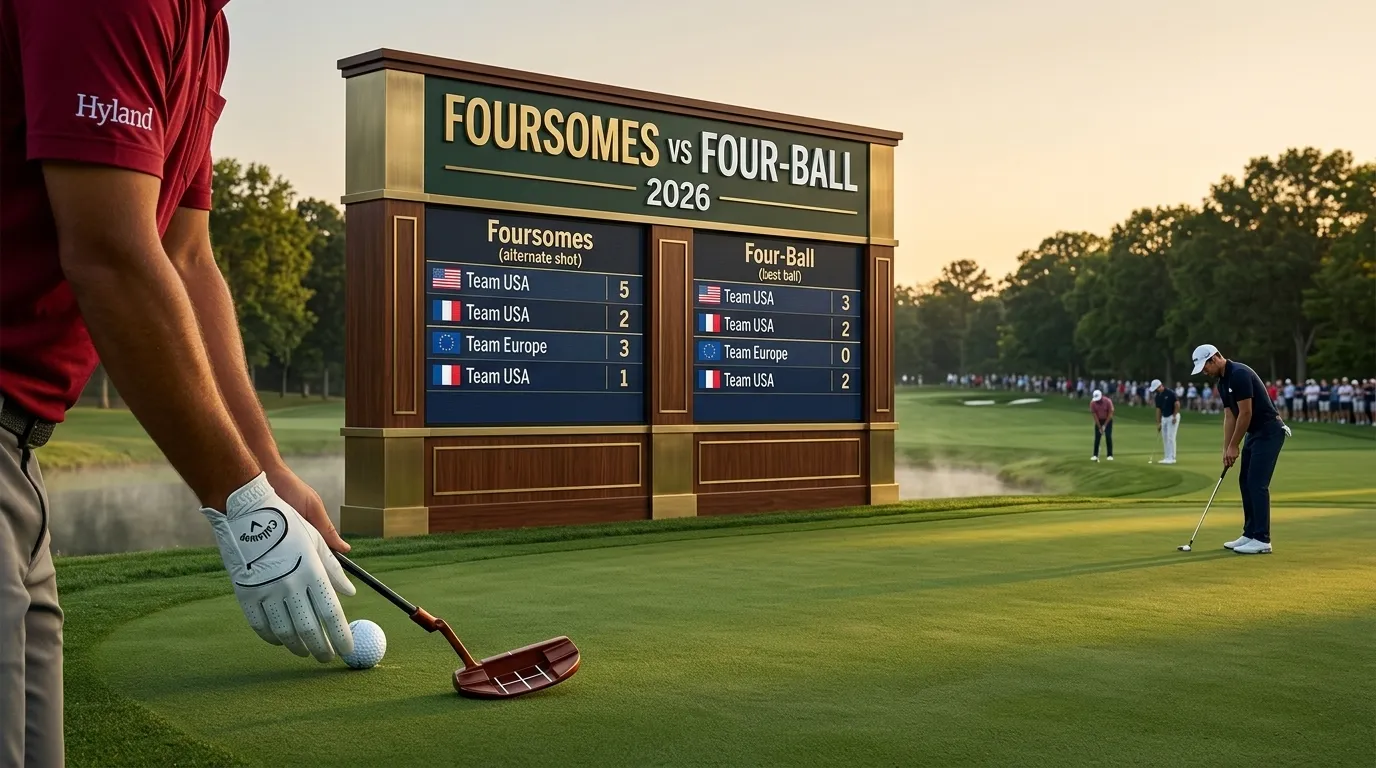
Quick Answer: Foursomes (alternate shot) has two partners share one ball, taking turns on every stroke, including the tee shot. Four-ball (best ball) has all four players in a group play their own ball, with each team counting only its lower score per hole. Foursomes punishes mistakes. Four-ball forgives them.
My club’s member-guest runs foursomes on Saturday morning and four-ball on Saturday afternoon, and I’ve played both every year since I got down to a 9-handicap. Two summers ago I chunked a approach into the front bunker on the 5th hole during our foursomes match, and that mistake cost my partner and me the hole outright. Twenty minutes later, in the four-ball match, I hit nearly the same shot into the same bunker. My partner made par anyway, and we halved the hole without anyone mentioning my bunker shot at the 19th.
Same swing, same bunker, completely different outcome. That’s the whole difference between these two formats in one sentence, and it’s why so many golfers still mix them up before every Ryder Cup.
Foursomes vs. Four-Ball at a Glance
Both formats pair two golfers against another two-golfer team, and both show up constantly in the Ryder Cup, the Presidents Cup, and the Solheim Cup. The similarities stop there. The actual difference between fourball and foursomes in golf comes down to one number, how many balls hit the fairway, and that single number changes how you calculate your handicap, how much pressure sits on each shot, and how fast your group can play. If you’ve searched golf foursomes vs four ball looking for a straight answer, that’s it.
| Fact | Foursomes (Alternate Shot) | Four-Ball (Best Ball) |
|---|---|---|
| Balls in play per hole | 1 per team, 2 total | 1 per player, 4 total |
| Who hits each shot | Partners alternate every stroke | Each player plays their own ball start to finish |
| Tee-off order | One partner tees off odd holes, the other even holes | Either partner can tee off, in any order |
| Team score per hole | The single ball’s score | The lower of the two partners’ scores |
| Handicap allocation | 50% of combined course handicaps | Each player gets 90% of their handicap difference to the group’s lowest |
| Pressure per shot | High. One bad swing costs the team the hole. | Lower. A partner’s good hole cancels out a bad one. |
| Best suited to | Two players who trust each other’s swing under pressure | Two players with very different handicaps or one aggressive, one steady player |
Nothing in that pressure or pairing-strategy column shows up in any golf publication currently ranking for foursomes vs four ball, and it’s the part that actually changes how you should pick your partner.
How Foursomes (Alternate Shot) Actually Works
Foursomes only needs two golf balls for four players, and that single detail changes every decision you make on the course.
- Decide who tees off on odd-numbered holes and who takes the even-numbered holes. This order locks in for the whole round.
- The designated player hits the tee shot. Their partner plays the second shot from wherever that ball ends up, good or bad.
- Partners keep alternating strokes, including putts, until they hole the ball.
- Whoever isn’t hitting can still help. Lining up a putt, reading the green, or offering a yardage is fine. Hitting the ball out of turn isn’t, and it costs a two-stroke penalty in stroke play or loss of hole in match play.
- The team’s score for the hole is whatever that single ball’s total came to.
This format goes by “alternate shot” almost as often as “foursomes,” and both terms describe the same foursome golf format. A related but different setup called greensomes, or Scotch foursomes, has both partners tee off before picking the better drive and alternating shots from there. Greensomes shows up at some club events and the Bass Pro Shops Legends of Golf, but it isn’t what the Ryder Cup plays.
How Four-Ball (Best Ball) Actually Works
Four-ball flips the whole equation. It’s the more familiar four ball golf format for anyone who’s played a scramble before but never tried alternate shot, since everybody hits their own ball on every hole instead of hoarding strokes between two players.
- All four players in the match play their own ball from tee to green.
- Partners can play in whatever order suits the team, and one partner can go first even when it’s technically the other’s turn.
- Once both partners on a side have holed out (or picked up), the team compares their two scores.
- The lower score of the pair becomes the team’s score for that hole. The other player’s number doesn’t count for anything.
- Only one partner needs to finish a hole for the team to post a score. If your ball’s in a hazard and your partner already made birdie, pick up and move on.
This is what club golfers mean when they ask what is four ball match play, and the four ball stroke play rules work identically to what’s described above. The only difference between the two is how you decide a winner at the end: hole-by-hole margin in match play, total strokes across all 18 holes in stroke play.
Four-Ball vs Best Ball: You’re Not Choosing Between Two Formats
Here’s where a lot of searches go sideways. The moment someone types four ball vs best ball into a search bar, they’ve usually already noticed something doesn’t add up, and that’s because four-ball, best ball, and better ball are the same format wearing three different names. There’s no rules distinction to learn, no separate format to compare.
The USGA’s official rulebook calls it “Four-Ball” under Rule 23. American golfers say “best ball” almost as often, and British broadcasters lean on “better ball” or “fourball” as one word. Scorecards at your home club might use any of the three.
The confusion usually comes from a specific mix-up: fourball better ball involves two-person teams where only the lower score counts, while true best ball can also describe one golfer against a group of three, where you compare that single player’s score against the best score among the other three. Both use identical scoring logic. The team size is what changes, not the rules.
How Handicaps Work in Foursomes vs Four-Ball
I’ve seen more member-guest arguments start over handicap math than over actual rules disputes, so it’s worth getting the numbers right before you tee off.
In foursomes, a team’s combined handicap is 50% of the two partners’ added course handicaps. Say I’m carrying a 9 and my partner is a 15. Add those together for 24, then cut that in half, and our team plays off a 12.
It doesn’t matter which of us is actually swinging on a given hole. The team gets 12 strokes distributed across the card, full stop.
Four-ball works differently because both players need individual strokes to make the match fair. Each golfer gets 90% of the difference between their handicap and the lowest handicap in the group. If the lowest handicap in a four-ball match is a 4 and I’m a 9, the gap is 5 strokes, and I get 90% of that, so I play with roughly 4 or 5 strokes. My partner and I both keep our own adjusted numbers instead of splitting one team figure.
That 90% multiplier isn’t arbitrary. It accounts for the fact that only one score per team counts each hole, so full handicaps would hand out too much of an advantage to the higher-handicap pairing. For the full breakdown of how your Handicap Index converts into actual strokes on the card, our golf handicap guide walks through the math in more depth than fits here.
Foursomes vs Four-Ball at the Ryder Cup
The Ryder Cup is where most golf fans actually encounter these formats, and it’s worth knowing exactly how the sessions break down before the next one tees off.
The Friday foursomes vs four ball split is the first place most casual fans actually see both formats side by side, four foursomes matches and four four-ball matches, broken into a morning session and an afternoon session. That Ryder Cup foursomes format vs four ball breakdown repeats again on Saturday. Sunday is all singles, 12 matches, one per player.
Bethpage Black 2025: How the Formats Actually Played Out
At Bethpage Black in 2025, that structure produced some genuinely lopsided results. Ludvig Aberg and Matt Fitzpatrick won their Friday foursomes match 5&3 over Scottie Scheffler and Russell Henley, and Rory McIlroy and Tommy Fleetwood beat Collin Morikawa and Harris English 5&4 in the same session.
That “5&3” notation just means the winning team was 5 holes ahead with only 3 holes left to play, so the match ended early. It’s the same shorthand behind the “what does 4 and 3 mean in foursomes” question you’ll see floating around, and it applies to four-ball scoring too, not just foursomes.
Four-ball sessions at Bethpage told a different story. Sam Burns and Patrick Cantlay tied their match against Rory McIlroy and Shane Lowry, and Tommy Fleetwood and Justin Rose needed all 18 holes to close out a 1-up win. Four-ball matches run tighter on average because a mediocre hole from one partner rarely sinks the team, so the scoreboard stays close longer than it does in foursomes. Europe won that 2025 Ryder Cup 15-13 at Bethpage, its first road victory since 2012, after building a seven-point cushion through the foursomes and four-ball sessions before the U.S. team mounted a furious singles comeback that fell just short.
One thing worth knowing if you’re planning around the next one: there’s no Ryder Cup in 2026. The 2027 edition moves to Adare Manor in Ireland, running September 17 to 19, after organizers originally slated the event for 2026. If you’re searching for foursomes vs fourball Ryder Cup content expecting a 2026 event, that’s the reason you won’t find one on the calendar this year.
Four-Ball vs Foursomes at the Presidents Cup
The Presidents Cup runs a slightly different session structure than the Ryder Cup, and it’s the format the “four ball vs foursomes presidents cup” searches are usually hunting for.
The 2026 Presidents Cup takes place September 24 to 27 at Medinah Country Club outside Chicago. Thursday opens with five matches, and the home captain picks whether that session plays foursomes or four-ball. Friday flips to whichever format the captain didn’t choose on Thursday, again five matches. Saturday splits the difference with four foursomes matches and four four-ball matches. Sunday closes with all 12 players going out in singles. That’s 30 total points on offer across the week, with 15.5 needed to win outright.
Giving the home captain first choice on Thursday’s format is a wrinkle the Ryder Cup doesn’t have, and it matters more than it sounds. A captain sitting on a deep bench of steady ball-strikers who trust each other under pressure will usually open with foursomes to bank points early. A captain with more individually explosive players tends to lean four-ball first, betting on low individual scores canceling out any rough patches.
The One PGA Tour Event That Uses Both Formats
If you want to see exactly how differently these two formats play, the Zurich Classic of New Orleans hands you the proof every spring. It’s the only team event on the PGA Tour, and its 72-hole format alternates fourball and foursomes round by round, best ball on Thursday and Saturday, alternate shot on Friday and Sunday.
At the 2026 edition, Matt and Alex Fitzpatrick shot a tournament-record 15-under 57 during Saturday’s fourball round. One day later, playing foursomes, that same pair could only manage a 1-under 71, and they needed a birdie on the 72nd hole just to hold off two chasing teams and win by a single shot at 31-under 257. Same two players, same golf course, a 14-shot swing in scoring average between the two formats in back-to-back rounds. That gap is the entire foursomes vs four-ball argument condensed into one weekend, and no other source covering this topic points to it.
Four-Ball vs Scramble: Don’t Mix These Up
Golfers tend to lump four-ball, foursomes, greensomes, and scramble together under one banner, “team golf formats,” but only two of them are actually related. The four ball vs scramble comparison trips people up more than any other format question on this list.
A scramble has every player on the team, usually four, tee off on each hole. The team picks whichever drive it likes best, and everybody then plays their next shot from that exact spot. This repeats shot after shot until the team holes out, so the whole team is always playing one collective ball together rather than splitting into pairs. That’s the direct answer to “is four ball a scramble”: no, it isn’t. Four-ball keeps every player’s ball in play independently for the whole hole. A scramble collapses everyone onto a single spot after every stroke.
| Format | Balls in play | Who decides the next shot | Skill exposed |
|---|---|---|---|
| Four-Ball (best ball) | 4, one per player | Each player plays their own | Full individual skill for both partners |
| Foursomes (alternate shot) | 2, one per team | Whoever’s turn it is in the rotation | Combined, alternating skill |
| Scramble | 1, one per team of 4 | Team picks the best shot each time | Mostly the best player’s shot-making |
| Greensomes | 2, one per team | Both tee off, then alternate from the better drive | Blend of best-drive plus alternating skill |
If your club runs a charity scramble every summer, that’s a completely different animal from the four-ball or foursomes matches you’d see at a Ryder Cup broadcast, even though casual golfers use all four terms loosely in the same conversation.
Which Format Should You Play This Weekend?
If you’re setting up your own money game or a member-guest pairing, the format you pick should match who you’re playing with.
Foursomes is the better choice when both players have compatible swings and can stomach watching their partner’s mistake become their own problem. It’s also the faster format. Only two balls means less time hunting in the rough, which matters if your group is chasing tee times behind you.
Four-ball is the more forgiving option, and it’s the one I’d recommend for a mixed-skill pairing, like a low single-digit playing with a mid-20s handicap. The higher-handicap player gets real strokes and a real chance to contribute without needing to save every hole. If you’re building pairings and want a rough sense of who hits it how far before you commit to a format, our club distance chart by skill level is a decent starting point for matching up complementary games.
Honest limitation here: foursomes isn’t for every partnership. If you and your regular playing partner have wildly different tempos, wildly different miss patterns, or you just don’t trust each other’s swing under pressure yet, four-ball will make for a far more enjoyable round. Save foursomes for a partner you’ve actually played a full season with.
One more practical note if you’re playing foursomes, since partners technically share responsibility for a single ball: check whose ball you’re using before you tee off, and confirm it’s USGA conforming if the event has any handicap or prize implications. Most club events don’t police this closely, but it has come up in more serious member-guests than you’d expect.
Frequently Asked Questions
Do both players tee off in foursomes?
No. Only one partner tees off on any given hole. The two partners lock in that order before the round starts: one takes all odd-numbered holes, the other takes all even-numbered holes, and it holds for all 18 holes.
How do the foursomes work in the Ryder Cup?
Teams play four foursomes matches each on Friday and Saturday, split into morning and afternoon sessions alongside four four-ball matches. Partners alternate shots on a single ball exactly as they would in any foursomes match, with the winning team earning one point and a halved match splitting the point in two.
What does 4 and 3 mean in foursomes?
It’s match play shorthand for the margin of victory. A team that wins “4 and 3” was 4 holes ahead with only 3 holes left to play, which mathematically ends the match early since the trailing team can’t catch up. You’ll see this same notation in four-ball, singles, or any match play format, not just foursomes.
Why is golf played in foursomes?
Foursomes tests teamwork and composure under pressure in a way stroke play never can. One partner’s mistake instantly becomes the other’s problem to fix, which forces genuine communication about club selection, target lines, and pace. That’s exactly why the Ryder Cup, Presidents Cup, and Solheim Cup all lean on it as a format, it rewards partnerships, not just individual scoring.
Bottom Line
Foursomes and four-ball ask two golfers to solve completely different problems. One shares a single ball and a single fate. The other lets both players swing free and takes the better result. Once you’ve played both formats in the same afternoon like I have, the difference stops being a trivia question and starts being obvious after your first tee shot. If you’re building out your own match play knowledge before your next member-guest, our golf handicap guide is the natural next stop for getting your strokes calculated correctly before you argue about it on the first tee.