
Quick Answer: Gross score is every stroke you took, penalties included, with nothing subtracted. Net score is that same total minus your course handicap, the number that lets a 22-handicap and a 4-handicap chase the same trophy. Shoot 89 with a 14 handicap and your net score is 75. Most clubs award separate prizes for both. That’s not a mistake. It’s the entire point.
I shot 89 last October at my home course, a tight little track where nine of eighteen greens slope straight toward water. My gross score was 89. And my handicap was 14. My net score was 75, and it won the B-flight of our club’s fall net tournament by two strokes over a guy who carded 99 with a 22 handicap.
He shook my hand, then asked why his 99 counted for anything against my 89. That question is the entire net vs gross golf score debate in one sentence.
Gross and net aren’t two ways of writing the same number. They answer two different questions. Gross asks what you actually shot. Net asks how that compares to what your handicap says you should shoot.
Confuse the two and you’ll spend your whole round arguing about who actually won. The gross vs net golf split shows up everywhere once you know to look for it, from your Saturday foursome to the U.S. Open leaderboard.
What Is a Gross Score in Golf?
Your gross score is the total number of strokes it took you to finish the round. Every swing counts. Every penalty stroke counts. You subtract nothing from it, ever.
Add up every stroke across all 18 holes, penalties included, and you have your gross score. A gross 89 means you moved the ball 89 times, nothing more. There’s no adjustment for course difficulty, your skill level, or the plugged lie you caught in the bunker on 14.
Gross score is the only number that exists in professional golf. A PGA Tour pro doesn’t carry a handicap, so when someone shoots 66 on Tour, that’s the entire story, gross and only gross. The rules also let you submit just your gross score to your official handicap record. Whatever lands on your card before any subtraction happens is what the World Handicap System actually sees.
What Is a Net Score in Golf, and How Do You Calculate It?
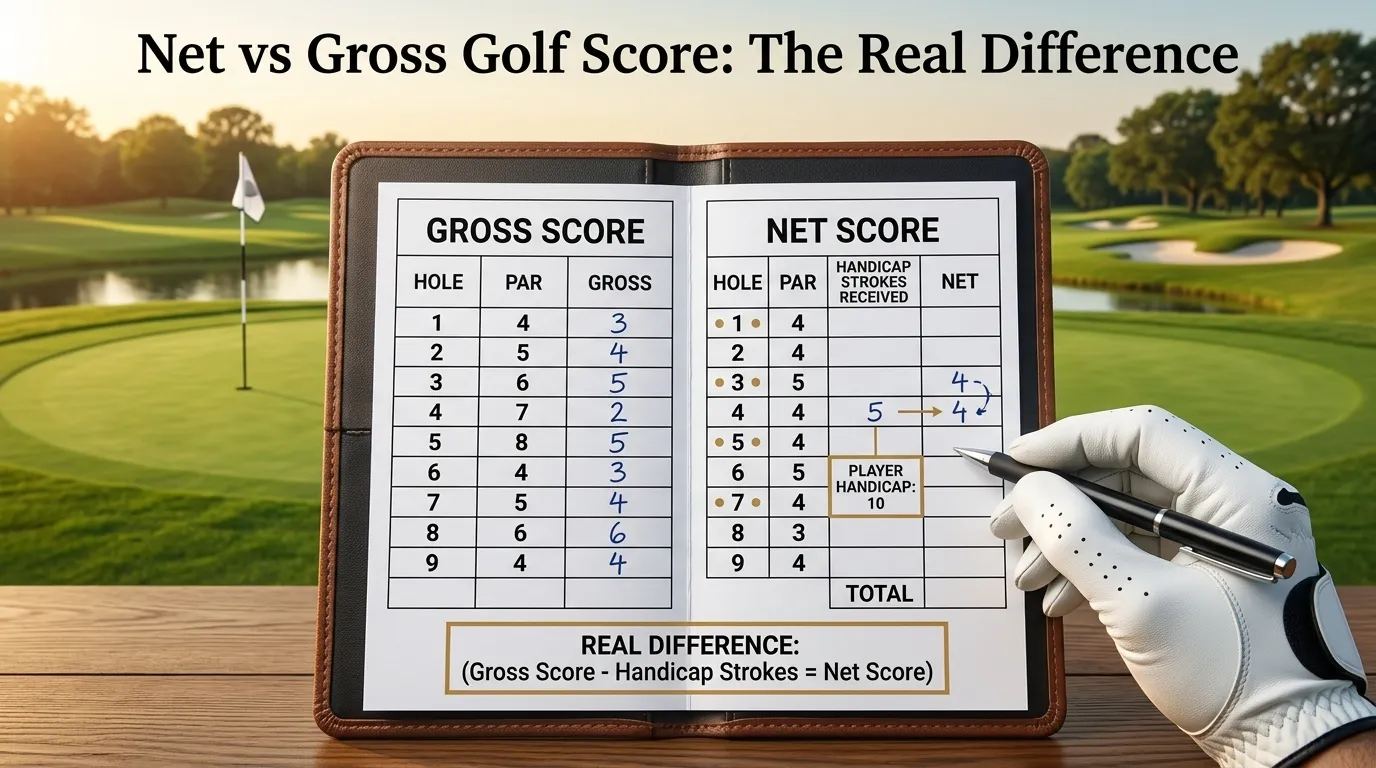
Here’s how gross score and net score actually differ, boiled down to one subtraction. Net score takes your gross score and subtracts your handicap. That single subtraction is the reason net scoring exists at all, so golfers of wildly different abilities can compete on the same leaderboard.
The Net Golf Score Calculator: 3 Steps, No App Needed
Net score = Gross score − Course Handicap
Every net score golf conversation starts with that one line. Nothing hides behind it. Three steps get you there:
- Find your Course Handicap for the tees you played, not your Handicap Index. They’re different numbers, and the difference matters more than most golfers realize.
- Play the round and total every stroke, including penalties. That’s your gross score.
- Subtract your Course Handicap from your gross score. What’s left is your net score.
Here’s my own scorecard from that October round. Gross 89, Course Handicap 14, net score 89 minus 14, which is 75. My buddy Dave, a 6-handicap, shot 82 that same afternoon. His net score was 82 minus 6, which is 76.
He beat my gross score by seven strokes. I beat his net score by one. Both of us were right about who played better that day. We just meant different things by “better.”
Net vs Gross Golf Score Chart: What Each Handicap Typically Shoots
This is the chart most articles on this topic skip, and it’s the one that actually makes the whole system click. Below is what a typical round looks like at each handicap level on a par-72 course of average difficulty, gross and net side by side.
| Handicap | Typical Gross Score | Typical Net Score |
|---|---|---|
| 0 (scratch) | 72–75 | 72–75 |
| 5 | 77–80 | 72–75 |
| 10 | 82–86 | 72–76 |
| 15 | 87–91 | 72–76 |
| 20 | 92–97 | 72–77 |
| 25 | 98–102 | 73–77 |
| 30 | 103–107 | 73–77 |
Look at the net column. It barely moves. A scratch golfer and a 30-handicap post wildly different gross scores, and their net scores land within a few strokes of each other.
That’s not a coincidence. That’s the handicap system doing its job.
These ranges shift with the slope rating of the course you’re playing, and a rough day can blow past any of them. If you want the full breakdown by exact handicap number instead of five-stroke bands, our average score by handicap chart lays it out in more detail.
Course Handicap vs Handicap Index: The Number You Actually Subtract
Every net vs gross golf score handicap conversation eventually comes back to one question: which handicap number are you actually subtracting? Here’s where a lot of golfers trip up, including a version of me a few years back who argued with a tournament committee over this exact point. The number on your phone or your federation card is your Handicap Index, a portable number that follows you to every course you play.
Your Course Handicap is different. It translates your Index to the specific tees you’re playing that day, and it changes every time you switch tee boxes.
The formula behind it:
Course Handicap = Handicap Index × (Slope Rating ÷ 113) + (Course Rating − Par).
My own Index is 14.2. From the white tees at my home course, slope 126 and rating 71.0, that works out to a Course Handicap of 15. Move back to the tips, slope 132 and rating 72.5, and the same 14.2 Index becomes a Course Handicap of 17.
Same golfer, same swing, same Index. Two different numbers to subtract, purely because the tees changed. Whenever you subtract a handicap from a gross score, make sure it’s the Course Handicap for the tees you actually played, not the Index sitting in your golf app.
Where Your Strokes Actually Go: The Stroke Index
Net scoring gets one more layer once you leave simple stroke play math and start applying strokes hole by hole, which matters in match play and net Stableford. Every scorecard ranks its 18 holes by difficulty under a row called the stroke index, with 1 marking the hardest hole and 18 the easiest.
If your Course Handicap is 14, you get a stroke on the 14 hardest holes, meaning everything ranked stroke index 1 through 14. Carry a Course Handicap over 18 and you get a stroke on every hole, plus a second stroke on your hardest holes once you pass 18.
On my home course, the 3rd hole is a long par 5 rated stroke index 1, the toughest hole on the card. With my 14 handicap, I get a stroke there. Last October I made a 7 on that hole.
Gross, that’s a double bogey. Net, subtract my one stroke and it becomes a 6, a net par. That single stroke turned a bad hole into a non-event on my card.
Net vs Gross in Tournaments: Why Some Events Crown Two Winners
Most amateur tournaments run two parallel competitions off the same round of golf. Low gross rewards whoever actually shot the lowest number, full stop, no adjustments. Low net rewards whoever played the furthest above their own handicap that day.
That’s why a 22-handicap and a scratch golfer can walk off the same course with trophies from the same event. They didn’t tie. They won different questions.
Club championships, state qualifiers, and USGA events tend to run gross only, since those fields already skew toward low-handicap players, where a level field isn’t really the point. Weekend member events, charity scrambles, and most flighted club tournaments run net, or both. Either way, that’s the net vs gross golf score split showing up right there on the same leaderboard.
Match play changes the math again, since you score it hole by hole instead of totaling everything at the end. If you want the full rundown on how that format compares to stroke play scoring, our guide to match play vs stroke play covers it in detail.
Gross vs Net Skins: How Side Games Change the Math
Skins games run on the same gross-versus-net split, and almost nobody explains it clearly. In gross skins, the lowest actual score on a hole wins the skin, no handicaps involved. In net skins, you apply strokes first and then compare, which means the low handicapper in your group might not win a single hole all day.
Say four of us are playing $5 net skins with handicaps of 2, 9, 14, and 24. On a hole rated stroke index 5, the 24-handicap gets a stroke and the 2-handicap doesn’t. If the 2-handicap makes a 4 and the 24-handicap makes a 5, their net scores tie at 4, and the skin carries to the next hole.
Our Saturday group has run net skins for years because our handicaps stretch from single digits to the mid-20s, and gross skins would hand the pot to the same one or two players every week. If your group is tightly bunched within four or five strokes of each other, gross skins is simpler and honestly more fun. For the full rules on carryovers and payouts, see our guide to how skins works.
“Net” or “Nett”? Why the Spelling Changes Depending on Where You Play
If you golf outside North America, you’ve probably noticed the same number spelled differently. Tournament results out of the UK, Australia, and clubs across Southeast Asia, including Sri Lanka and Malaysia, routinely print “Nett” with a double T instead of “Net.” Gulf clubs in the UAE do the same.
Both spellings describe the exact identical calculation, gross score minus handicap strokes. Nothing about the math changes, only the spelling on the scoreboard. If you’re reading results from a club overseas and spot “Gross” and “Nett” side by side, you’re looking at precisely the same two numbers this entire article covers.
Gross or Net, Which Should You Actually Care About?
Honestly, the net vs gross golf score question comes down to your handicap, and I’ll give you my real opinion instead of dodging it. If you’re a single-digit player chasing a state amateur qualifier, gross is the only number that matters, and net is basically decoration on your scorecard.
For the other 90 percent of us who play weekend club events, net is the more honest measure of whether you actually played well. A net 74 on a rough day tells you more about your game than a gross 91 does on its own.
Here’s the honest limitation nobody puts in these articles. If you don’t have an established Course Handicap, net scoring means nothing for you. You can’t level a playing field with a number you don’t have, so post some scores and get an official handicap before you worry about any of this.
Frequently Asked Questions
What is net and gross in golf?
Gross is your raw stroke total for the round, penalties included, with no adjustments. Net is that same total minus your Course Handicap. Gross measures what happened. Net measures how it compares to your expected level.
What is net and gross score in golf?
Your gross score is every stroke you took on the course that day. Your net score takes that number and subtracts the strokes your Course Handicap allows, which is what most club tournaments actually use to decide a winner.
What is the difference between gross and net score in golf?
The difference is one subtraction. Gross is the untouched total on your card. Net is gross minus your Course Handicap, and the gap in gross score vs net score only grows as your handicap climbs.
Is 27 a bad handicap?
Not for a woman. The average female handicap sits around 27 to 28, so a 27 is right in the middle of the pack. For a man, it’s well above the average of roughly 14 to 15, putting you in the higher-handicap range rather than a bad one.
What’s my handicap if I shoot 82?
On a par-72 course of average difficulty, a typical round of 82 usually lines up with somewhere between a 6 and a 10 handicap, depending on the course rating and slope. Most published tables land closest to 8.
What is the difference between gross and net skins in golf?
Gross skins compares actual scores on each hole with no handicap involved. Net skins applies each player’s handicap strokes to the hole first, based on the stroke index, then compares the adjusted numbers to decide the winner.
What score would a 20 handicap shoot?
Data on typical rounds puts a 20 handicap’s average gross score around 94 on a par-72 course, with most rounds falling between 92 and 97. Breaking 90 is a genuine milestone at that level, not a routine outcome.
What is a good net score in golf?
Net par, meaning 72 on a standard course, is a strong day for any handicap level. Net scores in the low 70s win most weekend club events, and anything in the high 60s is usually good enough to top a full tournament field.
What is the average handicap for a 65 year old man?
The data here genuinely varies by source. Some handicap trackers put men in their 60s around 15, barely above the overall male average. Others that isolate golfers 65 and older show it closer to 18 to 20, since swing speed drops with age even as course management improves.
The Bottom Line
Gross is what you shot. Net is what you shot after your handicap gets to have its say. Neither number is more real than the other. They just answer different questions about the same round of golf.
Learn to read both off any scorecard and you’ll never again find yourself confused about who actually won the net vs gross golf score argument on your own 18th green. If you’re curious how this same gross-versus-net logic plays out under a completely different scoring system, our guide to match play vs stroke play is the natural next read.