
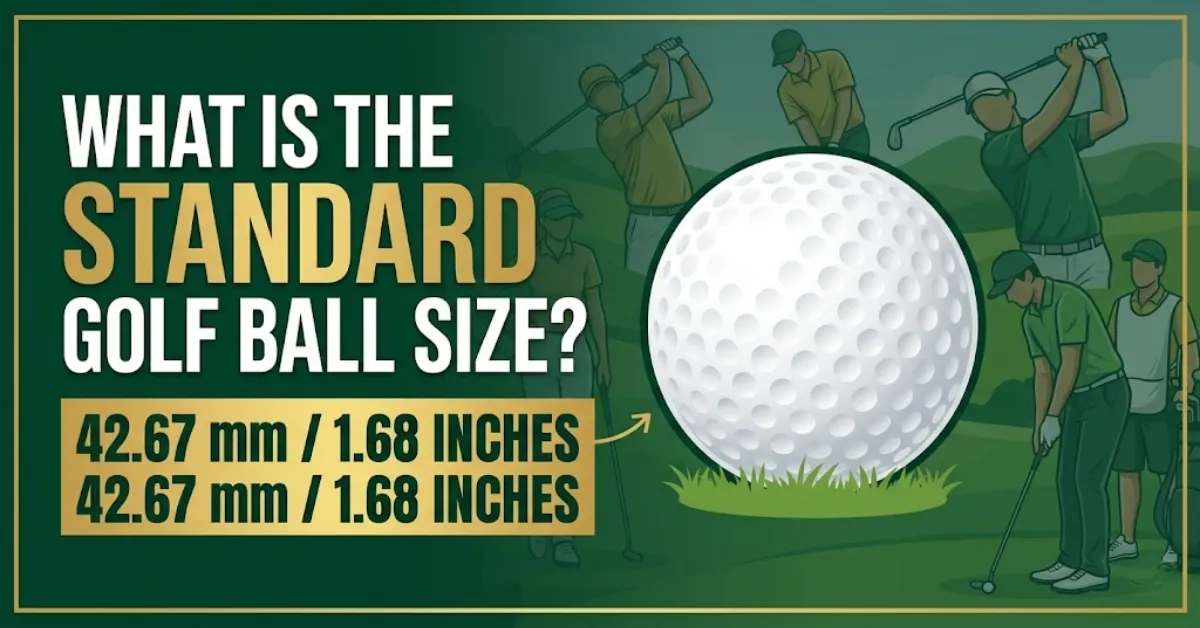
A regulation golf ball must be at least 1.68 inches (42.67 mm) in diameter and weigh no more than 1.62 oz (45.93 g). These standards have been jointly enforced by the USGA and the R&A since January 1, 1990 — and understanding them matters whether you are choosing a ball for a casual round or competing in a tournament where a non-conforming ball means instant disqualification.
In this guide, we’ll tell you everything you need to know about golf ball size. We’ll clear common misconceptions and explain why such a small ball is so carefully designed. Get ready to look at golf balls in a new way!
For example, did you know that a golf ball is approximately 1.68 inches in diameter? If it is smaller than that, it would be against the rules of the game. Likewise, its weight should not exceed 45.93 grams. These restrictions are in place to ensure that every player plays on the same terms.
So the next time you play golf, pay attention to this little ball—it could improve your game!
Golf Ball Size: Quick Reference
| Measurement | Value |
|---|---|
| Diameter (inches) | 1.68 in (minimum) |
| Diameter (mm) | 42.67 mm (minimum) |
| Diameter (cm) | 4.267 cm (minimum) |
| Circumference | 5.28 in / 134.05 mm |
| Weight (maximum) | 1.62 oz / 45.93 g |
| Volume | 40.68 cm³ |
All figures represent the USGA and R&A official standards. There is no maximum diameter — only a minimum.
The Evolution of Golf Ball Size: From British to American Standards
Golf clubs haven’t always been as big as they are today. Over the centuries, their size has undergone many changes. These changes have been due to changes in materials, manufacturing methods, and regional preferences. Let’s take a trip back in time to see how golf club sizes have changed.
(And to make this easier for you, think of it this way: the equipment people used in the past depended on what they had available. For example, early golf clubs were made from tree wood, and they were very different from today’s clubs.)
British Golf Ball: Where It All Began
When golf first began in England and Scotland, players often played on golf courses called links. At that time, they used hard wooden balls. But these balls were difficult to control, so in the 18th century, players began using a new type of ball called a “feathery.”
This feathery ball was much softer than a wooden ball because it was filled with feathers and covered with a leather-like material. But it was very expensive to make. Often, players would miss two or three balls in a round, which was a huge financial burden for them.
In addition, the feathery ball was not always round. So when the player hit it, they did not know where the ball would go — it was like a lottery!
Then players began using a new type of ball made from the sap of a special tree in Malaysia. It was called a “gutti.” This ball was easy to make, could be repaired if damaged, and was also very cheap. Thus, the ballast ball became an excellent solution for players.
American Golf Ball: A Step Toward Modern Standards
In the late 19th century, the introduction of the “gutta” ball was a big deal. The ball was made from a type of rubber called gutta-percha. By then, it was popular because it was cheaper to make and stronger. Before that, people used balls called featheries, which were slightly smaller than the ballast balls.
In the early 20th century, American companies began experimenting with standard ball sizes. These efforts led to the golf ball we use today. Not only was it more stable, but it was also better for playing.
Thus, the development of the golf ball made the game more fun and accessible.
Key Differences Between British and American Golf Balls
According to the rules of American golf, as set by the USGA (United States Golf Association), a golf ball must be 1.680 inches in diameter, and weigh no more than 1.620 ounces, or 45.93 grams. However, until the 1990s, the British body R&A (Royal and Ancient Golf Club) allowed the use of balls that were smaller than 1.68 inches. These smaller balls were called “British balls” by professional and amateur golfers.
In general terms, according to American rules, a golf ball must be within certain limits in size and weight. But in the UK, smaller balls were also used in the old days, which are no longer officially used. People called them “British balls” because they were something different and special.
In simple terms, the rules for golf balls used to vary from country to country, but now everyone follows the same rules.
Standard Golf Ball Size: What the USGA and R&A Rules Actually Say
Nowadays, the size and weight of a golf ball are very closely monitored. They are regulated by organizations such as the USGA (United States Golf Association) and the R&A (Royal and Ancient Golf Club of St. Andrews). The job of these organizations is to ensure that the balls used by professional players are of a standard. That is, the size, weight, and performance of the ball must comply with certain regulations.
Such rules are in place so that there is no unfairness in the game. If someone’s ball is too big or too small, its movement may also be different, which can destroy the spirit of the game. All these regulations are in place so that every player plays on the same level and no one takes advantage of it.
Did you know? The standard diameter of a golf ball is about 42.67 millimeters, and its weight should not exceed about 45.93 grams. Such specific rules make the game organized and interesting.
What is the Diameter and Weight of a Golf Ball?
To put it simply, according to government regulations, a golf ball must be at least 1.68 inches (4.27 cm) in size and weigh no more than 1.62 ounces (45.93 grams). This size makes the ball large enough to be easily visible during play and also has the right weight so that it can travel a long distance when hit.
The advantage of such a golf ball size and weight is that it is not only easy for the player to see but also allows him to reach the best distance when hitting it. All these rules are designed to ensure fairness in the game and equal opportunity for every player.
Let me also tell you that the structure and material of the golf ball also affect its flight. But I will try to explain this topic to you in detail later.
The Role of Dimples in Golf Ball Design
There is no rule about how many dimples (small bumps) a golf ball can have. However, the best and most popular golf balls on the market today usually have between 300 and 400 dimples.
There is no specific regulation on the number of dimples or their shape on a golf ball, but it is important that the dimple pattern and the structure of the golf ball meet the standards of the USGA (United States Golf Association). This way, the ball is legally fit for use in the game.
This means that it is good to keep these things in mind when you are playing golf, but not too much to worry about. Just make sure the ball is based on the correct rules!
Types of Golf Balls: Two-Piece, Three-Piece, and Multi-Layer Explained
Not all golf balls are created equal. Depending on your skill level and playing style, you might prefer a two-piece, three-piece, or multi-layer ball. Let’s break down the differences.
Two-Piece Golf Balls: Simplicity and Distance
Two-piece golf balls are the most commonly used type, especially among new players. These balls have two main parts: an inner, solid, flexible part that makes them strong, and an outer, hard core that gives them the ability to last longer. These balls are designed to travel as much distance as possible. This makes them ideal for players with a slower swing.
If you are a new player, these balls are a great choice to start with because they are easy to use and allow you to hit longer distances. In addition, these balls are more efficient and reliable, which makes playing golf more enjoyable.
Three-Piece Golf Balls: Control and Spin
A golf ball called a “three-piece” is preferred by most intermediate and expert players. This type of ball has three different layers: a hard outer layer, a soft middle layer, and a soft inner layer. All of these layers work together to give the player better control and the ability to earn more on the ball’s path.
For this reason, these balls are perfect for players who want to get the ball closer to the green with great precision. If you are a player who wants more control over your shot, this ball may be the best choice for you.
To understand more:
Generally, new players prefer balls that are easy to use, while experienced players prefer this type of “three-piece” balls because they allow them to play with more improvement. Thus, by adopting this ball, the player can take his game to new heights.
Multi-Layer Golf Balls: Advanced Performance
A golf ball with multiple layers provides a variety of benefits to professional players. These balls are designed to provide softness, spin control, and distance. Although all golf balls are the same size and weight — 1.68 inches (42.67 mm) in diameter and 45.93 grams (1.62 oz) in weight — their internal construction varies.
This type of ball has several small layers surrounding a small core. When the ball hits the club, these layers shape its flight, producing the best results for players. Top golfers like Rory McIlroy, Tiger Woods, and Bryson DeChambeau also use this type of ball.
Imagine how great old-time greats like Arnold Palmer or Jack Nicklaus would have been if they had this technology! Balls like this have redefined the game of golf.
What Makes a Golf Ball Illegal to Use in Competition?
Under the USGA rules of golf and R&A regulations, a golf ball is non-conforming — and therefore illegal in competition — if it fails any of the following tests:
| Rule | Requirement |
|---|---|
| Diameter | Must be at least 1.68 inches (42.67 mm) — smaller is illegal |
| Weight | Must not exceed 1.62 oz (45.93 g) — heavier is illegal |
| Symmetry | Must perform consistently regardless of how it is oriented |
| Initial velocity | Must not exceed the USGA velocity limit off the clubface |
| Overall distance | Must not exceed the USGA Overall Distance Standard (ODS) |
What happens if you use an illegal ball?
In stroke play: you are disqualified from the competition. In match play: you lose the hole on which the non-conforming ball was used.
The USGA publishes a Conforming Ball List that is updated regularly. Before using any ball in an official competition, players should verify their ball appears on this list. Most balls sold by major manufacturers at retail are conforming — the risk of an accidental illegal ball is low for recreational players, but high for competitors using older, damaged, or unofficial balls.
Is there a maximum size?
No. The rules specify only a minimum diameter. A ball larger than 1.68 inches is technically legal in terms of size — but it would generate more drag and fly shorter distances, so no manufacturer has any reason to make one.
Golf Ball Size in Inches, CM and MM: The Official Measurements
For easy reference, here’s a summary of golf ball size in centimeters and millimeters:
- Diameter: 4.27 cm (42.7 mm)
- Circumference: 13.42 cm (134.05 mm)
- Volume: 40.68 cm³
How Big Is a Golf Ball in Your Hand?
At 1.68 inches (42.67 mm) in diameter, a golf ball fits comfortably in the palm of most adult hands. To put the size in everyday context:
- A golf ball is roughly the same width as an average adult thumb
- Most adults can wrap their fingers just under halfway around the circumference
- It is slightly larger than a ping pong ball but noticeably smaller than a tennis ball
This compact size is not accidental. A golf ball needs to be small enough to fit into the 4.25-inch diameter hole — allowing enough clearance to drop cleanly — but large enough for a golfer to grip and place easily on a tee. The 1.68-inch standard achieves both.
Golf Ball Size vs. Ping Pong Ball, Tennis Ball and Baseball
At 1.68 inches (42.67 mm) in diameter, a golf ball is easy to hold in one hand but compact enough to disappear into rough or heavy grass. Here is how it compares to other common sports balls:
| Ball Type | Diameter (inches) | Diameter (mm) |
|---|---|---|
| Squash ball | 1.56–1.59 in | 39.5–40.5 mm |
| Ping pong ball | 1.57 in | 40 mm |
| Golf ball | 1.68 in | 42.67 mm |
| Racquetball | 2.25 in | 57 mm |
| Tennis ball | 2.57–2.70 in | 65.4–68.6 mm |
| Baseball | 2.86–2.94 in | 72.6–74.7 mm |
The golf ball is only slightly larger than a ping pong ball — a difference of just 2.67 mm in diameter. Despite their similar size, a golf ball is significantly heavier (45.93 g vs the 2.7 g of a ping pong ball) due to its dense rubber or resin core construction.
The golf ball is also notably smaller than a tennis ball or baseball, which is part of what makes finding a ball in the rough or in water a challenge — and why the regulations around minimum diameter exist.
How Golf Ball Size Affects Your Distance and Ball Flight
The 1.68-inch minimum was not chosen at random. There is a direct, measurable relationship between a golf ball’s diameter and how far and accurately it travels.
Why smaller balls fly farther
A smaller ball creates less aerodynamic drag as it moves through the air, which is why the old British 1.62-inch ball was known to fly slightly farther than the American 1.68-inch standard in calm conditions. When the USGA and R&A unified on the larger 1.68-inch size in 1990, they prioritised consistent, controllable performance across different weather and course conditions — rather than allowing manufacturers to chase maximum raw distance with a smaller ball.
Why manufacturers always aim for the minimum
Today, every major golf ball manufacturer designs their conforming balls as close to the 1.68-inch minimum as their production tolerances allow. Even a small increase beyond the minimum diameter increases drag and reduces carry distance, which is why you will never find a conforming ball noticeably larger than 1.68 inches.
Three ways diameter affects your game
Frequently Asked Questions About Golf Ball Size
Let’s address some of the most common questions about golf ball size, from its dimensions in centimeters to its weight and volume.
Are All Golf Balls the Same Size?
Yes — all golf balls used in official competition must conform to the same minimum standards: at least 1.68 inches (42.67 mm) in diameter and no more than 1.62 oz (45.93 g) in weight. These dimensions are set by the USGA and the Royal and Ancient Golf Club of St. Andrews (R&A). While balls can technically be larger than 1.68 inches and still conform, every major manufacturer targets the minimum diameter for optimal aerodynamic performance. So in practice, all commercially sold conforming golf balls are the same size.
When Did Golf Balls Change Size?
Golf ball sizes were standardised globally on January 1, 1990, when the USGA and the Royal and Ancient Golf Club of St. Andrews (R&A) agreed to adopt a single worldwide standard: a minimum diameter of 1.68 inches (42.67 mm). Before that date, the R&A still permitted the smaller British ball measuring 1.62 inches, which had been used in the UK and Europe for decades. The American 1.68-inch standard had been in place in the United States since 1931.
What Is the Size of a Golf Ball in Centimeters and Millimeters?
A standard golf ball has a diameter of 4.27 cm (42.7 mm) and a circumference of approximately 13.42 cm (134.2 mm). These measurements are consistent across all professional-grade balls.
How Much Does a Golf Ball Weigh?
The USGA and the R&A have come together to create a rule to keep golf ball weight within legal limits. Now, the maximum weight of a golf ball cannot exceed 1.62 ounces (45.93 grams).
A smaller ball that is slightly heavier can help stronger hitters travel longer distances.
(This means that golfers can still benefit from the weight of the ball, but within the rules!)
Why Is a Golf Hole 4.25 Inches in Diameter?
The size of a golf hole is directly related to the size of the ball. A 4.25-inch diameter provides enough space for the ball to fit comfortably while still presenting a challenge for players.
What Is the Volume of a Golf Ball?
The volume of a golf ball can be calculated using the formula for the volume of a sphere: V = (4/3)πr³. With a radius of 2.135 cm, the volume is approximately 40.68 cm³.
What Is the Circumference of a Golf Ball?
The circumference of a golf ball is approximately 13.42 cm (134.2 mm). This measurement is important for understanding how the ball interacts with the clubface and the air.
What is the difference in size between a golf ball and a ping pong ball?
A standard golf ball has a diameter of 42.67 mm (1.68 inches). A ping pong ball has a diameter of 40 mm (1.57 inches). That makes a golf ball approximately 2.67 mm — just over a tenth of an inch — larger than a ping pong ball. The two balls look very similar in size to the naked eye, but a golf ball is significantly heavier (45.93 g) compared to a ping pong ball (2.7 g), due to its dense rubber or resin core.
Can I use any golf ball in a USGA competition?
No. Only balls listed on the USGA Conforming Ball List are legal for use in official USGA competitions, as well as most amateur and professional tournaments. Manufacturers submit their balls for USGA testing, and only those that meet all size, weight, velocity, symmetry, and distance standards receive approval. Playing with a non-conforming ball in stroke play results in disqualification. Most balls sold by major manufacturers at retail are conforming, but it is the player’s responsibility to verify this before competing.
How does golf ball size affect distance?
A smaller ball creates less aerodynamic drag, which is why the old British 1.62-inch ball flew slightly farther than the American 1.68-inch standard in certain conditions. By unifying on the larger size in 1990, the USGA and R&A prioritised consistent performance over maximum raw distance. Today, manufacturers design their balls as close to the 1.68-inch minimum as possible, because even a small increase in diameter increases drag and reduces carry distance.
What golf ball size should a beginner use?
Any USGA-conforming ball at the standard 1.68-inch diameter is the right choice for a beginner. Within that category, beginners benefit most from a two-piece golf ball. It has a hard Surlyn cover, a large rubber core, and is designed to maximise distance and reduce the effects of mishits. Advanced balls — three-piece and multi-layer options — are engineered for spin control and feel around the greens, which requires a level of swing consistency that beginners are not yet in a position to take advantage of. See our guide to the best golf balls for beginners for specific recommendations.
Is there a maximum golf ball size?
No. USGA and R&A rules specify only a minimum diameter of 1.68 inches (42.67 mm) — there is no maximum size restriction. A ball larger than 1.68 inches would technically conform to the size rule (assuming it also passed weight, velocity, and symmetry tests). In practice, manufacturers never make balls larger than the minimum, because a larger ball generates more aerodynamic drag and flies shorter distances. The minimum is the sweet spot, and every conforming ball on the market is manufactured as close to it as possible.
Final Thoughts on Golf Ball Size
Golf ball size is one of the most precisely regulated elements in the game — and for good reason. The 1.68-inch minimum diameter, enforced jointly by the USGA and the Royal and Ancient Golf Club of St. Andrews (R&A) since 1990, exists to ensure fair competition, consistent performance, and predictable aerodynamics across every level of the game, from weekend rounds to major championships.
Now you know exactly what makes a golf ball legal, how those dimensions compare to other sports balls, and why size directly affects distance and ball flight. The next step is finding the right ball for your game. Check out our complete guide to the best golf balls for every skill level on Madknows — whether you are a beginner looking for maximum distance or an experienced player focused on spin control and feel, we cover every option in detail.