
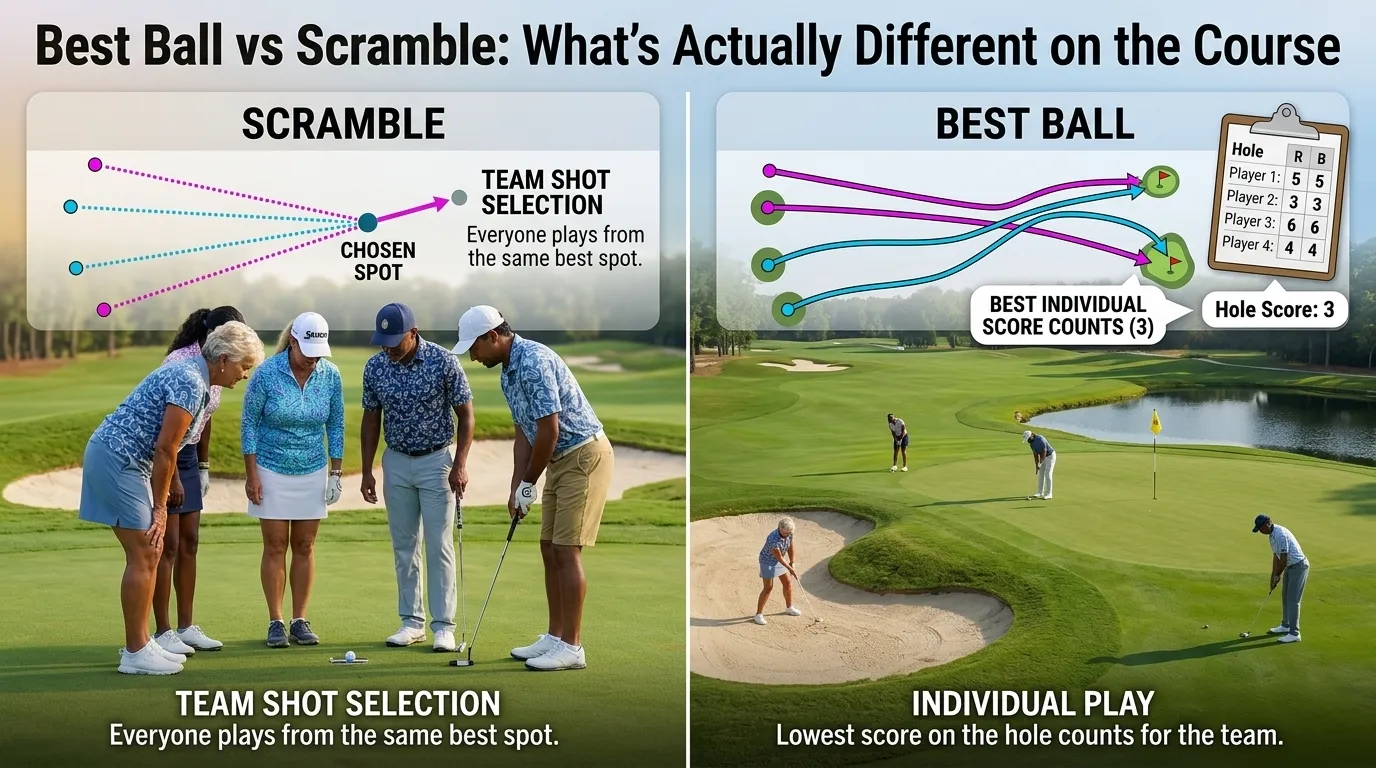
Quick Answer: In a scramble, everyone tees off, the team picks the single best shot, and everyone plays from there until the ball’s in the hole, for one team score. In best ball, everyone plays their own ball the whole way, and the lowest score counts. Scramble’s faster. Best ball counts toward your handicap.
I play to an 11 handicap, and I have three-putted my way through more scrambles than I can count.
I have also stood over a 4-footer in a member-guest best ball, needing to make it because my partner already had a bogey in the bag. Those are two completely different kinds of pressure.
A scramble hides your bad shots. Best ball makes you own every single one, then hands your good ones to the team. Below, you’ll find exactly how each format works, the USGA handicap percentages nobody else publishes, and where shamble, alternate shot, and simulator golf fit in.
Best Ball vs Scramble: The Fast Answer
Both are team formats, but the format you pick changes everything about pace, pressure, and who’s actually accountable for the score. Google auto-complete shows every version of this search, from “what’s best ball vs scramble” to “2v2 best ball vs scramble,” and they’re all asking the same three questions: who plays which ball, how does the score work, and which format should your group actually choose.
Here’s the side-by-side version, with two columns most comparison tables skip entirely.
| Feature | Scramble | Best Ball (Four-Ball) |
|---|---|---|
| How it’s played | Everyone tees off, the team plays the best shot, repeat until holed | Every player plays their own ball for the whole hole |
| Team score | One score per team, per hole | Lowest individual score on the team, per hole |
| USGA handicap allowance | 35% / 15% (2-man), 25% / 20% / 15% / 10% (4-man) | 85% of Course Handicap, every player |
| Posts to your Handicap Index | No | Yes |
| Typical team score, par 72, mid-handicap group | Low 60s to mid 60s | Low 70s to mid 70s |
| Best for | Charity events, large mixed-skill fields | Money games, member-guests, real competition |
| Pace of play | Faster, fewer total strokes struck | Slower, everyone finishes every hole |
How Best Ball Actually Works
Best ball vs scramble rules trip up more golfers than any other format pairing, mostly because they look identical for the first ten seconds before diverging completely. Best ball has zero shot selection. You just play your own ball, the way you would in a normal round.
- Every player tees off and plays their own ball for the entire hole.
- Each player finishes the hole and records their own gross score.
- The team compares scores. The lowest individual score becomes the team’s score for that hole.
- Repeat for all 18 holes, then add up the team’s low score from each hole for the final total.
Here’s how it plays out on an actual hole. Say you’re in a 2-man best ball with a buddy on a par-4 fourth hole. You make bogey, a 5. He sticks his approach to six feet and cards a birdie, a 3.
Your team’s score for the hole is 3. Your bogey never touches the scorecard.
I’ve watched this exact scenario from a fairway bunker. My ball sat buried in the sand while my partner’s approach trickled to three feet on the same hole. That’s best ball in one image.
His shot wins the hole. Nobody writes mine down anywhere that counts.
2-Man Best Ball vs 4-Man Best Ball
Two-man best ball is what you’ll find most often at private clubs and money games, since it’s simple to set up and easy to track. Four-man best ball uses the identical rule with twice the scores to compare on every hole, which usually drops a team’s final total by 3 to 5 strokes compared to the 2-man version. More players means more chances someone catches a good number.
If you’re setting up a 2-man best ball matchup for a member-guest, remember that only best ball posts to your Handicap Index. Add two more players for a 4-person team, and the call usually comes down to how many strong ball-strikers you’ve actually got in the group. Three shaky players and one steady one still gives that team a real shot on most holes.
How a Scramble Actually Works
A scramble strips out individual accountability almost entirely. Everyone contributes to the same ball, on the same shot, all day.
- Every player on the team tees off.
- The team picks the best drive among them.
- Everyone else drops within one club-length of that spot, no closer to the hole, and staying in the same type of grass. You can’t drop from the rough into the fairway.
- All players hit their next shot from that spot, and the team picks the best result again.
- Repeat until the ball’s in the hole. The team writes down one score for the hole.
I played in a work scramble two summers ago where our fourth guy, a first-timer who’d never broken 130, hit exactly one good shot all day. It was a 15-foot birdie putt on the 12th, and the rest of us stood around and watched it go in. That single putt was worth more to our team score than anything I did in four hours of golf. That’s the entire appeal of the format in one sentence.
Scoring, Pressure, and Pace: The Real Differences
This is where scramble and best ball actually diverge on your scorecard, not just in the rulebook.
Scoring. Scramble scores run dramatically lower because the team is always playing from its best position on the course. A mid-handicap scramble team commonly shoots 12 to 20 strokes under what any single player on that team would shoot alone. Best ball scores sit much closer to the low player’s individual round, usually just 3 to 6 strokes better, since a partner’s good shot typically rescues only one or two holes.
Pressure and accountability. A scramble spreads risk across the whole team. One bad shot vanishes the moment the team picks a teammate’s ball instead. Best ball keeps every shot on your personal card, even though only the low score counts toward the team total. You’ll know exactly how you played, whether the team needed it or not.
Pace. Scramble moves faster because the group hits fewer total shots. Best ball takes longer, especially with four players, since everyone plays out every hole to completion. Club selection matters more in best ball too, because you’re playing every shot yourself instead of bailing into a teammate’s good lie. If you don’t know your real numbers off each club, our golf club distance chart by handicap is worth checking before your next round.
A scramble is not real golf, and I say that as someone who has a great time playing them. You’re not managing your own round. You’re managing risk for a team, which is a completely different game.
Best Ball vs Scramble Handicap Rules (the Numbers Nobody Publishes)
Best ball vs scramble handicap allowances are where every other article on this topic goes vague. Here are the actual percentages.
| Format | Team Size | Handicap Allowance |
|---|---|---|
| Best ball (four-ball) | 2-person | 85% of each player’s Course Handicap |
| Scramble | 2-person | 35% low player, 15% high player |
| Scramble | 3-person | 30% / 20% / 10%, lowest to highest |
| Scramble | 4-person | 25% / 20% / 15% / 10%, lowest to highest |
Best ball is the only format here with one flat number. Under the World Handicap System, each player in a four-ball match takes 85 percent of their Course Handicap, and the USGA confirms that number in its official handicap FAQ. That’s down from the old split of 90 percent for men and 95 percent for women, which the USGA replaced when it standardized the allowance for all players under WHS.
Scramble handicaps scale with team size for a different reason. Add more players and you add more chances for someone to produce a good shot, so each individual’s strokes count for less. A 2-man team gets 35 percent of the low player’s handicap and 15 percent of the high player’s. Bump the team to four, and those numbers drop to 25/20/15/10, because a bigger team already has a built-in scoring advantage the handicap system has to correct for.
Tournament committees can change every number on this list. The USGA publishes these as recommended allowances, not a required rule, and plenty of committees adjust them based on their field. If your pairing sheet lists a different percentage, use that one. The committee running your event always has the final say.
If you don’t know how to calculate your own Course Handicap in the first place, our full breakdown of what a golf handicap means walks through the exact math.
Best Ball vs Scramble vs Shamble (and Alternate Shot)
The difference between best ball vs scramble comes down to one simple split. Best ball has you playing your own ball from the tee. A scramble keeps the team on one ball together, the whole way through. Shamble and alternate shot both borrow pieces of each.
| Format | Tee Shot | Rest of the Hole | Team Score |
|---|---|---|---|
| Scramble | Team picks the best drive | Everyone plays from that spot, every shot | One team score |
| Shamble | Team picks the best drive | Each player plays their own ball in from there | Lowest individual score |
| Best ball | Individual, no selection | Each player plays their own ball the whole hole | Lowest individual score |
| Alternate shot | Partners alternate who tees off | Partners alternate every shot on one shared ball | One shared score |
A shamble splits the difference between the other two formats. You get a scramble’s forgiving tee shot, since the team only plays from the best drive, but from the second shot on, you’re on your own ball, same as best ball. I’ve played it exactly once, at a charity event that called it a “scramble” on the flyer and then made everyone putt out individually, which is really a shamble wearing a scramble’s name tag. Handicap allowances run lower here too.
The commonly used guidance is 20 percent per player on a 2-person team and 6 to 8 percent per player on a 4-person team, since the shared drive already gives everyone a boost.
Once you throw alternate shot into the best ball vs scramble vs alternate shot conversation, the pressure curve changes completely. Alternate shot, which golfers call foursomes at the Ryder Cup, is the opposite of forgiving. Two players share one ball and swap every shot no matter who put it in trouble. If your partner drives it into a bunker, you’re the one hitting out of the sand, with no scramble-style mulligan coming.
Rory McIlroy and Tommy Fleetwood built one of the most dominant foursomes partnerships in Ryder Cup history around exactly that pressure, going unbeaten together in the format at Bethpage in 2025.
Best Ball vs Scramble on a Simulator (GSPro and 2v2 Leagues)
Indoor golf changes the math on both formats. If you searched gspro best ball vs scramble because you’re setting up a home sim league, here’s the short version. GSPro supports stroke play, scramble, best ball, alternate shot, and stableford natively, so the rules on screen match the rules on grass.
Scramble is the format you’ll see most in GSPro leagues, and it’s not close. A 2v2 scramble, meaning two teams of two competing head to head, moves fast because you’re only hitting the shots that matter. Nobody stands around waiting on a teammate to finish out a blown-up hole from the trees, because the team just skips that ball.
Best ball on a simulator solves the one problem it has outdoors: pace. On grass, a 4-man best ball can eat up five hours because every player finishes every hole. Indoors, there’s no walking between shots and no group ahead of you slowing things down. A 2v2 best ball round on GSPro typically wraps up in under two hours.
If your sim group is arguing over which format to run for a weekly league, I’d pick best ball over scramble every time. You get individual scores worth tracking against your own handicap, and the software does the math automatically.
Which Format Should You Play?
There’s no universal winner in the best ball vs scramble golf debate, only a better fit for your group. A best ball vs scramble golf tournament decision usually comes down to your field’s skill spread more than anything else.
| Your Situation | Play This |
|---|---|
| Charity tournament, corporate outing, mixed handicaps | Scramble |
| Money game or member-guest with two solid players | Best ball |
| Want a scramble tee shot with real scoring after | Shamble |
| Ryder Cup-style buddies trip, strong partner chemistry | Alternate shot |
| Tracking your Handicap Index | Best ball, the only one of the four that posts |
The PGA Tour runs on this same logic at the AT&T Pebble Beach Pro-Am, where the tournament pairs each pro with an amateur in a net best ball format. That setup lets one great hole from the professional partner carry a shaky amateur round, without needing the amateur to play four flawless days.
Best ball is not the right call for a group where three of your four players have never broken 110. You’ll sit through long stretches where nobody’s ball is in scoring position for the team, and that’s a rough way to spend five hours. Save best ball for players who can actually go the distance, and save scramble for everyone else.
Frequently Asked Questions
What is the difference between best ball and scramble?
In best ball, every player plays their own ball for the whole hole, and the team’s score is whoever shot the lowest. In a scramble, the team plays one ball, picking the best shot after every stroke, for one team score. That’s the entire best ball vs scramble difference. Best ball rewards individual consistency, and scramble rewards one great shot from anyone on the team.
What is the difference between best bowl and scramble?
“Best bowl” is almost always a typo or mishearing of “best ball.” Golf doesn’t have a separate format named best bowl. If that’s what brought you here, you’re looking for best ball, where each player plays their own ball and the low individual score counts for the team.
What is a marshmallow in golf?
It has nothing to do with best ball or scramble scoring. A marshmallow shows up at charity events as a novelty long-drive contest, where players swing at an actual marshmallow instead of a golf ball. You’ll also occasionally see it in a prank, where someone scatters marshmallows across a course to mess with players hunting for their real ball.
What is it called in golf when you play the best ball?
Golfers call it best ball, or four-ball in formal competition like the Ryder Cup. Some golfers say “better ball” instead, especially for the 2-player version. All three names describe the same format: everyone plays their own ball, and the lowest score on the team counts.
Best ball vs better ball vs scramble, what’s the difference?
Best ball and better ball are the same format wearing two different names. Scramble is the one that’s actually different, since it uses a single team ball instead of everyone playing their own.
Final Take
Pick scramble when the goal is fun for a big, mixed-skill group, and nobody wants a five-hour round of watching each other hit out of the rough. Pick best ball when you want your own round to matter and you’re playing with people who can go the distance. I play both most seasons, and neither one beats the other.
Before your next best ball match, our 7 wood vs 9 wood breakdown tackles another close call golfers argue about just as often.