
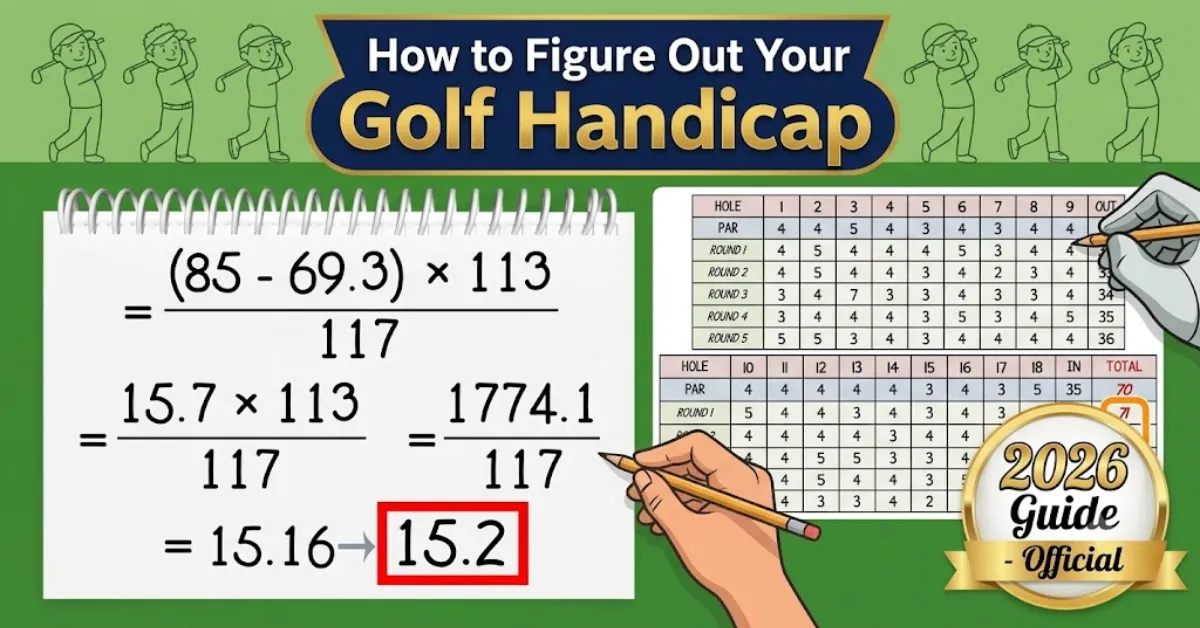
I remember standing in the pro shop at my local muni, staring at the handicap computer like it was written in ancient Greek. I’d been playing for six months, shooting somewhere in the 90s, and had no clue what my number was – or why I even needed one. Then I figured it out, got my first Handicap Index (28.4, if you’re curious), and watched it drop to 15.2 over the next season. This guide walks you through exactly what a handicap is, how to calculate it, and – most importantly – how to get one without pulling your hair out.
Quick Answer: A golf handicap (Handicap Index) measures your potential playing ability, not your average score. It’s calculated from your 8 best Score Differentials out of your last 20 rounds, using course difficulty ratings. You can establish one with as few as 54 holes (three 18-hole rounds or six 9-hole rounds).
What Is a Golf Handicap? (And Why It’s Not What You Think)
A golf handicap—officially called a Handicap Index—is a number that measures your potential ability on a course of standard difficulty. Notice I said “potential,” not “average.” That’s the single biggest misunderstanding about handicaps.
Most golfers think their handicap is what they typically shoot. It’s not. Your Handicap Index represents the score you’re capable of shooting on a good day, not what you shoot every Tuesday afternoon with your buddies.
Here’s what the numbers actually mean:
- Handicap Index 0 (scratch): You can play to par on any course. You’re the person everyone else is trying to beat.
- Handicap Index 1–9 (low): You’re a seriously good player. You break 80 regularly and probably play in amateur tournaments.
- Handicap Index 10–18 (mid): You’re the average dedicated golfer. You shoot in the 80s and low 90s, you’ve got a repeatable swing, and you know your misses.
- Handicap Index 19–36 (high): You’re still figuring things out. You break 100 sometimes, you’ve got a few good holes per round, and you’re having fun.
- Handicap Index 37–54 (maximum): You’re a beginner or a very casual player. The USGA set the maximum at 54.0 for all players in 2020 to make the game more inclusive.
The “Potential” Myth—Why Your Handicap Isn’t Your Average Score
Let me say this again because it’s that important: your Handicap Index is not your average score.
The system is designed to measure your best play, not your typical play. That’s why it uses your best 8 scores out of 20, not all 20. If you shoot 92, 88, 95, 91, and 84 over five rounds, your handicap is based on the 84 and 88—not the 95.
This is why “sandbagging” (deliberately posting bad scores to inflate your handicap) is such a big deal in tournament golf. A higher handicap means more strokes, which means an unfair advantage if you’re actually better than your number suggests.
What Handicap Numbers Actually Mean (0 to 54)
Your Handicap Index is expressed as a number with one decimal place—like 15.2 or 28.4. The lower the number, the better the player.
A golfer with a Handicap Index of 15.0 will generally shoot about 15 strokes higher than a scratch golfer on a course of standard difficulty. On a tougher course, that number might be higher. On an easier course, lower. That’s where Course Handicap comes in—which we’ll get to next.
Handicap Index vs. Course Handicap vs. Playing Handicap—The Three Numbers You Need to Know
This is where most beginners get lost. You’ll hear “handicap” thrown around like it means one thing, but there are actually three different numbers you need to understand.
| Term | What It Is | Example | When You Use It |
|---|---|---|---|
| Handicap Index | Your “raw” skill number, expressed with one decimal place | 15.2 | To track improvement, to calculate your Course Handicap |
| Course Handicap | Your Handicap Index adjusted for a specific course and tee set. Always a whole number. | 17 | Before a round—this tells you how many strokes you get |
| Playing Handicap | Your Course Handicap adjusted for competition format and allowances | 15 | In tournaments or matches with specific rules |
The Handicap Index—Your “Raw” Number
Your Handicap Index is the number that travels with you from course to course. It’s the only number that’s consistent regardless of where you play. Think of it as your “baseline” skill measurement.
You get this number by posting scores through an authorized golf association or app. It updates automatically as you post new rounds.
The Course Handicap—What You Actually Use on the Course
Here’s the formula:
Course Handicap = Handicap Index × (Slope Rating ÷ 113)
Let’s say your Handicap Index is 15.2 and you’re playing a course with a Slope Rating of 128 (moderately difficult).
15.2 × (128 ÷ 113) = 15.2 × 1.133 = 17.2 → rounded to 17
That means you get 17 strokes on that course from those tees. You’d subtract 17 from your gross score to get your net score.
If you played an easier course with a Slope Rating of 105:
15.2 × (105 ÷ 113) = 15.2 × 0.929 = 14.1 → rounded to 14
Same player, different course, different number of strokes. That’s the whole point of the system—it adjusts for course difficulty so you can compete fairly anywhere.
The Playing Handicap—For Competition Adjustments
Your Playing Handicap takes your Course Handicap and applies a handicap allowance based on the format of play. In a four-ball match, for example, you might only get 85% of your Course Handicap. In a stroke play competition, you might get 95%.
Most casual rounds use your full Course Handicap, so you don’t need to worry about this unless you’re playing in organized events.
How Is a Handicap Actually Calculated? (Step-by-Step with Real Numbers)
Now we get to the math. Don’t panic—it’s not as scary as it looks.
Step 1: Understanding Score Differentials
Every round you post gets converted into a Score Differential. This is the key adjustment that makes handicaps portable across different courses.
The formula:
Score Differential = (Adjusted Gross Score − Course Rating) × (113 ÷ Slope Rating)
Here’s what each part means:
- Adjusted Gross Score: Your actual score, adjusted for things like Net Double Bogey (more on that later)
- Course Rating: What a scratch golfer would shoot on that course from those tees (usually between 67–77)
- Slope Rating: How much harder the course is for a bogey golfer compared to a scratch golfer (ranges from 55–155, with 113 being average)
- 113: The standard Slope Rating for a course of average difficulty
Step 2: The Formula (With Real Numbers)
Let me walk you through a real example from my own scorecard.
I played my local course—let’s call it Oak Hills—from the white tees. Here’s what was on the card:
- Course Rating: 71.2
- Slope Rating: 124
- My score: 94
Plug those numbers in:
(94 − 71.2) × (113 ÷ 124) = 22.8 × 0.911 = 20.8
That 20.8 is my Score Differential for that round.
Now let’s say I played five more rounds and here were my Score Differentials:
| Round | Score | Course Rating | Slope Rating | Score Differential |
|---|---|---|---|---|
| 1 | 94 | 71.2 | 124 | 20.8 |
| 2 | 89 | 70.8 | 118 | 17.4 |
| 3 | 92 | 71.5 | 130 | 18.9 |
| 4 | 87 | 70.2 | 115 | 16.3 |
| 5 | 96 | 71.8 | 126 | 22.1 |
| 6 | 85 | 70.5 | 120 | 14.8 |
Step 3: The 8-of-20 Rule
Once you have 20 scores posted, your Handicap Index is the average of your 8 lowest Score Differentials.
With only 6 scores, you don’t have enough yet. The system needs at least 20 scores to use the full 8-of-20 calculation.
But here’s the good news: you can establish a Handicap Index with as few as 54 holes (three 18-hole rounds or six 9-hole rounds). With fewer than 20 scores, the system uses a reduced number of your best differentials:
Once you hit 20 scores, it’s always your 8 best out of the last 20.
Step 4: What About 9-Hole Scores?
Nine-hole scores count too—they just get combined into 18-hole equivalents.
When you post a 9-hole score, the system pairs it with another 9-hole score from a different round to create an 18-hole Score Differential.
The formula is the same, but you use the 9-hole Course Rating and Slope Rating (which are typically half of the 18-hole ratings).
How to Get a Golf Handicap (The Practical Path)
You don’t need to be a country club member to get a handicap. Here are your options.
Option 1: Join a Golf Club or Association
This is the traditional route. Join a club that’s affiliated with your regional golf association (like the USGA in the US, Golf Canada in Canada, or England Golf in the UK).
You’ll pay annual dues (typically $30–$100), get a GHIN number (in the US), and post scores through their app or website. Your handicap updates automatically.
- USGA route: Go to usga.org/getahandicap and sign up. You’ll become a member of your local Allied Golf Association.
- UK route: Join England Golf, Scottish Golf, or the GUI through your local club.
- Canada route: Join Golf Canada and get a handicap through their system.
Option 2: Use a Golf App
Several apps offer unofficial handicap tracking—and some now offer official USGA handicaps too.
18Birdies lets you track scores and gives you a handicap estimate. The Grint offers official USGA handicaps through their app. Golfshot and Hole19 also have tracking features.
The catch: not all app handicaps are “official.” If you want to play in tournaments or post scores that count toward an official Handicap Index, you need to go through an authorized association.
Option 3: Through Your Local Course
Many public courses have “eClub” memberships or associate memberships that include a handicap. You don’t need to be a full private member—just pay a small fee and get access to their handicap system.
The bottom line: You need to post at least 54 holes of acceptable scores (three 18s or six 9s) to establish your first Handicap Index. Once you’ve done that, keep posting scores—the more you post, the more accurate your handicap becomes.
What Does “Handicap” Mean on a Scorecard?
You know that row on the scorecard that says “Handicap” with numbers from 1 to 18? That’s the Stroke Index—and it has nothing to do with your Handicap Index.
The Stroke Index ranks the holes from hardest (1) to easiest (18). Hole 1 is the toughest hole on the course. Hole 18 is the easiest.
Here’s how you use it:
Let’s say your Course Handicap is 17. That means you get 17 strokes for the round. You look at the handicap row on the scorecard and take one stroke on the 17 hardest holes (holes ranked 1 through 17). You don’t take a stroke on hole 18 (the easiest hole).
If your Course Handicap is 22, you take one stroke on every hole (1–18), plus an extra stroke on the 4 hardest holes (1–4).
This is how you “apply” your handicap during a round to calculate your net score.
What’s a Good Golf Handicap? (And What Different Ranges Mean for Your Game)
“Good” is relative. Here’s what different handicap ranges actually look like on the course.
| Handicap Range | What It Looks Like | What You Shoot |
|---|---|---|
| 0–5 (Scratch to low) | You hit fairways and greens consistently. You rarely have a truly bad hole. | 72–78 on a par 72 |
| 6–10 (Low) | You’re a very solid player. You might miss a few greens, but you get up and down. | 78–84 |
| 11–15 (Mid-low) | You hit some good shots and some bad ones. You probably break 90 most rounds. | 84–90 |
| 16–20 (Mid) | You’re the average weekend warrior. You have a few blow-up holes per round. | 88–94 |
| 21–30 (High) | You’re still learning. You might have a few pars but also some double bogeys. | 94–105 |
| 31–54 (Maximum) | Beginner or very casual player. The goal is to have fun and keep the ball in play. | 105+ |
My take: If you’re a beginner, don’t worry about your handicap number. Just play, have fun, and post your scores. The number will come down naturally as you improve. I started at 28.4 and dropped to 15.2 in one season—not because I was grinding, but because I was playing consistently and learning my game.
The honest truth: if you’re a beginner who plays twice a month, your handicap is going to be high, and that’s fine. The handicap system exists so you can compete fairly with better players, not to make you feel bad about your game.
2024 World Handicap System Changes You Need to Know
The USGA and R&A announced several updates that went into effect in January 2024. Here’s what changed:
1. Shorter Courses Now Get Ratings
Courses as short as 1,500 yards (for 18 holes) can now receive official Course Ratings and Slope Ratings. This means more courses—especially par-3 and executive courses—can be used for handicap purposes.
2. 9-Hole Scores Get Better Treatment
Previously, 9-hole scores were combined in a specific way that sometimes created odd results. The 2024 update streamlined how 9-hole scores are handled, making it easier to post them and get accurate handicaps.
3. New Approach for Holes Not Played
If you don’t finish a hole—for weather, darkness, or any other reason—there’s now a more consistent method for calculating your score for handicap purposes.
The key change: you use your net par for the hole (par plus any strokes you would receive on that hole), rather than the previous system which had different rules for different situations.
These changes make the World Handicap System more inclusive and accessible—especially for casual golfers and beginners.
What Your Handicap Actually Tells You About Your Game
Here’s something nobody told me when I started: your handicap isn’t just a number to brag about (or hide). It tells you specific things about your game.
Your handicap tells you how consistent you are. If your handicap is stable (it doesn’t move much from month to month), you’re a consistent player. If it bounces around, you’re streaky—you shoot 85 one week and 100 the next.
Your handicap tells you where you need to improve. Look at your Score Differentials. Are they all over the place? You’re inconsistent. Are they clustered together? You’re consistent but need to work on something specific—maybe short game or driving accuracy.
Your handicap tells you when you’re getting better. Watching your Handicap Index drop is one of the most satisfying feelings in golf. Every 0.1 drop means you’re improving. When mine went from 28.4 to 15.2, I could feel the difference on the course. I wasn’t just scoring better—I was playing better golf.
Here’s what I learned from my own handicap journey: When I stopped worrying about my score and started worrying about my process, my handicap dropped faster. I stopped trying to “shoot a number” and started trying to hit good shots. The number took care of itself.
Frequently Asked Questions
What is handicap in golf?
A golf handicap is a numerical measure of a golfer’s playing ability that allows players of different skill levels to compete fairly against one another. It represents the number of strokes a player is expected to take above or below the course’s par score.
What is a golf handicap, and how is it calculated?
A golf handicap (Handicap Index) is calculated by averaging your 8 best Score Differentials out of your last 20 rounds. A Score Differential adjusts your score based on the Course Rating and Slope Rating of the course you played. You need a minimum of 54 holes (three 18s or six 9s) to establish a handicap.
What is a good golf handicap?
A “good” handicap depends on your skill level. For a beginner, anything under 30 is solid. For an average recreational golfer, 16–20 is typical. For a serious player, single digits (1–9) is excellent. Scratch (0) is elite.
How do I get a golf handicap?
You can get a handicap by joining a golf club or association (like the USGA), using a golf app with official handicap tracking, or signing up through your local course. You need to post at least 54 holes of acceptable scores to establish your first Handicap Index.
What does handicap mean on a scorecard?
The “handicap” row on a scorecard shows the Stroke Index—a ranking of holes from hardest (1) to easiest (18). This determines which holes you get strokes on based on your Course Handicap. If your Course Handicap is 17, you get one stroke on holes ranked 1 through 17.
What is the difference between handicap index and course handicap?
Your Handicap Index is your “raw” skill number (e.g., 15.2) that travels with you from course to course. Your Course Handicap is that number adjusted for a specific course and tee set using the Slope Rating. You use your Course Handicap on the course—it tells you how many strokes you get for that round.
How many rounds do you need for a handicap?
You need a minimum of 54 holes (three 18-hole rounds or six 9-hole rounds) to establish a Handicap Index. Once you have 20 scores posted, your handicap is calculated from your 8 best Score Differentials.
What does my handicap actually mean?
Your Handicap Index represents your potential playing ability—what you’re capable of shooting on a good day, not your average score. A handicap of 15.0 means you’d generally shoot about 15 strokes above a scratch golfer on a course of standard difficulty.
The Bottom Line on Figuring Out Your Handicap
Figuring out your golf handicap isn’t complicated – it just takes a few rounds of golf and a willingness to post your scores. Start by getting a GHIN number through the USGA or your local association, or use a reputable golf app. Post every round you play, even the bad ones – especially the bad ones. That’s the only way your handicap stays accurate.
And remember: your handicap is just a number. It doesn’t define you as a golfer. It’s a tool to help you compete fairly, track your improvement, and enjoy the game more. I went from 28.4 to 15.2 in a season, and the number that mattered most wasn’t the handicap itself – it was the fact that I was playing more golf and having more fun.
Want to track your improvement even more effectively? Check out our guide on the best golf apps for tracking your game in 2026 to find the right tool for your game.