
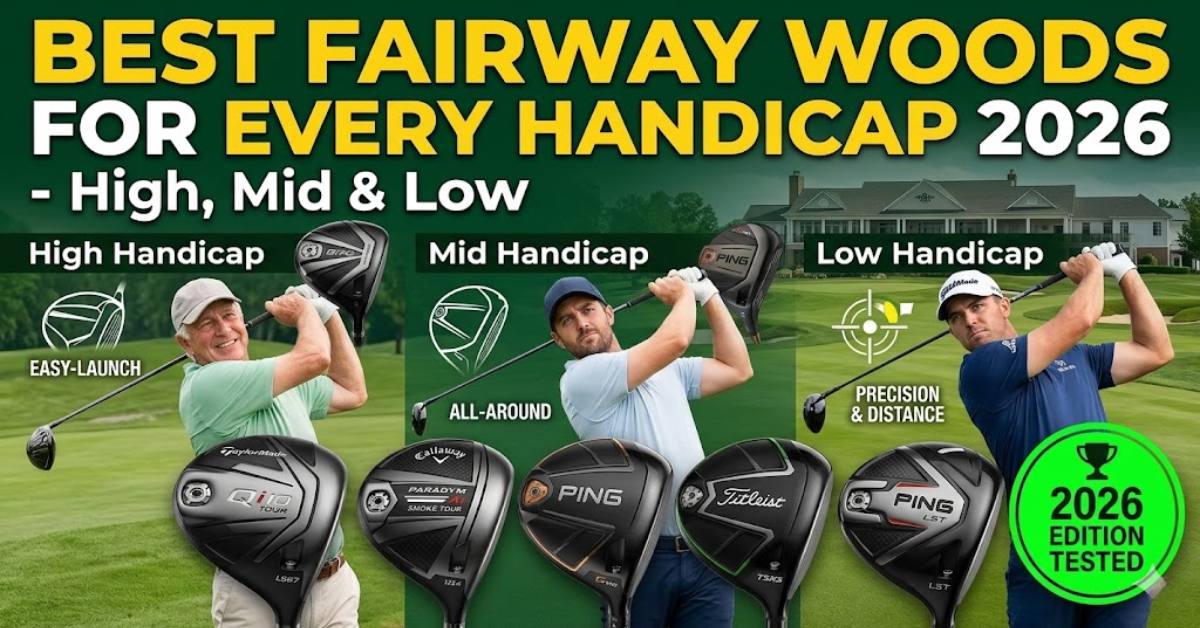
Four years I carried the wrong 3-wood. Didn’t know it at the time. I was playing a 15° Callaway off a 16 handicap, hitting it thin into trouble from the fairway at least three or four times a round, and blaming my swing every single time. A club fitter at a local PGA Superstore spent about ten minutes with a launch monitor and told me the problem wasn’t my swing at all, it was that I had too little loft for the way I swing. One 5-wood later, my fairway wood became the most reliable club in my bag. This guide is the research I wish I’d done before wasting those four years.
Best Fairway Woods for Every Handicap – The Full Comparison Table
Nine clubs, every major handicap category, one table. This is the fastest way to find your match before reading the full breakdowns below. Prices reflect May 2026 retail; used prices are from the secondary market (2nd Swing, GlobalGolf).
| Club | Best For | Handicap Range | Swing Speed Range | Loft Options | New Price | Used (avg) | Key Strength |
|---|---|---|---|---|---|---|---|
| TaylorMade Qi4D Max | Overall best for high hcp | 18–36+ | 65–90 mph | 3W(15°), 5W(18°), 7W(21°), 9W(24°) | $349 | ~$210 | Highest MOI, easiest launch |
| Callaway Quantum Max | Slow swing speeds | 20–36+ | Under 80 mph | 3W(15°), 3W HL(16.5°), 5W(18°), 7W(21°), 9W(24°), 11W(27°) | $399–$449 | ~$250 | Low-face speed protection, step sole |
| Cleveland Launcher Halo XL Lite | Budget high hcp | 18–36+ | 65–85 mph | 3W(15°), 5W(18°), 7W(21°) | $229 | ~$120 | Best price-per-yard, draw bias |
| Cobra OPTM Max | Adjustable high hcp | 18–28 | 70–90 mph | 3W, 5W, 7W | $369 | ~$220 | FutureFit33 hosel, high launch |
| TaylorMade Qi4D | Mid hcp all-arounder | 10–17 | 80–100 mph | 3W(15°), 3HL(16.5°), 5W(18°), 7W(21°), 9W(24°) | $349 | ~$200 | Tour-level ball speed, most versatile |
| PING G440 Max | Mid hcp forgiveness | 10–18 | 80–100 mph | 3W(15°), 5W(17.5°), 7W(21°) | $399 | ~$240 | Free-hosel technology, tall face |
| Cobra OPTM X | Mid hcp versatility | 8–17 | 85–105 mph | 3W, 5W | $369 | ~$210 | 33 loft/lie settings, POI design |
| Titleist GT2 | Low hcp feel + shape | 0–12 | 90–110 mph | 13.5°, 15°, 16.5°, 18°, 21° | $399 | ~$260 | Shot-shaping, 16 loft/lie settings |
| TaylorMade Qi4D Tour | Low hcp distance + workability | 0–9 | 95–115 mph | 3W(15°), 5W(18°) | $399 | ~$230 | Tour-level ball speed, fade/draw weights |
Best Fairway Woods for High Handicappers (Handicap 18–36+)
High handicappers need one thing from a fairway wood above everything else: the ball in the air and in play. Not maximum distance. Not Tour ball speed. Airborne, straight enough, and forgiving enough that a slightly thin strike stays in the fairway and doesn’t become a penalty. The clubs below all do that job, each one engineered so that low-face contact (the most common miss for a 20-handicapper) still launches with enough height to carry rough and reach the short grass.
The most common mistake I see high handicappers make is buying the same 3-wood a 5-handicapper uses. A 15° head with a stiff shaft requires a precise, steep angle of attack to get airborne from the turf. If your driver swing speed is under 90 mph, you’re almost certainly better served starting with an 18° 5-wood and working from there.
1. TaylorMade Qi4D Max — Best Overall for High Handicappers
Lofts: 3W (15°), 5W (18°), 7W (21°), 9W (24°) | Shaft length: 43″ (3W), 42″ (5W), 41.5″ (7W) | New price: $349 | Used avg: ~$210
Hit the Qi4D Max on the toe, the kind of contact that usually sends a fairway wood scuttling left and 30 yards short, and the ball still gets up, still flies somewhere between 210 and 220 yards, still lands somewhere useful. That’s the whole point of a 200cc head with rear-biased weight. TaylorMade moved the center of gravity as far back and low as they could get it, which means the club’s trying to launch the ball even when you’re not perfectly on it. For a 20-handicapper who hits the sweet spot maybe twice in a full round of fairway wood shots, that matters more than any other spec on the sheet.
What that means on the course: a low-face strike that would bleed 15 yards of carry on a standard fairway wood still gets up and goes on the Qi4D Max. In real testing by Today’s Golfer, the Max produced 152.0 mph ball speed, 245.2 yards of carry, 3,461 rpm of backspin, and a launch angle of 11.4° — numbers that reflect how effectively it gets the ball airborne for an average-to-moderate swing speed.
The Speed Pocket on the sole deserves particular mention for high handicappers. Most golfers at 18-handicap and above catch the ball low on the face far more often than in the center — the Speed Pocket is specifically designed to protect ball speed and maintain launch angle on exactly that contact point. This is the most common real-world benefit that never appears in a spec sheet.
Best for: High handicappers with 70–90 mph driver swing speed who want one fairway wood that works off the tee, off the fairway, and out of light rough. Avoid if: Your driver swing speed is consistently above 95 mph, the Max model is optimized for average-to-moderate speeds; consider the standard Qi4D instead.
2. Callaway Quantum Max – Best for Slow Swing Speeds Under 80 mph
Lofts: 3W (15°), 3W HL (16.5°), 5W (18°), 7W (21°), 9W (24°), 11W (27°) | New price: $399–$449 | Used avg: ~$250
The Callaway Quantum Max is the most forgiving fairway wood in the 2026 Quantum family, sitting between the draw-biased Max D and the Tour-spec Triple Diamond. The headline technology is the Step Sole, which allows the sole to glide through turf without digging — a direct fix for one of the most common problems slower swingers face when hitting from the fairway: the head buries into the ground and the ball goes nowhere. The Speed Wave 2.0 positions 40 grams of tungsten low and forward in the head, which protects ball speed on the low-face strikes that happen constantly for golfers under 80 mph.
In testing at 109.1 mph club speed (faster than most high handicappers, which means the carry numbers are a ceiling, not an average for this tier), the Quantum Max produced 156.6 mph ball speed and 257 yards of carry. At 75–80 mph, expect 185–210 yards of carry from the 5W, which is still excellent for this speed range.
The 11-wood at 27° is the sleeper option in this lineup and deserves attention. For golfers who struggle with hybrids, a 27° fairway wood is a legitimate alternative that sits lower to the ground and offers more confidence at address than a hybrid of similar loft.
Best for: High handicappers with driver swing speeds under 80 mph who want the most technology Callaway offers in a forgiving package. Budget alternative: A previous-generation Callaway Elyte Max or Paradym Max from the secondary market runs $130–$170 used and delivers similar performance.
3. Cleveland Launcher Halo XL Lite — Best Budget Pick for High Handicappers
Lofts: 3W (15°), 5W (18°), 7W (21°) | New price: $229 | Used avg: ~$120
The Cleveland Launcher Halo XL Lite is the only fairway wood in this guide under $250 that I’d put in the bag of a 20-handicapper without apology. The Halo Face Cup — a design that wraps the face material around into the sole and crown – creates a consistently springy contact area across a wide portion of the face. Low strikes, heel strikes, even the dreaded “almost a chip” contact — the Halo design keeps all of them airborne.
The Lite designation means a lighter overall build: lighter head, lighter shaft, lighter grip. The reduced total weight creates more club head speed for golfers who don’t naturally generate it, which translates directly to more carry distance. The draw-bias weighting in the heel also helps the majority of high handicappers who battle a left-to-right miss or an open club face at impact.
At $229 new and $120 used, it’s genuinely competitive with clubs that cost $150–$200 more. If budget is a real consideration — and for most golfers it is — start here and put the saved $150 into lessons.
Best for: High handicappers on a budget, or any golfer who regularly hits the ball thin and low on the face and needs a forgiving, draw-biased option. One real limitation: No loft adjustability. If you get fitted and find you need a 16.5° option, you’re stuck with 15° or 18°.
4. Cobra OPTM Max – Best Adjustability for High Handicappers
Lofts: 3W, 5W, 7W | New price: $369 | Used avg: ~$220
The Cobra OPTM Max is the high-handicapper version of Cobra’s OPTM family – oversized rounded head, shallow face profile, wide sole, and the FutureFit33 adjustable hosel that offers 33 different loft and lie combinations. That last feature matters more than it sounds: most high handicappers don’t know their ideal launch conditions until they try a few different setups, and having 33 options means you can dial in loft and face angle without buying a new club.
The oversized footprint looks unmissable at address – there’s real confidence built into the size and shape when you set it behind the ball. The lighter titanium face is 8% thinner than the previous generation for more face flex, and the 85g tungsten soleplate sits low and forward to maximize launch angle and reduce excess spin.
Best for: High handicappers who want adjustability to experiment with loft and lie settings, or anyone who has struggled with consistent face angle.
Best Fairway Woods for Mid Handicappers (Handicap 10–17)
Mid handicappers live in golf’s most interesting territory. You’re consistent enough to benefit from better equipment, but you still miss enough fairways and greens to need forgiveness on off-center strikes. The worst thing a 12-handicapper can do is jump into a Tour-player fairway wood chasing workability — you’ll punish yourself on mishits that a slightly more forgiving option would cover. The best thing is to find a club that rewards your decent strikes with excellent ball speed while covering your off-days without turning them into disasters.
The 10–17 handicap range also tends to match a driver swing speed of 85–100 mph, which opens up more shaft flex options. If you’re still in a regular flex at 90 mph, that’s likely costing you 8–12 yards per shot from a launch and spin efficiency standpoint. The right shaft matters here.
1. TaylorMade Qi4D — Best All-Around Mid-Handicap Fairway Wood
Lofts: 3W (15°), 3HL (16.5°), 5W (18°), 7W (21°), 9W (24°) | Shaft length: 43″ (3W) | New price: $349 | Used avg: ~$200
Today’s Golfer named it “comfortably the best fairway wood in our 2026 testing,” and from a mid-handicap perspective, that assessment holds. The standard Qi4D (not the Max) is built around a 185cc head — smaller and more Tour-inspired than the Max, but still engineered with tucked heel/toe protrusions to maintain tight ball speed variances across the face. In testing it ranked second for ball speed and fourth for carry distance among all 2026 fairway woods tested, with the fourth-tightest left-to-right dispersion.
What makes the standard Qi4D right for 10–17 handicappers is simple: it hits great shots when you hit it great, and it doesn’t embarrass you when you don’t. That’s harder to engineer than it sounds. Most clubs are either forgiving or fast — the Qi4D is legitimately both, and you can feel it. A pure strike at 90 mph produces ball speed that a low single-digit player wouldn’t be unhappy with. A toe-side miss at the same speed still carries 205 yards instead of 185. That 20-yard gap between a pure strike and an okay one is real performance for a 12-handicapper trying to hold a green in two.
The 4° adjustable hosel (available on all lofts) lets you access virtually any loft with your preferred face angle — a genuine upgrade over the previous adjustability system.
Best for: Mid handicappers with 80–100 mph driver swing speed who want Tour-level performance with enough forgiveness to survive a slightly off-center round.
2. PING G440 Max — Best Forgiveness for Mid Handicappers
Lofts: 3W (15°), 5W (17.5°), 7W (21°) | New price: $399 | Used avg: ~$240
PING’s engineering philosophy has always been stability first, and the G440 Max delivers on that. The Free-Hosel Technology removes weight from the hosel, screw, and heel section of the club, which allows for a 4% taller face height while keeping the center of gravity low — a significant engineering trade-off that most manufacturers can’t make because removing heel weight typically introduces unwanted draw bias. PING solved it.
For mid handicappers who regularly play courses with tight fairways and firm greens — and need to hold their fairway wood shots — the maraging steel face provides a consistently hot response across a larger area than most titanium faces of similar size. Golfers at the 10–17 level who battle a high, ballooning fairway wood shot will appreciate that the G440 Max’s spin rate sits consistently in the 3,200–3,600 rpm range at 85–95 mph swing speeds — not so low it runs off the green, not so high it drops short.
The 5W at 17.5° (versus the more common 18°) is a subtle detail worth noting for mid handicappers with faster swing speeds in this tier (95–100 mph) — that half-degree less loft keeps the launch angle in an optimal window rather than launching too high and losing carry distance.
Best for: Mid handicappers who prioritize consistency and fairway-finding over maximum distance, especially those who play courses where accuracy is more valuable than an extra 10 yards.
3. Cobra OPTM X — Best Versatility for 10–17 Handicap
Lofts: 3W, 5W | New price: $369 | Used avg: ~$210
The OPTM X sits between the high-handicapper Max and the Tour-level LS in Cobra’s 2026 lineup, and that middle position is exactly right for mid handicappers. Independent Golf Reviews described it as “built for mid-handicap golfers who want a reliable, versatile fairway wood that rewards decent contact and forgives the imperfect strike without looking or feeling like a game-improvement club.” That phrasing is accurate.
The POI (Point of Inertia) technology goes beyond standard MOI measurements to minimize unwanted head twisting across three separate axes simultaneously. In real testing it produced ball speeds close to the more demanding LS model at around 155 mph, with approximately 300 rpm more spin for a higher, more stable ball flight. That combination — near-LS ball speed with more accessible launch — is the definition of a mid-handicapper’s fairway wood.
The FutureFit33 hosel is genuinely the most versatile adjustability system on the market at this price point. 33 different loft and lie combinations give a fitter the ability to dial in your launch angle and face angle precisely — not just a 2° swing either direction, but genuine customization. For a mid-handicapper who’s getting fitted for the first time, this flexibility makes the OPTM X worth the investment.
Best for: Mid handicappers with 85–105 mph swing speed who want a slightly more precise feel than a game-improvement wood while retaining enough forgiveness to survive a bad day.
Best Fairway Woods for Low Handicappers (Handicap 0–9)
Low-handicap golfers have a different problem with fairway woods than everyone else. They’ve spent years building a swing they trust, and the last thing they want is a club that tries to correct it. A forgiving fairway wood with draw bias built in doesn’t help a 4-handicapper – it actively interferes with the shot-shaping they’ve developed. If they’re cutting it off the tee on a dog-leg right, they need to know the club will hold the face angle through impact and not fight them back to straight. The GT2 does that. Most max-forgiveness designs don’t.
When they’re trying to hold a green with a high, soft landing angle from 220 yards, they want to know the club will deliver a steep descent angle on command. The clubs below do not correct mistakes — they communicate them honestly and reward precision with the best ball speeds on the market.
Both picks here have a place in a single-digit player’s bag without reservation. The choice between them comes down to priorities: feel and shot-shaping versus pure distance.
1. Titleist GT2 – Best for Feel and Shot-Shaping
Lofts: 13.5°, 15°, 16.5°, 18°, 21° | Shaft length: 43.5″ (15°) | New price: $399 | Used avg: ~$260
The Titleist GT2 is built around a Seamless Thermoform Crown made from a proprietary matrix polymer that weighs one-fifth as much as the surrounding steel. The saved weight is redistributed to lower and deepen the center of gravity, which produces the high-launch, low-spin flight that low handicappers depend on when they need to carry a hazard or reach a par-5 green in two. The 16 loft and lie settings give a fitter the granularity to match the club to your specific angle of attack and swing path — not just loft, but face angle, which is where most fitting conversations for low handicappers start.
Golf Digest testers noted that the GT2 is “like a fairway-driving machine, really stable through impact and presents a great ball flight” with “tight dispersion off the tee.” For a 4-handicapper who plays most rounds from the back tees and needs to carry 215–230 yards to reach landing areas, the GT2’s combination of launch height and carry consistency is the most dependable in this category.
The five loft options (13.5° through 21°) are a meaningful advantage over most competitors. A low handicapper might carry a 3-wood at 15° and a 5-wood at 18° from the same head family, giving gapping consistency that mixed-brand set-ups can’t match.
Best for: Low handicappers with 90–110 mph driver swing speed who shape shots intentionally and want honest feedback from their fairway wood, plus a premium gloss-black look that won’t distract at address. One note: Golfers who swing over 110 mph should explore the GT3 instead — its taller face produces a more penetrating, workable flight at faster speeds.
2. TaylorMade Qi4D Tour – Best for Distance and Workability
Lofts: 3W (15°), 5W (18°) | New price: $399 | Used avg: ~$230
The Qi4D Tour is the most compact and performance-focused head in TaylorMade’s 2026 lineup. It uses a titanium body and thin-ply carbon composite crown to save mass for three movable weights — positions that control spin, launch angle, and shot bias. In Golf Digest’s 2026 Hot List testing it ranked in the Top 5 for performance among low, middle, and high handicappers, which reflects how efficiently the head generates ball speed across the face. Real-world data from Tour deployment shows consistently around 150 mph ball speeds at 100+ mph swing speeds.
The movable weights are the distinguishing feature for low handicappers. Two shots to the right all morning? Move the heel weight in and introduce draw bias without changing your swing. The 33-way equivalent that mid-handicappers get on the OPTM X becomes three precision weight positions here — less total combinations, but more meaningful adjustment for a player who knows exactly what their numbers look like.
Best for: Low handicappers with 95–115 mph driver swing speed who want maximum distance and the ability to fine-tune trajectory and ball flight independently of loft settings.
Should You Carry a 3 Wood, 5 Wood, or 7 Wood? (The Answer by Handicap)
The number on the sole of your fairway wood matters more than the brand name on the crown. I know that’s not what the equipment companies want you to believe, but the difference between a well-fitted 7-wood and a poorly-fitted 3-wood for the same golfer is easily 15–20 yards of average carry and two or three misses per round. I’ve seen a 22-handicapper shoot 83 because she put down her 3-wood and started hitting her 7-wood off the tee. That’s not a fluke — it’s loft doing what loft does.
| Golfer Type | Best Primary Fairway Wood | Reason | Optional 2nd Wood |
|---|---|---|---|
| 20+ handicap, driver swing under 75 mph | 7W (21°) or 5W (18°) | More loft = easier to launch, nearly same carry distance as 3W at this speed | 9W (24°) instead of a hybrid |
| 18–20 handicap, driver swing 75–85 mph | 5W (18°) | Easier off the deck than 3W; carries 185–210 yards; pairs well with 24° hybrid | 7W for tight par-3s |
| 12–17 handicap, driver swing 85–95 mph | 5W (18°) as primary, 3W optional | 5W still more reliable off the turf; 3W only if you can carry it 220+ yards | 7W replaces a 4-iron nicely |
| 8–12 handicap, driver swing 90–100 mph | 3W (15°) + 5W (18°) | Gap coverage; both viable off the deck; 3W earns its place off the tee | — |
| 0–7 handicap, driver swing 100+ mph | 3W as primary | Low spin, workable flight; can reach par 5s in two | 5W for long iron replacement |
The 7-wood nobody talks about: For golfers at 18+ handicap, a 21° 7-wood is one of the most underused clubs in the game. It launches higher than a 5-wood, is easier to hit off tight lies than a 4-hybrid, and fills the gap between a 5-wood and a 4-iron perfectly. The TaylorMade Qi4D Max and Callaway Quantum Max both offer 7-wood versions — neither costs more than the 3W or 5W.
The 3 wood vs 5 wood decision for high handicappers: A 5-wood with an 18° loft is, for most golfers shooting 90–100, carrying almost as far as a 3-wood — and usually farther, because it launches with a more optimal angle and is easier to hit from the fairway. The extra 0.5–1° of loft on a 5-wood is not losing distance for an 80 mph swing. It is gaining it.
Fairway Wood Loft and Shaft Flex Guide by Swing Speed
Buying a fairway wood without knowing your driver swing speed is like buying running shoes without knowing your size. This chart solves the two most common mistakes: choosing too little loft and playing the wrong shaft flex.
| Driver Swing Speed | Recommended 3W Loft | Recommended 5W Loft | Shaft Flex | Expected 5W Carry |
|---|---|---|---|---|
| Under 70 mph | 16.5° (3HL) or skip 3W | 20–21° (7W loft) | Ladies (L) or Senior (A) | 145–165 yards |
| 70–80 mph | 16.5°–17° | 19–20° | Senior (A) or Regular (R) | 165–185 yards |
| 80–90 mph | 15°–16.5° | 18°–19° | Regular (R) | 185–210 yards |
| 90–100 mph | 15° | 18° | Regular (R) or Stiff (S) | 210–235 yards |
| 100–110 mph | 14.5°–15° | 17.5°–18° | Stiff (S) | 235–255 yards |
| 110+ mph | 13.5°–15° | 16.5°–17.5° | Stiff (S) or X-Stiff (X) | 255–275+ yards |
Shaft flex reality check: Most recreational golfers are playing a shaft that is too stiff, not too flexible. A too-stiff shaft produces low launch, low spin, and a frustrating “ball goes nowhere” feeling on anything less than a perfect strike. If you’re 85 mph with a stiff shaft and your ball flight is low and spinny, go to regular flex. You’ll add 10–15 yards immediately.
Shaft weight: Stock shafts on most 2026 fairway woods are 50–65 grams for regular flex and 60–70 grams for stiff. Slower swingers (under 80 mph) benefit from shafts in the 45–55g range for more club head speed. The Callaway Quantum Max Fast and PING G440 HL Max are the only two clubs in this guide with factory-fitted lightweight shaft options (45–50g) — worth knowing if your swing speed is in the 65–75 mph window.
What to Look For in a Fairway Wood (By Handicap)
High Handicappers: Forgiveness First
For a golfer shooting 90–105, forgiveness means: high MOI (the club doesn’t twist on off-center hits), a low and forward center of gravity (promotes high launch on low-face contact), and a wide sole (glides through turf instead of digging). These three features matter far more than adjustability, Tour aesthetics, or brand name. Every high handicapper should be shopping for these specs in this order:
- MOI above 5,000 g·cm² — limits distance loss on off-center hits
- Loft of 18° or higher for primary fairway wood — works with a typical sweeping swing, not against it
- Draw-bias or neutral face angle — counteracts the most common miss shape for high handicappers (left-to-right)
- Wide sole with Step Sole, Gliderail, or equivalent — protects turf interaction on imperfect strikes
- Regular or Senior flex shaft — matched to your actual swing speed, not the one you wish you had
Mid Handicappers: Forgiveness Meets Workability
At 10–17 handicap, you hit the ball well enough that you can feel the difference between a mis-hit and a pure strike. The right fairway wood rewards pure strikes with noticeably better ball speed while still protecting the misses you haven’t eliminated. Key specs to prioritize:
- Variable-thickness face or AI-optimized face — maintains ball speed across a larger portion of the face
- Adjustable hosel — at least ±2° of loft adjustment; ideally the 33-way FutureFit33 or 16-way Titleist system
- Shaft flex matched to your actual swing speed — most mid handicappers at 85–95 mph should be in regular, not stiff
- Head size in the 185–200cc range — small enough for feedback on pure strikes, large enough to forgive a half-inch miss
Low Handicappers: Shot-Shaping and Feedback
Below a 10-handicap, the goal reverses. You want a club that responds precisely to what you do — draws when you set up for a draw, fades when you cut across it. A forgiving design actively works against this by correcting your path. Key specs for low handicappers:
- Titanium or high-strength steel face for direct feedback — you should feel where you made contact
- Compact head profile (165–185cc) — smaller footprint for trajectory control
- Movable weight system — fine-tune flight direction without changing swing
- Multiple loft options below 15° — some low handicappers carry a 13.5° “strong 3-wood” as a second driver alternative for tight par-4 tees
- Penetrating, mid-low flight at high swing speed — a high-launch game-improvement head ballooning at 100+ mph is worse than useless
Frequently Asked Questions
The best 3 wood for a high handicapper in 2026 is the TaylorMade Qi4D Max at 15°. Its oversized 200cc head, rear-biased weight, and Speed Pocket protect ball speed on low-face strikes, which are the most common miss for high handicappers. However, most golfers shooting 90+ should consider an 18° 5-wood instead — it is easier to launch from the fairway and carries nearly the same distance at swing speeds under 90 mph.
5-wood, every time, until you can consistently carry it 185+ yards from the fairway. The 3-wood is a club that rewards a specific, repeatable swing — and most golfers shooting 90+ aren’t there yet. The extra loft on a 5-wood doesn’t just make it easier to launch; it makes your mishits less catastrophic. Hit a 3-wood thin and you’re looking at a low screamer into the rough. Hit a 5-wood thin and you’ve still got a shot. That difference alone is worth the switch.
The easiest fairway wood to hit in 2026 is the TaylorMade Qi4D Max. It has the largest, most forgiving head in TaylorMade’s fairway wood lineup (200cc), the highest MOI of any 2026 fairway wood, and a shallow face profile that launches the ball without requiring a steep angle of attack. The Callaway Quantum Max and Cleveland Launcher Halo XL Lite are very close alternatives, with the Cleveland offering the same forgiveness at a significantly lower price point.
The best fairway wood for mid handicappers in 2026 is the TaylorMade Qi4D (standard model). It ranked first overall in Today’s Golfer’s 2026 fairway wood test — second for ball speed, fourth for carry distance, fourth tightest dispersion — and it balances Tour-level performance with enough face technology to protect off-center strikes. Mid handicappers with 80–100 mph swing speed who prioritize forgiveness over ball speed should consider the PING G440 Max as an alternative.
Yes — high handicappers arguably need a fairway wood more than any other skill level. A fairway wood hit into the short grass is worth far more to a 20-handicapper’s scorecard than an extra 20 yards from the driver. The goal at this skill level is hitting fairways and reaching greens in regulation, and a well-fitted 5-wood or 7-wood accomplishes both of those goals more reliably than a driver or long iron. Replace your 4-iron and 5-iron with fairway woods and count the strokes saved.
High handicappers should use a primary fairway wood with at least 18° of loft (a 5-wood). If your driver swing speed is under 75 mph, consider starting with a 21° 7-wood. A 15° 3-wood requires a more precise, steeper angle of attack to launch properly from the turf — most high handicappers have a shallower swing that works against the lower loft. Only add a 3-wood once you can consistently hit a 5-wood from the fairway and carry it 185+ yards.
Yes, a 5 wood is easier to hit than a 3 wood for the vast majority of golfers. The 5-wood is approximately 1″ shorter (easier to control), has more loft (easier to launch from the turf), and has a smaller head that still offers more forgiveness per swing than a 3-wood because the increased loft compensates for off-center contact better. For golfers with driver swing speeds under 95 mph, a 5-wood also carries the ball nearly as far as — or farther than — a 3-wood because the optimal launch angle is more achievable.
The best fairway wood for a 10-handicap golfer is the TaylorMade Qi4D or Cobra OPTM X. A 10-handicapper sits at the boundary of mid and low handicap performance — capable of benefiting from Tour-level ball speed on pure strikes while still needing protection on the off-center contact that remains part of a 10-handicapper’s round. Both of these clubs deliver near-maximum ball speed on pure contact while using variable-thickness face technology to protect ball speed and launch angle on the slightly off-center hits.
The Bottom Line
The right fairway wood is the one matched to your swing speed, your handicap, and how often you actually hit it from the turf versus the tee, not the one that looks best or that a Tour player uses. For most golfers shooting 85–100, the TaylorMade Qi4D at 5-wood sits in a sweet spot that nothing else quite matches at $349. High handicappers who want to stop mis-hitting their fairway wood should start with the Qi4D Max or drop $229 on the Cleveland Launcher Halo XL Lite, put it in the bag, and actually get comfortable with it before upgrading. The fairway wood that gets used is always worth more than the better one that intimidates you into reaching for a hybrid instead.