
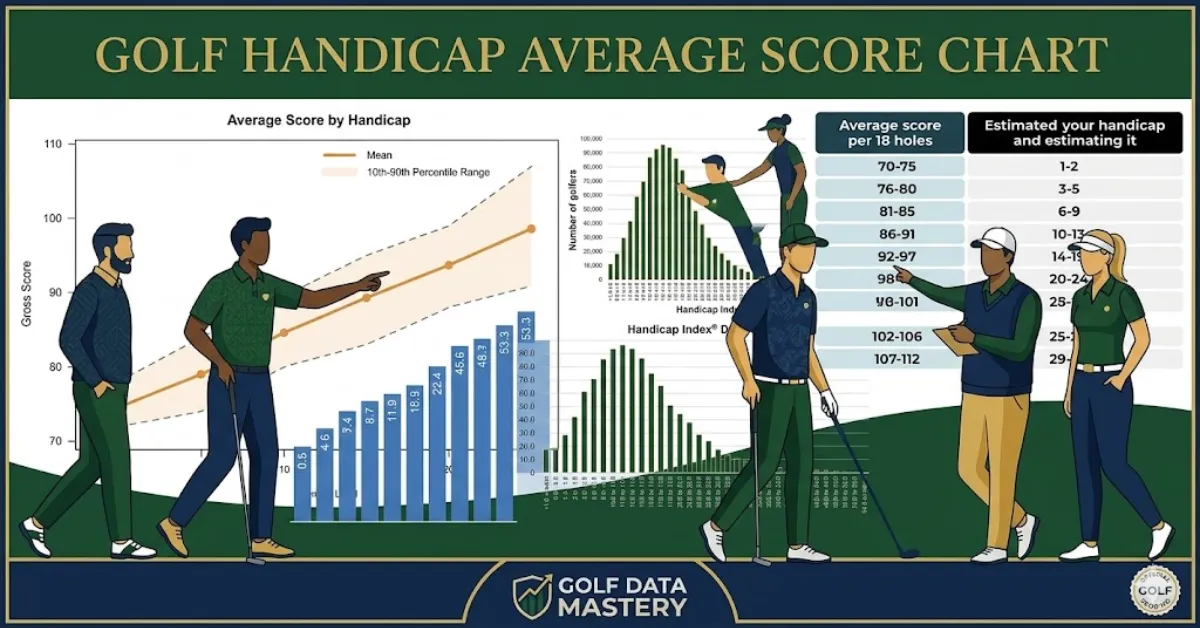
Your handicap average score tells you exactly what you should be shooting on a par-72 course – and the number might be different from what you expect. According to the USGA 2025 Golf Scorecard, the average male golfer carries a handicap of 14.0, which works out to roughly 86 strokes per round. The average female golfer carries a 28.8 handicap, translating to around 101 strokes. But what does every handicap level between scratch and 30 actually shoot? This guide breaks it all down, with a full handicap average score chart, what each handicap looks like on the course, and how to calculate your own.
What Is a Golf Handicap and How Does It Relate to Your Average Score?
What is a Handicap in golf?
A golf handicap is a number that indicates a golfer’s skill level and how many strokes they should add to par. Handicaps are used to make it fair for golfers of different abilities to compete against each other.
How is a handicap calculated?
- A golfer’s handicap is based on their previous scores, the difficulty of the course, and playing conditions.
- A golfer’s handicap is calculated by averaging their eight best score differentials from their last 20 rounds.
- A golfer’s handicap can change based on their future scores.
What does a handicap indicate?
- A lower handicap indicates a higher skill level, while a higher handicap indicates a lower skill level.
- A handicap can help golfers track their progress over time.
- A handicap can help golfers determine how many strokes to subtract from their gross score to get their net score.
Calculating a Golf Handicap Index
A Golf Handicap Index is a measure of a golfer’s potential ability, calculated using the World Handicap System (WHS). It is not based on average scores but rather on a golfer’s best performances relative to the difficulty of the courses played. The Handicap Index is derived from past scores, adjusted for factors such as course difficulty (Course Rating), tee selection, and playing conditions (as defined by the USGA).
This table explains how to calculate a Handicap Index for players who have fewer than 20 scores in their record. It uses simple steps to make it easier to understand.
Handicap Differential Formula
The formula for calculating a golf handicap differential is
Handicap Differential = (Adjusted Gross Score – Course Rating) x 113 / Slope Rating
Here is a simple worked example to make the formula clear:
You score 88 on a course with a Course Rating of 72.1 and a Slope Rating of 131.
Step 1: Subtract the Course Rating from your score → 88 − 72.1 = 15.9
Step 2: Multiply by 113 → 15.9 × 113 = 1,796.7
Step 3: Divide by the Slope Rating → 1,796.7 ÷ 131 = 13.7
Your score differential for that round is 13.7.
Once you have eight or more differentials recorded, the system averages your best eight and multiplies by 0.96 to produce your Handicap Index. In practice, you do not need to do this manually — the GHIN app and most course scoring apps calculate it automatically after you post your score.
Explanation
- Adjusted Gross Score (AGS): The score a player receives after applying any applicable adjustments
- Course Rating: A numerical value assigned by the USGA to each set of tees on a course
- Slope Rating: A measure of how difficult a course is for an average golfer
- 113: The standard slope for a course
To calculate a handicap differential, you can:
- Get your AGS, course rating, and slope rating for the course you played
- Plug the numbers into the formula
- Round the result to the nearest tenth
You can find the course rating and slope rating for most courses on their website or at the clubhouse.
Once you have your handicap differentials, you can average them and multiply the average by 0.96 to calculate your handicap index.
A Handicap Committee may adjust a player’s initial handicap index based on other evidence of their ability.
Why Average Scores Matter for Handicap Calculations
While a golfer’s average score isn’t directly used to calculate a handicap, it does play a role in understanding the overall trend of their performance, but the key aspect is that a handicap system primarily focuses on a player’s best scores, meaning it calculates a handicap based on the best few rounds out of a recent set, not simply averaging all scores, as this better reflects a golfer’s potential ability rather than their average consistency across all rounds; essentially, a handicap is more about what a golfer is capable of playing on their best day, not necessarily how they typically play on average.
Key points about handicap calculation and average scores:
Handicap Average Score Chart: Every Level From Scratch to 30
The table below shows the average score you can expect at every handicap level on a standard par-72 course, along with the realistic scoring range most golfers fall into. Your actual score on any given day will move inside that range — conditions, course difficulty, and whether you avoid a blow-up hole all play a role. The figures are based on USGA handicap system data and real amateur round analysis.
| Handicap | Average Score (par 72) | Typical Range | Skill Level |
|---|---|---|---|
| Scratch (0) | 74–76 | 72–79 | Elite amateur |
| 5 | 77–80 | 74–84 | Strong club player |
| 8 | 80–83 | 77–87 | Solid single-figure |
| 9 | 81–84 | 78–88 | Strong club player |
| 10 | 82–85 | 80–90 | Consistent mid-handicap |
| 12 | 84–87 | 81–91 | Mid handicap |
| 13 | 85–88 | 82–92 | Mid handicap |
| 14 | 86–89 | 83–93 | Mid handicap |
| 15 | 87–90 | 83–95 | Mid handicap |
| 16 | 88–91 | 84–96 | Mid–high handicap |
| 18 | 90–93 | 86–98 | High handicap |
| 20 | 92–95 | 88–100 | High handicap |
| 25 | 97–100 | 91–108 | Beginner–recreational |
| 30 | 102–105 | 96–112 | Beginner |
Source: USGA Handicap System data and Madknows analysis. Scores based on par-72 course with standard slope rating.
One thing most golfers get wrong: a handicap of 15 does not mean you will shoot 87 every single round. On a good day with everything clicking, a 15 handicap can card 83. On a difficult course with a tough wind, 95 is not a bad round — it is just a hard day. The range column is the honest picture of what real golf looks like at each level.
What is the Average Score for a 10 Handicap Golfer?
A golfer with a 10 handicap typically has an average score of around 82-85. This means that on a par-72 course, they usually shoot 10 strokes over par.
What is the Average Score for a 12 Handicap Golfer?
A 12 handicap golfer usually has an average score of about 84-87. This indicates that they are consistently shooting 12 strokes over par on a par-72 course.
What is the Average Score for a 15 Handicap Golfer?
A 15 handicap golfer generally has an average score of around 87-90. This means they are shooting 15 strokes over par on a par-72 course.
What is the Average Score for a 20 Handicap Golfer?
A 20 handicap golfer typically has an average score of about 92-95. This indicates that they are consistently shooting 20 strokes over par on a par-72 course.
Average Score by Handicap: 5, 8, 9, 10, 12, 13, 14, 15, 16, 18, 20, 25 and 30
What Is My Handicap If My Average Score Is 85, 88, 90, 95 or 100?
To calculate your golf handicap based on average scores, you need to take the average of your best 8 Score Differentials from your most recent 20 rounds, where a Score Differential is calculated by comparing your adjusted gross score to the course rating and slope rating of the course you played on; essentially, it measures how many strokes you played above or below the course’s average score for a player of your ability level; the lower your Score Differential, the better you played relative to the course difficulty.
Break Down By Calculate Your Golf Handicap Based on Average Scores.
If My Average Golf Score is 85, What is My Handicap?
If your average score is 85 on a par-72 course, your handicap is likely around 13. This means you’re a solid intermediate player.
If My Average Golf Score is 90, What is My Handicap?
An average score of 90 typically corresponds to a handicap of around 18. This places you in the mid-to-high handicap range.
If My Average Golf Score is 95, What is My Handicap?
A 95 average score usually equates to a handicap of about 23. You’re still developing your skills but making progress.
If My Average Golf Score is 100, What is My Handicap?
An average score of 100 suggests a handicap of approximately 28. You’re likely a beginner or casual golfer.
Key points to remember
- Score Differential calculation: To calculate your Score Differential for a round, you need the course rating, slope rating, and your adjusted gross score.
- Best 8 of 20: Once you have multiple rounds recorded, you take the average of the best 8 Score Differentials from your most recent 20 scores.
- Using a handicap calculator: Most golfers use online handicap calculators or apps to simplify the process of calculating their handicap index.
Handicap vs Average Score: Why They Are Not the Same Number
A golfer’s handicap represents their potential playing ability, calculated based on their best recent scores, and is not the same as their average score; a handicap is designed to level the playing field by giving better players fewer strokes on a given course, while the average score simply reflects the total strokes taken across all rounds played, including less optimal ones.
Key points to remember:
- Handicap is not a simple average: While it considers past scores, a golfer’s handicap is calculated by taking the average of their best few scores from a set period, not all rounds played, making it a more accurate representation of their potential ability rather than their consistent performance on every round.
- Factors affecting handicap: The World Handicap System (WHS) used in golf takes into account course difficulty (course rating and slope rating) when calculating a handicap, allowing for fairer comparisons across different courses.]
- Lower handicap means better player: A lower handicap indicates a better golfer, as it means they are expected to need fewer strokes to complete a course compared to a higher handicap player.
- Average score can be higher than handicap: A golfer’s average score will usually be higher than their handicap because it includes all rounds played, including less good ones, while the handicap only reflects their best performance.
Example:
A golfer with a handicap of 10 might average a score of 85 on a typical course, but their handicap reflects their ability to potentially play close to par on their best rounds.
What Does a Scratch Golfer Actually Average?
A scratch golfer (0 handicap) does not shoot level par every round. Most scratch golfers average somewhere between 74 and 76 on a par-72 course. Breaking par — shooting 71 or lower — happens less than once every twelve rounds even at this level.
A typical scratch round involves four to six bogeys, one or two birdies, and the rest pars. When a scratch golfer has an off-day and shoots 78, most club golfers would celebrate that score. That gives you a sense of just how tight the margins are at the top of the amateur game.
For context: PGA Tour professionals average between 69 and 70 strokes per round — roughly five shots better than a scratch amateur. Those five shots represent years of full-time practice, elite coaching, and world-class course management that separates professional golf from even the best amateur players.
If you are currently a 10 handicap with ambitions to reach scratch, you are looking at closing a gap of roughly 10 to 11 strokes per round. That is not impossible, but it requires consistent practice on all areas of the game — especially putting and course management, not just driving distance.
Average Golf Score by Age Group
Age affects your flexibility, swing speed, and recovery time — all of which show up in your scores. Here is how the average score changes across age groups on a par-72 course.
In your 20s — Average score: around 90. Players in their 20s typically have faster swing speeds and can recover quickly between rounds, but many are still developing their course management and short game. Raw distance is rarely the problem — decision-making is.
In your 30s — Average score: around 92. Many golfers in their 30s start to play more seriously, refining their fundamentals. Increasing work and family commitments reduce practice time, which is why scores in this bracket often plateau rather than drop quickly.
In your 40s — Average score: around 92–94. Experience on the course starts to offset slight reductions in distance. Smart course management and a reliable short game become more important than power, and golfers in their 40s who focus on scoring smarter rather than hitting longer tend to hold their handicap well.
In your 50s — Average score: around 94–96. Swing speed drops slightly, but golfers in this age group often have the best course management of their playing career. Seniors who stay physically active can maintain a very competitive handicap index and frequently outperform younger golfers with bigger swings but weaker course sense.
60s and beyond — Average score: around 96–102. Scores rise as distance and flexibility reduce, but many golfers in their 60s still carry mid-handicap indexes and compete comfortably in club events. Moving to more forward tees is not admitting defeat — it is smart golf that keeps the game enjoyable and the scorecards realistic.
Average Handicap Score for Men vs Women
Men and women carry different average handicaps, which means their average scores on a par-72 course differ as well. According to the USGA 2025 Golf Scorecard, the average male golfer in the United States carries a handicap of 14.0, which corresponds to an average score of around 86. The average female golfer carries a handicap of 28.8, which works out to approximately 101 on a standard par-72 course.
This gap does not reflect how seriously women play golf — it reflects the fact that women typically play from shorter tees with different course ratings and slope values. When tee selection is accounted for, the handicap system levels the playing field effectively, which is exactly what it was designed to do.
For women looking to benchmark themselves: a handicap below 20 is considered strong for a female recreational golfer. A handicap between 20 and 30 is the most common range among active female club golfers. Anything below 10 puts a woman in the top tier of amateur golfers at most clubs worldwide.
(Source: USGA 2025 Golf Scorecard)
Frequently Asked Questions About Golf Handicap Average Scores
No. Your handicap is not your average score — it is calculated from your eight best score differentials out of your last 20 rounds, adjusted for course difficulty. Your average score across all rounds will almost always be higher than your handicap suggests, because the handicap system measures your potential on a good day, not your typical performance every round.
For a beginner, any score under 108 on a par-72 course (which corresponds to a handicap of around 36) is a solid starting point. Most new golfers carry a handicap between 28 and 54 when they first register. A handicap of 20 to 30 within your first year of regular play is a realistic and respectable goal that shows you are developing the core skills of the game.
If you are averaging 88 on a standard par-72 course, your handicap index is likely around 15 to 16. This puts you solidly in the mid-handicap range. Your exact handicap will vary depending on the courses you play and their specific slope and course ratings — harder courses will produce higher differentials, which may keep your index slightly higher than expected.
Shooting 85 regularly on a par-72 course generally corresponds to a handicap of around 12 to 13. Your handicap index may actually be slightly lower than 13 because the system focuses on your best eight rounds — if those best rounds are closer to 82 or 83, your index could sit at 10 to 11. Post all your scores honestly and let the system calculate your true potential.
Most recreational golfers who practice consistently — particularly the short game — can drop two to four handicap strokes within a single season of regular play. The fastest improvements come from eliminating double bogeys and triple bogeys, not from making more birdies. A 20 handicap who stops making blow-up sevens and eights on straightforward holes will see their index drop faster than a golfer who focuses purely on distance off the tee.
According to the USGA 2025 Golf Scorecard, the average female golfer in the United States carries a handicap index of 28.8. On a standard par-72 course, this translates to an average score of approximately 101. Women who play regularly and practise their short game consistently can reach a handicap below 20 within one to two seasons of dedicated play, which puts them in the stronger half of all registered female golfers.
How to Lower Your Handicap Average Score: What Actually Works
To improve your golf handicap and lower your average score, focus on consistent practice, especially on your short game, hitting the driving range regularly, developing a solid pre-shot routine, learning to curve the ball, playing often, and aiming to hit more greens in regulation; also consider getting fitted for your clubs and maintaining a positive mindset to handle pressure on the course.
Key points to focus on:
- Regular Practice: Dedicate time to consistent practice sessions on the driving range to work on all aspects of your swing, including driving, iron play, and wedge shots.
- Sharpen Your Short Game: Prioritize practicing your short game, including putting drills, as this area significantly impacts your score.
- Pre-Shot Routine: Develop a consistent pre-shot routine to help you focus and visualize your shot before each swing.
- Distance Improvement: Work on increasing your driving distance to make the course easier to navigate.
- Shot Shaping: Learn to curve the golf ball intentionally with slice or hook shots to navigate challenging holes.
- Play Frequently: Play rounds regularly to apply your practice and get comfortable in competition situations.
- Greens in Regulation: Aim to hit more greens in regulation by improving your tee shots and approach shots.
- Club Fitting: Get fitted for clubs that best suit your swing and body type to optimize your performance.
- Mental Game: Develop mental toughness and a positive mindset to manage pressure on the course.
- Variety of Courses: Play on different courses to adapt to various layouts and challenges.
Your Handicap Average Score Is Just the Starting Point
Knowing what your handicap average score should be is one thing. Using that knowledge to play better is where the real work begins.
The golfers who lower their handicap fastest are not the ones who spend hours on the driving range working on swing mechanics. They are the ones who cut out the blow-up holes — the triple bogeys on the par 3 they always drop shots on, the lost ball that costs them two penalty strokes, the three-putt from inside ten feet. Clean those up, and your handicap drops almost automatically.
At Madknows, we have guides that help with exactly that — from reading your putting stroke to hitting more greens in regulation and managing a tough course without losing your head. Start with the areas of your game that are costing you the most shots per round, and track your progress honestly using your handicap index.
Your current handicap average score is not a ceiling. It is just where you are today.