
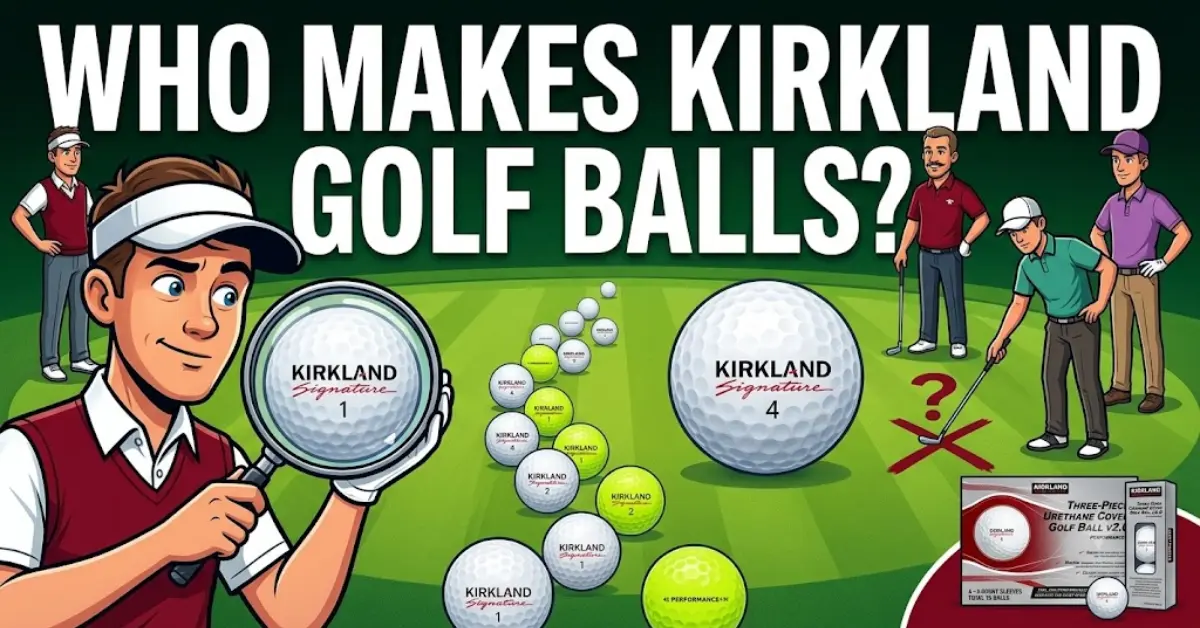
I’ve had a sleeve of Kirkland Performance+ balls rattling around my bag for three seasons now. Mostly because I’m too cheap to lose a $5 Pro V1 in the water on the 14th at my home course.
Every time I pull one out, somebody in my group asks the same question. Who actually makes these things?
Every article I read chasing that answer said basically the same name — Qingdao SM Parker — without ever pointing to where that name came from. So I went and pulled the actual document that settles equipment identity questions in golf: the USGA’s List of Conforming Golf Balls. It’s public. It’s searchable. And it names a manufacturer for every ball on it, including the Kirkland Signature Performance+.
Here’s what it actually says, why it doesn’t perfectly match the popular blog answer, and the two lawsuits that shaped the ball you can buy today.
Quick Answer: The USGA’s own List of Conforming Golf Balls names the manufacturer of the current Kirkland Signature Performance+ as SM Global, LLC. Most golf blogs will tell you it’s “Qingdao SM Parker” in China — likely the actual factory behind that entity’s supply chain, but not what’s on file with the governing body. Costco doesn’t own a factory either way. It writes the spec, survived two separate lawsuits over the ball and the irons, and contracts the build out to whichever manufacturer wins the bid.
The Short Answer: Who Makes Kirkland Golf Balls
Pull up the USGA’s current List of Conforming Golf Balls. Search the “K” section for “Kirkland Signature.”
Two listings come back — one white, one yellow. Both are for the “Performance +” ball. Both are three-piece, single-cover construction with 338 dimples and a medium-high spin rating.
The manufacturer field for both listings reads SM Global, LLC, with a country code of USA.
That’s the official record. It’s a different name than the one nearly every other article on this topic repeats, and the country code is different too — most competitor sites say the ball is built in China.
I don’t think that’s necessarily wrong. SM Global almost certainly contracts the actual molding overseas through a facility widely reported as Qingdao SM Parker. But the entity the USGA has on file — the one legally responsible for the ball conforming to the Rules of Golf — is a US-registered company. Nobody else covering this topic mentions that distinction, because nobody else pulled the primary document.
One Honest Caveat
The USGA listing tells you the company of record, not necessarily the building where the rubber core gets molded. Big equipment brands routinely list a holding or supply entity on USGA paperwork while the physical manufacturing happens at a contracted overseas plant.
SM Global, LLC is very likely that kind of front-facing entity for a Qingdao-based production partner. Neither Costco nor SM Global has published a statement naming the factory directly. So the “Qingdao SM Parker” detail you’ll read everywhere else stays in the “very likely, not officially confirmed” category — the USGA record just gets you one verifiable step closer to the truth than any blog post does.
How to Verify This Yourself on the USGA Database
You don’t have to take my word for this, or anyone else’s.
The USGA publishes the List of Conforming Golf Balls as a free, searchable database, updated on the first Wednesday of every month.
- Go to the USGA’s Conforming Golf Ball list (usga.org/ConformingGolfBall).
- Download the current PDF or use the searchable equipment database directly.
- Search “Kirkland Signature.” Balls are alphabetized by the brand name printed on the ball, so they sit in the K section.
- You’ll see two entries for the “Performance +” ball, one per cover color, listing construction (3P-1c), dimple count (338), spin rating (M-H), country (USA), and manufacturer (SM Global, LLC).
I did the same search for Kirkland’s other equipment while I was in there. The pattern is genuinely interesting — the manufacturer of record changes by product line, not just by ball generation.
Costco Uses Different Manufacturers For Different Kirkland Products
This is the part nobody else writing about “who makes Kirkland golf balls” seems to have checked.
Golf balls: SM Global, LLC, per the current USGA Conforming Ball List.
The newest forged wedge: Golf Digest and MyGolfSpy both reported this wedge hit the USGA Conforming Club List in April 2026 under “SM Global, LLC / SM Parker Golf” — the same manufacturer family as the ball.
The irons: GolfWRX found Kirkland’s irons listed under a completely different manufacturer, Indi Golf, when they hit the USGA Conforming Club List in 2023.
The earlier cast wedge: Golf Monthly reported this one as coming from Southern California Design Company, a Carlsbad-based shop that has also done work for Cobra.
Costco isn’t running one factory for the entire Kirkland Signature golf line. It’s spreading production across at least three different contract manufacturers depending on the product category. That’s a normal private-label strategy — Costco does the same thing with food and apparel — but it’s not something any of the current “who makes Kirkland golf balls” articles mention.
Costco’s Manufacturing Model (And Why It Works)
Costco doesn’t build factories for house brands. It never has, in golf or anywhere else.
The company’s private-label playbook is always the same. Find an established manufacturer. Negotiate a spec and a price. Use Costco’s buying volume to squeeze the per-unit cost down further than a name-brand company could manage on its own shelf space and marketing budget.
For golf balls specifically, that means Costco isn’t paying for a logo license, a Tour endorsement staff, or a national ad campaign. Those are three costs baked into every dozen Pro V1s you buy.
Strip those out and you’re left with the actual manufacturing cost of a three-piece urethane ball. That’s a lot closer to $1 per ball than $4.
I’m not going to pretend that makes Kirkland balls identical to a Pro V1. It doesn’t. But it explains the price gap without any conspiracy theory about inferior materials.
The Original 2016 Ball, and Why It Disappeared
The Kirkland Signature golf ball wasn’t always the mild-mannered three-piece ball sitting on shelves today.
The original 2016 version was a four-piece, urethane-cover ball, built to compete directly with tour-caliber balls like the Pro V1x. It sold for about $15 a dozen — roughly a third of Titleist’s price at the time.
It sold out almost instantly. Resellers were flipping single dozens on eBay for triple the retail price. Golf forums genuinely lost their minds over it.
That same ball is also the one that triggered a lawsuit large enough to nearly end Kirkland’s entire golf ball business before it started.
The 2017–2018 Titleist Lawsuit, Explained
This is the part of the story every competitor article mentions briefly. Here’s the detail most of them leave out.
Acushnet’s Letter, and Costco’s Preemptive Strike
In December 2016, Acushnet — Titleist’s parent company — sent Costco a letter accusing the retailer of infringing 11 patents with the four-piece Kirkland ball, and of false advertising over the “Kirkland Signature Guarantee,” which promised the ball would “meet or exceed the quality standards of leading national brands.”
Costco didn’t wait to get sued. In March 2017, it filed first, seeking a declaratory judgment that the ball didn’t infringe any valid Acushnet patent and that its marketing wasn’t misleading. Costco also asked the court to declare all 11 of the disputed patents invalid.
Acushnet’s 284-Page Countersuit
Five months later, Acushnet fired back with a countersuit spanning 284 pages. It narrowed its claim to 10 patents specifically covering ball core hardness, core springiness, and dimple surface coverage.
Acushnet wasn’t asking for a fixed dollar figure. It wanted “adequate damages,” including three times Costco’s profits from the ball, and requested a jury trial. Acushnet’s complaint went as far as stating its own internal testing “conclusively” showed the Pro V1 and Pro V1x were superior to the Kirkland ball — directly contradicting Costco’s quality guarantee.
How It Actually Ended
The case was settled out of court in 2018. Neither company disclosed the terms, and the dismissal was filed with confidentiality attached.
What we do know: the original four-piece ball never returned in its 2016 form. Since then, Kirkland’s golf ball lineup has centered almost entirely on the three-piece Performance+ construction — the one currently listed under SM Global, LLC on the USGA’s conforming list.
The 2019 Relaunch That Costco Had to Refund
Most articles skip this entirely, but it’s one of the more revealing chapters in the Kirkland golf ball story.
In 2019, Costco relaunched a four-piece Kirkland ball at $29.99 for two dozen. Reddit’s golf community started posting photos within days — cracked covers after as little as three holes of play. The ball’s rating on Costco’s own website fell to 1.7 stars.
Costco’s response was immediate and unusually direct. Tim Farmer, then Costco’s VP of merchandising, emailed every customer who’d purchased the ball: “Feedback we received since the item went on sale shows that some of the balls do not meet the high standards that are expected for the Kirkland Signature brand.” Costco refunded the purchase price and shipping — no return required.
The four-piece ball was pulled from shelves shortly after and hasn’t come back since. That refund episode is a big part of why today’s Kirkland lineup sticks to the three-piece Performance+ build almost exclusively.
The 2024 TaylorMade Lawsuit Nobody Mentions
Here’s a story that belongs in this article but doesn’t show up in a single competitor piece I found, because it’s not about the ball at all — it’s about the irons, and it names the manufacturer directly in a court filing.
In January 2024, TaylorMade sued Costco, alleging that Kirkland Signature’s $499.99 iron set was functionally identical to TaylorMade’s own $1,399 P790 irons. The lawsuit claimed Costco’s manufacturer employed a team that included a former TaylorMade engineer who had worked on the original P790 development.
That manufacturer, named directly in the Seattle Times’ coverage of the filing, was Southern California Design Company — the same Carlsbad-based shop Golf Monthly had already linked to Kirkland’s earlier cast wedges.
I’m including this because it does something none of the “who makes Kirkland golf balls” competitor articles do: it confirms a manufacturer name through an actual court filing rather than blog speculation, and it shows Costco’s golf equipment lawsuits didn’t stop with Titleist in 2018.
Kirkland Golf Ball Version History
Trying to figure out which Kirkland ball you’re holding gets confusing fast, because Costco has never been consistent about updating the label. Here’s the full timeline.
| Version | Year | Manufacturer | What Happened |
|---|---|---|---|
| Original four-piece | 2016 | Reported: Nassau Golf Co. (South Korea) | Sold out almost instantly at $15/dozen; triggered the Acushnet lawsuit |
| Four-piece, post-lawsuit | 2017–2018 | Not fully disclosed | Case settled privately in 2018; ball discontinued shortly after |
| Three-piece Performance+ V1/V2 | 2018–2020 | Reported: Qingdao SM Parker (China) | Manufacturing shifted to a new partner; became the primary Kirkland ball |
| Four-piece relaunch | 2019 | Not fully disclosed | Refunded and pulled within months after cover-cracking complaints |
| V3.0 | 2021–2025 | SM Global, LLC (USA, per USGA filing) | Solid chevron alignment marks; MyGolfSpy’s Ball Lab scored it below average for consistency |
| V3.0 “3.5” update | 2025–present | SM Global, LLC (same current USGA listing) | Black box with a red stripe, hollow alignment arrows instead of solid chevrons; meaningfully improved robot-test numbers |
How to Tell Which Version You Have
Forget the “3.0” label on the box — Costco never updated it for the 2025 refresh.
Check the ball itself. Solid chevron markings bracketing “Performance +” mean you’ve got the older, weaker version. Hollow alignment arrows mean you’ve got the improved current build.
If you’re buying in a warehouse, look at the box too. A silver stripe down the side is the older stock. A red stripe is the current version.
What the Current Ball Actually Does (Robot Data)
Opinions about Kirkland balls are everywhere. Actual robot-tested numbers are rarer.
I’m leaning on MyGolfSpy’s 2025 head-to-head against a Titleist Pro V1, run on Trackman and a Foresight GCQuad at 100 mph driver speed.
Compression
The Kirkland measured 97 on their gauges — close to Pro V1x territory — against 91 for the Pro V1.
That’s a four- to five-point jump from the previous Kirkland generation. It’s the single biggest reason this version finally plays firmer and more consistent than the ball that scored below average in Ball Lab testing.
Off the Tee
At 100 mph swing speed, the Kirkland actually out-carried the Pro V1. 239.8 yards to 238.4, with a tighter dispersion pattern.
I wouldn’t call that a statistically massive gap. But it’s real, and it’s the opposite of what most golfers assume a budget ball will do.
With a 7-Iron
The Pro V1 pulled ahead here. 173.5 yards of carry against 167.4 for the Kirkland, with noticeably tighter shot grouping.
This is where the actual performance gap shows up. Not off the tee, but on approach.
Wedges
Almost a wash. Carry distance differed by less than a yard, with the Pro V1 holding a roughly 100 RPM spin edge.
My own read on that data: if your misses are mostly off the tee, this ball won’t cost you anything. If you’re a player who leans on iron precision to attack pins, you’ll feel the difference by your third or fourth round with it.
Current Pricing (And How Much It’s Changed)
| Year | Price | Ball |
|---|---|---|
| 2016 | ~$15 / dozen | Original four-piece |
| 2019 | $29.99 / 2 dozen | Four-piece relaunch (refunded) |
| 2026, in-warehouse | $27.99–$34.99 / 2 dozen | V3.0 / 3.5 |
| 2026, Costco.com | $39.99 / 2 dozen | V3.0 / 3.5 |
Costco.com pricing almost always runs higher than what you’ll pay walking into a physical warehouse — expect a $5–$12 gap depending on location and current promotions.
Compare that to $50–$55 for two dozen Pro V1s at retail. You’re looking at roughly a third of the cost for a ball that, per the robot data above, gives up real ground only on iron shots.
How to Avoid Counterfeit Golf Balls When Shopping Around
This isn’t a Kirkland-specific problem, but it’s relevant here because Kirkland balls occasionally show up on resale marketplaces at a markup, and counterfeit urethane golf balls are a documented, ongoing issue across the entire industry.
U.S. Customs and Border Protection has reported rising seizures of counterfeit golf equipment for over a decade. Fake balls typically use a hollow or lower-quality core that won’t compress or spin the way a genuine ball does.
The safest move is simple: buy Kirkland balls directly from Costco, in-warehouse or through Costco.com, rather than from third-party marketplace listings. If you do buy secondhand or from a reseller, a ball that’s noticeably lighter than a normal golf ball, or a box with blurry printing and mismatched fonts, is a warning sign worth trusting.
Is It Worth Switching to Kirkland?
Here’s my honest take, and it’s an unhedged one. For the price, nothing on the market touches the current Kirkland Performance+.
I’ve gamed it in casual rounds and a couple of member-guest events. I’ve never once felt like I lost a shot because of the ball in my hand.
But I won’t tell you it’s a Pro V1 replacement for every golfer, because it isn’t. If you’re a single-digit handicapper who shapes iron shots and leans on tight wedge spin to attack back pins, the 7-iron numbers above mean you’re giving something up. Not a lot, but something.
If you’re a lower handicapper chasing every last yard of control, that gap is worth knowing about before you buy two dozen.
For the other 90% of us — mid-to-high handicappers who lose more balls to water and trees than we lose strokes to spin differential — the Kirkland is close to a no-brainer. Your swing speed matters more to your scorecard than the half-club of spin you’re leaving on the table with this ball.
Frequently Asked Questions
Why did Titleist sue Kirkland?
Acushnet, Titleist’s parent company, accused Costco of infringing 11 patents with the original four-piece Kirkland ball, later narrowed to 10 in its countersuit, plus false advertising over the “meets or exceeds” quality claim. The two companies settled privately in 2018.
Is Kirkland the same as Pro V1?
No. They’re both three-piece urethane-covered balls built for similar swing types, but Acushnet’s own testing and MyGolfSpy’s independent robot data both show real differences in iron spin, dispersion, and durability. They’re close enough that most amateur golfers won’t notice on the course — they’re not identical.
Do Kirkland golf balls go as far as Titleists?
Off the driver, the current version actually edges out the Pro V1 in robot testing. With a 7-iron, the Pro V1 pulls ahead by roughly six yards of carry. It depends entirely on which club you’re asking about.
Who makes Kirkland golf clubs?
It depends on the specific club, confirmed by USGA conforming-list filings and a 2024 court case rather than guesswork. Kirkland’s irons were listed under Indi Golf when they hit the USGA Conforming Club List in 2023. Kirkland’s earlier cast wedge and its irons were both linked in reporting to Southern California Design Company — the same manufacturer named directly in TaylorMade’s 2024 lawsuit over the irons. Kirkland’s newest forged wedge, which hit the conforming list in April 2026, is filed under SM Global, LLC / SM Parker Golf, the same manufacturer family as the golf ball.
Are Kirkland golf balls made by Titleist?
No, and this is worth saying plainly because it’s a persistent rumor. Titleist has never manufactured Kirkland golf balls. The two companies were on opposite sides of a lawsuit, not manufacturing partners.
Did Costco ever lose a golf equipment lawsuit?
Not that’s been publicly confirmed. The Acushnet case over the golf ball settled privately with no disclosed terms in 2018. The TaylorMade case over the irons, filed in early 2024, hadn’t produced a public ruling as of this writing — Costco has continued selling Kirkland-branded golf equipment throughout.
How many versions of the Kirkland golf ball have there been?
At least six distinct releases since 2016: the original four-piece, the post-lawsuit four-piece, the early three-piece Performance+, the ill-fated 2019 four-piece relaunch, V3.0, and the improved “3.5” update currently on shelves.
The Bottom Line
The USGA’s own conforming ball list names SM Global, LLC as the manufacturer of record for today’s Kirkland Signature Performance+. The ball itself has survived one major lawsuit, a refunded relaunch, and at least six distinct versions since the original four-piece ball sold out in 2016.
Costco doesn’t build any of it itself. It designs the spec and spreads production across at least three different contract manufacturers between its balls, irons, and wedges — a pattern confirmed by USGA filings and, in the case of the irons, a 2024 lawsuit that named the manufacturer directly.
The current V3.0 with hollow alignment arrows is the best version since that original 2016 ball, closing most of the performance gap with a Pro V1 for about a third of the price. If you want to see how that distance gap plays out with the rest of your bag, our fairway woods vs. hybrids breakdown digs into similar real-world distance comparisons.