
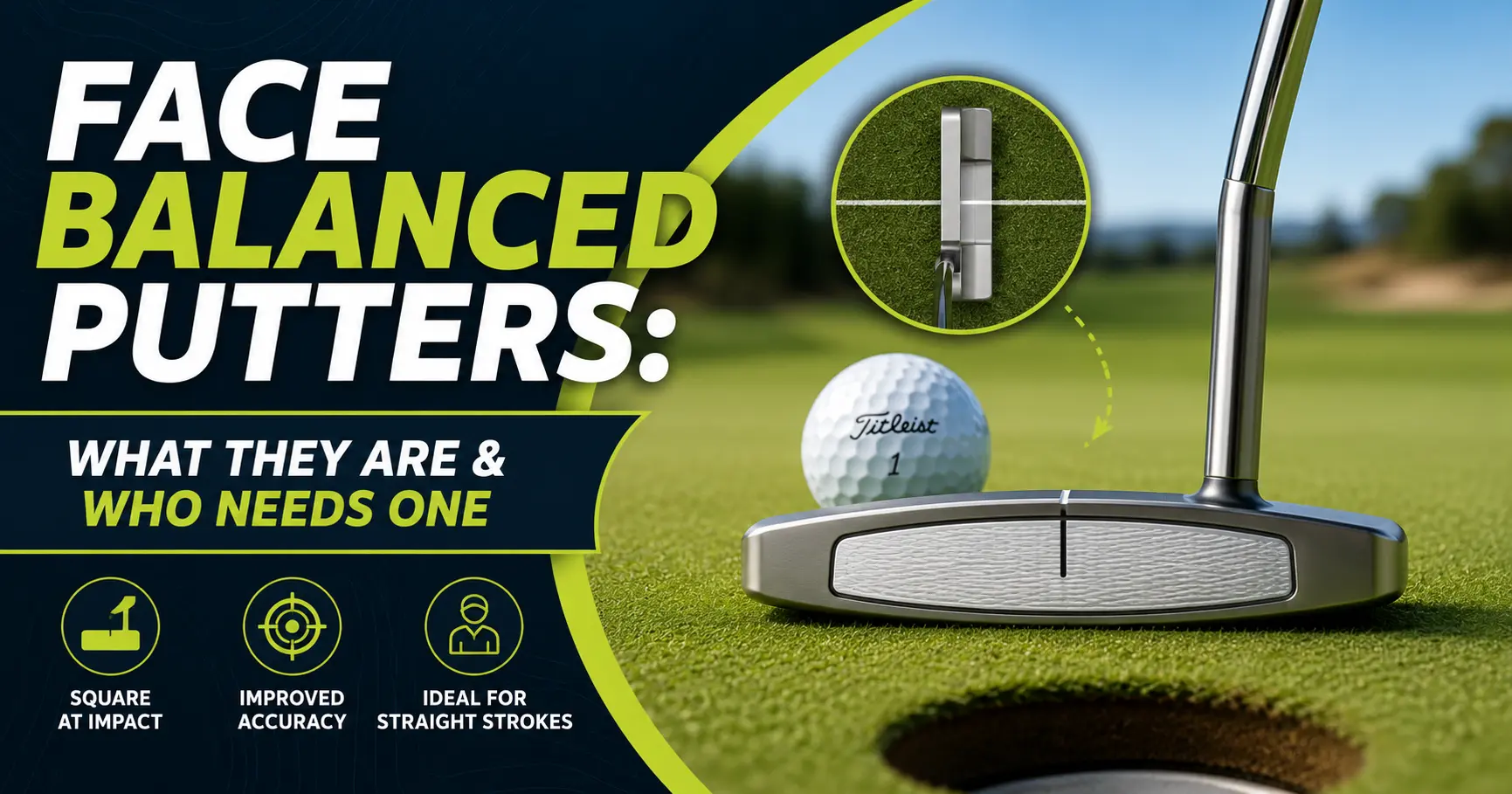
Quick Answer: A face-balanced putter has its center of gravity lined up directly under the shaft, so the face points straight up when you balance it across a finger and resists twisting through the stroke. It’s built for a straight-back-straight-through putting motion and shows up most often in center-shafted or double-bend-shaft mallets, though a handful of blades achieve it too. If your stroke has real arc in it, some toe hang will almost always serve you better.
Balance any putter across your index finger, shaft parallel to the ground, and let the head settle on its own. If the face points straight up at the ceiling, you’re holding a face-balanced putter. If the toe drops instead, you’re not, and no amount of “it looks like a mallet so it must be face balanced” changes that.
That distinction gets treated as a footnote on most spec sheets, sitting next to the loft and lie angle like it’s just another number. It isn’t. Face balance determines how much your putter fights, ignores, or reinforces the way your hands naturally move through a stroke. Get it wrong and you spend every round manually correcting a face angle your putter should be managing for you.
This guide covers what face balance actually is, how manufacturers build it into a head, which stroke type genuinely benefits from it, and which current 2026 putters actually qualify, with real specs instead of guesses. It also covers where face balance stops helping, because it isn’t the safe default some buying guides make it out to be.
What “Face Balanced” Actually Means
Every putter head has a center of gravity, the single point where its weight effectively concentrates. Face balance describes where that point sits relative to the shaft. When the center of gravity lines up directly under the shaft axis, the head has no tendency to rotate around it. Balance the club on your finger and the face has nothing pulling it open or closed, so it settles pointing at the sky.
Move that center of gravity off to the toe side, which is what happens with most heel-shafted blades, and gravity has something to pull against. The toe drops. The farther it drops, the more toe hang the putter has, and the more the face naturally wants to rotate open on the way back and closed through impact.
Neither design is better in the abstract. A face-balanced putter resists face rotation. A toe-hang putter encourages it. Which one helps you depends entirely on whether your stroke already has rotation built into it. Madknows has a full breakdown of toe hang, the degree ranges, and how to measure it in our toe hang putter guide. This piece focuses specifically on the 0° end of that spectrum and what actually qualifies for it.
The Balance Test: Check Any Putter in 10 Seconds
You don’t need a launch monitor or a fitting studio for this. You need the putter and about ten seconds.
- Hold the putter shaft loosely across your extended index finger, roughly where your bottom hand sits at address, not right under the grip cap.
- Let go with your other hand completely. Don’t guide the head.
- Watch where the face ends up once it stops moving.
- If the face points straight up, it’s face balanced. If the toe drops toward the ground at any noticeable angle, it has some degree of toe hang, and the further it drops, the more there is.
Do this with a few putters back to back, including ones that look similar at address, and you’ll notice something the pro-shop wall never tells you: head shape alone doesn’t predict the result. Two mallets that look nearly identical can balance completely differently depending on where the shaft enters the head.
How Manufacturers Actually Build Face Balance In
Face balance isn’t a separate part bolted onto a putter. It’s a byproduct of where the shaft connects to the head relative to that head’s own center of gravity, and manufacturers control it almost entirely through hosel and shaft-bend geometry.
A double-bend shaft routes the shaft so it enters the head directly above the center of gravity, which is the most common way current mallets achieve face balance. A center shaft or Onset Center (OC) design does something similar with a straight, unbent shaft positioned right over the CG instead of bending toward it. A crank hosel or plumber’s neck, by contrast, deliberately offsets the shaft toward the heel, which is exactly what creates toe hang.
The part almost every buying guide skips: the same head shape is frequently sold in more than one of these configurations. Odyssey’s Ai-ONE 2-Ball ships as both a “DB” (double bend, face balanced) and a “CH” (crank hosel, moderate toe hang) version of the identical head. Scotty Cameron’s 2026 Phantom 5 exists as a near-face-balanced single-bend build, a plumbing-neck version with moderate toe flow for a slight arc, and now a dedicated Onset Center build for straight-stroke players, all sharing the same wingback shape. Buying by silhouette alone tells you nothing about which one you’re getting. Always check the specific model suffix or ask the fitter to confirm.
Here’s real spec data from three current, verifiably face-balanced putters spanning different price points, checked against manufacturer and major-retailer listings:
| Putter | Head Type | How It Achieves Face Balance | Price |
|---|---|---|---|
| TaylorMade Spider Tour X Double Bend | High-MOI mallet | Double-bend hosel, eliminates toe hang entirely | $349.99 |
| Odyssey Ai-ONE 2-Ball DB | Mallet | Double-bend shaft over the head’s CG | $349.99 (MSRP) |
| Scotty Cameron Phantom 5 OC | Mid-mallet | Onset Center, straight shaft installed in line with the CG for low-torque, near-zero face rotation | $549 |
Notice that two of the three sit at the exact same price point despite coming from completely different brands and design philosophies, which is a reminder that price tier and balance type aren’t linked the way some shoppers assume. The Phantom 5 OC is marketed primarily around “low torque” rather than the term “face balanced,” but the mechanism, a shaft installed directly over the center of gravity, is the textbook definition. Titleist’s own team distinguishes it from earlier “face-balanced” Phantom builds mainly by degree, not by category.
Which Putting Stroke Actually Calls for Face Balance
A genuinely straight-back-straight-through stroke, one where the putter head travels back and through with almost no inside-to-square-to-inside arc, is the stroke face balance was built for. Because the club has nothing pulling it open or closed, it stays square with less manual effort from your hands, which is exactly what a straight-line stroke needs and exactly what an arcing stroke fights against.
Here’s the honest complication: fewer golfers have a truly straight stroke than assume they do. Standard putter lie angle sits around 70 to 72 degrees, not 90, and that geometry alone pulls the head slightly inside the line on the backswing whether you intend an arc or not. Titleist’s own Scotty Cameron has said publicly that not every mallet should be face balanced, and that golfers with any real arc in their stroke tend to putt better with some toe hang working with them instead of against them. If you’ve never actually checked your own stroke path, that’s worth doing before you buy based on the assumption that “straighter is safer.”
Video yourself from directly behind the ball, watch how far the putter head travels inside the target line on the backswing, and compare that against a straight edge. Madknows’ toe hang guide walks through exactly how to read that footage and translate it into a toe hang range if you find real arc. If the head barely moves inside the line, face balance is a legitimate fit. If it moves noticeably, don’t force a face-balanced putter just because the category sounds like the “correct” default.
Face-Balanced Blades Are Rare, But They Exist
Most classic blades are heel-shafted by design, which pulls the center of gravity toward the toe and produces meaningful toe hang almost automatically. That’s why “face balanced” gets treated as mallet-only shorthand in casual conversation, and it’s wrong.
A single-bend shaft can center the CG under the shaft on a blade head, the same principle a double-bend shaft applies to a mallet. Boutique makers build this deliberately: Meridian Putters’ Charleston Face Balanced model takes their standard blade profile and achieves face balance purely through a single-bend shaft, without changing the classic one-piece look the blade is known for. It’s not the norm for mass-market blades, and you should verify the exact configuration before assuming any blade qualifies, but the option exists for golfers who want a blade’s compact look with a face-balanced stroke fit. For the fuller shape-by-shape comparison, see Madknows’ blade vs. mallet putter breakdown.
Face Balanced Isn’t the Same as Zero-Torque
These two get lumped together constantly, and they’re solving the same problem through different means. Traditional face balance is purely geometric: align the shaft directly over the center of gravity, and the head has nothing to rotate around. Zero-torque designs, the approach L.A.B. Golf built its reputation on, use extra weighting positioned low and out toward the heel and toe to resist rotation regardless of where the shaft physically enters the head.
That’s a meaningfully different engineering philosophy, not a marketing repackage of the same idea. A face-balanced mallet and a zero-torque putter can both resist face rotation effectively, but they get there differently, and they can feel different in hand as a result. If you’re weighing a traditional face-balanced mallet against L.A.B.’s approach specifically, Madknows’ zero-torque putters guide and our best L.A.B. putters roundup cover that comparison directly.
The Honest Limitation: Face Balance Won’t Fix a Stroke Flaw
This is the part most buying guides leave out entirely. A face-balanced putter doesn’t correct a push or a pull. It removes face rotation, full stop, which only helps if your stroke doesn’t actually need that rotation in the first place.
Hand a face-balanced mallet to a golfer with a real, uncorrected arc, and the putter won’t square itself the way their hands were used to doing on their own. Their timing, built around a stroke that opens and closes the face, now has nothing to work with. The face stays open or closes too early depending on the mismatch, which shows up on the green as exactly the kind of miss the golfer was hoping the “more stable” putter would prevent. One putting instructor and former tournament player documented this exact experience firsthand: switching to a face-balanced design to force a straighter stroke, only to find the real fix was matching a putter to the arc that was already there, not fighting it with equipment.
If you put a face-balanced putter in play and find yourself actively manipulating the face to get it to open or close, that’s not a technique problem. That’s the putter telling you it doesn’t match your stroke.
Who Shouldn’t Buy a Face-Balanced Putter
Skip face balance if your stroke has any real, video-confirmed arc to it and you’re comfortable with the timing that arc already requires. Skip it if you’ve been custom fit into a toe-hang putter and you’re rolling the ball well. And skip it if you’re buying one purely because it’s marketed as the more forgiving or more “correct” option. Forgiveness comes from a head’s moment of inertia, which is a separate spec from balance type entirely. A face-balanced blade with low MOI isn’t automatically more forgiving than a toe-hang mallet with high MOI. They’re different variables, and conflating them is one of the most common mistakes in putter shopping.
Frequently Asked Questions
What does “face balanced” mean on a putter?
It means the putter’s center of gravity is aligned directly under the shaft, so the head has minimal tendency to rotate during the stroke. You can confirm it by balancing the shaft across a finger. A face-balanced putter’s face points straight up.
How do I know if my putter is face balanced without a fitter?
Balance the shaft across your finger or open palm at roughly the point your bottom hand grips it, and let the head settle freely. A face-balanced putter’s face points at the ceiling. Any noticeable toe drop means the putter has some degree of toe hang instead.
Is a face-balanced putter better than a toe-hang putter?
Neither is better on its own. A face-balanced putter suits a straight-back-straight-through stroke, and a toe-hang putter suits a stroke with real arc. The right choice depends entirely on your own stroke path, not on which category sounds more “advanced” or forgiving.
Can a blade putter be face balanced?
Yes, though it’s uncommon. Most blades are heel-shafted, which naturally creates toe hang, but a single-bend shaft can center the head’s mass under the shaft on a blade profile the same way a double-bend shaft does on a mallet. Boutique makers offer this more often than mainstream blade lines do.
Should a beginner use a face-balanced putter?
It’s a reasonable starting point if you haven’t yet developed a consistent stroke, since the design reduces the face-angle errors that come from an inconsistent, still-developing motion. As your stroke settles into a repeatable pattern, worth re-checking whether it’s genuinely straight or has picked up some arc, since that should guide whether you stay face balanced or move toward some toe hang.
What’s the difference between face balanced and zero torque?
Face balance achieves rotation resistance through shaft geometry, positioning the shaft directly over the head’s center of gravity. Zero-torque designs, like L.A.B. Golf’s putters, use added heel-and-toe weighting to resist rotation regardless of where the shaft enters the head. Both aim at the same result through different engineering paths.
Bottom Line
The finger test takes ten seconds and tells you more than any amount of staring at a putter on a wall. If your stroke is genuinely straight, a face-balanced mallet, or one of the rarer face-balanced blades, will feel like it’s doing less work fighting your hands. If your stroke has real arc, forcing face balance won’t make your stroke straighter, it’ll just remove the rotation your hands were relying on. Check your own stroke honestly before you shop the category, not after. If a straight stroke is confirmed and you want the toe-hang side of the comparison too, our toe hang putter guide covers the degree ranges in full, and our putter length and size chart is worth a look before you finalize any purchase, since balance type only matters once the length is already right.