
My first time watching a major, I had no idea what the leaderboard numbers meant. I knew the guy at -9 was winning. I didn’t know why. My playing partner – a 7-handicapper who’d been at it for 20 years – explained par in about two sentences, and suddenly the whole scoring system clicked. That’s what this article does: give you that two-minute explanation, then go deeper on everything your playing partner probably forgot to mention.
Quick Answer: Par is the score an expert golfer (scratch handicap) is expected to shoot on a hole or full course. A standard 18-hole course plays to a par of 72. Each hole carries a par of 3, 4, or 5 based on its length. Anything below par is good; anything above par means extra strokes taken.
Par in Golf, Defined Simply
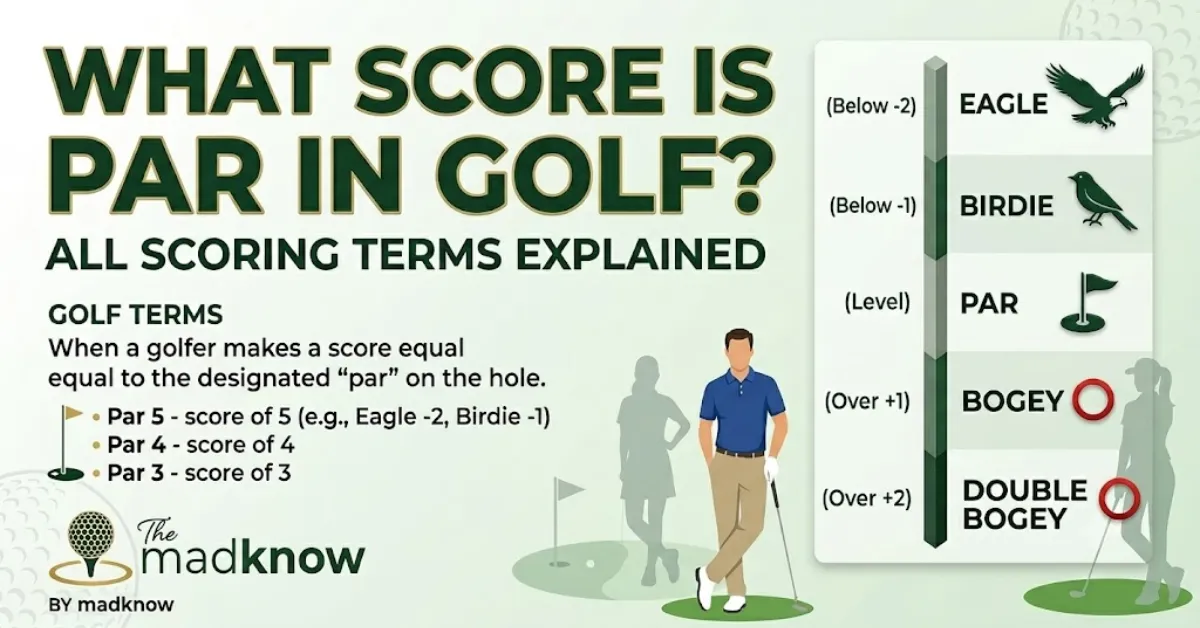
Par is the number of strokes a scratch golfer (a player with a zero handicap) should need to complete a hole or a full round under normal conditions. Score exactly that number of strokes and you’ve made par. And score fewer and you’re under par. Score more and you’re over par.
Every hole on a course carries its own par number – 3, 4, or 5 – and those numbers add up to the course’s total par. On a standard 18-hole layout, that total is almost always 72.
Why Par Always Assumes Two Putts
Here’s the part most explainers skip: par isn’t just about distance. The USGA designs every par score to include exactly two putts on the green. That’s non-negotiable. A par-3 hole gives you one shot to reach the green and two putts to hole out. A par-4 gives you two shots to the green and two putts. A par-5 gives you three shots plus two putts.
Understanding this changes how you read your own scorecard. Make the green in regulation – and you’ve given yourself a legitimate shot at par. Miss the green and you’re already scrambling, needing to get up and down in one chip and one putt just to salvage the number. Improving greens in regulation is the single fastest way to shoot more pars, because you’re working with the stroke budget the hole was designed around.
Par for 18 Holes and 9 Holes – The Numbers You Need
On a standard 18-hole course, par for the full round is typically 72. That’s the number you’ll see on most scorecards and every professional leaderboard.
What is par in golf for 18 holes, exactly? Par-72 is the most common layout, built around 10 par-4s, four par-3s, and four par-5s. But courses aren’t required to hit 72. A par-70 usually swaps two par-5s for extra par-4s. A par-71 splits the difference. Courses ranging from par-69 to par-73 all exist on legitimate tracks. Augusta National – home of the Masters – plays to par-72. So does Pebble Beach. So do most courses on the PGA Tour.
What is par in golf for 9 holes? Exactly half the 18-hole total, give or take. A standard 9-hole layout runs to par-36 — five par-4s, two par-3s, and two par-5s. Short or executive courses built with all par-3 holes play to par-27 for nine holes. Post a 9-hole round, and your scorecard shows your score relative to that 9-hole par number.
| Course Type | Total Holes | Typical Total Par | Common Layout |
|---|---|---|---|
| Standard 18-hole | 18 | 70–72 | 10× par-4, 4× par-3, 4× par-5 |
| Par-3 / Executive course | 18 | 54 | All par-3 |
| Standard 9-hole | 9 | 34–36 | 5× par-4, 2× par-3, 2× par-5 |
| Par-3 / Executive 9-hole | 9 | 27 | All par-3 |
How Every Hole Gets Its Par Number – The USGA Yardage System
The USGA sets the official framework for how par is assigned to each hole, and distance is the primary factor. Course raters measure the “effective playing length” of each hole – which accounts for elevation, prevailing wind, and obstacles, not just the raw yardage on the map. A steep uphill par-3 might measure 170 yards but play like 195. A downhill par-4 at altitude might shrink by a full club.
Here are the USGA yardage guidelines used to assign par, including the column no competitor table currently includes – the regulation number of shots to reach the green:
| Par | Men’s Yardage Range | Women’s Yardage Range | Shots to Reach Green | Putts Assumed |
|---|---|---|---|---|
| 3 | Up to 260 yards | Up to 220 yards | 1 | 2 |
| 4 | 240–490 yards | 200–420 yards | 2 | 2 |
| 5 | 450–710 yards | 370–600 yards | 3 | 2 |
| 6 | Over 670 yards (rare) | Over 570 yards (rare) | 4 | 2 |
Par-6 holes exist – rarely – but you’ll almost never encounter one in professional competition. The USGA doesn’t officially recognise par-7, and courses claiming to have one aren’t running an official rating for it.
Notice the overlap between par values. A 250-yard hole could legitimately be rated par-3 or par-4 depending on elevation change, a dogleg, or a water carry. That’s the course rater’s judgment call, not an error.
All 7 Golf Scoring Terms, Ranked Worst to Best
Ask anyone what are the 7 golf scoring terms and you’ll get a different list every time. Here’s the definitive version — 10 terms total if you count every named score, but the seven most important ones start with bogey and end with albatross. This table includes columns no competitor currently has: what the score looks like on a specific hole and what it means on your scorecard.
| Scoring Term | Score vs Par | Example on Par-4 | Example on Par-5 | Scorecard Symbol |
|---|---|---|---|---|
| Condor | −4 | Hole-in-one (rare par-5) | N/A | Rare; not standardised |
| Albatross / Double Eagle | −3 | 1 stroke (ace) | 2 strokes | Triple circle |
| Eagle | −2 | 2 strokes | 3 strokes | Double circle |
| Birdie | −1 | 3 strokes | 4 strokes | Single circle |
| Par | 0 (even) | 4 strokes | 5 strokes | Plain number |
| Bogey | +1 | 5 strokes | 6 strokes | Single square |
| Double Bogey | +2 | 6 strokes | 7 strokes | Double square |
| Triple Bogey | +3 | 7 strokes | 8 strokes | Triple square |
| Quadruple Bogey | +4 | 8 strokes | 9 strokes | Rarely recorded separately |
| Ace / Hole-in-One | −2 on par-3 | N/A – always par-3 | N/A | Single circle (eagle) |
A Scoring Term You’ve Probably Never Heard Of: The Condor
Four under par on a single hole. Only four condors have ever been recorded in golf history, and every single one required a player to hit a hole-in-one on a par-5 – usually by cutting a severe dogleg with a driver. Mike Crean did it in 2002 at Green Valley Ranch Golf Club in Denver, aided significantly by the mile-high altitude. At sea level, it’s essentially impossible. Don’t plan your scorecard around it.
What “Under Par” Means – And Why the Numbers on TV Make Sense
Under par means you’ve taken fewer strokes than the course requires. Every stroke saved below par shows up as a negative number. Shoot a 71 on a par-72 course and you finished at −1. Shoot a 67 and you’re −5.
Here’s what each under-par level means in concrete terms:
- (one under, birdie): One exceptional hole – a 3 on a par-4, or a 4 on a par-5
- (two under, eagle): Two birdies and a par on three holes, or a 3 on a par-5
- (three under par in golf): Three birdies, or the rare albatross – a 2 on a par-5
- (four under par in golf): Four birdies in a row, or an eagle plus two birdies
- (five under par in golf): What a genuinely hot round looks like for a scratch golfer
For professional reference: Rory McIlroy shot −16 over 72 holes to win the 2011 US Open at Congressional – the biggest winning margin in that event’s modern history. Tiger Woods shot −12 in a single round (59) at the 2020 Masters. Watching those numbers on the leaderboard makes far more sense once you understand what “under par” actually represents.
What is under par in golf for a regular viewer? It’s the number telling you how many strokes ahead of the course’s expected standard a player currently sits. The lower (more negative) that number, the better. A player at −7 is beating a player at −3 by four strokes.
The TV Invention That Made This All Make Sense
Most people don’t know this: scoring relative to par wasn’t the standard way to broadcast golf until the 1950s. Before that, TV showed only raw stroke totals. You had no way to compare players who’d played different numbers of holes. Frank Chirkinian – a CBS producer, not a golfer – changed everything by introducing the now-universal red-number/black-number display for scores relative to par. Red for under par, black for over. Every golf broadcast since has used that system. One producer’s decision shaped how a billion people understand golf scoring.
Why Is It Called Par? The Stock Market Story Behind the Word
The word “par” has nothing to do with golf originally. It comes from Latin – “par” meaning “equal” or “equality” – and entered the English language via the stock exchange, where traders used it to describe a stock trading at its standard face value. A stock could trade above par, below par, or at par.
In 1870, a Scottish golf writer named A.H. Doleman asked two professionals – David Strath and James Anderson – what score would win the Open Championship at Prestwick, a 12-hole course at the time. They said a perfect round would produce a score of 49 strokes. Doleman called that score “par for Prestwick.” Young Tom Morris won with a score two strokes over that standard. Par had entered golf.
The USGA didn’t formally define par in its modern sense until 1911, when it established specific yardage bands to determine whether a hole deserved a 3, 4, or 5. Before that, “par” and “bogey” were used interchangeably. Bogey meant roughly the same thing – the score a good player should make. Over time, par became the standard for scratch golfers, and bogey shifted to mean one over par for everyone else.
The Latin root still shows up in everyday English: “on par” means equal to a standard; “below par” means underperforming; “par for the course” means typical or expected. Golf borrowed a financial term and made it universal.
What Par Actually Means for Real Golfers (Not Just Scratch Players)
Here’s the honest truth nobody tells you: par is not a realistic target for most golfers. Ever.
The USGA’s 2025 Golf Scorecard – based on 82 million rounds posted under the World Handicap System – puts the average male handicap at 14.0 and the average female handicap at 28.8. Shot Scope data from over 200,000 rounds tracked in 2024 shows the average amateur finishing 14.97 strokes over par per round. On a par-72 course, that’s a score of roughly 87.
So par is not the goal. Par is the finish line most golfers spend their whole career chasing and never cross – and that’s fine. The game’s scoring system works because par gives every player a shared reference point regardless of skill level.
Here’s what par realistically means at different skill levels:
| Handicap Index | Typical Score on Par-72 | Pars Per Round | Birdies Per Round | Practical Goal |
|---|---|---|---|---|
| 0 (Scratch) | 72 | 12–14 | 2–4 | Break par |
| 5–9 | 77–81 | 8–11 | 1–2 | Break 80 |
| 10–15 | 82–87 | 4–7 | 0–1 | Break 85 |
| 16–20 | 88–92 | 2–4 | ~0.3 | Break 90 |
| 21–28 | 93–100 | 0–2 | Rare | Break 100 |
| 28+ (Avg. female) | 100+ | 0–1 | Very rare | Enjoy the round |
A golfer with a 16–20 handicap averages just 3.6 pars per round, according to data from MyGolfSpy and TheGrint. Birdies happen about 0.3 times per round – meaning once every three rounds or so. That context changes how you should think about your own scorecard. Making par on a hole isn’t failure. For most golfers, making par on a difficult par-4 is a genuine achievement worth marking.
One thing worth saying clearly: if you’re a 20-handicapper and you’re disappointed every time you make a bogey, you’ve got the wrong target. Bogeys are perfectly legitimate golf for most of the people who play this game. Your goal is to make more of them and fewer doubles, not to chase scratch-golfer par.
Improving how you hit your irons – specifically your ability to hit more greens in regulation – is the single most data-supported path to shooting closer to par over time. A scratch golfer hits 52% of greens in regulation. A 25-handicapper hits 9%. Close that gap and your pars will follow.
Is 72 Always Par? (And Other Questions Real Golfers Ask)
No. Par-72 is the most common course total, but courses can – and do – play to other numbers. Course designers set par based on the individual holes, and the total depends on how many par-3s, par-4s, and par-5s they’ve included.
A par-70 course typically replaces two par-5s with extra par-4s, putting a bigger premium on precise iron play. A par-73 course usually adds an extra par-5, giving long hitters more birdie opportunities. Most elite tour layouts run between par-70 and par-72. Executive and resort courses often come in lower – par-60 or par-62 – because they’re built with mostly short holes.
The course rating and slope rating tell you more about difficulty than par alone. A par-72 with a course rating of 75 is genuinely hard – even scratch golfers are expected to shoot three over. A par-72 rated at 69 plays short and easy by comparison.
Frequently Asked Questions
No, 72 is the most common par score for an 18-hole course, but courses can play to any total par. Most fall between 70 and 73. Par-70, par-71, and par-73 courses are all common. The total par depends on how the individual holes are designed and rated. The course’s scorecard will always show you the exact par for every hole and the total for the round.
Tiger Woods became a billionaire through a combination of career prize money and decades of endorsement earnings, making him the first professional golfer to reach that figure. His net worth crossed $1 billion largely through his Nike deal, course design business, and TGR Ventures.
Golf involves rotation and impact forces that can aggravate spinal stenosis in some players. Many golfers with spinal stenosis play without significant problems by modifying their swing — reducing rotation, using more upright posture, and avoiding over-swinging. Check with a physician or physical therapist who understands golf mechanics before playing through spinal symptoms.
Yes. Unlike many professional sports, golf has no rule prohibiting players from smoking during a round. Several tour pros have smoked on the course throughout golf history. Whether it’s allowed on a specific golf course is a club policy matter, not a USGA rule.
The Scoreboard Makes Sense Now
Par is the baseline everything else in golf scoring is measured against. A 72 on a par-72 course is even. A 68 is −4. A 90 is +18. Once you know the baseline, every number on a leaderboard – or your own scorecard – starts making sense.
The most useful thing to remember: par is set for scratch golfers, not for you. Your personal par is the score you’ve been building toward. A bogey golfer shooting 90 is doing exactly what their handicap predicts. That’s not failure – that’s golf. Making one fewer double bogey per round is the real path toward better scores, and understanding what par actually represents is the first step to setting goals that make sense for where your game actually is. For more on the equipment choices that support lower scoring at your level, check out our golf ball guide for what works across different handicap ranges.