
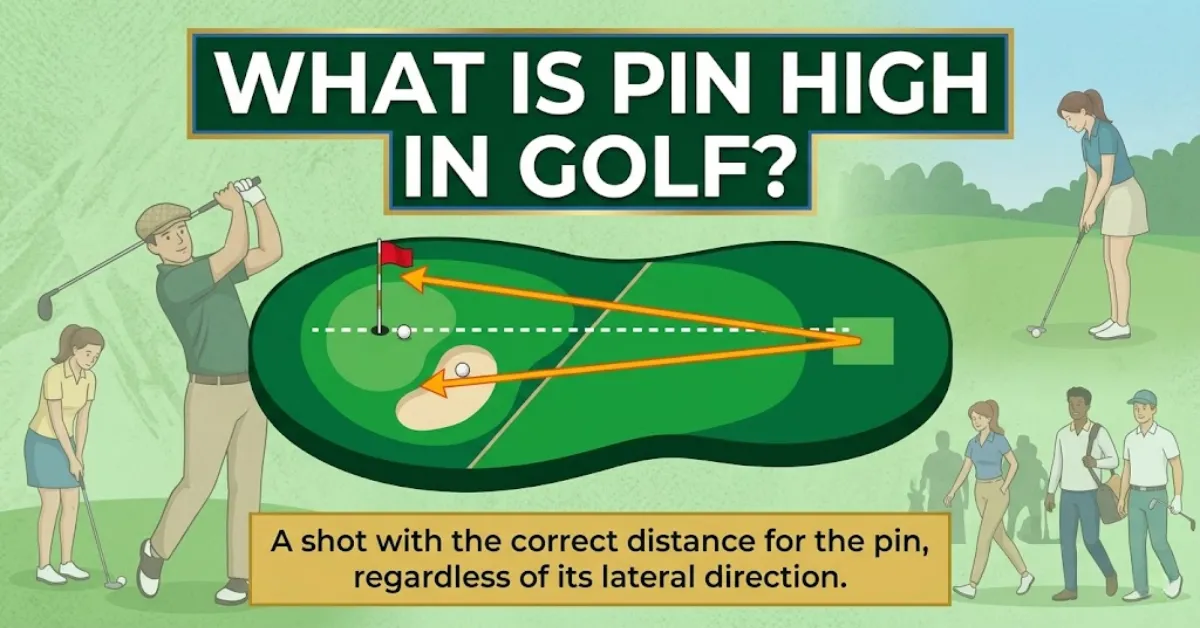
Pin high in golf means your approach shot traveled the exact right distance to reach the hole — even if the ball finished left or right of the flag. It is one of the most-used terms on the golf course, and understanding it is the first step to dialling in your distance control.
In this guide, we explain what pin high means, how it differs from pin low, whether you can be pin high off the green, and — most importantly — how to start hitting pin high more consistently.
Have you ever heard people using words like pin high or hole high while playing on a golf course?
Did you not understand what these words mean?
If so, this article is for you.…
Pin high means that when you hit the ball, it reaches near the pin (the stick). It doesn’t necessarily mean the ball is directly above or very close to the pin, but it simply means your shot was the correct distance. It might not be a perfect shot, but it’s a positive result because it shows you judged the distance correctly.
Pin high is a term that seems simple, but it holds a lot of importance. It can improve your approach shots, and if you master it, it can help you gain control over your scorecard. This way, the quality of your game can improve.
So, let’s understand more about pin high and see how it can improve your game. This will not only help you understand the rules of golf better but also bring you new joy associated with the game.
What is a Pin in Golf?
It’s a good thing! Let’s explain it in words that are easy for everyone to understand.
When you go to play golf, the first thing you need to understand is what a pin is. It’s also commonly called a flagstick. It’s a long, thin stick with a small flag on top. This flag marks the hole where you want to put the ball. This is your target when you play golf. The pin makes it easier for you to know where your target is and helps you choose the right distance and angle.
The pin isn’t just a target; it’s a very important part of the game of golf. Golfers use the pin to figure out the direction of the wind, how sloped the ground is, and how to plan their shot. If there were no pin, finding the hole would be like looking for a needle in a haystack.
Now you understand that in pin high, the pin refers to the golf flagstick. This term comes from the long and thin shape of the stick. Another term, hole high is also used, which means the same as pin high. Both refer to the same thing.
You should also know that the pin isn’t just there to show you where the hole is. It also helps golfers improve their path. So, the next time you play golf, don’t just think of the pin as a target—think of it as an important tool for your game.
What Does Pin High Mean in Golf?
So, you’ve understood what a pin is? Now, let’s think about this question: What does “pin high” mean in golf?
In simple words, “pin high” means that your ball has landed the same distance away from the pin as where you hit it from. Even though the ball might be to the left or right of the pin, if it’s at the correct distance, it’s called “pin high.”
For example, if the pin is 150 yards away, and you hit your shot exactly that far, even if your ball is 10 feet to the left or right of the pin, it means you’ve hit it pin high. This shows that you’ve judged the distance perfectly, and it’s a sign of great skill.
Now, let’s look at it another way. Imagine you’re trying to land your ball on the green. Your ball goes to the left, but when you reach the green, you see that the ball is at the exact right distance! It’s level with the flag in height. This means you’ve hit it “pin high.”
During a golf game, if your fellow golfers say you’ve hit it pin high, it’s a way of encouraging you. You might have missed the green, but the important thing is that you hit the ball the right distance. And that’s a key part of improving your game.
Lastly, remember that the rules of “pin high” also include some conditions about the green. For example, if your ball is within two inches from the right side of the green, it will count as “pin high,” but according to the rules, it won’t be considered on the green. Golf is a strange game, but these small details are very important in it.
To summarize, “pin high” means your ball is at the correct distance, and it’s proof of your skill. If you’ve done it, congratulate yourself because it’s not an easy thing to do!
Pin High vs Pin Low — What’s the Difference?
Pin high and pin low both describe your ball’s distance relative to the hole — but they mean opposite things. The pin high means you hit the correct distance and your ball finished level with the flagstick. Pin low means your shot came up short, finishing closer to the front of the green than the hole.
The difference matters more than most golfers realise. Statistics consistently show that amateur golfers miss short far more often than they miss long — meaning most golfers are pin low the majority of the time, not pin high. The tendency to under-club is one of the most common mistakes in recreational golf.
Being pin high gives you a flat, level putt with full line of sight to the hole. And being pin low means your putt is uphill, which makes distance control harder. Being pin high but left or right is still considered a positive result — your distance was correct, and you only need to fix your direction.
What Does Hole High Mean in Golf?
You might have heard terms like hole high or pin high. Both are used interchangeably, especially during the game of golf.
So, what does “hole high” mean?…..
Let’s understand it in simple words. “Hole high” refers to a shot that lands very close to the hole, but it doesn’t necessarily go directly into the hole. Even if your ball is lying near the hole, it is still considered a good result.
Now you might say that “pin high” and “hole high” mean the same thing. The “pin” is the stick that marks the hole on the golf course, either inside or outside the hole. Since the pin is close to the hole, both terms are often used with the same meaning.
The goal is to get your ball as close to the hole as possible. This way, you put yourself in a good position to get the next shot into the hole. Understanding and controlling the distance accurately is very important.
Whether you call it “pin high” or “hole high,” the ultimate goal is the same: to get your ball close enough to win. This means you need to use your hands, eyes, and mind together to maximize your advantage.
Can You Be Pin High Off the Green?
Yes — you can absolutely be pin high without being on the putting surface. If your approach shot finishes in a greenside bunker, the rough, or just off the fringe but at the same depth as the hole, golfers and caddies will still call it pin high.
Being pin high off the green is still considered a good distance result. It tells you that your club selection and swing produced the right yardage — the miss was lateral, not a distance error. From pin high in a bunker, your sand shot will be a more neutral, level-ground recovery rather than a steep uphill blast or a delicate chip with a lot of green to work with.
Why Is It Called Pin High?
The term comes from the word “pin,” which is the informal name golfers use for the flagstick — the tall pole placed in the hole to help players see where to aim from a distance. “High” in this context does not mean above the hole; it means level with it in terms of distance from the tee or fairway.
Technically, “hole high” or “flag high” would be more accurate names since the official Rules of Golf do not use the word “pin” at all — the correct term in the rulebook is “flagstick.” But “pin high” is the term that stuck in everyday golf language and is universally understood on any golf course in the world.
You may also hear “flag high” used occasionally, but it never became as widely adopted as “pin high.” All three phrases mean exactly the same thing.
How to Hit Pin High More Often — Distance Control Tips
Knowing what pin high means is only half the battle. Here is how to start hitting it more consistently:
1. Know your real carry distances, not your best-ever distances
Most golfers overestimate how far they hit each club because they remember their best shots, not their average ones. Track your carry distance for every club over 10–15 rounds and use the average. A realistic number is the one that actually gets you pin high — not the distance you once hit it perfectly on a downhill hole with the wind behind you.
2. Use a rangefinder or GPS watch every single shot
Guessing yardage is the fastest way to miss pin high. Laser rangefinders give you exact carry to the flag in seconds. GPS watches like the Garmin Approach or Bushnell Ion series give you front, middle, and back of green distances. If you are not using one of these tools on every approach shot, you are giving up control before you even swing.
3. Account for elevation changes
A shot played uphill plays longer than the flat yardage suggests — the ball needs to climb. A downhill shot plays shorter. As a basic rule, add or subtract roughly one yard for every foot of elevation change. On steep holes, this can add up to a full club difference.
4. Adjust for wind
Into a headwind, take more club and swing smoother — a harder swing with less club creates more spin and the ball goes higher and shorter, not farther. Downwind, the ball carries further and often rolls out more after landing. A knockdown shot — taking one extra club and swinging at 80% — is the most reliable way to keep distance control in wind.
5. Close your club gapping gaps
If you have a 30-yard gap between your 7-iron and your 9-iron but nothing in between, you will regularly face yardages that fall into that gap and have no confident club to reach for. Consider adding a gap wedge, adjusting lofts, or practising half-swings with your in-between clubs.
Pin High and the Green in Regulation Stat
Hitting the ball pin high is directly connected to one of the most important scoring statistics in golf: greens in regulation (GIR). A green in regulation means you reached the putting surface in the correct number of strokes — two fewer than par. A par-4 means on the green in two shots. A par-3 means on the green in one shot.
Being pin high is essentially the distance component of hitting a GIR. If your approach finishes pin high but just to the left or right of the hole, you are extremely close to a GIR result — and any putt from pin high is, at worst, a flat putt with good speed control.
Tour professionals hit greens in regulation around 65–70% of the time. Most amateur golfers hit GIRs only 25–35% of the time. Improving your distance control to hit more pin high approach shots is one of the most direct ways to start increasing that percentage and lowering your scores.
Technology That Helps You Hit Pin High
Modern golf technology makes it significantly easier to dial in your distance control and start hitting pin high more often. Here are the main tools golfers use today:
Laser rangefinders — A laser rangefinder gives you the exact yardage to the flag by reflecting a laser beam off the pin. Bushnell, Precision Pro, and Blue Tees are among the most popular brands. Most models are legal for use in competition (check local rules). They give the most accurate single-flag distance of any tool available.
GPS watches — GPS golf watches like the Garmin Approach S series, Bushnell Ion, and Shot Scope V5 give you real-time distances to the front, middle, and back of every green on thousands of pre-loaded courses. They also track your shots, so over time you build an accurate picture of your actual carry distances with each club.
Shot-tracking apps — Apps like Arccos Golf and Shot Scope use sensors on your club handles to automatically track every shot without you needing to tap anything. Over a season, they build a detailed picture of your real distances and where on the green your approach shots finish — including how often you are pin high versus short.
What Happens If You Hit the Pin in Golf?
Hitting the pin in golf can be both a blessing and a curse. When your ball is moving, if it hits the pin (the flag), two things can happen: either the ball will stop near the pin or the hole, or it might bounce off unexpectedly in another direction and move away. What happens depends on the speed and angle of your shot.
Sometimes, hitting the pin can save you from trouble. For example, if your ball is moving too fast, the pin can stop it and keep it close to the hole. But in other cases, if the ball bounces off the pin, it might move away from the hole. The rules of golf allow you to choose whether to leave the pin in or take it out, so it’s up to you to decide whether to take the risk of hitting the pin or not.
If you successfully aim for this small target, don’t worry! The ball can go anywhere, but you get the chance to play it from wherever it ends up.
Hitting the pin has both positive and negative sides. Sometimes you want the ball to hit the pin because it can stop the ball from going past the green or slow it down. But there are also times when you think you’ve made the perfect shot, but the ball hits the pin and bounces off in the wrong direction. This is where you win some and lose some.
Remember, keeping the pin in the middle can act like a backstop, but it’s not necessary for your ball to hit it every time. I also think aiming your shots toward the pin is a good thing because it makes the hole look bigger visually and helps you.
Rule Change About Hitting the Pin While Putting
In 2019, two major golf organizations, the USGA and R&A, made an important rule change. Now, golfers are allowed to leave the pin (the stick with the flag on it) in place when putting the ball, instead of removing it. This change sparked debate among players. Some players believed it was better to leave the pin in place, while others thought removing it was more appropriate to avoid any interference with the ball.
This new rule has changed the way golf is played. Now, players have more options to decide whether to leave the pin in or take it out. These decisions depend on which method works best for them. It also depends on practicing and trying different approaches. Ultimately, you should do what gives you the best result.
In a way, this change is an effort to simplify golf rules, making the game more interesting and easier to play.
Conclusion
If you are a golfer and want to improve your game, understanding “pin high” is very important. Pin high is not just a term; it shows how accurate and well-placed your shots are. These two things—distance control and accuracy—can greatly improve your game.
Now that you know what pin high means and how to hit it more often, the next step is building a consistent pre-shot routine so your distance control holds up under pressure. Check out our guide to iron distance control at Madknows.com for step-by-step practice drills you can take straight to the range.