
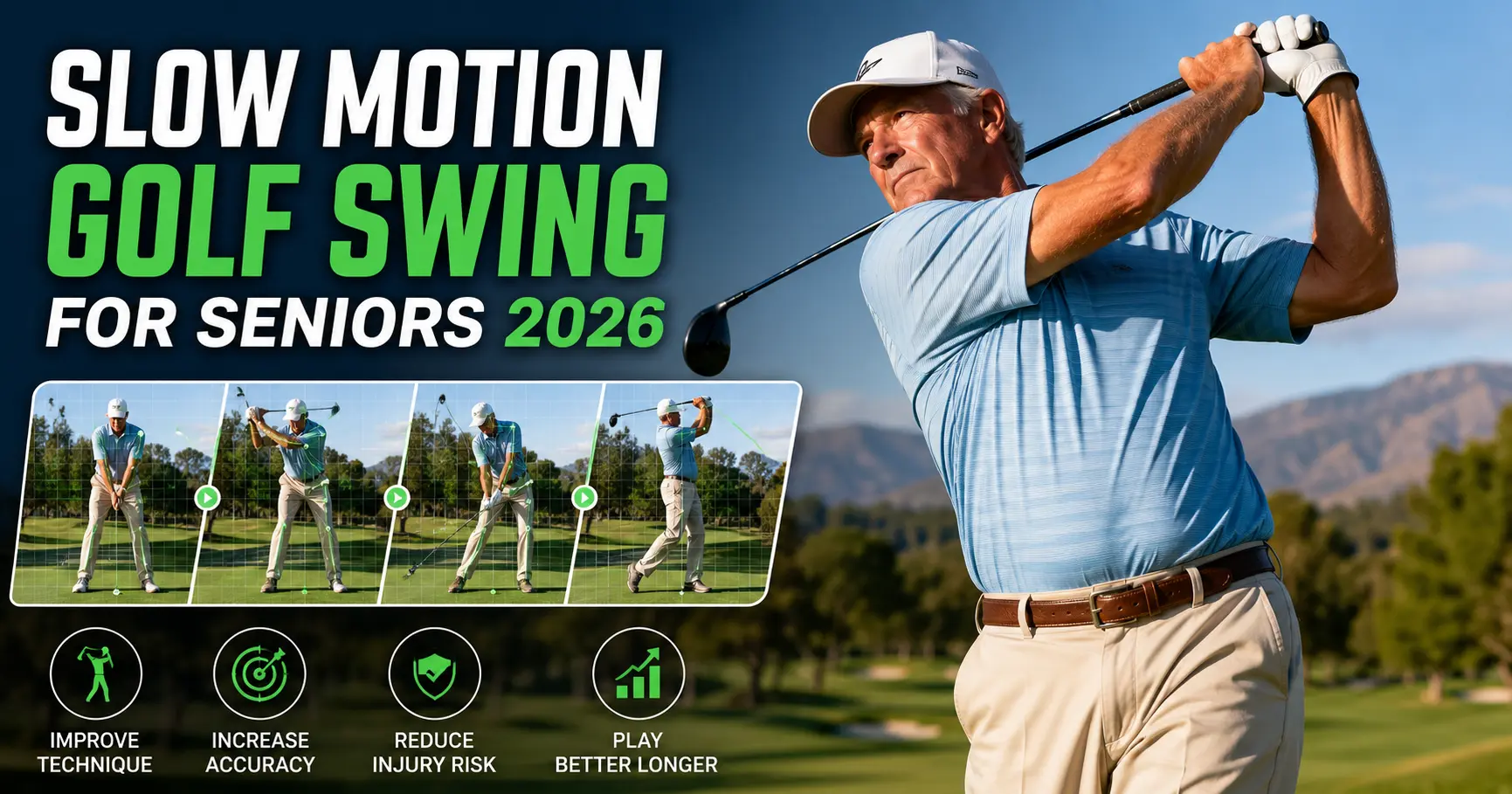
Quick Answer: A slow motion golf swing means swinging at roughly half your normal speed while keeping the same 3:1 backswing-to-downswing tempo ratio. For seniors, 10 slow reps before every session rebuilds swing sequencing that flexibility loss breaks down, without the joint stress of a full-speed swing.
Search slow motion golf swing for seniors on YouTube and you’ll find dozens of videos showing what a slow swing looks like. Almost none explain why it works, or how slow is actually useful versus just pointless. The real answer involves motor learning research, a tempo ratio that doesn’t change no matter your age, and a specific weakness in aging bodies that most instruction ignores entirely. Here’s what actually matters: the mechanics, the drills, and the one mistake that turns slow motion practice into wasted range time.
Why Slow Motion Practice Works Better for Aging Bodies (Not Just Slower Ones)
Most instruction treats every golfer the same. Slow down, watch your positions, speed back up. That advice misses something specific to golfers over 55: your body has changed the mechanics you’re trying to slow down.
Swing speed drops roughly 1 to 2 mph per year once you pass 50, largely because fast-twitch muscle fibers decline with age. Hip rotation and thoracic spine mobility shrink too, and that combination forces a shorter, more restricted turn whether you intend it or not. GOLFTEC’s coaching data shows driver swing speeds under 90 mph are common past 60, a threshold that changes which drills even make sense.
Here’s the part nobody mentions: a restricted hip turn doesn’t just cost you distance. A 2025 cross-sectional study of professional golfers found that limited hip rotation correlates with increased lumbar spine extension, and that pattern raises injury risk at the lower back. A body that’s turning less needs a swing that asks less of it, not a slow motion copy of the swing you had at 40.
That’s the real case for a slow motion golf swing for seniors. It isn’t about looking pretty on camera. It’s about rebuilding a swing your current hips and shoulders can actually repeat, at a speed slow enough to feel where the compensation happens before it becomes a habit.
The Real Science Behind Slow Motion Practice (Backswing, Downswing, and Reaction Time)
A full golf swing lasts about a second and a half from takeaway to finish, with the clubhead traveling more than 50 feet as it circles your body. Split that into halves and the numbers get interesting. The backswing eats up roughly 0.8 seconds. Your downswing is over in 0.2 to 0.4 seconds.
Human reaction time to a conscious thought averages 150 milliseconds. Do the math and you’ll see the problem: by the time you think about a swing correction during your downswing, the ball is already gone. Full speed doesn’t give your brain enough time to apply anything you’re working on.
Slowing the swing down changes that equation completely. Golf instructors who’ve studied this report that dropping about 10 mph below your normal swing speed lets a golfer make real-time adjustments and still make solid contact, while going slower than that tends to break down contact quality. That 10 mph window is the sweet spot, not “as slow as possible.”
This isn’t a new idea. Ben Hogan reportedly built entire practice sessions around slow, deliberate repetitions, programming his body through repetition before ever swinging fast. Modern sports science calls this chunking, breaking a complex movement into pieces the nervous system can actually absorb. For a senior golfer relearning a swing around a changed body, that’s exactly the tool you need.
How Slow Is “Slow Motion”? The 3:1 Tempo Ratio Every Senior Swing Should Keep
Tempo and speed are not the same thing, and mixing them up is where most slow motion practice goes wrong. One measures the ratio between backswing time and downswing time. The other just measures how fast you’re moving.
Every efficient swing, from tour pros to 20-handicap seniors, tends to land close to a 3:1 ratio. Backswing takes three units of time, downswing takes one. Slow the whole swing down and keep that 3:1 ratio intact, and you’re doing it right. Let the ratio drift instead, and you’re just making bad habits in slow motion.
Here’s a simple way to feel it. Count “one, two, three” on the way back, then “one” on the way through. Say it out loud the first few times you try this on the range. Once the rhythm feels automatic, you can drop the counting and just feel the 3:1 relationship in your hands.
For seniors specifically, this matters more than it does for a 30-year-old. A slower swing speed already stretches out your transition window, and rushing that transition is the single most common cause of a topped or thin shot among golfers over 60. Nail the ratio in slow motion first. The full-speed version tends to sort itself out from there.
The 3-Tempo Slow Motion Drill (Step by Step)
Build a slow motion golf swing for seniors in three stages: slow, medium, and full speed, in that order, every time. Skipping stages is the single biggest reason slow motion practice fails to transfer to the course.
| Stage | Swing Speed | Reps | Focus Point |
|---|---|---|---|
| Slow | ~50% of normal | 5 | 3:1 tempo ratio, flat lead wrist at impact |
| Bridge | ~75% of normal | 5 | Weight forward at finish, same tempo ratio |
| Full | Your real pace | 5 | Only once the first two stages felt clean |
- Half-speed reps (5 swings). Swing at roughly 50% of your normal speed, focusing only on keeping the 3:1 tempo ratio. Check that your lead wrist stays flat through impact and your weight has moved to your front foot by the finish. Don’t worry about ball contact yet. If you’re hitting balls, tee one up and just brush the grass.
- Three-quarter speed reps (5 swings). Increase to about 75% of full speed. This is where most golfers feel the breakthrough. Golf instructor research on slow-speed practice shows a jump of roughly 5 mph in swing speed is common at this stage compared to the half-speed reps, even though it doesn’t feel much faster. Keep checking the same two positions: flat lead wrist, weight forward at the finish.
- Full-speed reps (5 swings). Swing at your real pace, but only after the first two stages felt clean. If the wheels come off here, drop back to three-quarter speed and rebuild before trying full speed again.
Run this sequence at the start of every range session, not as a one-time fix. Ten to fifteen minutes, three stages, done. The positions you rehearse slow are the ones your body defaults to under pressure, which is the entire point of doing this in the first place.
Where in the Swing Slow Motion Practice Helps Most
Most instruction treats the golf swing as one continuous motion, and tells you to slow all of it down evenly. That’s backwards. Some parts of your swing benefit enormously from slowing down. Others barely need it at all.
Your transition, the split second where backswing ends and downswing begins, is where slow motion practice earns its value most. Seniors rush this moment more than any other part of the swing, usually because a shorter, more restricted backswing, itself a byproduct of reduced hip and shoulder rotation, leaves less time to feel the change of direction. Slowing down specifically through the transition, even while keeping your backswing and follow-through closer to normal pace, fixes more swings than slowing the entire motion evenly.
Coaches who work with senior clients often recommend physically shortening the backswing itself, stopping the lead arm around parallel to the ground instead of the longer arc a 30-year-old might use. Combine a shorter backswing with a deliberately unrushed transition and you get a swing that matches what your body can actually deliver, not what it delivered twenty years ago.
If you only have five minutes before a round, skip the full slow motion sequence and rehearse the transition alone. Three slow, deliberate reps focused purely on that change of direction will do more for your first tee shot than ten rushed full swings.
3 Slow Motion Drills Built for Limited Flexibility and Joint Pain
Standard slow motion drills assume a full range of motion. If arthritis, a fused vertebra, or a stiff shoulder limits how far you can turn, forcing a full-length backswing in slow motion just grooves the same compensation pattern you’re trying to fix. These three drills work within a restricted range instead of fighting it.
- The Half-Swing Wall Drill. Stand with your back nearly touching a wall, club across your chest, and rotate only as far as feels comfortable in each direction. This builds rotational awareness for a shorter backswing without ever stressing a joint past its limit. Ten slow reps, each direction, before you touch a club for real.
- The Feet-Together Swing. Set up with your feet touching, then make slow, three-quarter-length swings. Balance issues show up immediately at this width, which forces your weight transfer to happen through your hips and core instead of a big lower body slide that stresses your knees.
- The Grip-and-Pause Drill. Take your grip, swing back slowly to hip height, and pause for two full seconds before starting down. This isolates the transition, the exact spot most senior swings break down, without ever asking your body for a full-length backswing. If your hands ache by the back nine, a grip that doesn’t require squeezing hard, like a 10-finger grip, makes this drill, and every swing after it, noticeably easier to repeat pain-free.
None of these drills require full range of motion, and that’s the point. A senior golfer with 40 degrees of hip turn benefits more from a swing built around 40 degrees than one built around the 90 degrees a tour player uses.
When Slow Motion Practice Stops Helping (The Honest Limitation)
Here’s what most slow motion content won’t tell you: practicing exclusively in slow motion can actually cap your swing speed gains over time. If every rep on the range happens at half speed, your body never rehearses the sequencing that full-speed delivery demands. Slow motion teaches positions. It doesn’t teach speed.
That’s why the three-tempo progression matters more than the slow reps alone. Slow motion practice is a tool for fixing sequencing and building feel, not a replacement for swinging at your actual pace on the course. If you already have solid tempo and clean contact, extra slow motion reps won’t move the needle much further. Put that practice time into speed training instead, or just play more golf.
Equipment Adjustments That Make Slow Motion Practice More Effective for Seniors
Slow motion practice exposes equipment problems that full-speed swings hide. A shaft that’s too heavy or too stiff makes the transition feel forced even at half speed, which tells you something a normal range session never would.
Graphite iron shafts reduce the vibration and joint strain that steel transmits at impact, and that difference gets more noticeable as swing speed drops below 90 mph, which GOLFTEC notes is common for golfers over 60. If your hands or elbows ache after a range session, that’s often the shaft talking, not your technique.
Grip size matters just as much during slow motion work, since you’ll notice grip pressure issues at slow speed long before they show up at full speed. Our breakdown of the 10-finger grip covers why a thicker, easier-to-hold grip helps golfers dealing with arthritis or joint stiffness specifically.
Ball selection plays a role too, even in practice. A lower compression ball matches a slower swing speed and compresses properly at the speeds you’re rehearsing, which our golf ball compression chart breaks down by swing speed range. And once your slow motion work starts paying off in real yardage gains, our golf club distance chart shows realistic carry numbers by age and swing speed so you know what to actually expect on the course.
Frequently Asked Questions
How many slow motion golf swings should I do before I play?
Ten to fifteen slow motion swings, split across the three-tempo drill above, is enough to prime your sequencing before a round. More than that adds diminishing returns and eats into your actual warm-up time on real shots.
Does slow motion practice actually improve your golf swing?
Yes, when you keep the 3:1 tempo ratio intact while slowing down. Research on slow-speed practice shows golfers make more accurate real-time corrections at roughly 10 mph below their normal swing speed, which is what makes a slow motion golf swing for seniors effective rather than just a demonstration.
What swing speed counts as “slow motion” for practice?
Around half your normal swing speed is the useful range for feeling positions, with three-quarter speed as the bridge step before full speed. Going much slower than half speed tends to break down the swing’s natural sequencing instead of reinforcing it.
Can slow motion practice fix an overswing?
It helps, but only if you also physically shorten the backswing itself. Slow motion alone won’t fix a backswing that goes past parallel. Combine the shorter arc with slow reps, and you’ll retrain the position faster than a hundred rushed full-speed swings ever will.
Is slow motion practice good for seniors with back pain?
Generally yes, since it lets you feel where compensation happens without the impact stress of full-speed swings. Keep any drill within a comfortable range of motion, and check with a physio first if you’re managing a specific injury. The half-swing wall drill above is a good starting point.
The Bottom Line
A slow motion golf swing for seniors works when it targets what actually changes with age: rotation, transition timing, and the sequencing a restricted body needs to repeat a swing at real speed. Keep the 3:1 tempo ratio, run the three-tempo progression before every session, and stop treating “slow” as the whole goal instead of the tool that gets you there. The swing you build this way matches the body you actually have on the first tee, not the one you had at 35. For a fuller picture of how your carry distances should look at your current swing speed, check our golf club distance chart next.