
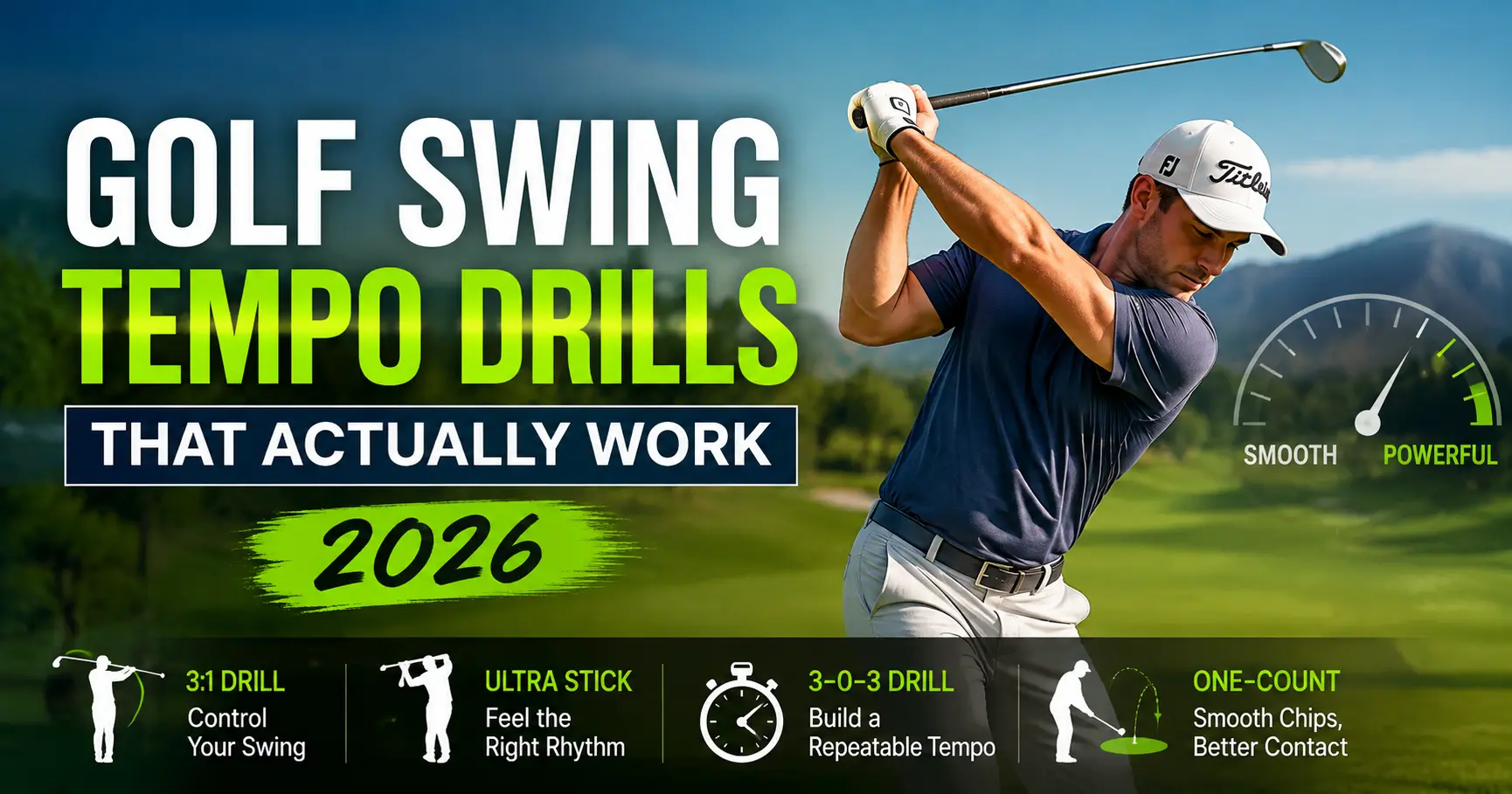
Quick Answer: Good golf swing tempo means holding a consistent 3:1 backswing-to-downswing ratio, the same ratio Yale researchers measured across PGA Tour swings. You don’t need to slow down to get it. The two-ball drill, the pause-at-the-top drill, and a metronome app set between 50 and 70 BPM will groove that ratio in under a week.
Your driver swing feels rushed on the first tee and smooth by the back nine. That’s tempo, not mechanics. Most golfers chase a swing thought instead, a grip change, a stronger turn, a new setup position, and none of it fixes a transition that fires before the backswing finishes loading.
Below are the golf swing tempo drills that actually change your ratio, the real research behind the 3:1 number every teaching pro quotes, and a two-minute test you can run on your own phone to find out exactly where your swing sits right now.
What Is Tempo in the Golf Swing?
Tempo is the relationship between how long your backswing takes and how long your downswing takes. It has nothing to do with how fast the club moves at impact. That’s swing speed: how quickly the clubhead travels through the ball, measured in miles per hour, and it’s a completely separate number.
You can swing 115 mph with terrible tempo. You can also swing 85 mph with tempo so clean it looks effortless on video. A rushed transition, where the downswing starts before the backswing finishes loading, is the single biggest tempo fault amateur golfers bring to a lesson tee.
What Is a Good Golf Swing Tempo? The 3:1 Ratio Explained
The number every teaching pro reaches for is 3:1. Your backswing takes roughly three units of time, your downswing takes one. Count it out loud on the range: “one, two, three” going back, “four” coming down and through.
That ratio comes from a real research project, not a marketing department. John Novosel filmed hundreds of PGA Tour swings frame by frame for his 2004 book Tour Tempo, co-written with Sports Illustrated senior writer John Garrity. At standard 30-frames-per-second video, tour pros averaged 24 frames on the backswing and 8 frames on the downswing, a 3:1 ratio give or take. Novosel found the same 2:1 relationship held for chips and pitches around the green, and something close to that for putting, though putting tempo varies more by teaching philosophy than full-swing tempo does.
What the Yale Study Actually Found (And Why It Changes the Advice)
Two Yale researchers, Robert Grober from the Applied Physics department and Jacek Cholewicki from Biomedical Engineering, put Novosel’s numbers to the test with better equipment in a 2006 study. They wired 43 golfers with motion sensors sampling 250 times per second, eight times the resolution of standard video, and split them into three groups: 12 touring professionals, 13 teaching pros and low-handicap amateurs, and 18 recreational golfers.
Here’s the part almost nobody covers. The average ratio for all three groups centered close to 3:1. Recreational golfers weren’t swinging at some wildly different ratio like 5:1 or 1.5:1 on average. What separated the tour pros was consistency.
Their swing-to-swing variation was tiny. The weekend golfers’ ratio bounced all over the place from one swing to the next, even though the average came out close to 3:1 anyway.
That’s the real target. Chasing the number 3:1 on one good practice swing does almost nothing. Chasing the same ratio, swing after swing, is what tour players actually have and most amateurs don’t.
Golf Swing Tempo Examples: Same Ratio, Completely Different Looks
Watch Ernie Els and Jon Rahm swing back to back and you’d guess they’re playing different sports. Els built “The Big Easy” nickname on a long, unhurried backswing. Rahm’s backswing is short and almost abrupt by comparison.
Time them both, though, and the ratio lands in the same neighborhood. Tempo isn’t about how long or short your swing looks. It’s about proportion.
| Player | Swing Style | Backswing:Downswing Ratio |
|---|---|---|
| Ernie Els | Long, flowing | ~3:1 |
| Jon Rahm | Short, compact | ~3:1 |
| Nick Price | Fast, aggressive | ~3:1 |
| Scottie Scheffler | Athletic, moderate | ~3:1 |
A slow-looking swing and a fast-looking swing can share the exact same ratio. That’s the whole point, and it’s why “just slow down” is bad advice. If you want to see swing repeatability taken to its logical extreme, our breakdown of In Gee Chun’s swing covers a three-time major champion whose backswing barely changes from rep to rep.
Find Your Own Tempo Number: A 2-Minute Slow-Motion Test
Grober and Cholewicki needed a lab full of accelerometers to measure tempo in 2006. You have a better tool sitting in your pocket right now.
Open your phone’s slow-motion camera, prop it up behind you, and record five full swings with a mid-iron. Most phones shoot slow-motion at 120 or 240 frames per second. Scrub through the video frame by frame and count from the first movement away from the ball to the top of the backswing, then from the top to impact.
Divide the backswing frame count by the downswing frame count. If you land between 2.5:1 and 3.5:1, your ratio is fine and your miss is coming from somewhere else in the swing. If you’re under 2:1, your transition is rushing ahead of your backswing, and that’s exactly the fault the drills below fix.
Run the test on all five swings, not just one. One swing at 3:1 next to four swings at 1.8:1 tells you exactly what the Yale data predicted. Your average might look fine. Your consistency is the leak.
The Best Golf Swing Tempo Drills
These are drills to improve golf swing tempo at the cause instead of the symptom, covering the two most common faults: a takeaway that gets snatched away too fast, and a transition that starts before the backswing finishes.
Tempo doesn’t change much between a wedge and a driver even though loft does. Our golf club lofts guide breaks down how loft changes launch and spin, so you know what should change when you switch clubs and what shouldn’t.
1. The 1-2-3 Count Drill
Set up to the ball and count “one, two, three” out loud or in your head as you swing to the top. Start the downswing on “four.” Some golfers call this the golf swing tempo 1-2-3 drill, and it’s the fastest way to internalize the 3:1 ratio without any equipment.
Don’t rush the count to match a swing you’re used to. Slow the count down until your actual swing matches it, not the other way around.
2. The Two-Ball Drill
Place two golf balls in a line, about three inches apart, and set up to the back ball. A rushed takeaway knocks the front ball out of the way before you’re ready. A controlled one clips only the ball you’re aiming at.
Start with a pitching wedge or 9-iron. This drill fixes a snatched takeaway faster than almost anything else because it gives you instant physical feedback instead of a swing thought to remember.
3. The Pause-at-the-Top Drill
Swing to the top of your backswing and hold for a full second before starting down. It feels exaggerated and slightly ridiculous the first few times. That’s fine.
The pause forces your lower body to finish its job before your arms and hands take over, which is exactly what a rushed transition skips. Once the pause feels natural, shorten it gradually until it disappears into a normal-speed swing that still has that same sequencing.
4. The Step Drill
Start with your feet together and set the club down just behind the ball. As you swing back, step your trail foot into your normal stance width. As you swing down, step your lead foot toward the target.
This syncs your lower body to your arm swing instead of letting them race each other. Golfers with a “flip” or “cast” at the top usually have upper and lower body working on two different clocks, and this drill puts them back on one.
5. The Continuous Rhythm Drill
Line up four or five balls a few inches apart and swing through them one after another without stopping between shots. No practice swing, no reset, no re-gripping.
The goal isn’t ball-striking quality on this one. Keep the club moving at a single, unbroken rhythm from the first ball to the last. Golfers who stop and reset between every shot on the range are training a stop-start motion that doesn’t exist anywhere in a real tour swing.
Drills to Slow Down a Rushed Golf Swing Tempo
Not every fast tempo is a problem. Nick Price and Lanny Wadkins both played quick, aggressive golf at the highest level. Speed was never their issue. A transition that outruns the backswing is what actually causes trouble.
Use this table to match your actual miss to the drill that fixes it, instead of guessing.
| Your Miss | Likely Tempo Fault | Best Drill |
|---|---|---|
| Push or big hook off the tee | Transition starts before backswing finishes loading | Pause-at-the-Top |
| Thin or fat iron contact | Takeaway gets snatched away too fast | Two-Ball Drill |
| Good range sessions, bad rounds | No repeatable ratio under pressure | 1-2-3 Count Drill |
| Choppy, disconnected-looking swing | Lower body and arms working on separate timing | Step Drill |
One honest note here. If your miss is a low, screaming shank or a shot that’s offline by 40 yards, that’s a path or face issue, not tempo. These drills won’t fix a swing path problem, and no amount of counting to three will save a clubface that’s wide open at impact.
Golf Swing Tempo Drills at Home (No Clubs Needed)
You don’t need a range membership or even a backyard to work on golf swing tempo. These three golf swing tempo drills at home use whatever space you’ve got.
The Towel Drill. Roll a hand towel lengthwise and grip it like a club. Take slow practice swings and feel the towel’s tail lag behind your hands on the downswing. If the towel snaps through evenly with no lag, you’re casting from the top, the same fault that ruins a driver swing.
The Wall Drill. Stand close enough to a wall that your backswing would clip it if you turned too far or lifted your arms too high. Make slow half-swings that stay clear of the wall. This teaches width and rotation without a single ball or club in your hand.
The Silent Count Drill. Stand in your living room, cross your arms like you’re holding a club, and make the motion of a backswing and downswing while counting “one, two, three, four” internally. It sounds too simple to matter, but it’s a rehearsal you can run anywhere: a hotel room, an office, waiting in line.
Metronome and Tempo Trainer Options
Set a free metronome app somewhere between 50 and 70 BPM, and it gives you an audio cue to match your swing to. Start your backswing on one beat and make impact on the next. Adjust the tempo until the beat matches a rhythm that still feels athletic, not sluggish.
Purpose-built options exist too. The Tour Tempo app currently costs around $25 in the App Store and plays the exact frame-ratio tones Novosel measured from tour pros. Orange Whip, a weighted training club invented by PGA professional Jim Hackenberg, forces a smoother transition because you physically can’t rush a weighted head without losing your balance.
I’ll say this plainly. Training aids can groove a feeling faster than counting in your head, but they’re not required. Every drill above works with nothing but a club, some balls, and a few minutes on the range.
Frequently Asked Questions
What is tempo in the golf swing?
Tempo is the timing relationship between your backswing and your downswing. Golfers usually express it as a ratio, like 3:1, and it’s separate from swing speed, which measures how fast the clubhead moves at impact.
What is a good golf swing tempo?
PGA Tour pros use a 3:1 backswing-to-downswing ratio as their benchmark, and a Yale University biomechanics study confirmed it independently. The bigger factor is repeating that ratio on every swing, not hitting it once on a good practice pass.
What is the ideal tempo for a golf swing?
There’s no single ideal number that fits every golfer, but 3:1 for full swings and 2:1 for chips and pitches covers the vast majority of tour-level players regardless of how fast or slow their swing looks.
Can I just slow my golf swing down to fix my tempo?
No, and this trips up more golfers than any other tempo myth. Slowing down usually costs you clubhead speed and can leave the face open at impact. Fix the ratio between backswing and downswing instead of the overall speed.
Are there golf swing tempo drills on YouTube I can watch?
Yes. Myrtle Beach Golf Trips has a short video of teaching pro Meredith Kirk demonstrating the 1-2-3 count drill with a driver, and it’s a good visual reference for the drill above.
Is golf swing tempo the same as swing speed?
No. Swing speed measures how fast the clubhead travels, typically in miles per hour. Tempo measures the ratio of time between your backswing and downswing. A golfer can have high swing speed and poor tempo, or moderate swing speed and excellent tempo.
Putting It Together
Tempo isn’t a talent. It’s a ratio you can measure, test, and train, the same way Grober and Cholewicki proved at Yale. Start with the slow-motion phone test to find out where your swing actually sits, then pick one drill, the two-ball drill or the pause-at-the-top drill, and stick with it for two weeks.
Repeatable tempo does more for your ball-striking than almost any other mechanical change. If you’re also working on strike quality, our golf tee height chart is the next fundamental worth dialing in.