
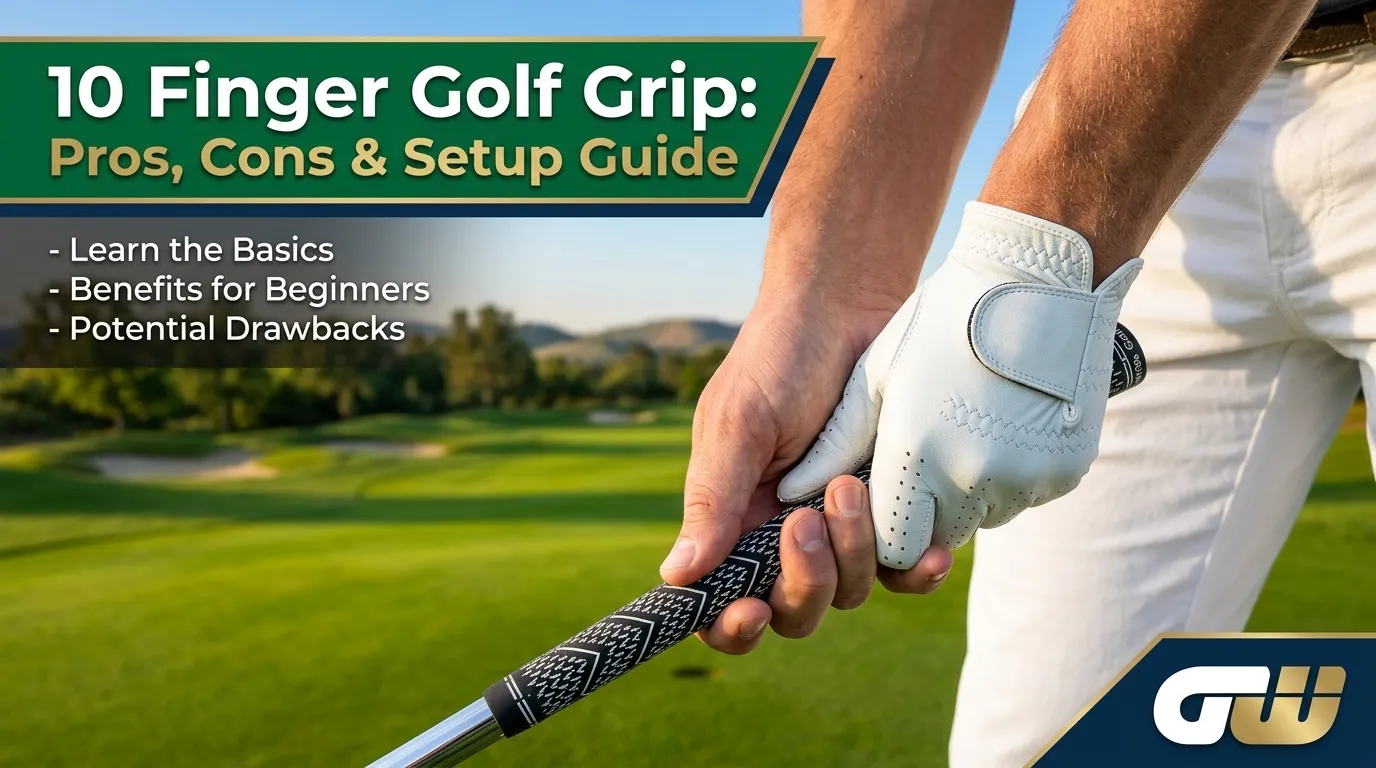
Quick Answer: The 10 finger golf grip, also called the baseball grip, places all ten fingers on the handle with no overlap or interlock. It’s easy to learn and suits beginners, kids, seniors, and anyone with hand or wrist pain. One tradeoff: it can let one hand dominate and pull shots left.
My first golf lesson ever, at a driving range in Ohio, involved a shag bag of range balls and a rental 7-iron with a grip the size of a rolling pin. The teaching pro took one look at me fumbling an interlock and said, forget it, just put all ten fingers on there like you’re holding a bat. That was fifteen years ago. My handicap sat at 14 that summer, dropped to 11 by September, and I never touched an interlock grip again.
This guide walks through exactly how to set up a 10 finger grip correctly, what it does and doesn’t fix in your swing, and who actually benefits from it. I’ll also correct a myth about Moe Norman that gets repeated on nearly every forum thread about this grip, and clear up a confusing wrinkle in the term “10 finger golf gloves” that has nothing to do with how you hold the club.
What Is the 10 Finger Golf Grip?
The 10 finger grip, sometimes called the baseball grip or the natural grip, does exactly what the name says. All ten fingers wrap around the handle. Nothing overlaps, nothing interlocks, and neither pinky finger has extra work to do.
Compare that to the two grips most tour pros use instead. The overlap grip rests your trail hand’s pinky in the groove between your lead hand’s index and middle finger. Interlock hooks that same pinky under your lead index finger rather than resting on top of it. Both physically link your hands into one unit.
The 10 finger grip skips that link entirely. Your hands sit side by side, independent, each one fully wrapped around the shaft on its own. That independence explains almost everything good and bad about this grip, and nothing else about your swing needs to change because of it.
How to Set Up a Proper 10 Finger Grip
Most golfers who try this grip for a week and quit set it up wrong from the start. Here’s the sequence that actually holds up on the course, not just on the range.
- Set your lead hand first. Rest the grip diagonally across your fingers, not flat in your palm. Look down at address and check for two visible knuckles, the same test that applies to every grip style, not just this one.
- Bring your trail hand up flush against the lead hand’s pinky. No gap, no overlap, no interlock. The trail hand’s little finger touches the side of the lead hand’s index finger with zero space between them.
- Tuck your lead thumb into your trail hand’s lifeline. Skip this step and the grip feels like two separate hands holding two separate objects. Get it right and the two hands finally feel connected even though nothing locks them together.
- Angle both thumbs slightly off center. Point the lead thumb a touch right of center and the trail thumb a touch left. Straight-down-the-middle thumbs add tension neither hand needs.
- Drop your grip pressure to roughly a 3 out of 10. Ten independent fingers squeezing a handle create more total tension than eight fingers working as a locked unit, so this grip punishes a death grip harder than overlap or interlock ever will.
Get those five steps right and the “disconnected hands” complaint that shows up in almost every forum thread about this grip mostly disappears.
The Real Pros of the 10 Finger Grip
Skip the generic “it’s beginner friendly” line for a second. Here’s what actually changes when all ten fingers sit on the handle.
You get more raw hand speed. Both hands wrapped fully and independently around the grip let you hinge and release your wrists more aggressively than an overlap grip allows. Baseball and hockey players gravitate toward this grip for exactly that reason. Their hands already know how to generate speed this way, and the transition costs them nothing.
Small hands and short fingers stop being a limitation. Overlap and interlock both ask a finger to reach across your own hand and rest on or under another finger. Short fingers make that reach awkward, and it often pushes the whole grip too far into the palm to compensate. Ten fingers side by side removes that reach completely.
Arthritis and stiff joints get easier to manage. Interlocking a swollen pinky hurts, every single time you set up over the ball. Ten finger grip removes that specific movement from the equation, which is exactly why it shows up so often among senior golfers.
Short shots pick up a touch more spin. Independent hand action through impact and more finger pressure on the handle add backspin around the greens. A few short-game specialists keep this grip on chips and pitches even after switching to overlap or interlock for full swings.
I’ll say this plainly: for a total beginner standing over a ball for the first time, the 10 finger grip is the best starting point available, full stop. Telling a brand-new golfer to master interlock in their first week makes an already hard game harder than it needs to be.
The Honest Disadvantages of the 10 Finger Grip
Most guide gloss over this part. Not here.
Your hands can work against each other. Nothing physically ties them together, so under pressure, one hand, usually the trail hand, gets more active than the other. That mismatch produces the pull and the pull-hook you’ll read about in nearly every forum thread on this grip. One golfer on Titleist’s own player forum described testing the grip for a single range session before switching straight back to overlap.
Timing becomes the whole game. Overlap and interlock force your hands into one piece, so the other hand automatically absorbs a small timing error. Ten finger grip absorbs nothing. Miss your timing by a fraction and the mishit shows up immediately, whether that’s a chunk, a block, or a big pull.
Grip pressure creeps up without you noticing. Ten separate fingers each want to squeeze on their own, and that adds up to more overall tension than an overlap or interlock grip carries at the same “feel.” Extra tension in the hands travels straight into the forearms, and tense forearms slow down clubhead speed no matter how strong your swing is.
It’s not the grip most instruction is built around. Nearly every swing tip, training aid, and fitting chart on the market assumes an overlap or interlock grip. Ten finger grippers sometimes have to translate generic advice to fit their setup, which is a small tax but a real one.
Here’s an honest limitation worth stating outright: if you already play to a single-digit handicap with a stable, comfortable overlap grip, switching to 10 finger isn’t going to fix anything for you. It’s more likely to introduce a hook you don’t currently have than to solve a problem you don’t currently have either.
10 Finger Golf Grip for Seniors: What Actually Changes
Seniors ask about this grip more than any other group, and the reason is almost always the same: joint pain, not swing mechanics.
I played nine holes last spring with a member at my home course named Gary, 71 years old, who switched to a 10 finger grip after a flare-up of arthritis in his left hand made interlocking painful. His ball flight didn’t change much. What changed was that he could finish eighteen holes without his hand aching by the back nine.
The real advantage for seniors isn’t distance, it’s comfort. Interlocking or overlapping a stiff or swollen pinky, round after round, adds up to real wear on that joint. Ten finger grip removes that specific bend entirely, since neither pinky needs to fold under or over anything.
A slightly thicker grip helps even more. Many senior golfers pair the 10 finger grip with an oversized or midsize grip on their clubs, which reduces how hard the hands need to squeeze to feel secure. Less squeeze means less strain on arthritic joints and less fatigue over a full round, which matters even more once natural swing speed starts declining with age.
The disadvantage worth knowing: hand dominance gets harder to manage with age. Grip strength typically drops in one hand faster than the other as golfers get older, often the trail hand for right-handed players. Since nothing ties the hands together in this grip, that strength imbalance can show up as a bigger miss than it would with overlap or interlock. Seniors who notice a new hook or a loss of accuracy after switching should have a pro check hand dominance specifically, rather than assuming the whole grip is the problem.
There’s no universal answer here. Some seniors gain total comfort at almost no cost to their scores. Others trade a small strength imbalance for that comfort. Either way, it’s worth trying for a full range session before deciding, not half a bucket of balls.
10 Finger Grip vs. Interlock vs. Overlap
Here’s the side-by-side most articles skip, including a column you won’t find anywhere else: how much grip pressure each style actually needs to feel secure.
| Grip Style | Hand Connection | Grip Pressure Needed | Best For | Common Miss |
|---|---|---|---|---|
| 10 Finger (Baseball) | None, hands sit independently | Higher, needs conscious relaxing | Beginners, kids, small hands, arthritis, chipping feel | Pull, hook, pull-hook |
| Overlap (Vardon) | Trail pinky rests on lead hand knuckle | Lowest of the three | Most tour pros, larger hands, all-around control | Slice if grip gets too weak |
| Interlock | Trail pinky locks under lead index finger | Low to moderate | Smaller hands wanting a locked feel | Grip creep, loss of lead hand control |
Harry Vardon popularized the overlap grip more than a century ago, and it remains what most tour pros use today because it needs the least grip pressure to hold both hands together as one unit. Interlock does something similar by physically locking the fingers instead of resting them, which is why players with smaller hands often prefer it over overlap. Ten finger grip trades that low-effort connection for total independence, and independence is exactly what beginners, kids, and arthritic hands need most.
None of these grips is objectively correct. They solve different problems for different hands.
Using the 10 Finger Grip for Chipping
Search forums for this grip long enough and you’ll notice something odd. Golfers who ditched it for full swings often keep it for chips and pitches.
I do exactly that. My full swing grip is a standard overlap, but I switch to 10 finger the moment I’m inside 30 yards. The extra feel through my fingertips tells me more about strike quality on a delicate shot than an overlap grip ever has, and the added backspin helps balls check up on firm greens instead of releasing another ten feet.
Here’s why it works for short shots specifically, even for golfers who won’t touch it on full swings. Chipping needs less power and more touch, and 10 finger grip trades exactly the power you don’t need for exactly the touch you do. There’s also less risk of the trail hand taking over, since a chip swing produces far less clubhead speed than a driver swing, so the hands-working-against-each-other problem barely shows up at these speeds.
One real limitation here: this only holds up on shots inside roughly 40 yards. Push the 10 finger grip out to full pitch shots or longer, and the same hand-independence problem that shows up off the tee starts creeping back in.
Who Actually Plays With a 10-Finger Grip
The idea that no real golfer uses this grip past childhood is flat wrong, and the list of players who’ve used it at a high level proves it.
Michael Thorbjornsen finished a season as the No. 1 ranked player in PGA Tour University and has used a 10 finger grip his entire life, going back to age five or six when he first gripped a club with no thumbs on it at all. He’s said publicly that he’s never needed to change it, even at the professional level.
Scott Piercy won twice on the PGA Tour, including the 2012 RBC Canadian Open, using a 10 finger grip he’d played since childhood. His long-time caddie confirmed Piercy reliably hits a draw with it, not the pull-hook the grip supposedly guarantees.
Bob Estes played the PGA Tour with a 10 finger grip for years before eventually switching styles, and Hall of Fame LPGA player Beth Daniel won 33 LPGA Tour events and a major championship never using anything else. Art Wall Jr. won 14 PGA Tour events, including the 1959 Masters, with the same grip decades before anyone argued about it on a forum. Tommy Tolles carried it onto tour through the 1990s.
At the 2024 PGA Championship, club professional Kyle Mendoza was the only player in the 150-plus man field using a baseball grip. He’d switched to it in college after a finger injury made interlocking impossible, and when he tried switching back later, he found he’d lost his feel for the clubface entirely.
That’s not a fringe list. It’s a reminder that grip style matters far less than most golfers assume, as long as the rest of the fundamentals hold up.
The Moe Norman Myth, Debunked
Every 10 finger grip discussion online eventually name-drops Moe Norman as proof pros use this grip. That’s only half true, and the missing half matters.
Norman won more than 50 professional events and set course records across Canada using an overlap grip, the same style Vardon popularized, for virtually his entire competitive career. He didn’t switch to a 10 finger setup until 1994, well after his best competitive years, when he partnered with an instruction company called Natural Golf that taught a wider hand split and a 10 finger position to match its longer, single-length clubs.
So the accurate version of the story is this: one of the greatest ball strikers anyone has ever seen built that reputation with an overlap grip. His association with the 10 finger grip came later, tied to a specific teaching method, not to the swing that made him famous in the first place.
It’s a small correction, but it matters if you’re choosing a grip based on Moe Norman’s results. Copy the swing philosophy if you want. Just know which grip actually produced it.
10 Finger Golf Gloves: Clearing Up a Confusing Search Term
If you searched “10 finger golf gloves” hoping for a glove built just for this grip, here’s the honest answer: that’s not what most results actually show you.
Most of those search results point to FINGER TEN, a golf glove brand that Walmart and eBay both carry in bulk. That’s a brand name, not a technical answer. Golf glove makers don’t actually make a separate glove for the baseball-style grip, and the naming coincidence trips up a lot of golfers searching for one.
Here’s the more useful question hiding underneath that search: does the 10 finger grip actually need a different glove? Not really. Any standard golf glove works fine, since this grip doesn’t shift where your palm or fingers sit on the handle any more than overlap or interlock does. Some golfers who use this grip prefer a slightly thinner glove for more feedback through the fingertips, especially on the chipping shots covered above, but that comes down to personal feel rather than any real requirement.
One tip that does matter: pair this grip with an oversized club grip, a common move for seniors covered earlier, and size your golf glove the same as always. Don’t size the glove up just because the club grip did.
Who Should Use a 10 Finger Grip?
Based on everything above, here’s the direct answer instead of a wishy-washy “it depends.”
Use it if: you’re brand new to golf, you’re a junior golfer whose hands haven’t grown into an adult grip yet, you have arthritis or joint pain in either pinky, your fingers are noticeably short for your hand size, or you play baseball or softball and already know how to generate speed this way.
Consider switching away from it if: you’ve plateaued at a low single-digit handicap and keep fighting a hook or pull you can’t explain, your hands feel disconnected under pressure on the course even though they feel fine on the range, or you’re chasing more consistency on full shots specifically rather than comfort.
Skip switching entirely if: you already play to a stable handicap with overlap or interlock and nothing is actually broken. Grip changes solve real, specific problems. They don’t add distance or lower scores on their own, and chasing a grip change without a clear problem to fix usually just adds a new miss on top of whatever you already had.
Frequently Asked Questions
What is the 10 finger golf grip?
The 10 finger grip, also called the baseball grip, is a way of holding the club where all ten fingers touch the handle and neither hand overlaps or interlocks with the other. Your hands sit side by side, each one fully wrapped around the grip independently, similar to how you’d hold a baseball bat.
Do any PGA players use a 10 finger grip?
Yes. Scott Piercy has won twice on the PGA Tour with it, Michael Thorbjornsen used it to become the No. 1 ranked player in PGA Tour University, and Art Wall Jr. won the 1959 Masters using the same grip. It’s uncommon at the tour level, but it has never been absent from it.
What is the advantage of a 10 finger golf grip?
The biggest advantage is independence. Both hands work on their own instead of being physically linked, which makes the grip easier to learn, gentler on arthritic or stiff joints, and a better fit for small hands or short fingers that struggle to reach across for overlap or interlock.
What are the disadvantages of the 10 finger golf grip for seniors?
The main disadvantage is that grip strength often declines unevenly between a senior’s two hands, and since nothing ties the hands together in this grip, that imbalance can show up as a hook or a loss of accuracy. Comfort for arthritic joints is the real gain here, but it can come with a small trade-off in consistency worth checking with a pro.
The Bottom Line
The 10 finger golf grip isn’t a beginner’s crutch you’re supposed to outgrow. It’s a legitimate, tour-tested way to hold a golf club that happens to solve very specific problems: small hands, sore joints, a total lack of golf experience, or a short game that wants more feel than power.
It’s not a fix for a hook you can’t explain, and it won’t lower a stable single-digit handicap on its own. Try it for a full range session before judging it off a few swings, set it up correctly using the five steps above, and let your own results decide instead of a forum thread. For more on the fundamentals that actually move your scores, our guide to hitting irons consistently is a good next stop.