
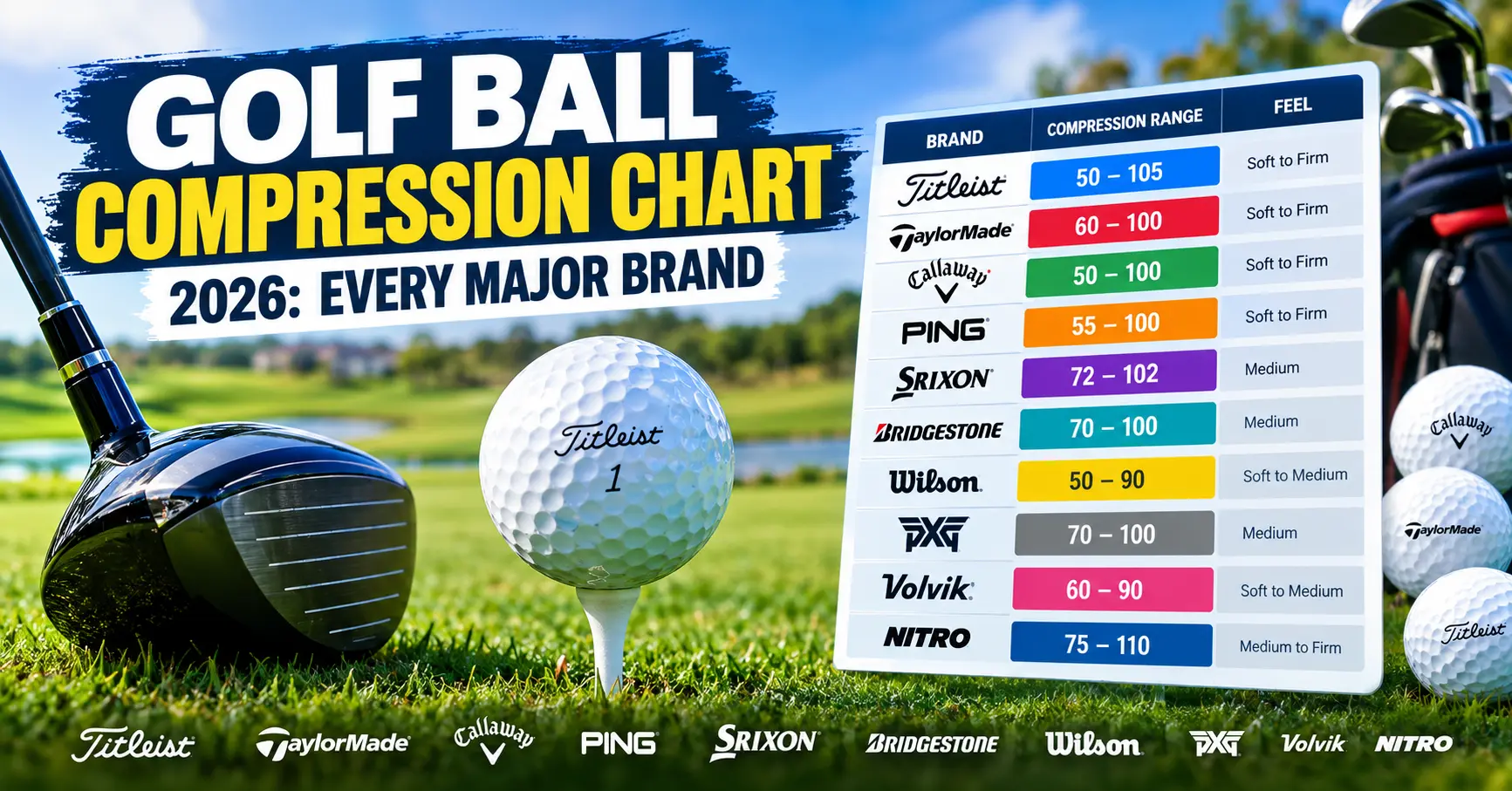
Titleist’s Pro V1 measures roughly 87–92 on an independent compression gauge — not the flat “90” most golfers assume, and a different number than what’s printed on the sleeve. Manufacturers rarely publish a standardized figure, which is why the chart below uses independently-reported measurements instead of marketing claims. Find your brand, match it to your swing speed, and stop guessing at the pro shop.
What Is Golf Ball Compression?
Golf ball compression is a measurement of how much a golf ball deforms when it is struck by a club. It is expressed as a number on a scale from 30 (very soft) to 120 (very firm).
Think of it like squeezing two sponges — one firm, one soft. The soft sponge compresses with very little force. The firm sponge needs much more pressure to squeeze down. When your club hits a golf ball, the same principle applies. Your swing speed determines how much force you deliver at impact, and the ball’s compression rating determines how far it deforms and springs back.
That moment of deformation and rebound is where energy transfers from the club to the ball. When the ball’s compression matches your swing speed, energy transfer is efficient — and you get the distance, feel, and control you are looking for. When it does not match, you lose some of that energy every single time you swing.
Compression Chart by Brand
Every major manufacturer measures compression a little differently, and stated numbers on the box often reflect the core only. The figures below use consistent, independently-reported ranges so you can compare across brands fairly.
Titleist
| Model | Compression (approx.) | Cover | Best swing speed |
|---|---|---|---|
| Pro V1 | ~87–92 | Urethane | 88–105 mph |
| Pro V1x | ~97–104 | Urethane | 98–115+ mph |
| AVX | ~78–84 | Urethane | 85–100 mph |
| Tour Soft | ~65–70 | Ionomer | Under 90 mph |
| TruFeel | ~55–62 | Ionomer | Under 85 mph |
| Velocity | ~90–98 | Ionomer | 90–105 mph |
Callaway
| Model | Compression (approx.) | Cover | Best swing speed |
|---|---|---|---|
| Chrome Tour | ~92–96 | Urethane | 88–105 mph |
| Chrome Soft | ~74–78 | Urethane | 85–100 mph |
| Chrome Soft X | ~88–93 | Urethane | 90–105 mph |
| Supersoft | ~35–40 | Ionomer | Under 85 mph |
| ERC Soft | ~55–60 | Ionomer | Under 90 mph |
TaylorMade
| Model | Compression (approx.) | Cover | Best swing speed |
|---|---|---|---|
| TP5 | ~85–90 | Urethane | 88–105 mph |
| TP5x | ~95–100 | Urethane | 98–115+ mph |
| Tour Response | ~70–75 | Urethane | 80–95 mph |
| SpeedSoft | ~45–50 | Ionomer | Under 85 mph |
Srixon
| Model | Compression (approx.) | Cover | Best swing speed |
|---|---|---|---|
| Z-Star | ~80–85 | Urethane | 85–100 mph |
| Z-Star XV | ~90–95 | Urethane | 100–115+ mph |
| Q-Star Tour | ~68–73 | Urethane | 80–95 mph |
| Soft Feel | ~55–60 | Ionomer | Under 85 mph |
Bridgestone
| Model | Compression (approx.) | Cover | Best swing speed |
|---|---|---|---|
| Tour B X | ~95–100 | Urethane | 100–115+ mph |
| Tour B XS | ~85–90 | Urethane | 85–100 mph |
| Tour B RX | ~83–88 | Urethane | 85–100 mph |
| e6 | ~45–52 | Ionomer | Under 85 mph |
Other brands
| Model | Compression (approx.) | Cover | Best swing speed |
|---|---|---|---|
| Wilson Duo Soft | ~35–40 | Ionomer | Under 85 mph |
| Wilson Triad | ~78–82 | Urethane | 85–100 mph |
| Vice Pro | ~85–90 | Urethane | 88–105 mph |
| Mizuno RB Tour | ~95–100 | Urethane | 98–115+ mph |
| Snell MTB | ~88–93 | Urethane | 88–105 mph |
Compression Chart by Swing Speed
If you’d rather shop by your swing speed than hunt through every brand, start here.
Under 85 mph (low compression, 30–70) At slower swing speeds, the club doesn’t generate enough force to fully compress a firmer ball, so a soft core returns more energy and helps recover distance. Almost every ball in this tier uses a two-piece ionomer construction, trading some greenside spin for forgiveness and a lower price. Good starting points: Titleist TruFeel, Callaway Supersoft, TaylorMade SpeedSoft, Srixon Soft Feel, Wilson Duo Soft, Bridgestone e6.
85–100 mph (mid compression, 65–90) This is where most amateur golfers land, and it’s also where premium urethane-cover tour balls start to make sense — your swing speed is enough to activate the core and take advantage of the spin a urethane cover offers. Good starting points: Titleist Pro V1, Callaway Chrome Soft, TaylorMade Tour Response, Srixon Z-Star, Bridgestone Tour B XS, Wilson Triad.
Over 100 mph (high/firm compression, 90–115) Fast swings can overpower a soft ball, causing the core to over-compress at impact and actually costing ball speed. Firmer, higher-compression balls are built to hold up at these speeds without collapsing that energy transfer. Good starting points: Titleist Pro V1x, Callaway Chrome Tour, TaylorMade TP5x, Srixon Z-Star XV, Bridgestone Tour B X, Mizuno RB Tour.
Not sure what your swing speed actually is? Most indoor simulator bays and club-fitting counters will read it for you in under a minute — worth doing before trusting a guess.
How Compression Is Measured
Compression is a measure of how much a golf ball deforms under a fixed load — the more a ball compresses, the softer its rating. There’s no single industry-standard gauge, so different labs and manufacturers can report slightly different numbers for the same ball, and it’s common for a brand’s own stated compression to differ from an independent third-party measurement. Manufacturers also sometimes cite core-only compression for marketing purposes, which reads softer than a measurement of the whole assembled ball. That’s why the chart on this page uses consistent, independently-reported ranges rather than mixing manufacturer-stated numbers with lab-tested ones — comparing a Titleist “90” to a Callaway “90” only means something if both numbers came from the same kind of test.
Free Printable Compression Chart (PDF)
Want this chart without scrolling through the full page? Download the one-page printable version below — every brand, organized by swing speed, ready to print or save to your phone before your next pro shop trip.
Download: Golf Ball Compression Chart 2026 (PDF)
What Happens When You Play the Wrong Compression Ball?
Most golfers choose a ball based on brand name, a playing partner’s recommendation, or price. The problem is, a ball that is too firm or too soft for your swing speed will actively hurt your game — regardless of what it costs or what tour player endorses it.
If the Ball Is Too Firm for Your Swing Speed
You will not compress the ball fully at impact. The ball springs back before maximum energy has transferred from the club. The result is shorter drives, a harder feel off the clubface, and less feedback on mishits. If your swing speed is under 85 mph and you are playing a Titleist Pro V1 (compression around 90), you are probably leaving 10 to 20 yards on the table on every drive.
If the Ball Is Too Soft for Your Swing Speed
You will over-compress it. The ball deforms too much and loses its ability to rebound efficiently. You will notice a mushy, dead feeling at impact, reduced distance even at higher speeds, and a loss of the spin control you need on approach shots and chips near the green. Fast swingers at 100 mph or above using a Callaway Supersoft (compression 47) will feel exactly this.
What the Right Compression Feels Like
The right compression match feels crisp and responsive at impact. It gives you confident distance off the tee, predictable spin on approach shots, and a consistent feel across all clubs. When your ball matches your swing, you stop fighting your equipment and start playing golf. That is exactly what this chart is designed to help you find.
How Is Golf Ball Compression Measured?
Golf ball compression is measured using a standardised test that applies a set force to the ball and records how much it deforms. The resulting number — typically between 30 and 120 for balls you will find in any golf shop — represents the ball’s firmness. Lower numbers mean a softer ball that deforms more easily. Higher numbers mean a firmer ball that resists deformation and requires a faster swing to fully compress.
Golf Ball Compression Chart by Swing Speed
Use this table as your starting point. Find your swing speed in the left column and you will see which compression range to look for, how the ball will feel, and which specific balls work best at your speed.
| Swing Speed | Compression Range | Ball Feel | Best For | Recommended Balls |
|---|---|---|---|---|
| Under 75 mph | 30–55 (Low) | Very Soft | Seniors, very slow swingers | Callaway Supersoft, Wilson Duo Soft |
| 75–85 mph | 55–70 (Low) | Soft | Beginners, high handicappers | Srixon Soft Feel, Titleist TruFeel, Cut Red |
| 85–95 mph | 70–85 (Medium) | Soft–Medium | Average golfers, mid-handicappers | Callaway Chrome Soft, Titleist AVX, Bridgestone Tour B RX |
| 95–105 mph | 85–95 (Medium-High) | Medium–Firm | Low handicappers, competitive golfers | Titleist Pro V1, Srixon Z-Star, TaylorMade TP5 |
| 105+ mph | 95–120 (High) | Firm | Fast swingers, tour-level players | Titleist Pro V1x, TaylorMade TP5x, Srixon Z-Star XV |
Do not know your swing speed? Jump to the “How to Measure Your Swing Speed” section below — there are four ways to find it, including a free method using your driver carry distance.
High Compression Golf Balls (90 and Above)
High compression golf balls (rated 90 and above) are designed for players with swing speeds over 95 mph. These balls are firmer and require real force to compress fully. In the right hands — meaning a fast, repeatable swing — they deliver maximum distance, lower spin off the tee to reduce hooks and slices, and excellent workability for shaping shots.
If your swing speed is below 90 mph, these balls will feel hard and unresponsive. You will not compress them enough to benefit from their design.
| Golf Ball | Layers | Compression | Best Swing Speed | Price Range |
|---|---|---|---|---|
| Mizuno RB Tour X | 4-piece | 110 | 105+ mph | $$$$ |
| Srixon Z-Star XV | 4-piece | 102 | 105+ mph | $$$ |
| TaylorMade TP5x | 5-piece | 97 | 100+ mph | $$$$ |
| Callaway Chrome Soft X LS | 4-piece | 99 | 100+ mph | $$$$ |
| Cut DC | 4-piece | 99 | 100+ mph | $$ |
| Titleist Pro V1x | 4-piece | 100 | 100+ mph | $$$$ |
| Callaway Chrome Soft X | 4-piece | 95 | 100+ mph | $$$ |
| Vice Pro Plus | 4-piece | 95 | 100+ mph | $$ |
| Bridgestone Tour B X | 3-piece | 94 | 100+ mph | $$$ |
Best picks at this compression:
Medium Compression Golf Balls (70 to 90)
Medium compression balls (rated 70–90) are the most versatile option in golf and suit the widest range of players. If your swing speed is between 85 and 100 mph — which covers most amateur golfers — this is your compression range.
These balls give you a balance of distance off the tee, a soft enough feel for short game feedback, and enough spin to hold approach shots on the green.
| Golf Ball | Layers | Compression | Best Swing Speed | Price Range |
|---|---|---|---|---|
| Titleist Pro V1 | 3-piece | 87–90 | 90+ mph | $$$$ |
| TaylorMade TP5 | 5-piece | 85 | 90+ mph | $$$$ |
| Callaway Chrome Tour | 4-piece | 87 | 90+ mph | $$$$ |
| Snell MTB-X | 3-piece | 85 | 90+ mph | $$$ |
| Srixon Z-Star | 3-piece | 88 | 90+ mph | $$$ |
| Bridgestone Tour B XS | 3-piece | 84 | 90+ mph | $$$ |
| Bridgestone Tour B RX | 3-piece | 79 | 85+ mph | $$$ |
| Callaway Chrome Soft | 4-piece | 74 | 85+ mph | $$$ |
| Cut Grey | 4-piece | 80 | 85+ mph | $ |
| Titleist AVX | 3-piece | 75 | 85+ mph | $$$$ |
Best picks at this compression:
Low Compression Golf Balls (Below 70)
Low compression golf balls (rated below 70) are ideal for players with swing speeds under 85 mph. This includes most beginners, senior golfers, and many women golfers. Do not think of these as inferior balls — they are specifically engineered to perform at lower swing speeds, and using one will give you more distance and better feel than any high-compression tour ball at your speed.
| Golf Ball | Layers | Compression | Best Swing Speed | Price Range |
|---|---|---|---|---|
| Callaway Supersoft | 2-piece | 47 | Under 80 mph | $ |
| Wilson Staff Duo Soft | 2-piece | 40 | Under 75 mph | $ |
| Srixon Soft Feel | 2-piece | 60 | Under 85 mph | $ |
| Bridgestone e12 Soft | 3-piece | 50 | Under 75 mph | $$ |
| Cut Red | 4-piece | 60 | Under 80 mph | $ |
| Bridgestone Tour B RXS | 3-piece | 65 | Under 85 mph | $$$ |
| Titleist TruFeel | 2-piece | 65 | Under 85 mph | $$ |
| Wilson Duo Professional | 3-piece | 60 | Under 80 mph | $$ |
Best picks at this compression:
Golf Ball Compression for Women and Senior Golfers
Most women and senior golfers have swing speeds in the 60–80 mph range. This places them firmly in low compression territory — and that is not a consolation prize. Low compression balls are engineered specifically to perform at these speeds, and using one will give a slower swinger more distance, better feel, and more consistent results than any premium tour ball on the market.
Using a high-compression tour ball at 65 mph is one of the most common equipment mistakes in the game. At that speed, you cannot compress the ball enough to activate the design. You get none of the distance or spin benefits the manufacturer built into it — you have simply paid more for a ball that works against you.
Best Golf Balls for Women Golfers
Best Golf Balls for Senior Golfers
As swing speeds naturally slow with age, moving to a softer ball is one of the most impactful equipment changes a senior golfer can make — and it costs nothing to switch.
If your swing speed is between 80 and 90 mph, you are in the medium-low range. The Titleist AVX (compression 75) or Callaway Chrome Soft (compression 74) will give you the best blend of distance and feel at this speed.
Why Compression Matters: Distance, Control, Feel and Spin
Compression is not just a technical term—it directly affects how you play golf. It means that when you hit the ball, how hard it moves and the way it behaves are greatly influenced by compression. Now, the question is, why is it important?
Let’s break it down in simple terms
Distance:
When you hit the ball correctly, it moves with more force, giving you greater distance. If your swing speed (how fast you hit the ball with your club) and the ball’s compression don’t match, you might not get much distance from the tee.
Control:
Compression also tells you how much control you have over the ball. If the ball’s compression matches your swing, you’ll have better control over your shots. This is especially important when you’re playing near the green.
Feel:
The sensation when you hit the ball can also vary. Some players prefer soft and comfortable balls, while others like firm and solid ones. This feeling depends on your personality and playing style.
Spin:
Compression affects spin too. Spin refers to how much the ball rotates and how it can be stopped on the green. If you want more control over your shots, choosing the right compression ball is essential.
In the end, by using a golf ball compression chart, you can find a ball that suits your swing speed and playing style. This way, you’ll gain a competitive edge and understand the game better.
So, the whole point is to improve your game and enjoy it even more!
How Temperature Affects Golf Ball Compression
Here is something most golfers never think about: temperature changes the effective compression of your golf ball on the course.
In cold weather (below 50°F / 10°C), golf balls play firmer. The materials inside the ball contract slightly in low temperatures, which effectively raises the compression rating by around 5 to 10 points. A ball that compresses at 80 in summer conditions can play like a 90 when temperatures drop.
What this means for your game:
Cold weather golfers — Consider dropping one compression tier in winter. If you normally play a medium compression ball in summer, try a soft-medium option when temperatures fall below 50°F. Your shots will feel crisper and you will regain some of the distance you lose to cold conditions.
Warm weather golfers — Your standard compression selection will perform as rated by the manufacturer. No adjustment needed.
Rain and wet conditions — Wet conditions do not significantly change compression, but they do affect cover friction and spin. This is a conversation about cover material — urethane vs ionomer — rather than compression rating.
A practical tip: Keep your spare golf balls in your bag pocket or your jacket pocket before a cold round rather than in a separate ball bag. Body warmth slows the compression-hardening effect and helps your ball play closer to its rated compression during your round.
Does the Number of Layers Make a Difference?
If the number of layers in your golf ball varies, the results will also differ based on the players’ skills. If your swing speed is low and you are still new to the game, especially expensive premium 5-piece golf balls may not be suitable for you. In fact, it is very important to choose the right ball for you.
Two-piece balls: These are usually used by those who play casually or have a low swing speed. These balls are also more reasonably priced. For example, the Srixon Soft Feel is a great two-piece ball.
Three-piece balls: These are somewhat suitable for all players, especially those with varying swing speeds and skill levels. The Titleist Pro V1 is a popular ball of this type. But if you lose very few balls during play, this ball might be good for you. Another good three-piece ball is the Srixon Z-Star.
Four and five-piece balls: These are specially made for expert players. Their aim is to improve both distance and control. If you are very confident in your game and your skills are at the best level, these balls can give you the best performance.
How High and Low Compression Balls Feel
The feel of golf balls depends a lot on the materials used and their construction. If the ball has high compression, it feels firm, and when it hits the club, it makes a sharp, click-like sound. On the other hand, if the ball has low compression, it feels soft with the club, and the sound it makes is more pleasant.
But it’s not just compression that makes a difference. The outer part of the ball, called the “cover,” also affects its feel. If the ball’s cover is made of urethane, it feels soft and smooth. Usually, this type of ball is used in 3-piece golf balls.
In comparison, balls with covers made of ionomer or surlyn feel firmer and more solid. They also produce a click-like sound. These types of balls are commonly found in 2-piece golf balls.
How to Measure Your Swing Speed at Home or at the Range
You cannot use a golf ball compression chart without knowing your swing speed. Here are four ways to find it — from free to very accurate.
1. Launch Monitor or Simulator (Most Accurate)
Most golf retailers — PGA Tour Superstore, Golf Galaxy, and many independent pro shops — offer free or low-cost swing measurements using professional launch monitors. A 10-minute session gives you a reliable driver swing speed number you can use immediately.
2. Smartphone Apps
Apps like Swing Speed Radar by Sports Sensors or the Arccos Caddie Smart Sensors give real readings using equipment you already own. Accuracy varies but they provide a useful baseline, especially for tracking changes over time.
3. Estimate From Your Driver Carry Distance
If you know roughly how far your driver carries (not total, just carry), use this guide:
| Carry Distance | Approximate Swing Speed |
|---|---|
| Under 180 yards | Under 75 mph |
| 180–200 yards | 75–85 mph |
| 200–230 yards | 85–95 mph |
| 230–260 yards | 95–105 mph |
| 260+ yards | 105+ mph |
4. Ask Your Golf Pro
Any PGA teaching professional can clock your swing speed during a lesson, usually without any specialist equipment. If you take lessons, ask your pro at the start of your next session — it takes less than two minutes.
Once you know your swing speed, the master comparison table above will tell you exactly which compression range to look for.
Kirkland Golf Ball Compression Explained
Costco’s Kirkland Signature golf balls sit in the medium-to-high compression range at approximately 85–90, depending on which version you are using. The construction is 4-piece with a urethane cover, making them directly comparable to premium tour balls from Titleist, TaylorMade, and Srixon — but at a fraction of the price.
This compression range makes Kirkland balls best suited to players swinging between 90 and 100 mph. At those speeds, the urethane cover delivers noticeably better spin and stopping power around the greens than budget ionomer alternatives.
What makes Kirkland balls interesting in terms of value: independent testing has consistently placed their performance close to balls costing two to three times more. If your swing speed matches the medium-high range and budget matters, these are worth trying for a full round before committing to a premium option.
Does Low or High Compression Go Farther?
The answer depends on the type of ball you use and your swing style. Generally, for those who swing slowly, low-compression balls are better. These balls are designed to compress easily and transfer energy more efficiently, allowing for greater distance.
On the other hand, if you have a fast swing, high-compression balls might be more effective for you. These balls require more power to compress properly and achieve greater distance.
The key point is that it’s very important to choose a ball that matches your swing speed. This will help you achieve more distance while playing golf. If you find it difficult to understand which ball is better for which type of player, you can use a golf ball compression chart to make the best choice. This chart provides easy-to-understand information about different types of balls.
In this way, maintaining the right balance between your swing speed and the ball will help you achieve better results in the game.
How Does Compression Affect Spin?
Compression plays a significant role in spin rates. High-compression balls tend to produce lower spin, which can help reduce hooks and slices off the tee. Low-compression balls, on the other hand, generate more spin, making them ideal for players who want better control around the greens.
The key is finding a balance that suits your game. If you struggle with accuracy off the tee, a high-compression ball might be the answer. If you need more spin for approach shots, a low-compression ball could be the better choice.
Do Low Compression Balls Work Around the Greens?
Low spin, low compression balls are designed to provide a balance of distance and control. While they may not generate as much spin as high-compression balls, they still offer enough grip to hold the green on approach shots. These balls are ideal for players who want a soft feel without sacrificing too much spin.
Does Compression Affect Short Game Shots?
Absolutely. Compression influences how the ball reacts on short shots, chips, and putts. Low-compression balls tend to feel softer and provide more feedback, making them easier to control on delicate shots. High-compression balls, while firmer, can still offer excellent control for players with faster swings.
Golf Ball Compression Chart — Frequently Asked Questions
Most beginners benefit from low compression balls rated below 70. The Callaway Supersoft (compression 47) and Srixon Soft Feel (compression 60) are two of the most popular choices. These balls compress easily even at slower swing speeds, giving you better distance off the tee and a forgiving, soft feel when you make less-than-perfect contact — which happens more often when you are still learning the game.
A 90 mph swing speed sits at the lower end of the medium-high compression range. Balls rated between 74 and 87 will give you the best results at this speed. Strong options include the Titleist AVX (compression 75), Callaway Chrome Soft (compression 74), and Bridgestone Tour B RX (compression 79). All three give you distance off the tee and enough feel and spin to control approach shots close to the green.
Yes — and arguably more so for average golfers than for tour players, who can make almost any ball work with their technique and speed. If your swing speed is 85 mph and you are playing a high-compression tour ball, you are physically unable to compress it fully at impact. The result is reduced ball speed, shorter drives, and a hard, click-like feel that gives you very little feedback. Switch to a ball that matches your swing speed and the improvement is immediate and obvious. You will not need a launch monitor to notice it.
The Titleist Pro V1 has a compression rating of approximately 87–90, placing it in the medium-high range. It is best suited to players swinging at 90 mph and above. The Pro V1x is a different ball with a higher compression rating of approximately 100, designed for swing speeds of 100 mph and above. Many average golfers play the Pro V1x when the regular Pro V1 would serve them better — and many Pro V1 players would benefit more from dropping to a medium compression ball. Choose based on your swing speed, not on which one looks more impressive at the checkout.
Only if your swing speed is in the slow-to-moderate range (under 85 mph). At those speeds, a low compression ball deforms more fully at impact, transfers energy more efficiently, and produces better ball speed — which translates directly to more carry distance. For players swinging above 100 mph, the opposite is true. A low compression ball over-compresses at high speed, creating a dead, mushy feel and actually reducing both distance and control. The correct compression for your specific swing speed is always the right compression for your maximum distance.
How do I know if a golf ball is right for my swing speed?
Match your driver swing speed to a compression band: under 85 mph favors 30–70 compression, 85–100 mph favors roughly 65–90, and over 100 mph favors 90+. Outside those extremes the difference is smaller than most golfers assume. Action tip: if you don’t know your swing speed, most indoor simulator bays and club-fitting counters will read it for you in under a minute.
Does a lower-compression ball go farther?
Only below about 85 mph swing speed, where a softer core returns energy more efficiently off the driver. Above roughly 100 mph, a too-soft ball actually costs distance because the core over-compresses at impact. Action tip: if your driver swing speed is in the 85–100 mph range, compression matters less than short-game feel — pick by spin, not by number.
What compression is the Titleist Pro V1?
Independent gauge testing puts the Pro V1 at roughly 92, with the firmer Pro V1x closer to 102. Titleist doesn’t publish an official compression number, so third-party measurements are the most reliable reference available. Action tip: don’t compare a stated “compression” from one brand’s marketing directly against another’s — use one consistent gauge’s numbers, like the chart above.
Can a high handicapper play a high-compression ball?
Yes, but there’s usually no benefit and a real cost — high-compression tour balls need swing speeds above roughly 90 mph to fully activate the core. Below that, a firmer ball plays slower off the tee without returning the greenside spin it’s built for. Action tip: if you’re a high handicapper unsure what you’re currently playing, check the number stamped on the ball against the chart above before your next purchase.
Is compression the same thing as “feel”?
Not exactly — feel is a combination of compression and cover material. A low-compression ball with a urethane cover will generally feel softer around the greens than an equally low-compression ball with an ionomer (harder plastic) cover, even though their compression numbers are similar. Action tip: if two balls “feel” different despite similar compression numbers on this chart, check the cover material column first.
Do compression ratings change in cold weather?
Barely — testing shows only a 2–3 point shift after several hours of cold exposure, but ball speed can drop noticeably more than that number suggests, because cold mainly costs the core’s resilience, not its measured firmness. Action tip: keep balls at room temperature before a cold-weather round rather than switching to a “winter” compression tier.
The Bottom Line on Golf Ball Compression
The most important takeaway from this golf ball compression chart is straightforward: forget the logo on the ball and match the number to your swing speed.
If you swing under 85 mph, a soft ball will give you more distance than any premium tour ball in the shop. And if you swing above 100 mph, a high compression ball will give you the control and flight consistency you need to score. If you are in the middle, the medium range is your starting point — and there are excellent options at every price point.
Pick one ball from the right compression range, commit to it for a full month, and actually learn how it performs across different shots and conditions. Changing balls every round is one of the most common reasons golfers never feel consistent — your equipment is part of the equation.
Ready to go further? Check out our full guide to the best golf balls for every handicap level on Madknows — it breaks down exactly which balls perform best across all skill levels, with real-round testing results.
And if you want to work on the swing speed itself, read our guide to adding distance to your drives — more speed means access to better compression options and more distance without buying a single new club.