
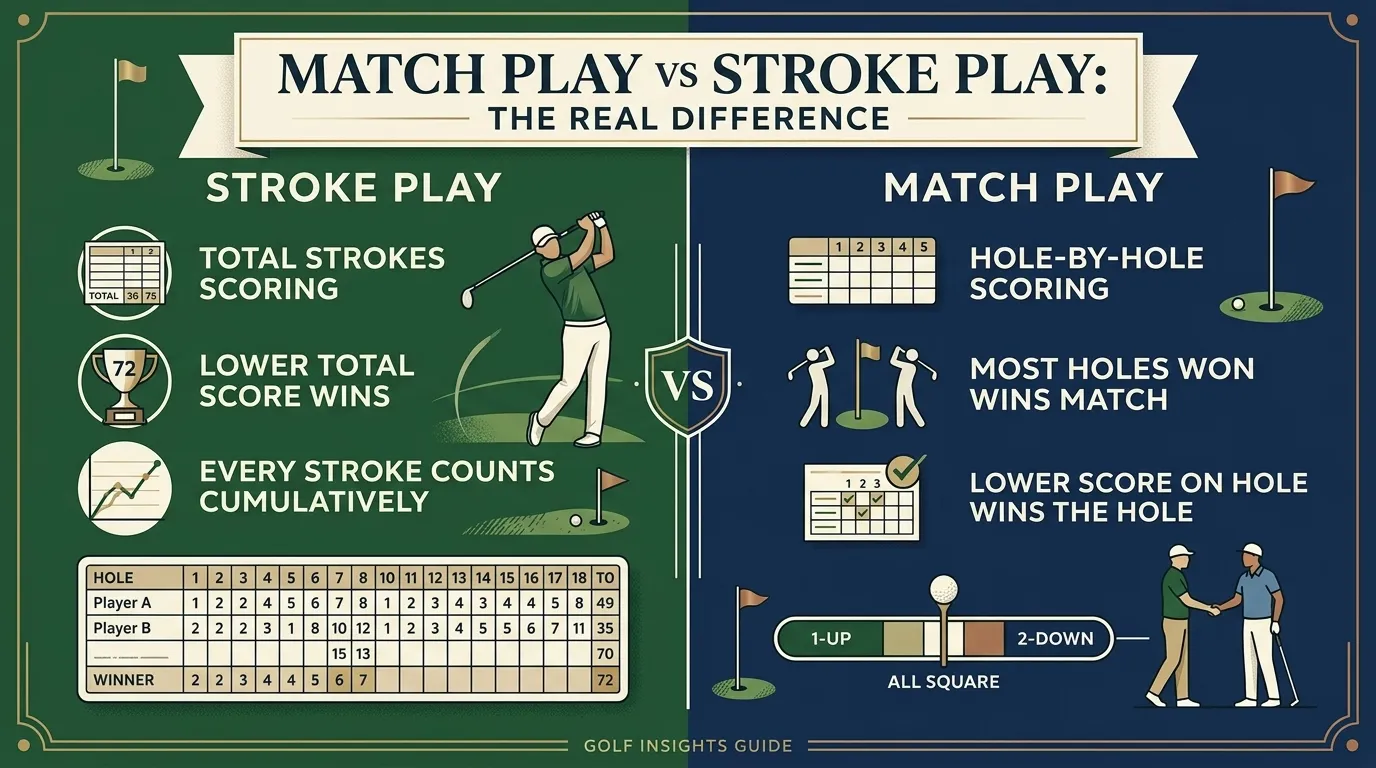
Quick Answer: Match play vs stroke play comes down to what you’re fighting: your opponent, or the scorecard. In match play, you win holes one at a time, a blow-up hole only costs you that hole. In stroke play, every stroke you take goes straight onto your final score.
I am a 9-handicap, and I play both formats most months, medal competitions with my club on Saturdays, a running match play series with my regular Sunday four-ball. The two formats feel like different sports wearing the same clothes. Three-putt the 4th in stroke play and that bogey follows you all the way to the 18th green. Do the same thing in match play, and you just lose a hole, the slate wipes clean on the very next tee.
This piece breaks down exactly what changes between match play and stroke play: the scoring, the penalties, the handicap math, and the strategy shift that separates good match play golfers from good medal-play golfers. I’ll also get into something none of the golf sites currently ranking for this topic have caught yet a real structural change coming to professional match play, starting in 2028.
What Is Stroke Play?
Stroke play, also called medal play, is the format most golfers learn first, even without ever hearing the term. You count every stroke across all 18 holes, add up the total, and the lowest number wins. Nothing resets between holes.
A snowman on the 7th (an 8, for anyone lucky enough not to know the nickname) sits on your card exactly the same as it would on the 18th. Every men’s major, the Masters, the PGA Championship, the U.S. Open, the Open Championship, runs 72 holes of stroke play across four rounds, with a cut trimming the field after 36 holes. That single structural choice is why professional stroke play rewards avoiding disasters at least as much as it rewards making birdies.
What Is Match Play?
Match play flips the entire framework. Instead of one long tally, each hole becomes its own contest worth exactly one point. Win a hole outright and you go 1-up. Match the other player’s stroke count and you halve the hole nobody gains ground.
Here’s the language that trips up newer players: being 3-up with 4 holes to play means your opponent needs to win all 4 remaining holes just to draw level. Win one more hole while already 3-up with 3 to play, and the match ends immediately at “4 and 3” four holes ahead, three left unplayed. Nobody finishes the back nine in that scenario, and that’s completely normal, not an error on the card.
Match Play vs Stroke Play: Quick Comparison Table
Here’s the match play vs stroke play side-by-side breakdown, including the one column most comparison charts skip what a rule breach actually costs you in the moment.
| Element | Match Play | Stroke Play |
|---|---|---|
| Unit of competition | One hole at a time | Cumulative strokes over the full round |
| Winner | Player or team that wins the most holes | Player with the fewest total strokes |
| Rule breach penalty | Loss of the hole | Two strokes added to your score |
| Concessions | Allowed putts, holes, even the whole match | Not allowed every ball must be holed out |
| Who you’re playing against | One opponent, in your own group | The entire field, most of whom you never see |
| Can the round end early? | Yes, once the result is mathematically settled | No you always play every hole |
Dormie, Halved Matches, and What Happens When Nobody Wins by 18
“Dormie” is one of golf’s oldest terms, and hardly anyone explains it well. A match goes dormie when the leader is up by exactly as many holes as remain, 2-up with 2 to play, for instance. From that point, the trailing player has to win every remaining hole just to force a tie; one more halved hole and the match is over.
If both players finish all 18 holes level, that’s a halved match, a genuine, official tie. In a friendly round, it usually just stays a tie. At a knockout event, club match play brackets, Ryder Cup singles, a halved match moves straight into sudden-death: hole 1, then hole 2, and so on, until somebody wins a hole outright.
There’s no stroke-play-style playoff format here, the head-to-head structure just continues past the 18th.
Penalties: Loss of Hole vs Two Strokes
The USGA and the R&A write golf’s rulebook together, and Rule 3 spells out exactly how the General Penalty applies differently by format. Break a rule that carries the General Penalty in stroke play, and two strokes land on your score for that hole. Break the identical rule in match play, and you simply lose the hole, full stop.
I watched this play out at my own club last summer: a friend took relief from the wrong spot on a par-5 during our stroke play event, picked up his two-stroke penalty, and still walked off with a perfectly playable 7 on the card. Do that in match play, and the hole is just gone it doesn’t matter how many strokes he’d have needed to actually lose it straight up.
One-stroke penalties for a lost ball or an unplayable lie, for example apply identically in both formats. It’s only the bigger breaches, the ones covered by the General Penalty, where match play and stroke play genuinely part ways.
Concessions and Order of Play: What You Can Skip (and What You Can’t)
Match play lets you concede a putt, a hole, or the entire match to your opponent and once you concede it, you can’t take it back. Players often wave in a three-foot bogey putt during a friendly match: everyone already knows how it ends, so why make someone putt it. Stroke play offers no such shortcut. Skip holing out on any hole, and you forfeit the entire round instead of just losing strokes.
Order of play differs too, and it’s not just etiquette it’s an actual rule. In match play, you have to wait for your opponent to play if they’re farther from the hole, even off the tee. Stroke play allows “ready golf,” meaning you can play out of turn when it’s safe and speeds things up. That’s a small rule, but it’s the reason a match play round can drag on when two competitive players both insist on playing strictly in order.
Net Match Play: How Handicap Strokes Actually Get Applied
Almost every club match play event runs off net scores, not gross ones, and the mechanics are simpler than they look once you see the math. Take the difference between the two players’ Course Handicaps, and the higher-handicap player receives that many strokes on the holes the course’s stroke index ranks hardest one stroke per hole, starting at stroke index 1.
Say Player A carries a Course Handicap of 6 and Player B carries a 14. Subtract, and B picks up 8 strokes, one apiece on the 8 toughest-rated holes on the card.
| Stroke Index (Hole Difficulty) | Does Player B Get a Stroke? |
|---|---|
| 1 through 8 (hardest holes) | Yes one stroke each |
| 9 through 18 (easier holes) | No |
That means B’s net score on stroke-index-1 is one shot lower than what actually went in the hole. Win the hole with those numbers and the strokes count exactly the same as if B had truly played it in one fewer shot. If you’ve never worked out your own Handicap Index, or you’re fuzzy on how it turns into a Course Handicap, sort that out before your next net match it decides who gets strokes and where.
Which Tournaments Use Which Format
Stroke play dominates professional golf. The Masters, the PGA Championship, the U.S. Open, and the Open Championship are all 72-hole stroke play events, and so is the vast majority of the PGA Tour and LPGA Tour regular-season schedule. That wasn’t always true of the PGA Championship, though it ran as a match play event from 1916 through 1957, before switching to stroke play to attract sponsors and TV coverage that a knockout bracket made harder to sell.
That switch never sat right with me a Sunday match play final beats a leaderboard chase for pure drama, no contest.
Match play still owns its own territory at the top level. The Ryder Cup and Presidents Cup are entirely match play, singles and team formats both. Most member-guest events, club championships with a match play bracket, and college dual matches use it too, largely because it’s faster to run and easier to televise as a head-to-head storyline than a leaderboard full of 140 names.
The PGA Tour Is Bringing Match Play Back in 2028
Here’s the part that’s missing from every other article on this topic, because it only became public in the past few weeks. In June 2026, the PGA Tour announced a full restructuring into two tiers a Championship Series and a Challenger Series that will launch in 2028. That announcement buries one detail relevant here: match play is coming back to the season-ending playoffs.
The new Tour Championship will run as a two-week playoff that opens with a group stage and moves into a bracket, with match play deciding the finish. That’s a real shift from the stroke-play FedEx Cup Playoffs format the Tour has used for years, and it fills the gap the WGC-Dell Technologies Match Play left behind when it ended after its 2023 edition at Austin Country Club. Nothing about your Saturday club match changes because of this. But if you’ve wondered whether match play still has a place in pro golf, the Tour just answered that question for 2028 and beyond.
Foursomes and Four-Ball: The Team Match Play Formats Behind the Ryder Cup
Match play doesn’t stop at one-on-one. Team match play comes in two formats you’ll see every two years at the Ryder Cup, and neither works anything like regular stroke play.
Foursomes golfers often call it alternate shot has two partners sharing one ball, taking turns hitting it until someone holes it, with one player teeing off on odd holes and the other on even holes. Four-ball most golfers just say better ball has both partners playing their own ball all the way through the hole, and only the better of the two scores counts toward the team’s result. Foursomes rewards a team that communicates well and covers for each other’s misses; four-ball rewards raw firepower, since one hot player can carry a hole even if their partner has an off day.
Strategy: How to Actually Play Each Format Differently
Match play is the most fun 18 holes in golf, and it isn’t close. Because a disaster only costs you one hole instead of your entire card, you can fire at a tucked pin you’d never touch in a medal round. I’ve hit driver off the deck into a green I’d normally lay up short of in stroke play, purely because losing that hole cost me nothing beyond the hole itself.
Stroke play punishes that same swing decision severely, since a bad outcome doesn’t disappear at the next tee it rides with you to the scorer’s table. That’s why smart stroke-play strategy leans conservative around trouble take the club that gets you to 150 yards instead of the one that might get you to 100 but also might find the water. If you’re not sure what club actually gets you to which number, check a club distance chart that breaks it down by skill level before you decide what “safe” really means for your swing.
Match play also rewards reading your opponent, not just the golf course. Watch your opponent hit a poor tee shot into the trees, and you can play the safe, high-percentage club off the tee yourself you’re already ahead in that battle before either of you swings again. Stroke play offers no such luxury; the golfer three groups ahead of you doesn’t care what club you just pulled.
Which Format Should You Choose for Your Next Round or Event?
If your group argues about handicaps every single week, net match play settles it better than stroke play ever will it turns “who’s really better” into a hole-by-hole scoreboard everyone can see in real time. It’s also the better pick for a quick weeknight nine, since a lopsided match can end at the 14th or 15th hole instead of dragging to the 18th.
Stroke play is the right call if you’re chasing a new Handicap Index, since posting a score requires a hole-by-hole result and match play often ends with conceded or unplayed holes. It’s also the better format for a big-field event, a charity scramble, or anything where ranking an entire field matters more than a single rivalry.
Honestly, if you’re playing solo or chasing a personal best round, match play just doesn’t apply there’s no opponent to measure yourself against, so stroke play is your only real option.
Frequently Asked Questions
Is match play harder than stroke play?
Neither format is objectively harder they test different skills. Match play demands sharper tactical decisions and mental resets after a lost hole, while stroke play demands sustained consistency and course management across every single shot for the full round.
Is PGA match play or stroke play?
Today, the PGA Tour’s regular events and all four men’s majors run on stroke play. That changes starting in 2028, when the Tour’s new Championship Series brings match play back into the season-ending playoffs for the first time since the WGC-Dell Technologies Match Play ended in 2023.
What are the disadvantages of match play?
Match play scores don’t always translate cleanly into an official handicap round, since conceded and unplayed holes need a most-likely-score entry to post. It also can’t rank a large field the way stroke play does, and a round can end early, which some golfers find unsatisfying if they were playing well.
What is the difference between match play and stroke play?
Match play plays out hole by hole: a rule breach costs you the hole, and a bad hole costs you nothing beyond it. Stroke play comes down to the lowest total strokes across the entire round: a rule breach adds two strokes, and every bad hole follows you to the final score.
The Bottom Line
Match play vs stroke play isn’t a question of which format is better it’s a question of what you’re actually trying to do that day. Chasing a personal best or an official handicap score points you toward stroke play. Settling a rivalry, running a quick club event, or just wanting a format where one bad hole doesn’t wreck your afternoon points you toward match play. Once you’ve got your format sorted, dial in your numbers with our golf club distance chart by skill level so you know exactly what club gets you home either way.