
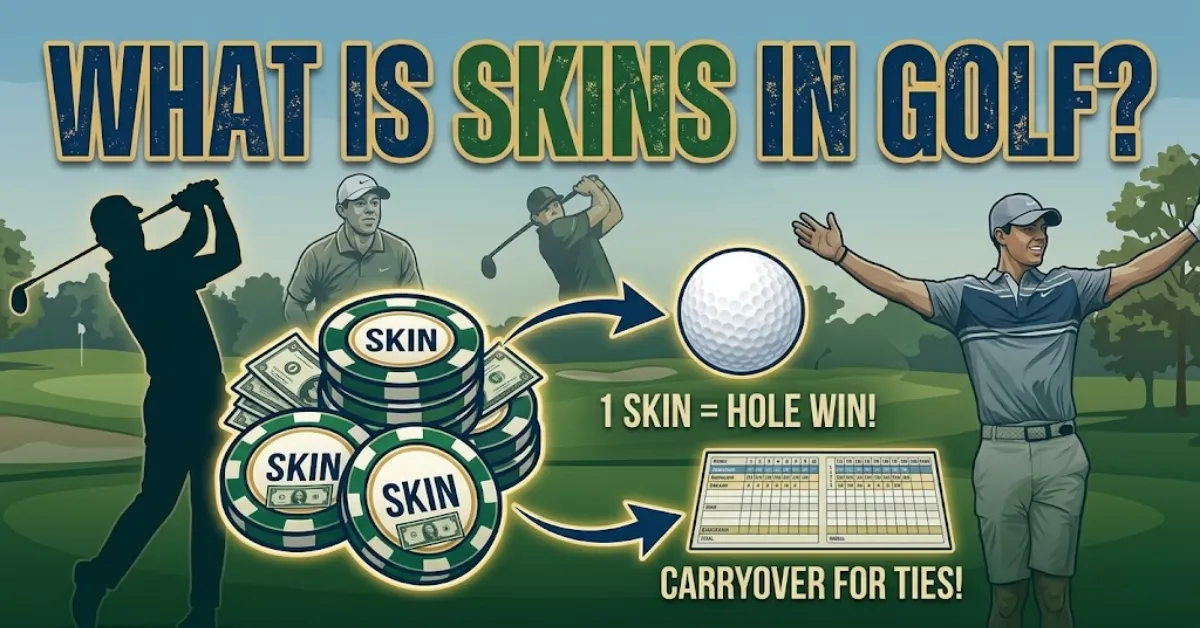
Skins in golf is a hole-by-hole competition where the player with the lowest score on each hole wins a “skin” — a point, a cash prize, or bragging rights, whatever your group agrees on. If two players tie, nobody wins, and that skin carries over to the next hole, raising the stakes. It is one of the most played betting formats in the game, and once you know how it works, you will want to suggest it every time you tee up.
Why Is It Called Skins in Golf?
The exact origin is debated, but the most widely accepted theory traces it back to a wagering tradition where players bet animal pelts — or “skins” — on the outcome of a hole. Another theory connects it to “scalps,” a term that appeared in early American gambling slang for small side bets. A third explanation simply points to the word “skin” as old slang for a dollar bill.
Whatever the true source, the term has been attached to this format since at least the 1950s, and today a “skin” means one thing: the prize sitting on the current hole, waiting for someone to claim it outright.
What Is Skins in Golf?
So, what is skins in golf? At its core, skins is a game where players compete to win individual holes instead of focusing on the total score for the round. Each hole is worth a “skin,” which could be a point, a small cash prize, or just bragging rights—whatever your group decides! The catch? Only one player can win a skin on each hole by posting the lowest score. If there’s a tie, the skin carries over to the next hole, making things even more exciting.
Imagine this: you’re playing 18 holes with three buddies. On the first hole, you score a 4, while they get 5s and 6s. Boom—you win the skin! But if two of you tie with a 4, no one wins, and that skin moves to the next hole, stacking up the stakes. It’s a hole-by-hole battle that keeps everyone on their toes.
Each hole in a skins game has a value — a set dollar amount, a point, or simply a mark on the scorecard. The player who posts the lowest score on that hole wins the skin. The catch that makes this format so gripping: if two or more players tie, nobody wins. The skin rolls over to the next hole, doubling the prize on offer. This can continue across multiple holes, and when five or six skins stack up on one hole, the pressure is unlike anything in a regular stroke-play round.
A bad hole does not end your day. One great shot on any individual hole can win you a skin and put you back in the conversation. That is why golfers of every level enjoy it.
The Basics: Understanding the Skins Game in Golf
A skins game is a betting format in golf where players compete for a prize – typically money – on each individual hole. The term “skin” refers to the prize at stake for each hole. What makes skins appealing is their simplicity. They can quickly add excitement to a casual game with friends.

How Does a Skins Game Work?
The concept is straightforward. Before teeing off, all players agree on the value of each skin — say, $5 per hole. Then everyone plays their own ball throughout the round. After each hole, the scores are compared.
For example: holes 1, 2, and 3 all tie. Hole 4 is now worth four skins — the value of the current hole plus the three that carried over. One great approach shot suddenly becomes the most important shot of the day.
How Many Players Do You Need?
Skins works with as few as two players but is best with three or four. The more players in the group, the harder it is for anyone to win a hole outright — which means more carryovers and higher-value holes as the round goes on. That tension is what makes skins so addictive.
How to Play Skins Golf with 3 or 4 Players
Skins with 3 Players
With three players, ties happen less often than with four, so skins get claimed more regularly. The game moves fast and rarely sees massive carryover pots. To keep the stakes interesting with only three players, many groups raise the per-skin value or use escalating values across the back nine.
- All three players agree on a skin value before the first tee
- Each player plays their own ball on every hole
- The player with the lowest score wins the skin
- If any two players tie for low score, the skin carries over
- Count skins at the end and pay out from the agreed pot
Skins with 4 Players
Four-player skins is the most common format. With four scores on each hole, ties happen more frequently, which means carryovers build up — and the pressure on big holes is intense. The format below is how most weekend golfers run it:
- All four players agree on a skin value and contribute to a pot (e.g., $1 per hole × 18 holes = $18 per player, $72 pot total)
- Every player plays their own ball throughout the round
- After each hole, compare all four scores
- If one player is alone in the lowest score, they win the skin
- If two or more players tie, the skin carries over
- At the end of the round, pay out based on skins won
Quick tip: Agree on what happens to unawarded skins after the 18th hole before you start. Most groups either split the remaining pot equally or extend to sudden-death playoff holes.
Setting Up a Skins Game
Setting up a skins game is relatively simple, but there are a few decisions your group needs to make before teeing off.
Establishing the Value of Skins
The first order of business is deciding how much each skin will be worth. This can range from mere pennies to substantial amounts, depending on your group’s comfort level with gambling. A typical casual game might value skins at $1-$5 each.
For a more organized approach, you might consider having everyone contribute to a pot before the round begins. In a four-person game with $1 skins, each player puts in $18. This is one dollar for each of the 18 holes. At the end of the round, the $72 pot would be divided according to how many skins each player won.
Golf Skins Game with Handicaps: Gross vs Net Skins Explained
One of the best things about skins is that it can be played fairly between golfers of different abilities. You just need to decide upfront whether you’re playing gross or net.
Gross Skins
No handicap strokes are applied. The actual score on each hole is used. This works well when players are at a similar level, but it puts higher-handicap players at a real disadvantage.
What Is Net Skins in Golf?
Net skins means each player’s handicap strokes are applied before comparing scores. A player’s adjusted (net) score is used to decide the hole winner. This levels the field and gives every player a genuine chance to win holes, regardless of ability.
Here’s how net strokes are allocated in a group with handicaps of 8, 16, and 28:
| Player Handicap | Strokes Received | How Allocated |
|---|---|---|
| 8 (lowest in group) | 0 strokes | Plays from scratch |
| 16 | 8 strokes | One stroke on the 8 hardest holes |
| 28 | 20 strokes | One stroke on every hole, two strokes on the 4 hardest holes |
Net skins is the recommended format any time the group has a mix of skill levels. It keeps everyone in the game and makes every hole competitive.
What Is Skins in a Golf Scramble?
In a scramble, teams of two, three, or four players select the best shot after each stroke and all play from that spot. When you add skins to a scramble, the format works almost identically to individual skins — except you’re comparing team scores instead of individual ones.
After each hole, the team with the lowest score wins the skin. If two teams tie, the skin carries over. The carryover rules are identical to individual skins play. Scramble skins are popular at charity events and corporate outings because even weaker players contribute — one great shot from anyone on the team can be the shot that wins the hole.
How to Set Up Scramble Skins
- Divide players into equal teams (aim for 2–4 players per team)
- Agree on a skin value per hole for each team
- Each team plays a scramble format — best shot is selected each time
- One team score is posted per hole
- The team with the lowest score wins the skin; ties carry over
Golf Skins Calculator: How to Track and Pay Out
Keeping track of skins mid-round is easy once you know what to watch for. You need to record three things on your scorecard after each hole:
- Who won the hole (or that it carried over)
- How many skins that hole was worth (current hole value + all carryovers)
- The running skin tally for each player
A simple method: mark “S” next to the winner’s score on each hole. Write the number of skins that hole was worth next to the S. If it carried over, write “CO” on that hole for all players.
Example Skins Payout — 4 Players at $5 Per Skin
| Hole | Skins Worth | Winner | Notes |
|---|---|---|---|
| 1 | 1 ($5) | Player A | A wins outright |
| 2 | Carry | — | Tie — carries to hole 3 |
| 3 | Carry | — | Tie again — carries to hole 4 |
| 4 | 3 ($15) | Player C | Wins holes 2+3+4 carryover |
| 5 | 1 ($5) | Player B | B wins outright |
At the end of 18 holes, add up each player’s total skins won and multiply by the agreed skin value. That is the payout. Several free apps — including the Leaderboard Golf app and 18Birdies — have a built-in skins calculator that does this automatically.
Popular Skins Game Variations
Escalating Skin Values
Many groups increase the value of skins as the round progresses. A common structure looks like this:
- Holes 1–6: $5 per skin
- Holes 7–12: $10 per skin
- Holes 13–17: $15 per skin
- Hole 18: $20 per skin
This keeps the back nine interesting even if someone runs away with the front nine.
Validation Skins
Winning a skin is not enough — you have to “validate” it by matching or beating your score on the very next hole. If you win hole 5 with a birdie but make a bogey on hole 6, the skin from hole 5 carries forward. This stops a player from cashing in one lucky hole and then coasting for the rest of the round.
Back It Up Skins
After winning a skin, you have a choice: take the guaranteed win, or “back it up” by betting you can win the next hole too. Win the next hole and you double your money. Lose it and you walk away with nothing — and your opponent picks up both skins. In short: back it up and win, you double. Back it up and lose, you get nothing.
Par-or-Better Requirement
A player must score par or better to win a skin, regardless of whether they have the lowest score in the group. Some groups go further and assign bonus skins for exceptional scores:
What Is Skins in a Golf Tournament or League?
In a club tournament or golf league, skins work slightly differently to a casual round. Instead of comparing just four players, you’re comparing everyone in the field who opted into the skins pot.
Here’s how it typically runs:
- Players pay an optional skins entry fee before the tournament (usually $5–$20)
- After the round, all opt-in scores are compared hole by hole across the entire field
- On each hole, if any one player’s score is lower than every other player in the field, they win that skin
- If two or more players post the same low score on a hole, that skin carries to the next hole
- Winnings are paid from the total skins pot based on how many skins each player won
This format is called “whole round skins” or “field skins.” It does not affect the main tournament competition — it runs as a separate side game. In a large tournament field, some holes may never produce a skin winner, which means the pot can roll over significantly and create large payouts on the few holes someone does win outright.
In a regular golf league, skins are often tracked weekly, with a small per-round entry building into a seasonal pot or paid out every week. Your league organizer will set the specific rules, but the carry-over scoring principle is always the same.
Strategies for Winning at Skins
Play Aggressively on the Right Holes
Each hole is its own contest. A bad score on hole 7 does not wreck your round the way it does in stroke play. Take dead aim when you feel confident, especially when skins have been carrying over — a birdie on a hole worth four skins is a round-changer.
Know When to Play It Safe
When every other player in the group is in trouble and a steady par is going to win the hole, there is no point in firing at a tight flag. Take your par, pocket the skin, and move on.
Know Your Handicap Strokes
If you’re playing net skins, know exactly which holes your strokes fall on. Those are your best chances to post a net birdie and win a skin against stronger players. Study the scorecard on the first tee and make a plan.
Handle the Pressure
When five skins are riding on one hole, the pressure is real. Stay focused on one shot at a time. The player who handles that pressure best, regardless of overall skill level, usually walks away with the most skins.
The History of Skins in Professional Golf
The PGA Tour Skins Game (1983–2008)
The Skins Game ran as an annual made-for-TV event on the PGA Tour from 1983 to 2008, held in November after the regular season ended. Four invited players competed for significant prize money with escalating skin values across the round.
In the final edition in 2008, the breakdown was:
- Holes 1–6: $25,000 per skin
- Holes 7–12: $50,000 per skin
- Holes 13–17: $70,000 per skin
- Hole 18: $200,000
The event became a Thanksgiving weekend tradition for golf fans — a relaxed but genuinely competitive showcase that showed off player personalities more than a regular tournament setting allowed.
Fred Couples: Mr. Skins
No conversation about professional skins games is complete without Fred Couples, who earned the nickname “Mr. Skins” through sheer dominance. In 11 appearances, Couples won $3,515,000 and 77 skins, claiming the overall event five times. His success proved that skins rewards a specific kind of player: someone who can make birdies in clusters and keep their nerve when everything is on the line.
Other Professional Skins Events
While the official PGA Tour Skins Game ended in 2008, the format never went away. Capital One’s The Match — the celebrity and professional player event that has run since 2018 — uses a skins-style format for several of its editions. LIV Golf has also incorporated skins elements into select events. At club level, skins remains one of the most-played formats worldwide, run every weekend in casual groups from Florida to Scotland to Australia.
Why Play Skins? The Benefits of This Format
Skins keeps everyone in the game. In stroke play, two bad holes early in the round and a player is effectively out of contention. In skins, every hole resets the competition. A player who loses four holes in a row can win one big carryover hole and be right back in the conversation.
It also rewards brilliance over consistency. A player who makes four birdies but also has two double bogeys will often outscore — in skins — someone who pars every hole. That makes it genuinely exciting for aggressive players who might struggle to keep a clean card all day.
With handicaps properly applied, skins also brings a mixed-ability group together fairly. A 24-handicapper can win skins in the same round as a scratch player. That is not possible in most other formats.
Skins for Different Group Sizes and Events
Two Players
Two-player skins feels similar to match play, but the carryover feature adds a twist. To keep things interesting with just two players, raise the skin value, add side bets on par 3s, or require a win by two strokes to claim a skin.
Large Groups (5+ Players)
With larger groups, outright hole wins become rare. Create teams of two or three players using a best-ball scoring format, or require a better-than-par score to win. “Quota skins” — where each player must win a minimum number of skins or pay a penalty — is another popular option.
Corporate or Charity Events
Sponsor individual holes and have each sponsor contribute to that hole’s skin value. Run teams for skins with winnings going to a nominated charity. Create one or two “super skin” holes with a boosted prize for extra excitement during the round.
How to Run a Skins Game Your Group Will Love
Agree on all rules before the first tee — skin value, how handicaps are applied, whether you’re playing gross or net, and what happens to unawarded skins on hole 18. Write it down if anyone is new to the format.
Collect money upfront. No awkward conversations at the 19th hole. Everyone pays in before the round starts, and winnings are paid out on the spot when the last putt drops.
Set stakes that nobody will stress over. A good guide: the total anyone can lose in a skins game should not exceed what they paid in greens fees. That keeps it fun and avoids anyone going quiet on the back nine because they’re down money they can’t afford.
If pace of play is a concern, use ready golf even on high-value holes, and agree that any player who cannot win the hole should pick up their ball. Skins should speed up a round compared to careful stroke play, not slow it down.
Frequently Asked Questions About Skins in Golf
The most widely accepted theory traces it to an old wagering tradition where players bet animal pelts — “skins” — on the outcome of a hole. Another theory links it to “scalps,” early American gambling slang for small side bets. A third simply points to “skin” as old slang for a dollar. Whatever the origin, the term has stuck since the 1950s.
In a scramble with skins, each team posts one score per hole — the best shot selected by the group. The team with the lowest score wins that hole’s skin. If two teams tie, the skin carries over to the next hole, just as it does in individual skins play.
Net skins means handicap strokes are applied before comparing scores. Each player’s adjusted (net) score decides the hole winner, allowing higher-handicap players to compete fairly against lower-handicap players. It is the recommended format any time your group has a mix of ability levels.
All four players agree on a skin value and contribute to a pot before the round. Each player plays their own ball on every hole. After each hole, all four scores are compared. The player with the lowest score — alone — wins the skin. If any two players tie for low score, the skin carries to the next hole.
Groups handle this three ways: play sudden-death extra holes until someone wins outright, split the remaining pot equally among all players, or hold a closest-to-the-pin contest on a par 3. Agree on your method before you start the round to avoid any debate at the 18th green.
No. Unlike match play, every putt should be holed out in skins. Because multiple players could tie for the low score on a hole, all scores need to be official. The only exception is when a player is already out of contention for the hole and picks up to keep pace of play moving.
Ready to Play? Here’s What to Do Next
Skins in golf is the easiest way to make every hole of a round feel like it matters. Agree on a value, decide gross or net, shake hands on the 18th hole rules, and you’re ready to go. Even if your full scorecard is a mess, one great hole at the right moment can make your day.
Next time you are organising a round, suggest it. Most groups that try skins once never want to go back to playing just for the score.
Want to learn more formats that keep every hole competitive? Read the Madknows guide to the best golf games and betting formats — covering Nassau, Wolf, Stableford, and more ways to make your round more interesting.