
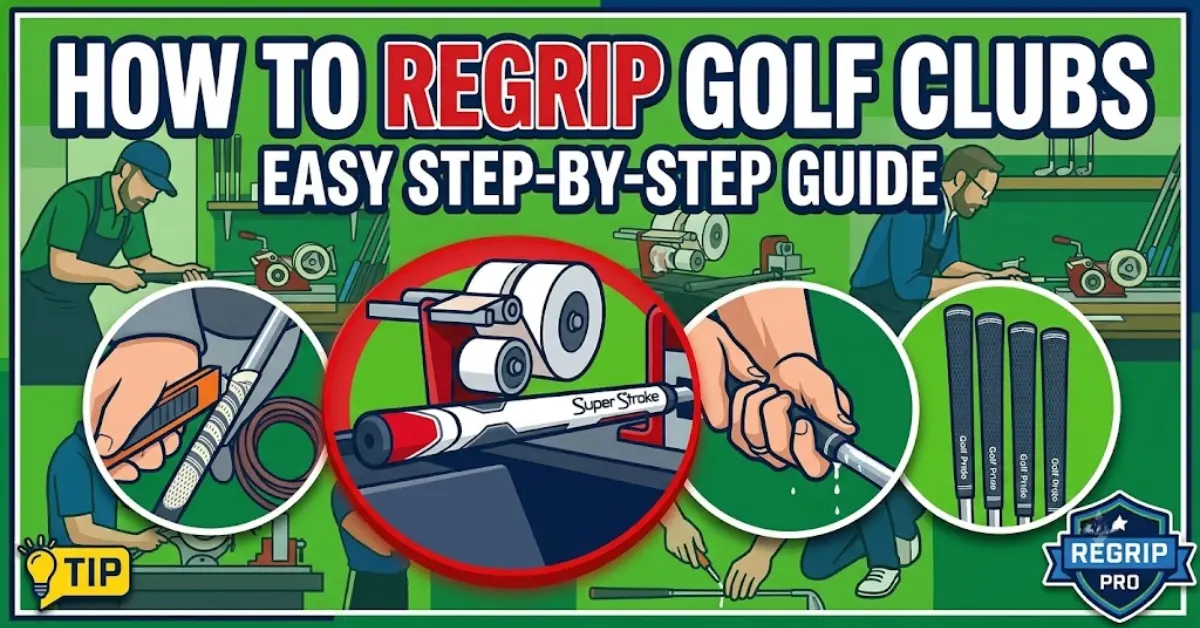
Quick Answer: To regrip a golf club, clamp the shaft, cut off the old grip with a hook blade, scrape off the old tape, wrap on new double-sided tape, soak it in grip solvent, then slide the new grip on and align it within about a minute before the adhesive sets. Let it cure 24 hours before playing.
My first regrip job cost me a Tour Velvet grip and about twenty minutes of quiet swearing in the garage. I’d used maybe a third of the solvent the instructions called for, and the grip stopped dead six inches up the shaft – no amount of pushing got it the rest of the way. That was back when I carried an 11-handicap and paid a shop for everything. Four years and roughly sixty clubs later, I do every regrip myself, and this guide walks through the exact process, what it actually costs to have Golf Galaxy or PGA Tour Superstore do it instead, and the specific mistakes that turn a five-minute job into a wasted grip.
Worn grips force you to squeeze tighter, and a tighter grip kills clubhead speed before the ball’s even struck. If your numbers on a club distance chart don’t match what you’re actually carrying anymore, a slick grip is worth checking before you blame your swing.
What You’ll Need
You don’t need a workshop to regrip golf clubs – just a handful of specific tools, most of which cost less than a sleeve of golf balls.
If you’d rather not piece all of this together separately, a bundled kit does the job. Saplize sells a 13-grip kit – grips, tape, solvent, vise clamp, and hook blade included for $59.99, which works out to roughly $4.60 per club for everything, not just the labor.
How to Regrip a Golf Club, Step by Step
Here’s the full process, start to finish. Budget about ten minutes per club once you’ve done a couple – the first one always takes longer.
Step 1 – Clamp the Club and Square the Face
Slide the rubber shaft clamp over the shaft, just below where the old grip ends, and lock it into the vise. Position the clubhead so the face sits square to the floor — dead perpendicular. Getting this right now saves you from guessing at alignment later, when the tape’s already wet and you’ve got sixty seconds to get it right.
Step 2 – Cut Off the Old Grip
Hook the blade under the bottom lip of the grip and drag it upward, away from your body, in one continuous motion. Peel the rubber skin off once you’ve scored it. Steel shafts forgive a stray cut. Graphite doesn’t — a straight utility blade can gouge deep enough to weaken the shaft, which is exactly why the hook blade exists.
Step 3 – Strip the Old Tape and Clean the Shaft
Score the old double-sided tape with your utility knife and peel it off in strips. If it won’t budge, a hairdryer or heat gun on low softens the adhesive in about fifteen seconds. Wipe the bare shaft down with solvent on a rag until it’s completely smooth — leftover residue is what causes a grip to stick halfway on the next installation.
While you’re down here, you’ll likely notice the small manufacturer sticker that runs down the shaft just below the tape line. You don’t need to remove the shaft sticker — it won’t affect the tape or how the grip seats.
Step 4 – Apply New Grip Tape
Hold the new grip against the shaft to gauge the length, then cut a strip of tape that matches it plus an extra 3/4 inch. Lay the tape on flat and smooth out every air bubble with your thumb — bubbles under the tape telegraph straight through to the outside of the grip once it’s installed. Peel the backing, twist the overhanging 3/4 inch into a point, and push it into the hollow butt end of the shaft to seal it.
Step 5 – Soak It in Solvent
Set a tray under the shaft to catch runoff. Plug the vent hole in the grip’s butt cap with your finger, pour in a generous amount of solvent, cover the opening with your other hand, and shake it to coat the entire inside. Pour whatever’s left over the taped shaft — you want the whole surface wet, because dry spots are the single biggest reason grips get stuck halfway.
Step 6 – Slide the Grip On and Align It
Pinch the grip’s open end and slide it onto the shaft in one continuous push while the tape’s still dripping. Tap the butt end on the floor to seat it fully. You’ve got roughly sixty to ninety seconds before the solvent starts to tack up, so look down the shaft from the butt end and square the grip’s alignment lines or logo to the clubface before it sets.
Putters are the one exception worth remembering. Most putter grips have a flat front face instead of a round profile — line that flat side up parallel to the putter face, not the alignment lines, or every putt will feel like it’s aimed slightly off.
The Air Compressor Method: Skip the Solvent Entirely
None of the shops selling regrip kits will tell you this, but there’s a second way to regrip golf clubs that skips solvent completely: compressed air.
Instead of double-sided tape and solvent, you tape the shaft with a single thin strip (or skip tape entirely and rely on friction), fit an air-gun nozzle over the grip’s vent hole, and blast air into the grip while sliding it onto the shaft. The air cushions the grip open just enough to slide on dry, and the moment you release the trigger, the grip seats and grabs the shaft immediately. Most club builders run somewhere around 45 PSI — go much higher and you risk stretching the grip past its limit.
The upside is real: zero cure time, so you can regrip in the morning and play that afternoon, and a crooked grip is fixable with another burst of air instead of a wasted grip. The tradeoff is upfront cost — a basic air-gun attachment runs $10-30 on top of a compressor you may not already own — and it’s genuinely fussier to get consistent on your first few clubs than the solvent method.
I’d only recommend it if you’re regripping often enough that the solvent smell and drying time actually bother you — but for anyone doing more than four or five clubs a year, it’s the smartest twenty dollars you’ll spend on this hobby.
What It Actually Costs to Regrip Golf Clubs in 2026
Every article on this topic throws out a vague range and moves on. Here’s what the two biggest golf retailers in the US actually charge, pulled straight from their current service menus.
| Where | Standard grip install | Long/belly putter | Notes |
|---|---|---|---|
| Golf Galaxy | $3.99/club | $5.99 | 24-hour guarantee — both services free if they miss it |
| PGA TOUR Superstore | $3.99/club (normal rate) | — | Frequently runs promos: free install with 8+ grip purchase, or as low as $0.99/club during Golf Pride promotions |
| DIY, full kit | ~$4.60/club all-in | — | Saplize 13-grip kit: grips + tape + solvent + vise clamp + hook blade for $59.99 |
| DIY, your own premium grips | Grip cost only | — | Tour Velvet ~$6-7, MCC Plus4 ~$12-14, plus ~$15-25 in reusable tools |
Dick’s Sporting Goods owns Golf Galaxy, and pricing at both generally lines up, so don’t expect a meaningfully different number walking into either one.
Golf Galaxy’s $3.99 install fee is the best deal left in golf retail, full stop — the catch is you’re still paying full retail for the grip itself. Run the math on a full 14-club set. Golf Galaxy’s labor alone comes to about $56, before you’ve paid for a single grip. Add Tour Velvet grips at roughly $6.50 each and you’re just over $145 out the door for the whole bag.
The Saplize kit gets you 13 clubs done, grips included, for $59.99. That’s not a small gap — it’s close to $90 on a set of budget-to-midrange grips, and the only thing you’re trading away is an afternoon in the garage.
I won’t pretend the bundled-kit grips feel identical to Golf Pride’s MCC line — they don’t, quite. But for anyone who isn’t particularly picky about grip feel, the savings are hard to argue with.
How Long It Takes (and How Long You Actually Have to Wait)
Hands-on time to regrip golf clubs is short. Once you’ve done a couple of clubs, each one takes five to ten minutes, start to finish — clamping, cutting, taping, and sliding the grip on. A full 14-club set runs somewhere around two hours if you’re working solo and taking your time.
The part people rush is the cure time, and it’s the single biggest reason DIY grips fail early.
| Method | Minimum wait before hitting balls | Full cure |
|---|---|---|
| Solvent, warm and dry (70°F+) | 2-3 hours | 24 hours |
| Solvent, cold or humid | 4-6 hours | 24-48 hours |
| Air compressor | 0 minutes | 0 minutes |
Two to three hours is enough to survive a few range balls without the grip shifting. It is not enough for the adhesive to fully bond, and if you tee off the same afternoon in humid weather, don’t be surprised if a grip twists slightly on your third or fourth aggressive swing.
I wait the full 24 hours now, every time, after watching a buddy’s MCC grip rotate a quarter-turn on his 3-wood mid-round because he’d hit balls just two hours after taping it.
How Often You Really Need to Regrip
Golf Pride and SuperStroke, the two brands on more clubs than anyone else, both point to roughly the same number: replace grips once a year, or every 40 to 60 rounds, whichever comes first. That’s a guideline for a golfer who plays weekly, not gospel.
If you’re teeing it up two or three times a week in summer heat, your grips are degrading faster than that — sweat and UV are brutal on rubber compounds. I regrip my driver and putter twice a year because they’re the two clubs I touch on literally every hole. My 4-iron gets a new grip every other year because, honestly, I don’t hit it enough for the wear to matter.
That’s the real answer: it’s not about the calendar, it’s about which clubs are actually in your hands. If you’re still deciding which 14 clubs belong in the bag in the first place, the clubs you’ll use most are the ones worth regripping first on a budget.
Regripping Without a Vise
A vise makes this easier, but it’s not mandatory. Wedge the clubhead between your feet or knees, gripping firmly enough that the shaft can’t rotate, and follow the same tape-and-solvent process. The catch is leverage — without a vise, you’re relying entirely on grip strength to seat the new grip fully, and it’s easy to stop an inch short without realizing it.
Go slow on this one. Push too hard without the club anchored and you risk bending the shaft, especially on a lighter graphite iron shaft that flexes more than you’d expect under sideways pressure. If you’re doing more than two or three clubs, borrow a vise — it’s worth the trip.
Common Mistakes That Ruin a Regrip
Most botched regrips trace back to one of these five things.
| Mistake | What happens | Fix |
|---|---|---|
| Too little solvent | Grip stalls halfway up the shaft and won’t budge | Don’t force it — you’ll usually need to cut the grip off and start over with more solvent |
| WD-40 or motor oil instead of solvent | Tape never fully cures; grip stays loose or spins for weeks | Strip it and redo with mineral spirits or golf-specific solvent |
| Clamping graphite directly in metal vise jaws | Shaft cracks or crushes, sometimes invisibly until it fails later | Always use a rubber shaft clamp on graphite, no exceptions |
| Rushing the alignment | Grip logo or lines sit crooked — permanently, since you’ll see it every address | Use your full 60-90 second window before the tape tacks up |
| Hitting balls too soon | Grip shifts or twists under load | Give it the full cure window, longer in cold or humid weather |
The WD-40 mistake is the one I see most, usually because it’s already sitting in the garage. Don’t. The silicone in it stops the tape from ever fully bonding, and you’ll be back here in two weeks doing the whole job again.
Steel vs. Graphite Shafts: What Changes
Graphite scratches and gouges far easier than steel, which is the entire reason the hook blade exists instead of a plain utility blade. Score a graphite shaft with a straight blade and you’ve potentially created a stress point that weakens it over time — one you won’t notice until it fails mid-swing.
Heat is the other difference. If you’re using a heat gun or hairdryer to loosen old tape, keep it moving and keep some distance on graphite. Parking direct heat on one spot for too long can soften the epoxy bond holding the head onto the shaft, and that’s not something you can see or test for afterward — you just find out the hard way.
Steel shafts don’t share either problem. You can be more aggressive with both the blade and the heat without much risk.
Frequently Asked Questions
Can you regrip golf clubs yourself?
Yes, and it’s genuinely one of the more approachable DIY projects in golf. The tools are inexpensive, the process takes about five to ten minutes per club once you’ve done a couple, and the only real risk is wasting a grip if you rush the solvent step or the alignment.
How much does it cost to have a full set of golf clubs regripped?
At Golf Galaxy or PGA Tour Superstore, labor alone runs about $56 for a 14-club set at the standard $3.99-per-club rate. Add mid-range grips like Golf Pride’s Tour Velvet at roughly $6.50 each, and the full job lands around $145 out the door. Doing it yourself with a bundled kit — grips included — typically runs $60-90 for a comparable set.
Is it worth regripping golf clubs yourself?
If you’re regripping more than four or five clubs, yes — the DIY route saves somewhere between $80 and $150 on a full set, and the process isn’t hard once you’ve done one club. If you’re only doing a single grip and don’t already own the tools, the time and cost of buying a kit for one club may not be worth it — just pay the $3.99 and let a shop handle it.
Is it easy to put grips on golf clubs?
The individual steps are easy. The part that trips people up is timing — solvent starts setting within a minute or two, so you need your tape cut, your grip ready, and your alignment plan already worked out before you pour anything. Rushed prep is what turns an easy job into a stuck grip.
Bottom Line
Regripping golf clubs isn’t complicated — it’s a five-to-ten-minute job once you’ve done it a couple of times, and the tools cost less than one round of golf at most courses. Whether you go the traditional solvent route or try the air compressor method, the two things that actually matter are patience with the cure time and not skimping on solvent during the slide-on step.
Start with whatever’s in your hands the most. If you’re still sorting out which 14 clubs actually belong in your bag, that’s the more useful question to answer before you regrip everything at once.