
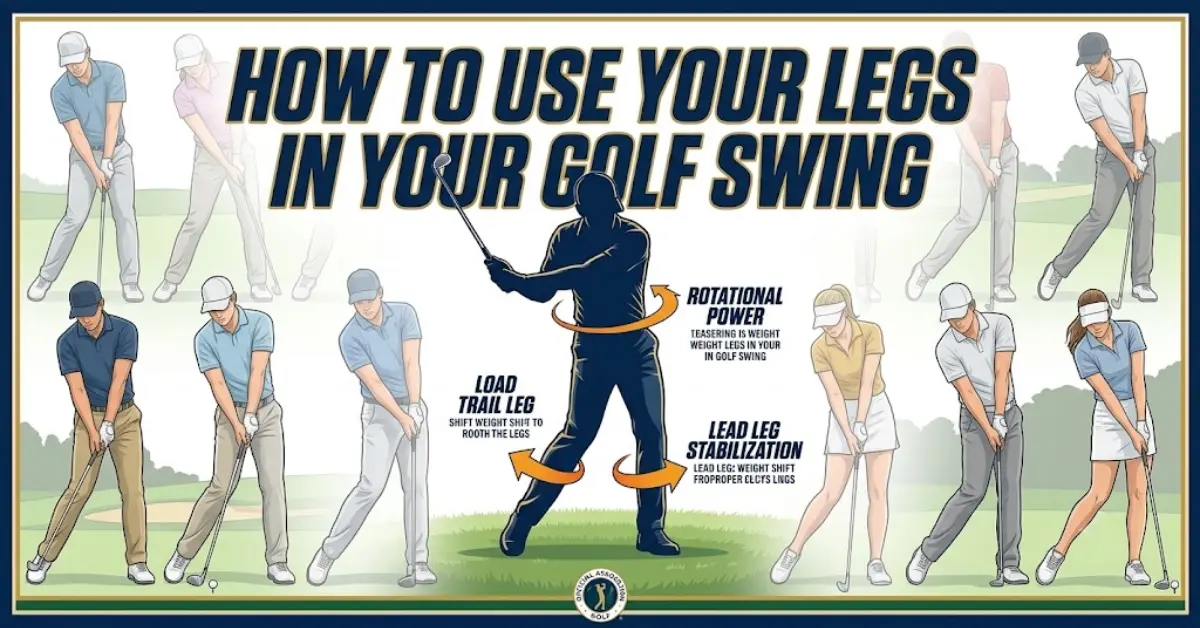
Quick Answer: Using your legs in the golf swing means loading pressure into your trail leg on the backswing, squatting into your lead leg during transition, and driving both legs into the ground through impact — like you’re about to jump. The load–squat–jump sequence adds 10–15 yards without swinging harder.
I spent two years convinced, I was using my legs in my golf swing. I wasn’t. And i was swaying, spinning out, and leaving 20 yards on the table – all because I had no idea what proper leg action actually felt like. I’m a 14-handicap who hits the ball about 245 off the tee when I’m swinging well, but I kept hitting these weak, spinning drives that fell out of the sky. My coach finally stopped me mid-swing and said: “Your legs are doing nothing. You’re all arms.”
That changed everything. This guide breaks down exactly how to use your legs — not with biomechanics jargon, but with feels, pressure numbers, and drills you can use tomorrow. By the end, you’ll know the load–squat–jump sequence, why your lead leg is the real power source, and how to add distance without changing your upper body swing. Check out our guide on hitting your driver straight if you’re struggling with accuracy too.
Why Most Amateurs Don’t Use Their Legs (And Why It’s Costing You Yards)
Here’s the honest truth: most amateurs think they’re using their legs when they’re really just moving their weight around. There’s a difference. Shifting weight is passive – your body moves because the club moves. Using your legs is active — you’re pressing into the ground, creating force, and unleashing it through the ball.
The Arms-Only Trap
When you swing with your arms, your legs become passengers. You might get 85 mph clubhead speed, but that’s your ceiling. The guys hitting it 280 aren’t swinging their arms faster — they’re using the ground. Rory McIlroy’s clubhead speed comes from his legs pushing into the turf, not from his arms pulling the club.
What “Using Your Legs” Actually Means
Using your legs means creating ground force reaction — pressing into the ground so the ground pushes back. That upward force travels through your legs, hips, and core, then into the club. It’s not about kicking or lunging. It’s about loading, squatting, and exploding.
The 5-Step Leg Action Sequence (Step-by-Step)
Here’s the meat of it. This is the load–squat–jump sequence you’ve probably heard about, but broken down into five steps you can actually follow.
Step 1: Setup — The Athletic Base
Stand with your feet shoulder-width apart. Your weight should be evenly distributed, but bias it slightly toward the balls of your feet — not your heels. Now flex your knees just a little. Not a deep squat, not locked straight. Think “athletic ready position” — like you’re about to catch a ball.
Pressure check: 50% left foot, 50% right foot at address.
Your trail foot (right foot for right-handers) should be square to the target line. Your lead foot can flare open slightly — about 10–15 degrees. That flare lets your lead hip clear on the downswing without your knee getting in the way.
Step 2: Backswing — Load the Trail Leg
As you take the club back, your trail leg straightens. Not locks out — straightens. Think of it as a post that your body rotates around. At the same time, your lead knee flexes slightly and points inward toward the ball.
Pressure check: 70–80% of your weight should be on the inside of your trail foot at the top of the backswing.
You’ll feel a stretch in your trail glute. That’s good. That’s the coil. If you feel pressure on the outside of your trail foot, you’re swaying — not rotating. Keep that pressure on the inside.
Step 3: Transition — The Squat and Re-Center
This is where most amateurs mess up. They start the downswing by throwing their arms or spinning their hips. Wrong move.
Instead, just before you start down, feel a subtle squat — like you’re sitting into a chair that’s slightly behind you. This drives pressure into the ground and recenters your weight onto your lead leg.
Pressure check: 60–70% of your weight shifts to your lead leg during transition. Your trail heel should still be on the ground — don’t lift it yet.
The squat feel is the secret sauce. It’s not a big movement — maybe an inch or two of downward travel. But that small move loads the ground so you can explode upward through impact.
Step 4: Impact — Explosive Extension
Now push. Both legs drive into the ground and straighten, like you’re about to jump. Your lead leg straightens hard — this is your brake that stops your hip rotation and transfers energy up into the club.
Phil Mickelson talks about this exact move: straightening the front leg creates a “whip” that adds clubhead speed.
Pressure check: 80%+ of your weight on your lead foot at impact. Your trail heel should be starting to lift.
You’re not jumping off the ground — you’re pushing into it. The ground pushes back. That’s your power.
Step 5: Follow-Through — The Finish
By the time you reach your finish, your lead leg should be fully straight, your trail foot up on its toe, and both knees close together. You should be able to hold this position until the ball lands — that’s how you know you stayed in balance.
Pressure check: 90–100% of your weight on your lead foot. Your trail foot is just a toe on the ground for balance.
The Pressure Map: Where Your Weight Should Be at Every Phase
| Swing Phase | Lead Leg (%) | Trail Leg (%) | Key Feel |
|---|---|---|---|
| Setup | 50% | 50% | Athletic, balanced |
| Top of Backswing | 20–30% | 70–80% | Loaded into trail heel |
| Transition (Squat) | 60–70% | 30–40% | Sitting into lead side |
| Impact | 80%+ | Less than 20% | Pushing into the ground |
| Follow-Through | 90–100% | 0–10% | Balanced finish |
Data compiled from biomechanical studies of professional golfers
3 Drills That Will Fix Your Leg Action Forever
These drills work. I’ve used all three, and each one targets a different part of the leg-action puzzle.
Drill 1: The Step Drill (Sequencing)
This drill forces you to start the downswing with your lower body.
How to do it:
- Set up in your normal stance with a 7-iron or 8-iron.
- Bring your lead foot back so it’s touching your trail foot — feet together.
- Make a normal backswing.
- As you start the downswing, step forward with your lead foot back to your normal stance width.
- Hit the ball.
If you step too late, you’ll top it. If you step too early, you’ll lose your balance. When you get it right, you’ll feel your lower body leading the swing for the first time.
Drill 2: The Squish the Bug Drill (Ground Force)
This one’s from the Rotary Swing guys — it’s the best feel for ground force I’ve found.
How to do it:
- Set up without a club.
- Get into your golf posture.
- Pretend there’s a bug under the inside of your lead foot.
- During the downswing, squish that bug by pressing your lead foot into the ground.
- Keep pressing until your lead leg straightens.
You’re not moving your foot — you’re pressing down. That downward pressure is what creates the upward explosion through impact.
Drill 3: The Single-Leg Drill (Balance and Stability)
This drill exposes whether you’re really balanced or just guessing.
How to do it:
- Address the ball with only your lead foot on the ground. Your trail foot should be behind you, toe touching the ground for balance.
- Make a half-swing.
- Feel your lead leg supporting your entire body through the swing.
- Switch to your trail leg and repeat.
If you can’t stay balanced, your leg action needs work. This drill builds the stability you need for consistent contact.
The Lead Leg vs. Trail Leg — What Each One Actually Does
Most articles lump “the legs” together. Big mistake. Your lead leg and trail leg do completely different things.
Trail Leg — The Post
In the backswing, your trail leg acts as a post. It straightens (but doesn’t lock) and holds your weight. Think of it like the leg of a tripod — stable, firm, unmoving. When your trail leg collapses or bends too much, you lose the coil that creates power.
Lead Leg — The Spring
Your lead leg is where the magic happens. In transition, it accepts your weight and flexes slightly — that’s the squat. Then through impact, it straightens hard, acting as a brake that stops your hip rotation and transfers energy up the chain.
Phil Mickelson says straightening the lead leg “slings the club down” and creates a “whip” effect. He’s right. The lead leg isn’t passive — it’s the engine of the downswing.
3 Common Leg-Action Mistakes (And How to Fix Them)
Mistake 1: Swaying
You shift your weight laterally instead of rotating. Your head moves off the ball, and you never get back to it.
The fix: Keep your weight on the inside of your trail foot in the backswing. If you feel pressure on the outside of that foot, you’re swaying.
Mistake 2: Spinning Out
Your hips spin open too early, and your arms get stuck behind you. The result? Blocks, hooks, and lost power.
The fix: Feel like your lead hip moves back and around — not just around. The squat move in transition keeps your hips from spinning too early.
Mistake 3: Early Extension
Your hips thrust toward the ball in the downswing, straightening your spine angle. You lose your posture and hit thin or fat shots.
The fix: Keep your tailbone back against an imaginary wall through impact. Your hips should rotate, not thrust. The squat feel helps here — sitting into your lead side keeps your hips from lunging forward.
Frequently Asked Questions
How do you use your legs in the golf swing?
You use your legs by loading pressure into your trail leg on the backswing, squatting into your lead leg during transition, and driving both legs into the ground through impact. The sequence is load → squat → jump — press into the ground so the ground pushes back.
How do I use my lower body in golf swing?
Your lower body initiates the downswing. Start by shifting your weight to your lead leg while keeping your trail heel down. Then squat slightly into your lead side, and push both legs into the ground through impact. Your hips should rotate, not slide.
How to generate power from legs in golf?
Power from your legs comes from ground force reaction — pressing into the ground so the ground pushes back. The harder you press, the more force travels up through your body. At impact, both legs should be straightening, creating an explosion of energy into the club.
What is the role of legs in golf swing?
The legs provide stability, generate power, and initiate the kinetic chain. They create the foundation for your swing, transfer energy from the ground to the clubhead, and keep you balanced throughout the motion.
How to stop early extension with legs?
To stop early extension, keep your tailbone back against an imaginary wall through impact. The squat feel in transition — sitting into your lead side — prevents your hips from thrusting toward the ball. Your hips should rotate around your spine, not lunge forward.
Should you straighten your legs in golf swing?
Yes — but at the right time. Your trail leg straightens in the backswing (acts as a post). Your lead leg straightens through impact (acts as a brake and power source). Neither leg should lock out completely — keep a slight flex even when straight.
Final Thoughts — Stop Thinking, Start Feeling
Here’s the thing about leg action: you can’t think your way through it. You have to feel it. That’s why I gave you drills, not just instructions. The step drill, the squish the bug drill, the single-leg drill — these aren’t academic exercises. They’re shortcuts to the right feeling.
One honest admission: if you’re already hitting it 270+ with a smooth swing, this probably isn’t for you. You’re already using your legs well enough. But for the other 90% of us — the ones who know we’re leaving yards on the table — this is the missing piece.
Try one drill tomorrow. Just one. Don’t try to fix everything at once. Pick the step drill, hit 20 balls, and see what changes. I guarantee you’ll feel something you’ve never felt before — and that feeling is the start of real power. Check out more distance-building drills to keep the momentum going.