
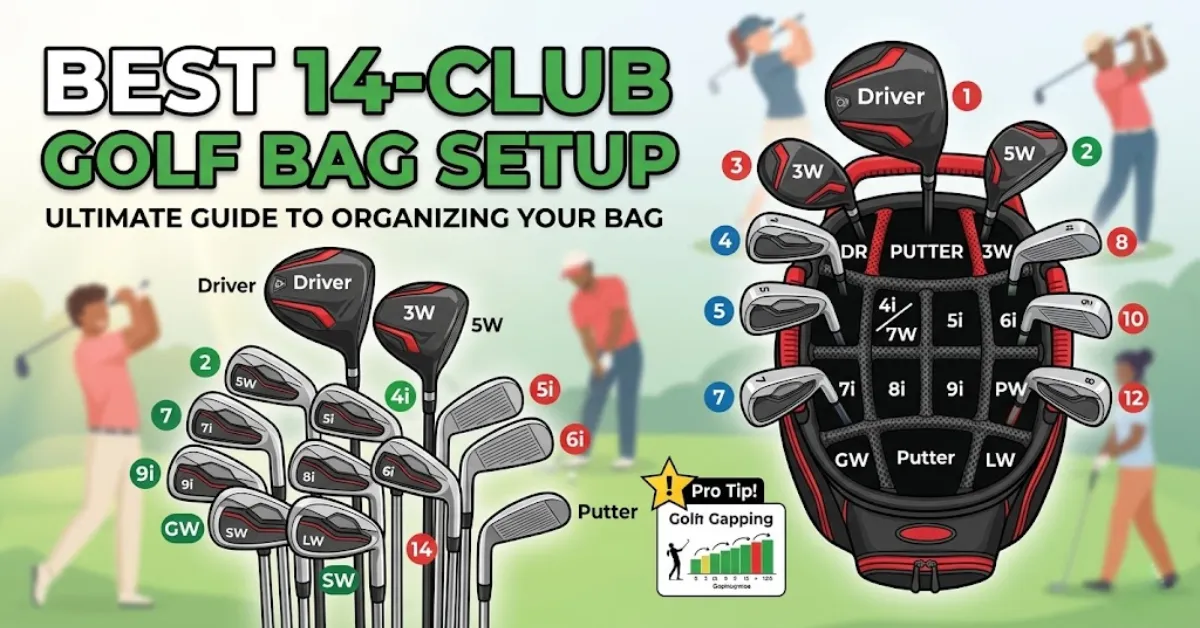
Figuring out the perfect golf bag setup took me an embarrassing amount of time. I’m a 13-handicap who spent two seasons carrying clubs I barely touched — a 4-iron I’d hit thin 80% of the time and a 60-degree lob wedge that mostly existed to terrify me from tight lies. Switching out both for a 4-hybrid and a more useful gap wedge dropped eight shots off my scoring average over the following season. The bag got simpler. The game got easier.
That’s what building the best 14-club golf bag setup actually looks like. Not copying what a tour pro carries. Not filling every slot because the rules allow it. It means choosing 14 clubs that each cover a specific job, with no overlap and no dead weight.
This guide covers the ideal 14-club setup for every handicap level, a full wedge loft breakdown, how to actually organise those clubs inside a 14-slot bag, and the one question every golfer should ask before spending money on new equipment.
The Right Way to Think About 14 Club Slots
The USGA Rules of Golf allow a maximum of 14 clubs per round — a rule in place since 1938. Most golfers treat those 14 slots as inventory space. The smart ones treat each slot as a decision.
Every club you add takes one away. More wedges means fewer long clubs. An extra fairway wood means dropping something else. The bag is a zero-sum game, and the players who score best understand that tradeoff before they ever step onto the first tee.
Your bag should cover your complete distance range — from maximum tee shot down to the shortest chip — with consistent gaps between clubs. Aim for 10–15 yards of separation between each full-swing club. Gaps wider than 20 yards create shot problems you can’t solve with technique alone.
You also don’t have to carry all 14. Plenty of golfers play their best rounds with 12 or 13 well-chosen clubs. The rule sets a ceiling, not a requirement.
The 3 Setups Side by Side: High, Mid, and Low Handicap
No two golfers need exactly the same 14 clubs. Your ball-striking consistency, swing speed, and short-game confidence all change which clubs deserve a slot. Here’s a clear view of the three most common setups — and the reasoning behind each one.
High Handicap Setup (Handicap Index 20+)
High-handicap golfers benefit most from forgiveness and launch. Long irons are the worst tools for this job. A high-handicap player who can’t consistently hit a 3-iron above 160 yards is better served by a 3-hybrid that naturally launches higher and recovers from off-center strikes.
| Slot | Club | Why This Slot |
|---|---|---|
| 1 | Driver | Only option for full tee shots on par-4s and par-5s |
| 2 | 3-Wood | Backup tee option; useful from the fairway on flat lies |
| 3 | 5-Wood | Easier to launch than a 3-wood from the deck; replaces 3-iron |
| 4 | 4-Hybrid | Fills the 185–200 yard range where long irons fail |
| 5 | 5-Hybrid | More consistent from rough and tight lies than a 5-iron |
| 6 | 6-Iron | Where the iron set starts for most high handicappers |
| 7 | 7-Iron | Bread-and-butter approach club |
| 8 | 8-Iron | |
| 9 | 9-Iron | |
| 10 | Pitching Wedge | Usually 44–46° — the key anchor for your wedge system |
| 11 | Gap Wedge (50–52°) | Fills the 80–100 yard range between PW and SW |
| 12 | Sand Wedge (54–56°) | Bunker play, greenside chips |
| 13 | Lob Wedge (58–60°) | Optional — only if you practice it |
| 14 | Putter |
The honest truth about lob wedges for high handicappers: most golfers carrying a 60-degree use it badly. Unless you’re practicing greenside shots twice a week, a second gap wedge or an extra hybrid is a smarter 13th slot. Start with 13 clubs and earn the 14th.
Mid Handicap Setup (Handicap Index 10–19)
Mid-handicap golfers hit the ball well enough to start reintroducing longer irons, but not well enough to rely on them under pressure. The ideal setup keeps hybrids in the long game and adds precision in the short game.
| Slot | Club | Why This Slot |
|---|---|---|
| 1 | Driver | |
| 2 | 3-Wood | Most mid-handicappers can flight this off the deck reliably |
| 3 | 5-Wood | Consistent gap coverage from 180–200 yards |
| 4 | 4-Hybrid | Bridge between 5-wood and 5-iron |
| 5 | 5-Iron | Where irons start — most mid-handicappers hit this decently |
| 6 | 6-Iron | |
| 7 | 7-Iron | |
| 8 | 8-Iron | |
| 9 | 9-Iron | |
| 10 | Pitching Wedge | |
| 11 | Gap Wedge (50–52°) | |
| 12 | Sand Wedge (54–56°) | |
| 13 | Lob Wedge (58–60°) | Earns its slot here — mid-handicappers can use it effectively |
| 14 | Putter |
At this stage, pay close attention to distance gapping. Many mid-handicap golfers discover that their 5-wood and 4-hybrid go the same distance. That’s a wasted slot. Check your carry numbers on a launch monitor or at the range before committing to the bag.
Low Handicap Setup (Handicap Index 0–9)
Low-handicap golfers build around precision and shot versatility. The ability to flight long irons, control trajectories, and work the ball both ways opens up club options that high handicappers simply can’t use effectively.
| Slot | Club | Why This Slot |
|---|---|---|
| 1 | Driver | |
| 2 | 3-Wood | |
| 3 | 2-Hybrid or Driving Iron | Low-handicappers favour the controlled trajectory over a 5-wood |
| 4 | 4-Iron or 4-Hybrid | Personal preference — both are viable at this level |
| 5 | 5-Iron | |
| 6 | 6-Iron | |
| 7 | 7-Iron | |
| 8 | 8-Iron | |
| 9 | 9-Iron | |
| 10 | Pitching Wedge | |
| 11 | Gap Wedge (48–50°) | PW lofts are often stronger in tour-style iron sets |
| 12 | Sand Wedge (54°) | |
| 13 | Lob Wedge (58–60°) | Non-negotiable at this level |
| 14 | Putter |
Low-handicap setups vary more than the others. Some scratch golfers prefer a 5-wood over a driving iron for rough performance. Others drop the 3-wood entirely for a second hybrid. The setup works because the player understands exactly what job each club does — and won’t carry anything they don’t trust completely under pressure.
Distance Gapping: The Number Every Club Has to Answer
Distance gapping is the single most useful framework for evaluating your bag. Ask yourself one question about every club you carry: does it cover a yardage range that no other club in my bag covers?
If the answer is no, that club is dead weight.
The chart below shows typical carry distances for a recreational golfer with average swing speed. Your numbers will be different — the pattern should be similar.
| Club | Typical Carry (Recreational) | Typical Carry (Faster Swinger) |
|---|---|---|
| Driver | 220–250 yards | 260–290 yards |
| 3-Wood | 200–220 yards | 230–255 yards |
| 5-Wood | 180–200 yards | 210–230 yards |
| 4-Hybrid | 175–190 yards | 200–215 yards |
| 5-Iron | 165–180 yards | 185–200 yards |
| 6-Iron | 150–165 yards | 170–185 yards |
| 7-Iron | 140–155 yards | 160–175 yards |
| 8-Iron | 130–145 yards | 148–162 yards |
| 9-Iron | 115–130 yards | 135–150 yards |
| Pitching Wedge | 100–115 yards | 118–135 yards |
| Gap Wedge | 85–100 yards | 100–118 yards |
| Sand Wedge | 70–85 yards | 85–100 yards |
| Lob Wedge | 55–70 yards | 70–85 yards |
Two gaps kill rounds more than any others: the jump between your 3-wood and your longest hybrid/iron (often 25+ yards for high handicappers who carry a 3-wood but can’t hit it off the deck), and the jump between your pitching wedge and sand wedge (can be 30+ yards if you’re missing a gap wedge). Both are solvable with one club addition.
Finding your own gaps doesn’t require a launch monitor, though a session on a Trackman or Foresight will give you exact numbers. Hitting 5–10 balls with each club at the range and pacing off typical carry distances works just as well for most players. The goal isn’t perfection — it’s identifying the two or three biggest jumps in your setup and deciding whether an additional club fills them better than what’s already in the bag.
The Wedge Slot Decision: Lofts, Degrees, and Why Your Pitching Wedge Matters More Than You Think
Most golfers think about wedge selection backwards. They ask “which lob wedge should I buy?” before they’ve even checked what their pitching wedge loft is. That order of operations is how you end up with a wedge setup that has 25-yard gaps between scoring clubs.
Here’s the problem. Modern game-improvement iron sets use strong lofts to generate more distance. A “pitching wedge” in a Callaway Paradym Ai Smoke iron set is 43°. A traditional players’ pitching wedge might be 46° or 47°. That 4-degree difference changes your entire wedge setup.
Check your PW loft first. It’s stamped on the sole of most modern irons or listed in the manufacturer’s specs. Then space your wedges at 4–6 degrees of separation from there. Any gap wider than 6 degrees creates a distance hole that’s hard to plug with swing manipulation.
Three-Wedge Setup (most common for mid and high handicappers):
- PW at 44°: add a 50° gap wedge and a 56° sand wedge
- PW at 46°: add a 52° gap wedge and a 58° lob wedge
- PW at 48°: add a 54° sand wedge — consider whether you need a gap wedge first
Four-Wedge Setup (common for low handicappers and those who practice short game regularly):
- PW at 43–44°: 48°, 52°, 56°, 60° — clean 4-degree increments across the board
- PW at 46°: 50°, 54°, 58° — or 50°, 54°, 60° if you use a flop shot
The lob wedge argument gets more heated on golf forums than almost any other equipment debate. My take: if you’re a high-handicap golfer who hasn’t yet learned to control a 56° sand wedge from tight lies, a 60° is going to punish you. Master the sand wedge first. The lob wedge earns its spot.
One thing nobody tells beginners: your iron set’s gap wedge (often labeled “GW” or “A”) is typically the weakest club in the set — weaker loft, thinner sole, limited forgiveness. Most golfers are better served by replacing the set gap wedge with a dedicated wedge that matches their sand and lob wedge in feel and turf interaction.
The 7-Wood Question: Should It Be in Your Bag?
More than 25% of PGA Tour players now carry a 7-wood. Matt Fitzpatrick, Viktor Hovland, and Max Homa are among those who’ve made the switch in recent seasons. The trend has filtered down to every handicap level, and for good reason.
A 7-wood typically sits at 21–22 degrees of loft — similar to a 3-hybrid or 4-hybrid — but with a much larger head. That extra head mass moves the center of gravity lower and further back, which means higher launch, more spin, and better stopping power on approach shots from distance. From fairway bunkers, semi-rough, or anything but the thinnest lies, a 7-wood is significantly more forgiving than the equivalent hybrid.
The catch? A 7-wood is longer than a hybrid of the same loft, which means it demands more swing consistency off the ground. Golfers who currently struggle to flush their 5-wood off the deck will struggle with a 7-wood too.
The players who benefit most are mid-to-low handicappers who already hit fairway woods solidly and need a long approach club with maximum stopping power. High handicappers are usually better served keeping a 4-hybrid or 5-hybrid in that distance range — the shorter shaft forgives swing inconsistencies that a 7-wood exposes.
The setup implication: if you add a 7-wood, something else comes out. Most golfers who make the switch drop their 4-hybrid. Check your carry distances first to make sure the replacement doesn’t create a gap.
How to Arrange Clubs in a 14-Slot Golf Bag (Cart, Stand, and Carry)
Getting your clubs into the right slots sounds trivial until you’re fumbling through six irons looking for your 8 on a 155-yard par 3 while the group behind watches. Organisation is a real performance variable. A well-arranged bag means less searching, less time, and fewer mid-round distractions.
The arrangement logic is identical regardless of bag type: longest clubs at the top (where the straps attach), shortest at the bottom (front face, facing away from you on a cart).
For a 14-Way Divider Cart Bag:
The most common 14-way layout runs four rows: back row (3 slots), second row (4 slots), third row (4 slots), front row (3 slots). Here’s how to fill it:
- Back row (3 slots): Driver, 3-wood, 5-wood. Longest clubs sit furthest from the cart face — this protects shafts from vibration and keeps the bag balanced.
- Second row (4 slots): 7-wood or 4-hybrid, 5-hybrid or 5-iron, 6-iron, 7-iron. Transition zone from long clubs to irons.
- Third row (4 slots): 8-iron, 9-iron, pitching wedge, gap wedge. Most-used scoring clubs in the most accessible row.
- Front row (3 slots): Sand wedge, lob wedge, putter. Putter goes in the dedicated putter well if your bag has one — most quality cart bags do, and it saves the grip from grip-on-shaft contact.
Left-handed golfers should mirror this arrangement — driver on the right side of the back row, working left as clubs get shorter.
For a Stand Bag or Carry Bag:
Stand bags typically have 4-way or 6-way dividers. Driver and woods go in the section nearest the shoulder strap. Irons group in the middle. Wedges and putter go closest to the ground. The principle is the same — heaviest, longest clubs toward the top to balance the bag as it sits against your body.
One practical note: in a 14-way bag, you don’t need head covers on your irons. The individual slots prevent shaft-on-shaft contact, which is the only reason to cover irons in the first place. Keep them on your driver, woods, and hybrids — those heads can scratch against bag material.
When Not to Carry All 14 Clubs
This is the section most bag-building guides skip. Filling all 14 slots isn’t always the right call.
If you’re a beginner still working on making consistent contact, 14 clubs creates decision paralysis. Standing over a 175-yard approach with a 4-hybrid, a 5-hybrid, and a 5-iron staring back at you forces a choice you’re not yet equipped to make confidently. Start with 9–11 clubs. Know each one deeply. Add more as your distance control improves and you start noticing genuine yardage gaps.
If your swing speed sits below 80 mph with the driver, you’re probably hitting your 3-wood and 5-wood within 10 yards of each other. One of them isn’t earning its slot. Golfers at lower swing speeds compress the distance table — what’s a 30-yard gap between clubs for a fast swinger might be a 12-yard gap at your tempo. Run the numbers before assuming you need the full 14.
If you’re playing a course with tight, tree-lined fairways where every hole plays under 350 yards, your driving iron might beat your 3-wood that day. The bag should adapt to the course, not the other way around. That’s not a beginner concept – that’s how scratch golfers think about every round.
Frequently Asked Questions
Most golfers should carry a driver, one or two fairway woods, one to three hybrids, five to six irons (typically 5-iron through pitching wedge), two to three additional wedges (gap, sand, optional lob), and a putter. The exact 14-club mix depends on your Handicap Index — high handicappers use more hybrids and fewer long irons; low handicappers reverse that. Every club needs to cover a specific yardage that no other club in the bag covers.
High-handicap golfers (Handicap Index 20+) get the most benefit from replacing long irons with hybrids. Start the iron set at 6-iron, add a 4-hybrid and 5-hybrid above, and carry a 5-wood and 3-wood for maximum distance coverage. Keep the wedge setup simple — pitching wedge, gap wedge, and sand wedge. Hold off on the lob wedge until your sand wedge is a trusted tool.
Put the driver and woods in the back row (top of the bag), arrange irons from longest to shortest through the middle rows, and put wedges and the putter in the front row (bottom of the bag). In a cart bag, back row faces the rear — that’s where the longest clubs go. In a stand bag, the heaviest clubs sit closest to the shoulder strap at the top.
No. The 14-club limit is a ceiling, not a requirement. Many beginners play better with 9–11 clubs — fewer decisions, more time developing feel with trusted clubs. Even experienced golfers sometimes play with 12 or 13 clubs. If you can’t honestly say every club covers a unique yardage range, you’re carrying dead weight.
The most common 14-club golf bag setup among recreational golfers runs: driver, 3-wood, 5-wood, 4-hybrid, 5-iron through pitching wedge (that’s 6 irons), a gap wedge (50–52°), sand wedge (54–56°), lob wedge (58–60°), and a putter. This setup works well for golfers in the 10–20 Handicap Index range. Low handicappers often swap the 5-wood or 4-hybrid for a driving iron or 7-wood.
Most golfers carry three wedges: pitching wedge (comes with the iron set), a gap wedge (50–52°), and a sand wedge (54–56°). A fourth wedge — the lob wedge (58–60°) — earns its slot when you practice greenside shots regularly and can use high loft confidently. Check your pitching wedge loft first. Modern game-improvement sets often have strong-lofted pitching wedges (43–44°), which means you need to start your wedge system earlier — a 48° gap wedge, not a 52°.
Your Bag Is a Tool, Not a Trophy
The best 14-club golf bag setup isn’t the one with the most expensive clubs. It’s the one where every single slot makes your game easier, your decisions clearer, and your scoring more consistent.
Start by knowing your carry distances. Then check your distance gaps. Then look for the two or three largest jumps in your current setup and ask whether one club addition closes them. Repeat that process every season as your game evolves, because the bag that made you a 20-handicap probably isn’t the right bag when you’re at 12.
If you want to keep building, check out our guides on the best hybrids for mid-handicappers and how to finally stop chunking wedge shots, two of the most impactful upgrade areas for golfers in the 10–20 Handicap Index range.