
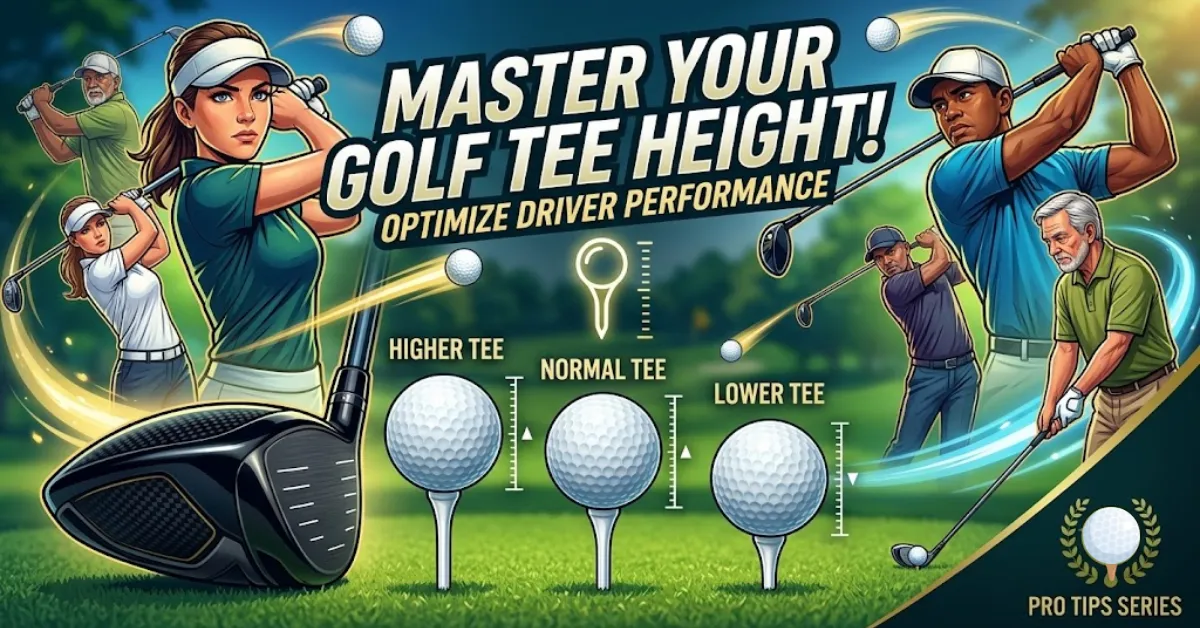
Most golfers spend serious money on the right driver and then grab whatever tee is sitting in the bottom of their bag. That is the wrong order of priorities. Last spring, playing a scramble at a course I had never visited, I watched a 12-handicapper sky his drive on the first hole because his tee was too tall for his swing path. He dropped it down by half an inch on the second hole and split the fairway. Same club. Same swing. Different tee height. That small adjustment made the whole difference.
Golf tee height is one of the cheapest and most overlooked performance adjustments in the game. The right height changes your launch angle, your spin rate, and your carry distance without changing a single thing about your swing mechanics. This guide gives you exact measurements for every club in the bag, the USGA rule that governs maximum height, and one simple trick for keeping your tee height consistent every single round.
Quick Answer: For a driver, tee the ball so half sits above the top of the clubhead. For fairway woods, the tee cone should barely show above the ground. For irons and hybrids, push the tee fully into the ground so the ball sits just off the grass. The USGA maximum tee height is 4 inches (101.6mm).
Golf Tee Height Chart: Every Club at a Glance
Pull this table up before your next round. Every golfer who uses these reference points plays more consistent tee shots by the back nine.
| Club | Tee Height (inches) | Tee Height (mm) | Visual Checkpoint |
|---|---|---|---|
| Driver (460cc) | 1.5 inches above ground | ~38mm | Half the ball above the crown |
| 3-Wood | 0.25–0.5 inches above ground | 6–13mm | Tee cone barely visible |
| 5-Wood / 7-Wood | 0.25 inches above ground | ~6mm | Tee cone just peeking out |
| Hybrid | Flush to ground | ~0mm | Ball sits just above the grass |
| 2-iron / 3-iron | Flush to ground | ~0mm | Ball sits just above the grass |
| 4-iron through 7-iron | Flush to ground | ~0mm | Looks like no tee at all |
| 8-iron through PW | Flush to ground | ~0mm | Looks like no tee at all |
| Sand Wedge / Lob Wedge | Flush to ground | ~0mm | Looks like no tee at all |
One column no other guide gives you: that visual checkpoint. You should be able to confirm your golf tee height at a glance without bending over and squinting at a ruler.
Tee Height for Driver – The Half-Ball Rule and When to Break It
The standard rule for a modern 460cc driver is simple. Stand the club on its sole behind the ball and look at where the top of the face sits. Half the ball should sit above that line. That means roughly 1.5 inches of the tee sticking out of the ground for most standard 3.25-inch wooden tees.
That measurement targets the upper half of the clubface at impact. Modern driver heads are engineered with this in mind. The center of gravity on most current 460cc heads sits higher than the geometric center of the face, so a strike on the upper half actually generates lower spin and higher launch. That combination is exactly what adds carry distance.
Here is what the data shows. MyGolfSpy testing with a PING G410 LST driver found that a 1.5-inch playing tee height produced 14.19 more yards of carry on average than a 0.5-inch tee. That is not a small margin. That is the difference between hitting a par 5 green in two and laying up. The same test found that impact location dropped more than 4mm lower on the face with the shorter tee, and backspin increased by 326 rpm.
GOLFTEC’s TrackMan data tells the same story from a different angle. A higher tee produced a launch angle of 15 degrees and max ball height of 37 yards. The lower tee dropped launch to 8 degrees and max height to 19 yards. That is a 7-degree swing in launch from one adjustment you can make in three seconds on the tee box.
Now for when to break the half-ball rule. Tee it a fraction lower than half-ball when you are fighting a headwind and want a more penetrating ball flight. Tee it slightly higher – more than half the ball above the crown – only if you have a steep downward angle of attack and need to stop hitting down on your driver. Most recreational golfers with a sweep or positive attack angle should leave the tee at the standard height.
Tee Height for 3-Wood and Fairway Woods
This is the section nobody covers clearly, and it causes real damage on par 5 second shots and long par 4 holes.
For a 3-wood off a tee, push the tee into the ground until only the very top of the cone peeks above the surface. That leaves roughly 0.25 to 0.5 inches of the tee above the ground. The ball sits barely above the grass, not elevated like a driver. The reason is the club design. A 3-wood has a lower center of gravity than a driver and a shallower face. It sweeps through the ball rather than striking it on the upswing. Giving it a high tee creates contact on the top edge of the club instead of the face, and the result is a sky shot that loses 30 or 40 yards instantly.
A 5-wood or 7-wood follows the same logic. Tee it at 0.25 inches above the ground, or just enough so the tee does not immediately fall over in soft turf. You want the contact centered on the face, not up toward the crown.
If you carry a Callaway Heavenwood or similar high-lofted fairway wood, read through our full fairway wood distance guide for more on optimizing those shots from the tee and the deck.
Tee Height for Hybrids
Hybrids present a real dilemma on the tee box, and most golfers get it wrong in the same direction. They tee the ball an inch off the ground like a fairway wood, then wonder why the shot balloons high and comes up short.
Push the tee completely into the ground for a hybrid. The ball should sit just above the level of the grass, as if you found a perfect lie in the fairway. That is the whole point of a hybrid – it already gives you extra launch compared to a matching-loft iron. Teeing it higher than flush does not add launch in any useful way. It pushes your contact point up the face, increases spin, and reduces distance.
The only time to give a hybrid any tee elevation is on a tight par 3 into a strong headwind, where you want a high, soft landing. Even then, half a tee cone height is the maximum. More than that and you are fighting your own club.
Tee Height for Irons and Wedges (Including Short Par 3s)
Push the tee completely into the ground for every iron, pitching wedge, sand wedge, and lob wedge. Do not leave any tee visible above the surface. The ball should look like it is sitting on a perfect fairway lie.
That is not just an aesthetic preference. Irons are designed to strike the ball slightly on the downswing, taking a divot after impact. A tee elevated even 0.5 inches forces you to hit up slightly to make contact, which destroys the ball-first contact that irons require for clean compression. The result is thin, high shots that fly shorter and land softer than you want.
For short par 3s – anything 120 yards and under with a wedge or 8-iron – always tee the ball. Even a flush tee gives you a cleaner lie than the firmest teeing ground, and you take out any awkward stances caused by grass grain or worn tee boxes. Push the tee fully in, ball barely above the ground, and swing exactly as you would from the fairway.
Here is where I need to be honest about one exception. If you carry your 8-iron consistently 155 yards and already hit a clean, penetrating ball from the fairway, tee height will change almost nothing for your iron shots. This section matters most to golfers who struggle with thin contact or inconsistent iron strikes – which covers most players under a 15 handicap.
Does Tee Height Affect Distance? The Data Says Yes
Most golfers know tee height matters, but they treat it like a minor preference. The numbers say otherwise.
The MyGolfSpy test found 14.19 yards more carry with a properly elevated driver tee versus an under-teed ball. GOLFTEC’s TrackMan session found a 7-degree swing in launch angle between the same two extremes. A 7-degree launch difference at a typical 90 mph swing speed represents somewhere between 15 and 25 yards of carry depending on spin conditions.
That gap exists because of where the ball contacts the face. Under-teed balls hit low on the face, which for modern drivers actually increases spin due to where the center of gravity sits relative to impact. More spin with the same ball speed means the ball climbs faster and descends sooner. High-face contact does the opposite – lower spin, higher launch, more distance.
Dialing in your distance with the right tee height is as real as club fitting. For more on understanding distance and shot control, see our guide on dialing in your distance on the course.
Golf Tee Height Maximum – What the USGA Rules Actually Say
No competitor article mentions this. It matters if you play any form of organized competition.
Under USGA Rule 6.2b, a tee must be no longer than 4 inches (101.6mm). That is the total length of the tee, not the height above the ground. Since you always push some portion of the tee into the ground, the maximum height a ball can realistically be teed is around 3.25 to 3.5 inches above the turf for most tee designs. Standard 3.25-inch golf tees pushed in slightly get close to that real-world maximum.
There is no minimum tee height. You can push a tee completely flat if you want. Most golfers playing recreational rounds never need to think about this rule at all. For club competitions, match play events, or any round where an official handicap score is submitted, using a tee longer than 4 inches is a breach of the Equipment Rules.
One practical note: no commonly sold golf tee exceeds 4 inches. You would have to specifically seek out an oversized tee to breach this rule. Standard 2.75-inch and 3.25-inch tees are both well within the legal limit.
How to Tee the Ball at the Same Height Every Time
Knowing the correct golf tee height is one thing. Hitting it consistently every hole is another.
Here are three methods that actually work on the course, not just the range.
Method 1: The Ring Finger Trick
This method comes from GOLFTEC coaching. Hold your tee between your thumb and index finger with your ring finger pressed against the tee below the ball. Push the tee into the ground until your ring finger touches the turf surface. That ring-finger length is your consistent tee height for a driver. The measurement varies slightly between golfers based on hand size — that is fine. What matters is repeating the same depth every time on the course.
Method 2: Step Tees for Consistent Depth
Step tees are tees with a physical stopper – a small disk or flange – that prevents you from pushing the tee past a set depth. When the stopper hits the ground, your height is set. No measuring, no guesswork. This method works especially well for golfers over 55 or anyone who plays in cold weather and loses fine motor precision. Research on tee height consistency found golfers using step tees cut their launch angle variance from plus or minus 3.2 degrees down to plus or minus 1.1 degrees in testing.
Method 3: Tee Markings
Some premium tees include printed lines at set heights. Look at the tee before you buy – brands like Pride Professional Tee System print measurement marks directly on the tee shaft. Set a consistent starting mark, push to that line, done. This method is the easiest to use and costs essentially nothing extra compared to standard wooden tees.
Wind and Course Conditions – When to Change Your Tee Height
No competitor mentions this at all. Every golfer who plays links-style courses or early morning rounds into the wind needs to know it.
Tee it lower into a headwind. When you tee the driver slightly below the standard half-ball height, you contact the ball lower on the face, which decreases launch angle and reduces the height of the ball flight. The ball stays under the wind longer, fights less resistance, and often rolls out further than a high-flying shot that stalls into a headwind at peak height.
Tee it higher when a strong tailwind is at your back. More height above the crown means a higher launch. A higher-flying shot catches more of the tailwind, stays in the air longer at peak height, and can add 10 to 15 yards of carry in strong following conditions.
For calm conditions or a crosswind, stay with the standard height. Crosswinds do not meaningfully respond to tee adjustments. Work on shot shape for crosswinds, not tee height.
One other course condition worth noting: soft, wet fairways. In soft conditions, carry distance matters more than total distance because the ball stops where it lands. Tee it at the standard height or slightly higher for maximum carry.
Frequently Asked Questions
Tee a driver so half the ball sits above the top of the clubhead when the club is grounded behind the ball. For a standard modern 460cc driver, this means 1.5 inches of tee showing above the ground, using a 3.25-inch tee pushed into the ground by roughly 1.75 inches. This positions impact on the upper half of the face where modern drivers generate the most distance.
Push the tee completely flush into the ground for all irons, including long irons, mid-irons, and scoring irons through pitching wedge. The ball should sit just above grass level and look identical to a clean fairway lie. Irons need a downward strike for ball-first contact, and any tee elevation interferes with that.
For a 3-wood off a tee, push the tee in until only the very top of the cone sits above the ground – roughly 0.25 to 0.5 inches of tee visible. This is far less than a driver. A 3-wood sweeps through the ball on a shallow path, and a higher tee causes contact near the top edge of the club, producing the dreaded sky shot.
Yes – and the data makes that very clear. Independent testing found that a 1.5-inch tee height produces 14 more yards of carry on average compared to a 0.5-inch tee with the same driver and swing. The reason is impact location: higher tee means higher face contact, which generates lower spin and higher launch angle – the exact combination that maximizes distance.
USGA Rule 6.2b sets the maximum tee length at 4 inches (101.6mm). Because some portion of the tee must enter the ground, the practical maximum ball height above the turf is around 3.25 to 3.5 inches. Standard 3.25-inch tees sold in every pro shop are well within this limit. No commonly available tee violates this rule.
Push the tee completely into the ground for a hybrid, leaving the ball just above the grass – the same as for an iron. Hybrids already generate extra height and launch compared to a matching-loft iron. Teeing a hybrid even 0.5 inches higher than flush increases spin and reduces distance rather than helping it.
The Bottom Line on Golf Tee Height
Proper golf tee height costs nothing and takes three seconds to get right on every hole. Half the ball above the driver crown. Tee cone barely showing for fairway woods. Completely flush for irons, wedges, and hybrids. Those three rules cover every club in the bag for every round you play. Change the height based on wind conditions and you have one more free tool most golfers never use. A good tee height does not fix a bad swing – but a bad tee height can absolutely ruin a good one. Take the chart above, bookmark it, and stop leaving yards in the parking lot.
Looking to match your tee height knowledge with the right equipment setup? Our guide on matching your clubs to your swing covers driver specs, iron selection, and everything in between.