
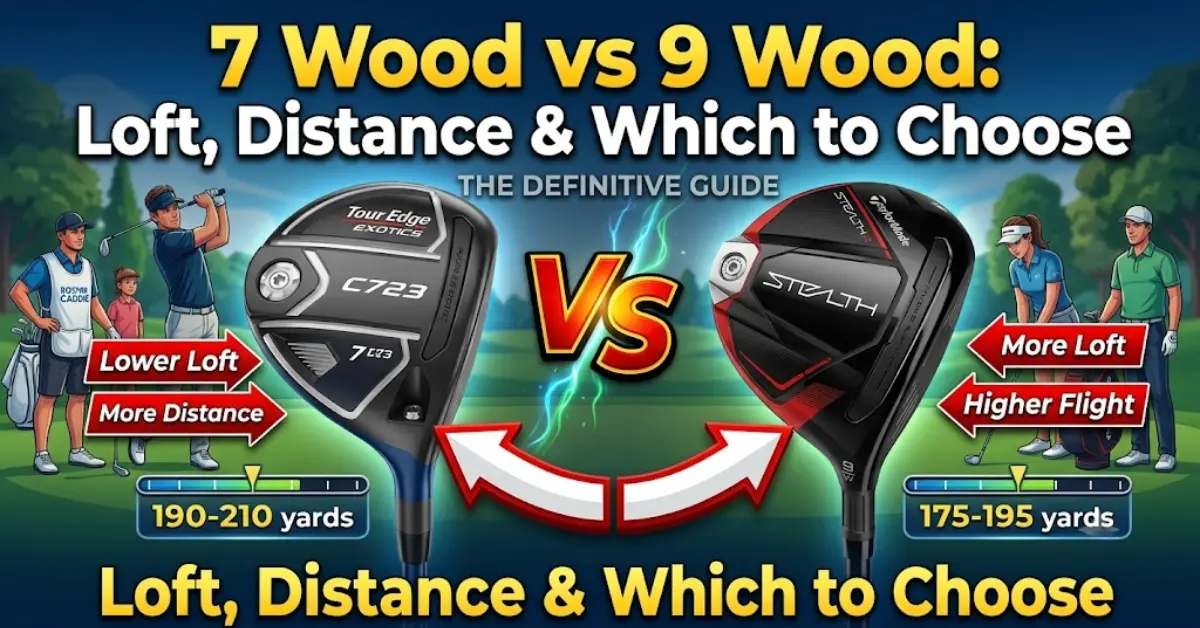
Three degrees of loft separates a 7 wood from a 9 wood. Half an inch of shaft length. About 28 grams of head weight. And yet golfers agonize over this decision for months – sometimes buying the wrong one, sometimes carrying neither, sometimes wondering whether they need both.
I play to a 9 handicap, and I carried a Ping G430 7 wood for most of last season before testing a 9 wood in the same line back-to-back on Trackman. The distance gap was real but smaller than I expected: about 11 yards on a well-struck shot. The height difference was far more dramatic. The 9 wood flew noticeably steeper and stopped much faster, which matters more on courses with firm greens than the yardage gap ever does. By the end of that session, I understood something most articles about these clubs miss entirely: the choice between a 7 wood vs 9 wood isn’t really about distance. It’s about what you need the ball to do when it lands.
Here’s every number you need, a decision framework that actually works, and a clear answer to whether one or both of these clubs deserves a slot in your bag.
Quick Answer: A 7 wood sits at 21° of loft and carries 180–210 yards depending on swing speed. A 9 wood sits at 24° and flies 10–15 yards shorter. Choose the 7 wood for distance and versatility. Choose the 9 wood for a steeper descent and softer landings. Most mid-handicappers get more from the 7 wood.
The Numbers First: Loft, Shaft Length, and Head Size
The 7 wood vs 9 wood loft difference is 3 degrees in the Ping G440 MAX line – 21° for the 7 wood, 24° for the 9 wood. That gap sounds small, but it changes the peak height, descent angle, and stopping power meaningfully.
Here are the exact Ping G440 MAX specs for both clubs direct from Ping’s specification sheet:
| Specification | 7 Wood (G440 MAX) | 9 Wood (G440 MAX) |
|---|---|---|
| Loft | 21.0° | 24.0° |
| Shaft Length | 42″ | 41.5″ |
| Head Weight | 227.9g | 232.6g |
| Head Size | 165cc | 157cc |
| Lie Angle | 57.0° | 57.5° |
| Loft Adjustability | ±1.5° | ±1.5° |
The 7 wood’s shaft is half an inch longer, its head slightly larger at 165cc vs 157cc, and its head weight lighter by about 5 grams. The longer shaft is why most golfers pick up 10–15 more yards from the 7 wood — it’s not purely the loft doing the work. That shaft length also explains why the 9 wood feels slightly more controlled off the turf, the same way a short iron feels easier to hit than a mid-iron.
Most brands follow this same pattern. Across the market, 7 woods sit between 20–22° and run 41.5–42.5″ in length. Nine woods cluster between 23–26° and come in at 40–41.5″. The Ping G440 lofts are on the lower end of the 9-wood range, which explains why it flies further than some competitors’ 9 woods — a 24° Ping 9 wood hits meaningfully further than a 26° version from another brand.
How Far Does Each One Go? Distance by Handicap
The 7 wood vs 9 wood distance gap is roughly 10–15 yards for most players, and that gap holds fairly consistently across handicap levels. Here’s a performance-average distance chart based on Shot Scope data and fairway wood benchmarks across handicap groups:
| Handicap Level | 7 Wood Avg Distance | 9 Wood Avg Distance | Gap |
|---|---|---|---|
| Scratch / 0–5 | 205–215 yards | 190–200 yards | ~15y |
| 5–10 | 195–205 yards | 180–190 yards | ~12y |
| 10–15 | 185–195 yards | 170–180 yards | ~12y |
| 15–20 | 170–185 yards | 158–170 yards | ~12y |
| 20–25 / Seniors | 155–170 yards | 145–160 yards | ~10y |
Two things matter more than these numbers alone. First, these are performance-average distances — solid contact, not your best hit of the day. Real carry distances run 5–8% shorter on a mis-hit, which is more common with the longer-shafted 7 wood than with the 9. Second, the 9 wood’s real advantage isn’t on the yardage chart at all — it’s the steeper descent angle that follows from higher peak height. At 20–25 handicap level, that descent angle is the difference between holding a green and watching the ball skip through the back.
Senior golfers and players with swing speeds below 85 mph typically see a proportionally smaller distance gap between the two clubs — closer to 8–10 yards — because slower speeds produce higher spin rates that close the loft gap somewhat.
What Iron Does Each Club Replace?
The iron-replacement question is where most buyers start — and where most articles give a vague answer.
| Club | Loft Range | Primary Iron Replacement | Backup Replacement |
|---|---|---|---|
| 7 Wood | 20–22° | 3-iron or 4-iron | 3-hybrid |
| 9 Wood | 23–26° | 4-iron or 5-iron | 4-hybrid |
The overlap between the 7 wood and a 3-hybrid is important. Both clubs sit in the 20–22° zone, but the 7 wood typically carries the ball 8–12 yards further than the equivalent hybrid due to its longer shaft and larger, low-CG head. Arccos data published by Golf Digest shows that golfers from scratch to 25 handicap hit greens in regulation 70% more often with a 7-wood than with a 3-hybrid across distances from 140–220 yards. That’s not a marginal difference — it’s significant enough that if you’re currently carrying a 3-hybrid, putting a 7 wood in its place will produce measurably better scorecards within a few rounds.
The 9 wood, sitting at 23–26°, slots in right next to a 4-hybrid or a mid-lofted driving iron. Some golfers carry the 9 wood specifically to replace a 5-iron they struggle to get airborne. That’s a completely legitimate reason — the 9 wood launches steeper and lands softer than almost any 5-iron in an amateur’s hands.
Who Should Choose the 7 Wood
The 7 wood is the right call for most golfers with swing speeds in the range of 85–95+ mph who want to replace a hybrid or long iron and gain real stopping power from longer distances.
The data is striking. Arccos tracked greens-in-regulation across scratch to 25 handicap golfers at distances between 140 and 220 yards, comparing 7 wood against 3-hybrid — the most natural alternative at this loft. The 7 wood’s GIR rate was higher in 28 of 40 data combinations, a 70% win rate. On longer par-5 second shots, that translates directly into birdie chances instead of chips. For a mid-handicapper playing 180-yard second shots regularly, that one substitution could reasonably shave a stroke or two per round over a season.
Golfers who tend to sweep the ball rather than take a divot are particularly well-suited to the 7 wood. The fairway wood’s wider, lower sole just glides through the turf more naturally than a hybrid at this loft. Any player already comfortable with a 5 wood will adapt to a 7 wood almost immediately — the swing is identical, just a bit shorter.
The 7 wood does not work as well into the wind. That high, spinning ball flight becomes a liability the moment you’re hitting into a 15 mph headwind. Keep that in mind if you play links-style courses regularly.
Who Should Choose the 9 Wood
The 9 wood is the better club for players whose priority is getting the ball up fast, keeping it high, and stopping it quickly on landing – regardless of distance.
This 9 wood golf club excels in three situations: approach shots to firm greens where you need maximum descent angle, long par-3 tee shots where stopping power beats an extra 10 yards of carry every time, and escape shots from light rough where a taller face and more loft help pop the ball upward cleanly from a sitting lie. Tommy Fleetwood put a TaylorMade Qi4D 9 wood into his bag at the 2026 Masters specifically for the last reason — he wanted the ball high enough and spinning enough to hold Augusta’s lightning-fast greens.
Seniors and players with swing speeds at or below 85 mph often find the 9 wood genuinely transformative. For 7 wood vs 9 wood distance for seniors, the gap narrows to about 8–10 yards, which barely matters. What does matter is that the 9 wood’s shorter shaft (41.5″ vs 42″) and higher loft combine to make every shot feel more controllable and less dependent on perfectly timed tempo. Slower swingers also pick up disproportionate carry from the extra loft because they need every degree of help getting the ball airborne cleanly.
One honest limitation: if you already carry a 24° or 25° hybrid and you hit it comfortably, the 9 wood gives you virtually the same distance with a bit more height and forgiveness. Good enough to justify a bag slot? Depends on how much you hate your current hybrid.
Should You Carry Both? The Case for a 7 Wood AND 9 Wood
Dustin Johnson does it. At the 2026 Masters, Fleetwood played a 9 wood and multiple players on Tour carry both a 7 and 9 wood simultaneously. The 5 wood vs 7 wood vs 9 wood debate is real at elite level, and it’s increasingly relevant for mid-handicap amateurs too.
Carrying both makes sense when your 5 wood sits at 18–19° and your lowest iron is a 6-iron. That gap from 18° down to your first iron is enormous — easily 50–60 yards — and trying to fill it with a single hybrid often leaves a 15–18 yard dead zone. A 7 wood at 21° and a 9 wood at 24° combined cover that entire range cleanly, with sensible 10–15 yard gaps between each step.
The trade-off is a bag slot. Carrying both means dropping either your 5 wood or one of your mid-irons. Most golfers playing 175-yard shots with a 7 or 8 iron are better served extending their comfortable range upward with a 9 wood than worrying about losing a club they rarely use.
Comparing this to the 7 wood vs 9 wood vs 11 wood conversation: the 11 wood (around 27–28°) starts encroaching on the territory of a 5-iron or even 6-iron replacement, which most golfers don’t need. Stick to 7 and 9 unless you genuinely struggle with everything above your 6-iron — in which case a fitter, not an 11 wood, is probably the real answer.
For the full picture on how the 5 wood stacks up against the 7, check out how the 5 wood stacks up against the 7 — the gaps are closer than most golfers assume.
The Ping G440 MAX: Best-in-Class for Both Lofts
For anyone specifically comparing the Ping G440 7 wood vs 9 wood, these clubs are the easiest recommendation on the market right now. Both lofts sit within the Ping G440 MAX family at a retail price of $349–$369 at Golf Galaxy and Dick’s Sporting Goods (June 2026 pricing). The standard shaft is the Ping Alta CB Blue 65 in Regular flex — a counter-balanced, mid-high launch graphite shaft that suits the vast majority of amateur swing speeds.
What makes the G440 MAX stand out against other fairway woods in both lofts is the Free Hosel Technology, which strips 11.5 grams from the hosel and redistributes that weight to lower the center of gravity. Combined with the CarbonFly Wrap crown, it produces a noticeably higher, softer launch than competitors at the same stated loft. Golfers comparing the Ping G430 (previous generation) to the G440 reported a consistent 3–5 yard carry increase in the 7 wood — largely because the taller face hits the CG-to-face relationship more precisely on slightly low contact.
Used G430 7 woods and 9 woods are available on the secondary market for $120–$180 in good condition if the $349 new price is a barrier.
Check out the best 7 woods available right now for a full breakdown of where the G440 sits against its competition.
Frequently Asked Questions
A 7 wood replaces a 3-iron or 4-iron, sitting at 20–22° of loft and carrying 180–210 yards depending on swing speed. A 9 wood replaces a 4-iron or 5-iron at 23–26°, carrying roughly 10–15 yards shorter. Both clubs replace hybrids of equivalent loft, but with more carry distance and a steeper, softer landing.
For most golfers playing at 10–20 handicap, the 7 wood is the better choice. It covers more distance, hits greens more often than a 3-hybrid in the same loft range (70% more greens according to Arccos data), and works from fairways, light rough, and tees. The 9 wood is the better choice for slower swing speeds, senior golfers, and anyone who specifically needs maximum height and stopping power on approaches between 155–180 yards.
A 9 wood replaces a 4-iron or 5-iron. With 23–26° of loft and a shaft around 41–41.5″ long, a 9 wood sits in the same distance and loft range as a 4-hybrid. It produces more carry distance than a 5-iron, with a significantly higher peak height and softer landing — making it the better choice for any golfer who struggles to get a 5-iron fully airborne.
A 7 wood replaces a 3-iron, 4-iron, or 3-hybrid. At 20–22° of loft, it sits in the same range as a standard 3-hybrid but typically carries 8–12 yards further due to its longer shaft and lower center of gravity. For golfers who carry a 3-hybrid and struggle to hold greens from long distances, swapping to a 7 wood is one of the highest-value equipment changes available at any handicap level.
The Bottom Line
The 7 wood vs 9 wood decision comes down to your swing speed, your typical distances, and what you actually need the ball to do at the other end. Faster swingers above 85 mph who need to hit and stop greens from 180–200 yards should start with the 7 wood — the data overwhelmingly supports it. Slower swingers, seniors, and players whose real problem is getting the ball airborne consistently should start with the 9 wood. And anyone with a wide gap between their 5 wood and longest comfortable iron should seriously consider both.
The Ping G440 MAX is the standard recommendation at either loft, priced at $349–$369 new. Get fitted before you buy – three degrees of loft difference makes these clubs feel surprisingly distinct under pressure, and the shaft flex that works in a 7 wood may not be right for your 9 wood setup.