
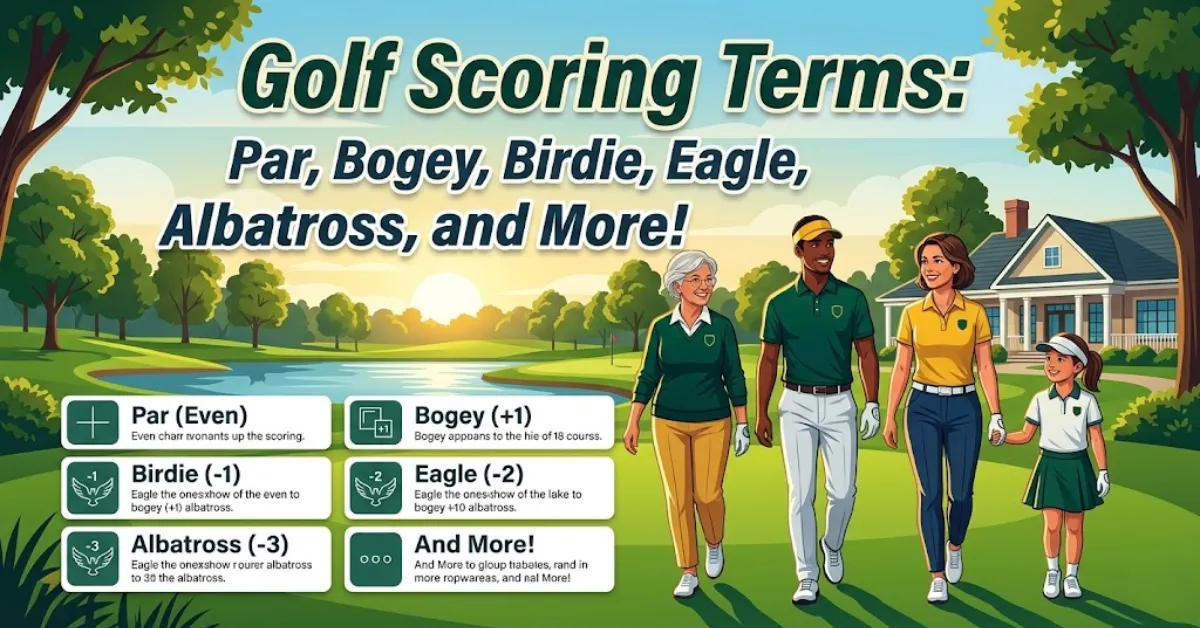
Golf scoring terms – birdie, bogey, eagle, par – are the language of every round of golf, and understanding them turns the game from confusing to genuinely exciting. This guide covers every scoring term used on the course, explains exactly what each one means relative to par, and tells you where they all came from. Whether you played your first round last week or you’ve been playing for years, this is the reference you’ll keep coming back to.
Golf Scoring Terms Quick-Reference Table
| Golf Score Term | What It Means | Example |
|---|---|---|
| Stroke | One swing at the ball | Any single hit |
| Par | Expected strokes for a hole | Par 4 = 4 strokes |
| Birdie | 1 stroke under par | 3 strokes on a par 4 |
| Eagle | 2 strokes under par | 3 strokes on a par 5 |
| Albatross / Double Eagle | 3 strokes under par | 2 strokes on a par 5 |
| Condor | 4 strokes under par | Hole-in-one on a par 5 |
| Hole-in-One / Ace | 1 stroke, any par | Ball in the cup off the tee |
| Bogey | 1 stroke over par | 5 strokes on a par 4 |
| Double Bogey | 2 strokes over par | 6 strokes on a par 4 |
| Triple Bogey | 3 strokes over par | 7 strokes on a par 4 |
| Quadruple Bogey | 4 strokes over par | 8 strokes on a par 4 |
Golf Scoring Terms in Order: Best Score to Worst
Here is every golf scoring term ranked from best to worst, so you can see exactly how the scoring system works from one end to the other:
Condor (-4): The rarest score in all of golf. Four strokes under par on a single hole. Requires a hole-in-one on a par 5. Fewer than ten verified condors have ever been recorded.
Albatross / Double Eagle (-3): Three strokes under par. Only possible on a par 4 (hole-in-one) or par 5 (two shots to the hole). An incredibly rare achievement even among professionals.
Eagle (-2): Two strokes under par. Common on par 5s when a golfer reaches the green in two shots and sinks the putt. Occasional on par 4s with a very long drive.
Birdie (-1): One stroke under par. The most celebrated routine score in golf. Getting a birdie means you beat the expected score for that hole.
Par (E / Even): You matched the expected score exactly. Two putts on the green was the assumption when par was set.
Bogey (+1): One stroke over par. The most common score for recreational golfers. On an 18-hole course, shooting all bogeys gives you a score of 90 on a par-72 course.
Double Bogey (+2): Two strokes over par. Often caused by a penalty shot, a bad approach, or three putts. Common among mid-handicap players.
Triple Bogey (+3): Three strokes over par. Happens to every golfer occasionally. The key is not to let one bad hole ruin the rest of the round.
Quadruple Bogey (+4): Four strokes over par. Also informally called a “snowman” when the total score on a hole is 8 (on a par 4), because the number 8 looks like a snowman. Shake it off.
Golf Scoring Terms Explained in Full
Stroke
A stroke is one forward swing of the club intended to hit the ball. Every swing counts – including mishits. If you swing at the ball and miss it completely (called a whiff), that still counts as a stroke. Count every one of them.
Par: The Foundation of Golf Scoring
Par is the number of strokes an expert golfer is expected to need to complete a hole, assuming two putts on the green. On a par 4, a scratch golfer should reach the green in 2 shots and then two-putt to finish.
The distance of a hole is the main factor in deciding its par. Here are the current USGA distance guidelines:
For men:
- Par 3: Up to 250 yards
- Par 4: 251 to 470 yards
- Par 5: 401 to 690 yards
For women:
- Par 3: Up to 210 yards
- Par 4: 211 to 400 yards
- Par 5: 401 to 575 yards
(Source: USGA — usga.org)
A standard 18-hole course includes a mix of par-3, par-4, and par-5 holes. Total course par is typically between 69 and 73, with par 72 being the most common. In a four-round PGA Tour event on a par-72 course, total par over the tournament is 288.
Under Par
Under par means you finished a hole (or a round) in fewer strokes than par. A score of -2 means you used two fewer strokes than the course expects across the holes played so far. Under par is always a good thing — the lower the number, the better the performance.
Over Par
Over par means you used more strokes than the course expects. A score of +3 means you took three extra strokes across the holes played. Over par is entirely normal for recreational golfers — most weekend rounds finish somewhere between +10 and +30.
Even (E)
Even means your total strokes exactly match the combined par of the holes you’ve played. On a scorecard or leaderboard, “E” is used to represent even par. It is a solid result for any golfer.
Birdie: One Stroke Under Par
A birdie is completing a hole in one fewer stroke than par – 2 strokes on a par 3, 3 strokes on a par 4, or 4 strokes on a par 5.
According to 2025 Shot Scope data – drawn from millions of recorded rounds – here is how often golfers at different handicap levels make a birdie per round:
| Handicap Level | Birdies Per Round |
|---|---|
| 25 handicap | 0.36 |
| 20 handicap | 0.36 |
| 15 handicap | 0.36 |
| 10 handicap | 0.72 |
| 5 handicap | 1.26 |
| Scratch (0) | 2.34 |
| PGA Tour average | 3.72 |
| PGA Tour leader (Scottie Scheffler, 2025) | 4.61 |
If you are a 15 or 20 handicapper and you make a birdie, celebrate it. The data shows it only happens once every three rounds on average.
Eagle: Two Strokes Under Par
An eagle is two strokes under par. On a par 5, that typically means reaching the green in two shots and sinking the putt. On a par 4, it means holing out from the fairway or getting very close in one shot and converting.
Eagles are rare for recreational golfers but become more achievable as your driving distance and approach accuracy improve. In professional golf, eagles on par 5s are a key separator between the field leaders and the rest.
Albatross / Double Eagle: Three Strokes Under Par
An albatross — called a double eagle in the United States — is three strokes under par. It can only happen on a par 4 (hole-in-one) or a par 5 (two shots into the cup). It is so rare that many touring professionals go their entire career without making one. If you make an albatross in a casual round, screenshot the scorecard. You have done something genuinely extraordinary.
Condor: Four Strokes Under Par
A condor is the single rarest achievement in golf — four strokes under par on one hole. This requires a hole-in-one on a par 5. Fewer than ten condors have ever been officially verified in golf history. They typically occur on par-5 holes with severe doglegs where cutting the corner allows the tee shot to reach the green. For all practical purposes, you will never see one in person.
Hole-in-One / Ace
A hole-in-one (also called an ace) is when your very first shot on a hole goes directly into the cup. It almost always happens on a par 3. The odds for an average golfer are roughly 12,500 to 1 per attempt. For a touring professional, the odds narrow to around 2,500 to 1. Holes-in-one on par-4 or even par-5 holes have been recorded but are vanishingly rare.
One golf tradition worth knowing: in many countries, holing a hole-in-one traditionally means you buy drinks for everyone in the clubhouse. The tab can run into hundreds or even thousands of dollars. Some golfers take out hole-in-one insurance before competitions for exactly this reason.
Bogey: One Stroke Over Par
A bogey is one stroke over par — 5 strokes on a par 4, 4 on a par 3, or 6 on a par 5. For a professional golfer, a bogey is a mistake they will be frustrated by. For a recreational golfer shooting around 90 to 100, a bogey on every hole is actually a solid, consistent round — a score of 90 on a par-72 course is all bogeys.
If your goal is to break 100 for the first time, making mostly bogeys with a few double bogeys will get you there.
Double Bogey: Two Strokes Over Par
A double bogey is two strokes over par — 6 on a par 4. The most common causes are a penalty shot (lost ball, out of bounds, hazard), a poor approach that leaves a long putt, or three putts on the green. According to Shot Scope data, a 20-handicap golfer averages 6.66 double bogeys or worse per round. The single biggest way to lower your handicap is to reduce this number, not to chase more birdies.
Triple Bogey: Three Strokes Over Par
A triple bogey is three strokes over par — 7 on a par 4. It usually comes from a hole that started badly (a penalty off the tee, for example) and never recovered. When you hit a triple bogey, move on quickly. Research consistently shows that the mental response to a bad hole — not the bad hole itself — is what produces more bad holes.
Quadruple Bogey: Four Strokes Over Par
A quadruple bogey is four strokes over par — 8 on a par 4. This is sometimes called a “snowman” when the total score on a hole is 8, because the number 8 looks like a snowman. In recreational golf, picking up your ball after a quadruple bogey is perfectly reasonable in casual play (just record it honestly on your card if it counts toward your handicap).
How Is a Golf Score Calculated?
Your total golf score is the sum of all strokes taken across 18 holes (or 9 for a shorter round). Each hole has a par number. You count your strokes on each hole, compare them to that hole’s par to identify the scoring term (birdie, bogey, etc.), and add up your total strokes at the end.
Example three-hole round:
- Hole 1 (Par 4): 4 strokes = even par
- Hole 2 (Par 3): 2 strokes = birdie (-1)
- Hole 3 (Par 5): 6 strokes = bogey (+1)
Total: 12 strokes across 12 par = even par overall.
Professionals track their score relative to par (e.g. -4 or +2). Beginners usually track total strokes first, then graduate to tracking against par once the scoring system feels natural.
Where Do Golf Scoring Terms Come From?
Golf scoring terms have surprisingly deep histories, and knowing the stories behind them makes the game feel richer.
Why Is It Called a Birdie?
The term “birdie” traces back to 1899 at Atlantic City Country Club in New Jersey. A golfer named Ab Smith hit what he called “a bird of a shot” — in early 20th-century American slang, “bird” meant something excellent or outstanding. When the shot resulted in a score one under par, his playing group began calling that result a “birdie.” The term spread across America and then the world, and it has been the standard name ever since.
Why Is It Called an Eagle?
“Eagle” followed naturally from “birdie” in the early 1920s. American golfers reasoned that if a good score was a small bird, an even better score deserved a more impressive bird. The bald eagle — America’s national bird — was the obvious choice. Two under par became an eagle, representing something bigger and grander than a birdie.
Why Is It Called an Albatross?
“Albatross” is a British term, first recorded in print in 1929. The albatross is one of the rarest and most majestic seabirds in the world, which made it the natural choice to describe a score of three under par — one of the rarest achievements in golf. Americans generally call the same score a “double eagle,” continuing the American bird-naming tradition, while the rest of the world tends to use “albatross.”
Why Is It Called a Bogey?
“Bogey” comes from an 1890s British music hall song called “The Bogey Man” — a mysterious, elusive figure that nobody could catch. Golfers in England began using the term to describe the ideal score they were chasing on each hole, because it felt like trying to catch something that always eluded them. Over time, as the standard of expert play tightened, “par” took over as the benchmark for perfection, and “bogey” shifted to mean one over par.
Golf Scoring Formats: How the Terms Apply Differently
The scoring terms above — birdie, bogey, eagle — apply to individual holes. But how those scores are counted depends on the format of play you are in. There are three main formats every golfer should know:
Stroke Play
Stroke play is the most common format in professional golf and in most club competitions. Every single stroke counts toward your total. At the end of the round, the golfer with the lowest total number of strokes wins. Your score is also expressed relative to par (e.g. -4 or +7). This is the format where hitting a birdie literally saves you one stroke on the final leaderboard.
Match Play
Match play is played hole by hole. You and your opponent each play a hole, and whoever finishes it in fewer strokes wins that hole. The player who wins the most holes overall wins the match — total strokes do not matter. This means a birdie only matters if your opponent makes par or worse on the same hole. A triple bogey on one hole is irrelevant if your opponent makes a quadruple bogey.
Stableford
Stableford is the most popular format in recreational golf worldwide, especially in the UK, Ireland, Australia, and South Africa. Instead of counting total strokes, you earn points per hole based on your score relative to par:
| Score on a Hole | Stableford Points |
|---|---|
| Condor or better | 6 points |
| Albatross | 5 points |
| Eagle | 4 points |
| Birdie | 3 points |
| Par | 2 points |
| Bogey | 1 point |
| Double bogey or worse | 0 points |
In Stableford, a bad hole (double bogey or worse) costs you nothing — you simply score zero and move on. This makes it a much more forgiving format for recreational golfers. The highest total points at the end wins.
Golf Scoring Terms FAQs
What is golf scoring terminology?
Golf scoring terminology is the set of words used to describe how many strokes a golfer takes on a hole compared to par. Par is the expected number of strokes for that hole. Scores below par use bird names — birdie (1 under), eagle (2 under), albatross (3 under) — while scores above par are called bogeys, double bogeys, and triple bogeys.
What are the 7 golf scoring terms in order?
The 7 most common golf scoring terms in order from best to worst are: hole-in-one (or ace), eagle, birdie, par, bogey, double bogey, and triple bogey. Below those sit quadruple bogey and, in rare cases, worse. The rarest terms beyond these are albatross (3 under par) and condor (4 under par).
What are the scores for golf called?
Scores in golf are named based on how your stroke count compares to par on each hole. Scoring fewer strokes than par earns you names like birdie or eagle. Matching par is simply called par or “even.” Scoring more strokes than par earns bogey, double bogey, or triple bogey.
What are some golf lingo terms every golfer should know?
Beyond the scoring terms, the most common golf lingo includes: Mulligan (an informal do-over shot, not allowed in official play), Gimme (a putt so short your playing partners concede it in casual play), Snowman (slang for scoring 8 on a hole, because 8 looks like a snowman), Sandbagger (a golfer who deliberately plays to a higher handicap than their real ability), and Greenie (a side bet for hitting the green closest to the pin on a par 3).
Why do golf scores use bird names?
The bird names in golf scoring all trace back to one origin: early 20th-century American slang where “bird” meant something excellent. A score one under par was called a “birdie” after Ab Smith’s phrase “a bird of a shot” at Atlantic City Country Club in 1899. Eagle followed as a more impressive bird for a more impressive score. Albatross — one of the rarest birds in nature — was adopted by British golfers for the rarest common score.
What is 2 under par called in golf?
Two under par is called an eagle. On a par 5, an eagle means finishing in 3 strokes. On a par 4, it means finishing in 2 strokes — which is extremely difficult. The eagle is named after America’s national bird and represents one of the most exciting scores in golf.
What score is better than an eagle?
Better than an eagle is an albatross (also called a double eagle), which is 3 strokes under par. Even rarer than that is a condor, which is 4 strokes under par and requires a hole-in-one on a par 5 — one of the rarest achievements in all of sport.
How Understanding Golf Scoring Terms Makes You a Better Golfer
Knowing these terms does more than help you keep score. It changes how you think about each hole.
Once you know that a bogey is simply one over par — not a failure — you stop catastrophising mid-round when you make one. Once you understand that a 20-handicapper makes a birdie roughly once every three rounds, you stop expecting them every time you step on the tee. That realistic framework leads to better decisions, less frustration, and lower scores over time.
You can also start using a golf GPS watch or scoring app to track your scoring patterns. Are you consistently making bogeys on par 3s? That tells you your short iron game needs work. Are you making double bogeys in bunkers? That tells you sand play is the priority. The terms give you the language to analyse your game properly.
For a deeper look at how to apply this knowledge on the course, see our guide on How to Read a Golf Scorecard and our Golf Handicap Explained guide here.
The Bottom Line on Golf Scoring Terms
Golf scoring terms are not complicated once you see the logic behind them. Everything measures against par. Scores below par use bird names, with bigger and rarer birds for bigger achievements. Scores above par use bogey increments. The full system — from condor to quadruple bogey — tells you everything about how a hole or a round went in a single number.
Use the quick-reference table at the top of this page next time you are on the course. Print it out, screenshot it, or bookmark this page. Once these terms become automatic, the game gets more enjoyable — because you are speaking its language.
Ready to put this into practice? Head over to our Beginner Golf Guide start building the rest of your golf knowledge from here.
Want more? Keep reading—I’ll explain each one with examples you can picture.