
Scrambles are the most forgiving format in golf, and the most misunderstood. After 15 years playing in charity scrambles, corporate outings, and club tournaments, I’ve watched more teams get the ball placement rule wrong on the very first hole than I can count. Some drop on the wrong surface. And some move the ball closer to the hole. Some putt out before their partner has a chance, locking in a bogey instead of giving someone a birdie putt.
This guide covers every golf scramble rule you need, from the standard 4-person format through 2-player and 3-player variations, handicap calculations, and every major variant from Texas Scramble to Florida Scramble. Print it, share it, or pull it up on the first tee. You’ll be the most prepared person in your group.
The Core Golf Scramble Rules (Step by Step)
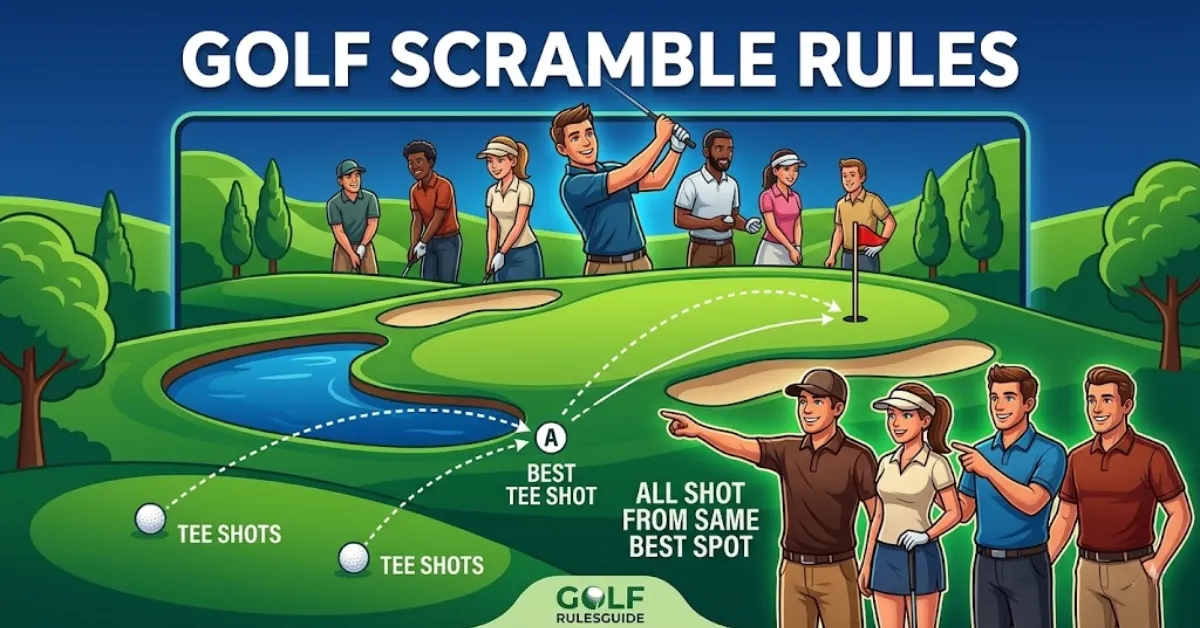
Golf scramble rules are simple at the surface. Every player hits, the team picks the best one, and everyone plays from that spot. Here’s the exact sequence for a standard 4-person scramble:
- All four players hit tee shots from the teeing ground, behind the tee markers. No exceptions – every player must tee off on every hole.
- The team selects the best drive. Mark the spot with a tee peg or coin.
- The three players whose shots weren’t chosen pick up their balls and move to within one club length of the marked spot – no closer to the hole.
- All four players hit from within that zone. This is not optional. You can’t skip a shot because you’re “safe.”
- The team selects the best second shot and repeats the process until the ball is holed.
- One score is recorded for the hole. Count every stroke from tee to hole – the number of times the team chose a new position and all played from it.
That’s the full loop. Straightforward — until placement rules come into play.
Ball Placement Rules: Fairway, Rough, and Green
This is where most scramble disputes happen, and most articles on this topic get it wrong. Ball placement isn’t just “within one club length.” There are three distinct situations, each with its own rule.
On the fairway or rough: Place your ball within one club length of the marked spot, no closer to the hole. You must stay on the same type of ground. If the chosen ball is on the fairway, you place on the fairway. If it’s in the rough, you place in the rough. You cannot drop from rough onto fairway to improve your lie – even if the fairway is only two feet away.
In a bunker or hazard: The same one-club-length rule applies, but you cannot move the ball out of the bunker. If the team selects a shot in a bunker, all players must hit from within the bunker. Raking your stance area is permitted under standard USGA rules.
On the putting green: The rule changes. Placing within one club length on a putting green would create an unreasonable advantage — putter lengths are roughly 33–35 inches, and moving a foot and a half toward the hole matters a lot on short putts. Most events use a putter-head length (about 5–6 inches) on the green, not a club length. Mark the spot with a coin, and every player putts from within a putter-head length of that mark, on either side.
One critical rule almost nobody mentions: don’t hole out until all players have had their chance to putt. If you’re the first putter and you drain a birdie, your team takes the birdie — and your partners never get to putt. Mark your ball if it looks like it’s going in and let everyone attempt the putt first.
Golf Scramble Handicap: How to Calculate Your Team Allowance
Scramble handicaps confuse tournament directors and players alike. The USGA doesn’t include the scramble in its official Rules of Golf — but it does provide recommended handicap allowances in its Committee Procedures, and those are widely adopted.
Here’s exactly how the math works.
4-Player Scramble (USGA-Recommended Allowances): Rank your four players from lowest Course Handicap (Player A) to highest (Player D).
| Player | Role | Allowance |
|---|---|---|
| A (lowest) | Best player | 25% of Course Handicap |
| B | Second lowest | 20% of Course Handicap |
| C | Second highest | 15% of Course Handicap |
| D (highest) | Highest handicap | 10% of Course Handicap |
Add all four figures together and round to the nearest whole number. That’s your team playing handicap.
Worked example — 4-player scramble: Players have Course Handicaps of 4, 10, 18, and 26.
- A (4) × 25% = 1.0
- B (10) × 20% = 2.0
- C (18) × 15% = 2.7
- D (26) × 10% = 2.6
- Team Handicap = 8.3 → rounds to 8 strokes
3-Player Scramble:
| Player | Allowance |
|---|---|
| A (lowest) | 30% |
| B (middle) | 20% |
| C (highest) | 10% |
2-Player Scramble:
| Player | Allowance |
|---|---|
| A (lower) | 35% |
| B (higher) | 15% |
The 2-player formula is intuitive: the lower handicap player contributes more to the team’s scoring potential, so they get the larger percentage.
One thing tournament directors often overlook: use Course Handicap, not Handicap Index. Your Handicap Index is your portable number. Your Course Handicap adjusts it for the specific course and tees being played. The formula only works correctly with Course Handicap — plugging in raw Handicap Index numbers will produce inaccurate team allowances.
Golf Scramble Rules by Team Size (2, 3, and 4 Players)
The core scramble rules hold across all team sizes. Everyone hits, pick the best, repeat. But a few important details shift depending on how many players you have.
2-Player Scramble: Two-person scrambles are common at member-guest tournaments and casual outings. Both players hit every shot, and the pair picks the better one. Minimum drive requirements are rarer in 2-player formats simply because there are only two options — but some events do require each player’s tee shot to be used a minimum of two or three times during the round. Without that rule, the longer hitter will dominate the tee box on every hole.
3-Player Scramble: Three-player teams typically require each player’s tee shot to be used at least four times during an 18-hole round. This prevents the best driver from carrying the team off the tee. It also keeps the format fair for slower players or higher handicappers — they know they’ll contribute.
4-Player Scramble: The standard format. Most events require each player’s drive to be used a minimum of three or four times. If you have 18 holes and four players, and each drive must be used at least four times, that accounts for 16 of your 18 tee shots — leaving two holes where the team can freely choose any drive.
Minimum drive rule — the strategy implication: Don’t save a weaker player’s drive requirement for the last two holes under pressure. Use it early, on a comfortable par 5 or a generous par 4, where one shot off the ideal landing zone doesn’t cost much. Running out of holes with two required drives still unused is the fastest way to blow a good round.
| Format | Min. Drives per Player (typical) | Handicap Allowance |
|---|---|---|
| 2-Player | 2–3 per player | 35% / 15% |
| 3-Player | 3–4 per player | 30% / 20% / 10% |
| 4-Player | 3–4 per player | 25% / 20% / 15% / 10% |
Scramble Variations: Texas, Florida, Las Vegas, Ambrose, and Step Aside
The standard scramble is just the beginning. Most competitive scramble events use one of these variants, and if you don’t know the rules before the shotgun start, you’re going to get caught out.
Texas Scramble
The most common variation worldwide. Texas Scramble adds one rule to the standard format: each player’s tee shot must be used a minimum number of times — usually four drives per player per round. This stops one long hitter from teeing off on behalf of the entire team. Everything else runs exactly like a standard scramble.
Florida Scramble (Step Aside Scramble)
Florida Scramble adds a penalty clause to the standard format: the player whose shot is selected sits out the next stroke. If your approach shot is chosen, your teammates hit the next shot and you wait. This rotates contribution throughout the round and rewards teams with depth rather than teams carried by one elite player. It’s more demanding to track and slows pace slightly.
Las Vegas Scramble
This format injects randomness into drive selection. After all four players tee off, a six-sided die is rolled. Players are numbered 1 through 4. Whatever number comes up, that player’s drive is used — regardless of where it landed. Rolling a 5 or 6 allows the team to freely choose. It’s chaotic, funny, and terrible for your score. It’s also perfect for a corporate outing where the organizer wants everyone equally involved.
Ambrose
Ambrose is the Australian-born scramble variant that incorporates a full team handicap into net scoring. It uses the same scramble format but deducts the team’s combined handicap allowance from the gross score to produce a net result. Popular in Australia, New Zealand, and increasingly in club events in Ireland and the UK.
Step Aside Scramble
Similar to Florida Scramble but applied to all shots — not just drives. The player whose shot is chosen steps aside and doesn’t hit the next shot. This ensures every player contributes throughout the round, not just on tee shots.
Variant Comparison Table:
| Variant | Drive Freedom | Sit-Out Rule | Handicap Applied | Best For |
|---|---|---|---|---|
| Standard Scramble | Free choice | No | Optional | Charity events, beginners |
| Texas Scramble | Each drive used min. 4× | No | Optional | Clubs, serious tournaments |
| Florida Scramble | Free choice | Yes — per shot | Optional | Groups wanting more skill variety |
| Las Vegas Scramble | Die roll determines drive | No | No | Corporate fun days |
| Ambrose | Free choice | No | Yes — full net | Competitive club events (AUS/NZ/IRE) |
| Step Aside Scramble | Free choice | Yes — all shots | Optional | Organized charity events |
Golf Scramble vs. Best Ball: What’s Actually Different
These two formats get confused constantly. Here’s the one-sentence difference: in a scramble, all players share one ball position after every shot; in best ball, every player plays their own ball all the way to the hole.
Best ball – sometimes called four-ball, means each player plays a full individual round. The team’s score on each hole is simply the lowest individual score among the players. If you make a 3 and your partner makes a 5 on a par 4, the team scores a 3. You never move your ball to where someone else’s landed.
In a scramble, your individual score is irrelevant. You pick up your ball, move to the best shot, and all four play from the same place. One team score comes out the other end.
| Feature | Scramble | Best Ball |
|---|---|---|
| Ball position | Shared after every shot | Each player’s own ball |
| Individual scoring | Not tracked | Tracked for each player |
| Bad shots | Abandoned – no penalty | Must be played out |
| Typical team score | 10–18 under par | Closer to even par |
| Best for | Mixed ability groups | Players of similar ability |
| Pace of play | Faster | Slightly slower |
Scramble scores are dramatically lower because no bad shot survives. Best ball requires each player to manage their own mistakes, so scores are more realistic.
What Score to Expect in a Scramble
Scrambles produce low scores by design. Understanding realistic expectations helps both players and organizers set up fair competitions.
4-Player scramble, 18 holes:
| Team Skill Level | Typical Gross Score | Under Par Equivalent |
|---|---|---|
| All 20+ handicappers | 68–74 | Even to 4 under |
| Mixed (10–20 range) | 62–68 | 4–10 under |
| Mixed (5–15 range) | 58–64 | 8–14 under |
| Strong (all under 10) | 54–60 | 12–18 under |
| Competitive (all under 5) | 50–56 | 16–22 under |
A score of 58 on a par-72 course, 14 under — is a great round from a team of solid mid-handicappers. Anything below 54 requires either elite players or mulligans and string. If your charity event sees scores of 46 or 47, someone isn’t keeping an honest scorecard.
Two-player scrambles score higher simply because you have fewer options on every shot. Expect 2-player teams to run about 4–6 strokes higher than a 4-player team of equivalent combined ability.
Frequently Asked Questions
All four players hit a tee shot. The team picks the best drive and marks the spot. Every player places their ball within one club length of that mark – no closer to the hole, same type of ground. All four hit again, pick the best result, and repeat until the ball is holed. One score is recorded per hole.
In a scramble, all players hit every shot from the same spot — the team’s chosen best position. No individual scores are tracked. In best ball, each player plays their own ball the entire hole and the team takes the lowest individual score on each hole. Scrambles produce lower scores because no bad shot is ever used.
Use Course Handicap (not Handicap Index). For a 4-player team, take 25% of the lowest player’s Course Handicap, 20% of the second, 15% of the third, and 10% of the highest. Add them together and round. For a 2-player team, use 35% (lower player) and 15% (higher player). Always confirm which formula your tournament uses before you play.
Place your ball within one club length of the selected spot, no closer to the hole, on the same type of ground. Don’t move from rough to fairway or fairway to rough. On the putting green, use a putter-head length (around 5–6 inches) instead of a club length. In a bunker, stay in the bunker — you can’t move the ball out of sand.
A Texas Scramble follows all standard scramble rules with one addition: each player’s tee shot must be used a minimum number of times during the round — typically four times per player. This prevents one long hitter from dominating the tee on every hole and ensures all four players contribute off the tee.
In a Florida Scramble, the player whose shot is selected must sit out the next stroke. If your approach is chosen, your teammates hit the following shot without you. This rotates who contributes on each shot and ensures the entire team is involved throughout the round. It’s more complex to track but creates a fairer spread of contribution.
There’s no universal rule – it depends on the event. Most 4-player scrambles require each player’s tee shot to be used at least three or four times during 18 holes. Always check the local rules sheet before you tee off. Texas Scramble specifically mandates four drives per player.
You can place rather than drop the ball in a scramble, which technically allows you to position it more favorably within the allowed zone. However, you can’t change the surface type – rough stays rough, fairway stays fairway. On the green, you play from within a putter-head length of the marked spot. You cannot move the ball from a bunker or penalty area to a better lie.
Conclusion
Golf scramble rules reward preparation. The teams that know the placement rules, understand the minimum drive requirement, and save their mulligans for the right moments consistently score better than teams with better golfers who wing it. Know the format before you show up – whether it’s a standard 4-person scramble, a Texas Scramble, or an Ambrose event – and you’ll spend the round making birdies instead of arguing over whether the rough drop was legal. For more on how team formats use handicaps, read our full breakdown of how golf handicaps work.