
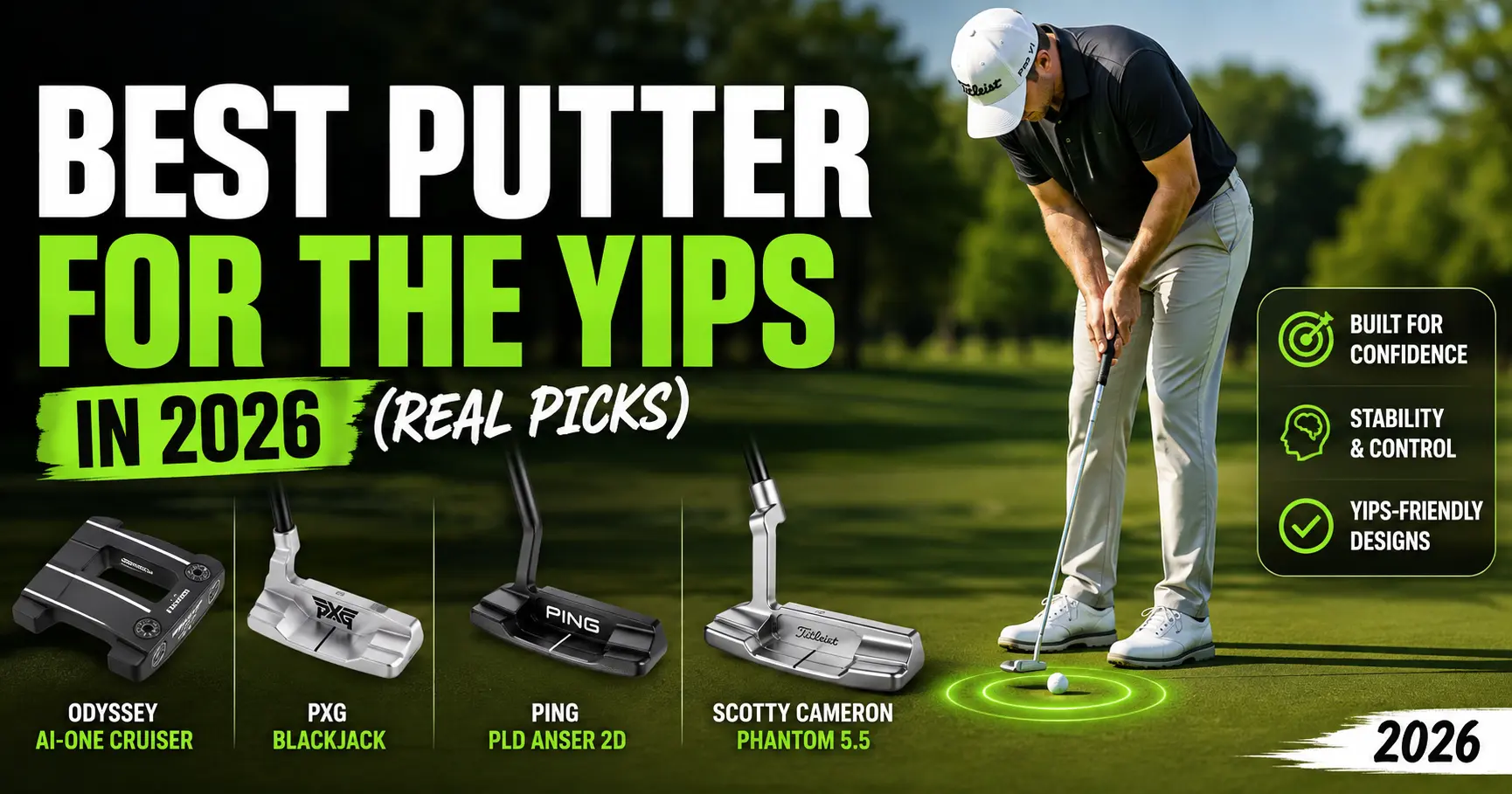
Quick Answer: There’s no single best putter for the yips. Zero-torque mallets like the L.A.B. Golf DF3 ($399) cut down face rotation, broomstick putters like the Ping PLD Oslo L ($449.99) shift control to your arms, and a $35 claw grip fixes plenty of cases before you spend a dollar on a new head.
Every golf forum has a thread like the one on GolfWRX where a player describes averaging six or seven three-putts a round because their hands won’t cooperate inside three feet. That’s the yips, and it ends careers. J.J. Spaun won the 2025 U.S. Open with a putter built around the exact technology that helps fix it. Lucas Glover spent ten years fighting the same problem before a $469 mallet saved his career. This guide skips the vague “it’s all mental” advice and gets specific about the putters, grips, and prices that actually address a twitchy stroke, including the one cheap fix most buying guides leave out entirely.
What the Yips Actually Are (It’s Not Just “In Your Head”)
Golfers have called it the shakes, the jerks, and whiskey fingers since Tommy Armour popularized the term “yips” in the 1920s. Mayo Clinic neurologists now treat it as a real, measurable condition. Dr. Charles Adler’s research team found co-contraction, a muscle-firing pattern associated with focal dystonia, in the dominant forearms of five out of ten golfers with the yips during putting, and in zero of ten golfers without it.
This isn’t a fringe problem. A 1989 study published in the journal Neurology surveyed 1,050 golfers and found that 28% of male respondents reported experiencing the yips. A separate epidemiological study of highly skilled Japanese golfers found the number closer to 39%. Research out of the Mayo Clinic’s own sports medicine group puts a number on the damage too: golfers affected by the yips add roughly 4.7 strokes to their score over 18 holes, on average, compared to golfers without it.
None of that means it’s purely physical, either. The same research links yips symptoms to competitive anxiety, and plenty of golfers describe the exact three-putt problem showing up only when something’s on the line. Both things can be true at once. That’s the whole reason equipment changes work for some golfers and not others: a putter can fix a mechanical issue, but it can’t fix nerves by itself.
Try the $35 Fix Before the $400 One
Here’s an unpopular opinion for a site that’s about to recommend several putters that cost $400 or more: the best putter for yips might not be a putter at all. It might be a grip.
Mayo Clinic’s own clinical guidance lists changing your grip as a first-line treatment for the yips, right alongside using a different putter. The logic holds up. A grip change recruits different muscles for the same motion, which is often enough to interrupt whatever pattern was causing the misfire in the first place.
The claw grip is the most common version golfers reach for, and it shows up constantly in real accounts from golfers who’ve actually lived through this. In one Team Titleist community thread from 2016, multiple posters independently described real relief after switching to a claw or left-hand-low grip, years apart from each other and with no product to sell. That’s a pattern worth taking seriously.
SuperStroke’s Zenergy Claw grip runs $34.99 to $39.99 depending on retailer, and its three flat sides are built specifically to support the claw hold without you having to jury-rig a standard grip into working. It bolts onto whatever putter is already in your bag. Before you spend $400 on a new head, spend $35 and give your current putter two weeks with a different grip style. It’s worth understanding how grip strength changes your stroke more broadly, since the same principle that fixes a slice can quiet a yippy putting stroke.
If that doesn’t move the needle, the equipment recommendations below are where to go next.
What Actually Makes a Putter Yips-Resistant
A lot of putter marketing throws around terms like “forgiveness” and “stability” without explaining what’s actually happening at impact. Three mechanisms genuinely matter here, and they solve different problems.
Zero-torque design puts the putter head’s center of gravity directly under the shaft, instead of off to one side the way a traditional blade sits. Traditional putters twist open on the backswing and closed through impact, a behavior golfers call toe hang, and timing that rotation perfectly under pressure is exactly where a yippy stroke breaks down. Remove the twisting force and there’s nothing left to time. This is the zero torque putter category, and it’s the single biggest putter technology story in golf over the past three years.
Counterbalancing and arm-lock designs shift weight toward the grip end or lock the putter against your lead forearm, which pulls control away from small, twitchy hand and wrist muscles and hands it to your bigger arm and shoulder muscles. Mayo Clinic’s own treatment guidance says exactly this: a longer putter lets you use more arm and shoulder, and less hand and wrist, during the stroke.
High-MOI mallets use a heavier, wider head to resist twisting on a mishit. This doesn’t stop the yips directly, but it shrinks the penalty when a stressed-out stroke doesn’t find the center of the face.
None of these three approaches are mutually exclusive. Several of the putters below combine two of them in a single head.
Best Putter for the Yips: Full Comparison (2026 Prices)
This isn’t a generic “top picks” list padded out with affiliate links to whatever’s on sale. Every price below comes straight from the manufacturer or a major retailer, and every “real-world proof” entry is a documented, verifiable fact, not a marketing claim.
| Putter | Category | Price (2026) | Real-World Proof | Best For |
|---|---|---|---|---|
| L.A.B. Golf DF3 | Zero-torque mallet | $399 stock / $499 custom | J.J. Spaun’s 64-foot, 5-inch winning putt at the 2025 U.S. Open | Misses that drift both left and right under pressure |
| L.A.B. Golf MEZZ.1 MAX | Zero-torque broomstick mallet | $469 stock / $559 custom | Ended Lucas Glover’s 10-year yips battle in 2023 | Severe cases with constant hand and wrist involvement |
| Ping PLD Milled AS Oslo L | Broomstick / long putter | $449.99 | Ping’s first long putter since the 2016 anchoring ban | Golfers who want arm-and-shoulder control from a major brand |
| Odyssey Ai-DUAL #7 | High-MOI mallet | $349.99 to $399.99 | Launched January 2026 as the successor to an insert Callaway credits with reducing tour three-putts | Golfers who mishit the face and want the miss to still travel the right distance |
| SIK Golf Pro | Descending Loft Technology blade/mallet | $399.99 to $529.99 | Bryson DeChambeau’s putter for his 2020 U.S. Open win | Golfers who want a traditional look with a face built to correct loft errors |
| Wilson Infinite Zero Torque Lakeview | Budget zero-torque mallet | $199.99 | One of several sub-$230 zero-torque options now on the market | Golfers who want the zero-torque concept without a $400 buy-in |
| SuperStroke Zenergy Claw grip | Grip only, any putter | $34.99 to $39.99 | Grip change is a Mayo Clinic-listed first treatment for the yips | Anyone who hasn’t tried a grip change before buying a new head |
A quick note on that Odyssey line:
Callaway’s own marketing calculates that tour pros collectively lost $25 million to three-putts in 2023, the exact problem the newer Ai-DUAL insert is built to improve on. Treat that as the company’s own framing rather than an independent study, but the underlying idea, that a smarter face insert normalizes ball speed on mishits, holds up under independent review too.
If you want a shorter shortlist: the DF3 or MEZZ.1 MAX for face-rotation problems, the Oslo L if you want the broomstick look and feel from a big-name brand, and the Wilson if you want to test the zero-torque concept before committing real money.
The Lucas Glover Playbook
Lucas Glover won the 2009 U.S. Open. Six years later he’d fallen to 634th in the world, and putting was the reason. By 2023, he ranked 194th out of 198 players on the PGA Tour in strokes gained putting, a statistic that doesn’t leave much room for interpretation.
At the Rocket Mortgage Classic that June, Glover put a L.A.B. Golf MEZZ.1 MAX broomstick putter in his bag. He’d never used anything like it. “I needed a whole new idea,” Glover said afterward. He taught himself the new stance and split grip in his garage over a few days, then took it to the course.
It worked immediately. Glover finished top 10 in six of his next seven starts, jumped from outside the top 100 in strokes gained putting into the top 40, and by early 2026 was still gaming a L.A.B. putter, an OZ.1 HS model, years after the initial switch. This isn’t a one-tournament fluke or a sponsor’s talking point. It’s a multi-year, statistically documented recovery that happened in full public view on the PGA Tour.
Glover’s story matters for a specific reason: he’s not paid to use the brand. He switched because a decade of other fixes hadn’t worked, and this one did.
Do Broomstick Putters Actually Fix the Yips, or Just Hide Them?
Broomstick putters look ridiculous propped against your sternum in a pro shop mirror. They also work, for the right kind of miss.
Here’s the honest limitation nobody selling one wants to lead with: you can’t anchor a long putter against your body anymore. The USGA and R&A banned anchoring in 2016, so you now hover or brace every modern broomstick and arm-lock putter instead, a genuinely different stroke than the belly putters golfers used before the rule change. Ping’s Oslo L, at 47 inches, is built for that hover-and-guide method, and it’s the company’s first long putter released since that ban took effect.
If your yips show up as a face-rotation problem, hands opening or closing the putter face at the last second, a broomstick can help enormously, because it takes those small hand muscles almost entirely out of the stroke. If your yips are closer to pure performance anxiety with a stroke that’s mechanically sound on the practice green, a $450 broomstick putter probably won’t touch the actual problem.
When a New Putter Won’t Fix It
Not every case of the yips responds to a different putter, and it’s worth saying that plainly instead of pretending every product on this page is a guaranteed cure.
Mayo Clinic lists several non-equipment treatments alongside grip and putter changes: looking at the hole instead of the ball while putting, mental skills training like visualization and relaxation techniques, and in more severe or persistent cases, medication or botulinum toxin injections targeting the affected muscles. Golfers considering medication should check their sport’s rules on banned substances first if they compete in sanctioned events.
If you’ve tried a grip change, tried a different putter, and you’re still fighting the same three-putt problem three months later, that’s a reasonable point to talk to a sports medicine professional rather than buying a third putter.
Frequently Asked Questions
What is the best putter for the yips?
There isn’t one universal answer. Zero-torque mallets like the L.A.B. Golf DF3 help golfers whose misses come from face rotation, broomstick putters like the Ping PLD Oslo L help golfers who want hand and wrist involvement minimized entirely, and a grip change costs a fraction of either and works for plenty of golfers on its own.
Can a heavier putter help with the yips?
Yes, for a specific kind of miss. A heavier, higher-MOI head resists twisting on off-center hits, which shrinks the penalty when a stressed stroke doesn’t find the center of the face. It won’t stop the underlying muscle spasm by itself, but it makes the misses that do happen less costly.
Does a longer putter help with the yips?
Often, yes. Mayo Clinic specifically recommends longer putters because they let you use more of your arms and shoulders and less of your hands and wrists, which are the muscles most involved in yips symptoms. Broomstick and arm-lock putters both work on this principle.
What grip is best for the yips?
The claw grip has the strongest track record among real golfers describing their own recovery, followed by left-hand-low. Both work by recruiting different muscles than a conventional grip, which can interrupt the exact motor pattern causing the problem.
Are the yips permanent?
Not for most golfers. The condition can improve, disappear, or resurface after periods of remission, and many golfers manage it successfully for years with the right combination of grip, equipment, and practice routine. A small number of severe cases require medical treatment to see meaningful improvement.
Does a zero torque putter help with the yips?
It can, specifically for yips that show up as inconsistent face control. And it’s removes the timing requirement that causes a traditional blade’s face to rotate open and closed during the stroke. It won’t help yips rooted purely in nerves or anxiety, since that’s a different problem with a different fix.
What putter does Lucas Glover use?
As of early 2026, Glover games a L.A.B. Golf OZ.1 HS putter, part of the same Lie Angle Balance family as the MEZZ.1 MAX broomstick that first ended his 10-year yips battle in 2023.
Is the claw grip legal in golf?
Yes. The claw grip is a hand-position choice, not an equipment modification, so it’s legal at every level of golf, including the PGA Tour, where multiple players use it.
The Bottom Line
The best putter for the yips depends entirely on what your specific miss looks like. If your face rotates open and closed under pressure, a zero-torque mallet like the DF3 addresses that directly. If your hands and wrists are the whole problem, a broomstick putter takes them almost entirely out of the equation. And if you haven’t tried a $35 grip change yet, that’s genuinely the smartest place to start before spending $400 on anything. Whatever you land on, pair it with a real look at your 3-putt problem beyond just the yips itself, since speed control and green reading matter just as much as the equipment in your hands.