
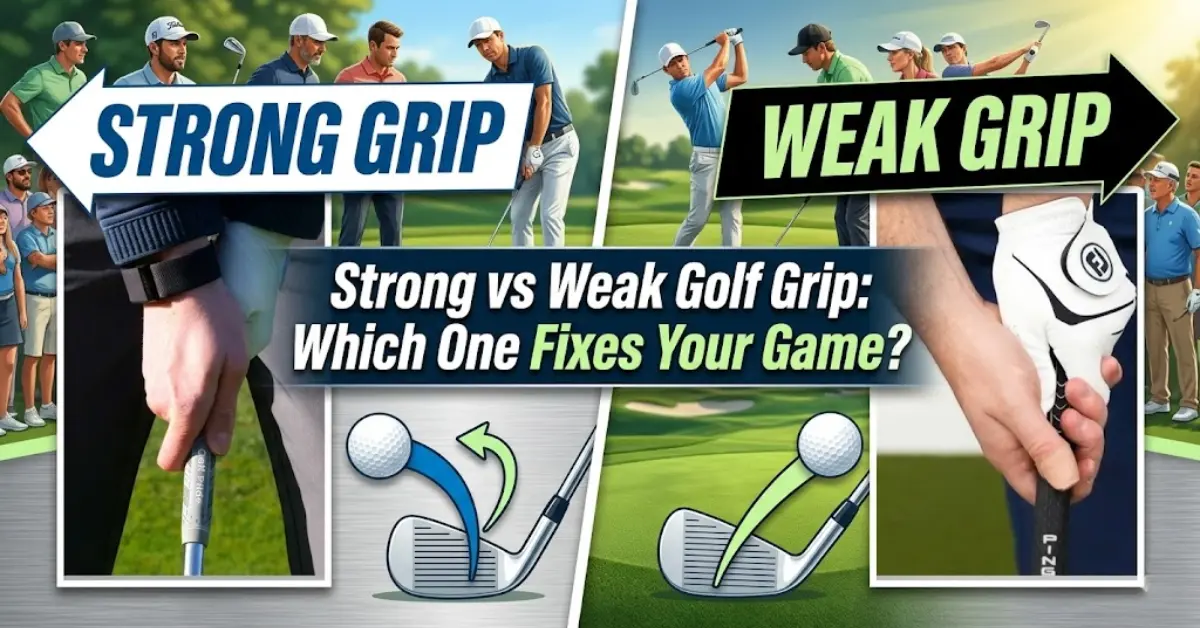
Your grip has a major influence on how the clubface behaves through impact, but it does not work alone. A strong, neutral, or weak golf grip changes how your hands and wrists interact with the club, while swing path, face angle, release, and body rotation still determine the final shot.
That is why two golfers can use similar-looking grips and produce completely different ball flights.
In this guide, you’ll learn how to identify a strong vs weak golf grip, what each position tends to change, how to match your grip to your ball flight, and when a grip change is worth testing.
What Does Strong vs Weak Actually Mean in Golf?
Before anything else, let’s clear up the biggest confusion beginners face: grip strength has nothing to do with how tightly you squeeze the club.
The terms strong and weak describe where your hands sit on the grip – specifically, how far they rotate toward or away from the target.
- A strong golf grip = hands rotated away from the target (to the right for a right-handed golfer)
- A weak golf grip = hands rotated toward the target (to the left for a right-handed golfer)
- A neutral golf grip = hands positioned in the middle – the balanced starting point
That rotation changes how the clubface behaves through impact – and that’s what controls your ball flight.
How to Check Your Grip Right Now – The Knuckle Test
You don’t need a coach or a mirror to know which grip you’re using. Take a club and grip it the way you normally do. Look straight down at your lead hand (left hand for right-handers).
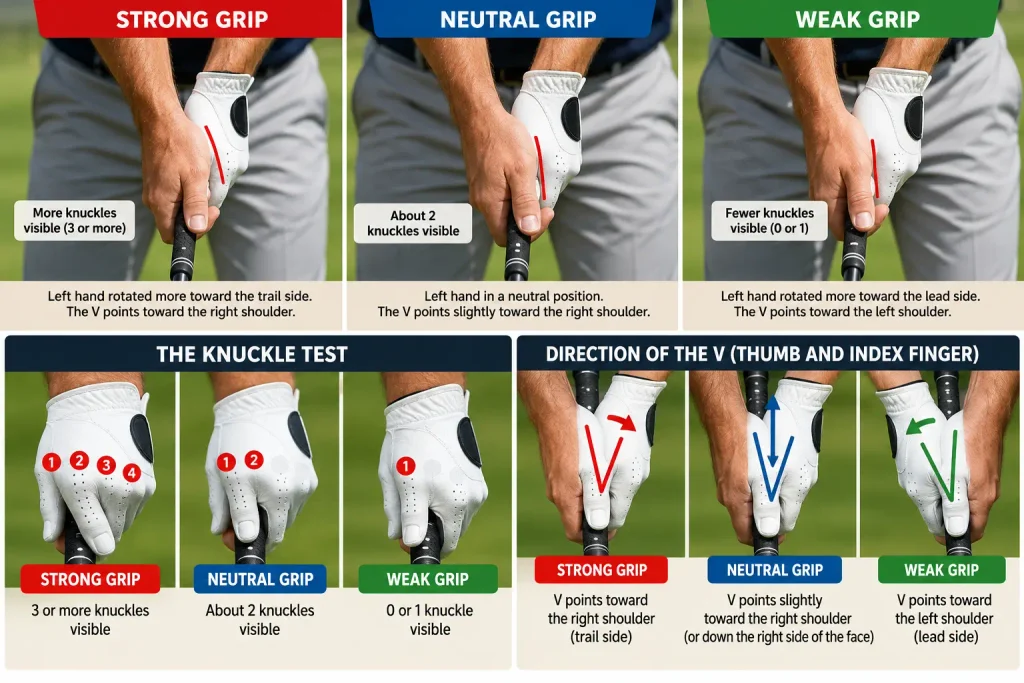
Strong, neutral, and weak golf grip positions compared using visible knuckles and hand direction.Count how many knuckles you can see.
| Knuckles Visible | Grip Type |
|---|---|
| 3 or more | Strong grip |
| 2 | Neutral grip |
| 0–1 | Weak grip |
At the same time, check the V shape formed between your thumb and index finger on both hands:
This simple test takes 30 seconds and tells you exactly where you stand before you change anything.
Grip, Clubface, Swing Path, and Release: How They Work Together
Your grip influences the clubface, but it does not determine your shot shape by itself.
For a right-handed golfer, a stronger grip generally makes it easier to deliver the clubface less open through impact. A weaker grip generally does the opposite. But the result still depends on what the clubface is doing relative to the swing path.
A golfer can use a strong grip and still hit a slice if the face is open relative to the path. A golfer can also use a weak grip and hit a draw if the rest of the swing matches that hand position.
Think of your grip as one part of a system:
| Factor | What It Influences |
|---|---|
| Grip position | How your hands and wrists tend to control the face |
| Clubface angle | Where the ball tends to start |
| Swing path | Helps determine the direction and amount of curvature |
| Wrist action and release | How quickly the face rotates through impact |
| Body rotation | Helps determine how the hands, arms, and club are delivered |
This is why changing your grip can improve a recurring miss, but it should not be treated as an automatic cure for every slice or hook.
Strong Golf Grip – What It Does, Who It Helps, and When to Use It
What a Strong Golf Grip Looks Like
With a strong grip, your lead hand sits more on top of the club and your trail hand wraps further underneath. Looking down at address, you’ll see three or more knuckles on your lead hand. The V shapes formed by both thumbs and index fingers point toward or past your trail shoulder.
The result at impact: the clubface has a natural tendency to arrive slightly closed, which is exactly what most amateur golfers need.
How a Strong Golf Grip Can Affect Your Ball Flight
A stronger grip rotates the hands farther toward the trail side of the club. For many golfers, that makes it easier to deliver the clubface less open through impact and can reduce the amount of hand rotation needed to square the face.
That does not mean a strong grip automatically creates a draw.
If your clubface is still open relative to your swing path, you can use a strong grip and continue hitting shots to the right. The grip changes one part of the delivery; it does not replace the rest of the swing.
Common tendencies with a stronger grip can include:
- A clubface that is easier to square for a golfer who normally leaves it open
- Less rightward curvature when an open face is contributing to a slice
- A greater chance of drawing or hooking the ball if the face begins closing too much
- A lower-looking flight for some golfers if the grip change also reduces delivered loft
Advantages of a Strong Golf Grip
It can help a golfer who struggles with an open clubface. If your shots repeatedly start right or curve right because the face is arriving open, strengthening the grip slightly can make the face easier to square.
It can reduce the need for an aggressive hand roll. Some golfers feel they have to flip or rotate their hands rapidly to prevent the ball from leaking right. A slightly stronger position can make the clubface easier to manage without that last-second manipulation.
It can work well with strong body rotation. Players who continue rotating through impact can successfully match that motion with a strong grip. Fred Couples is a good example of a player whose strong grip works as part of a much larger swing pattern.
It can help produce a draw when the rest of the delivery matches. A stronger grip may make a right-to-left ball flight easier for some golfers, but swing path and face angle still have to work together.
Disadvantages of a Strong Golf Grip
It can turn a draw into a hook. If you already deliver the face closed relative to the path, strengthening your grip further may send the ball even farther left.
It can create a low-left miss. Golfers who combine a very strong grip with an aggressive release can close the face too quickly through impact.
It can become a compensation instead of a solution. Strengthening the grip may reduce a slice caused by an open face, but it will not automatically correct an excessive out-to-in swing path.
It may feel uncomfortable when taken too far. Small grip changes can have a noticeable effect. You usually do not need to rotate both hands dramatically to change your ball flight.
When to Test a Stronger Grip
Consider testing a slightly stronger grip if your clubface repeatedly arrives open, your shots start right, or your normal pattern is a push or slice.
Make the change gradually. Rotate the hands only a small amount, hit several shots, and watch both the starting direction and curve before making another adjustment.
Weak Golf Grip – What It Does, Who It Helps, and When to Use It
What a Weak Golf Grip Looks Like
With a weak grip, your lead hand rotates toward the target and sits more underneath the club. Looking down at address, you’ll see one knuckle or none at all on your lead hand. The V shapes point toward your chin or lead shoulder. The trail hand tends to sit more on top of the grip and shaft.
The result at impact: the clubface has a natural tendency to be open, which produces fades and – at the extreme – slices.
How a Weak Golf Grip Can Affect Your Ball Flight
A weaker grip rotates the hands more toward the lead side of the club. For many golfers, this makes it less likely that the clubface will close rapidly through impact.
That can be useful for someone whose normal miss is a pull or hook.
Like a strong grip, however, a weak grip does not automatically produce one ball flight. The result still depends on swing path, wrist conditions, release, and clubface position.
Common tendencies with a weaker grip can include:
- Less tendency for the clubface to close excessively
- A reduced left miss for golfers who normally hook the ball
- A greater chance of leaving the face open if the golfer already struggles to square it
- A fade-biased pattern when the rest of the swing matches the grip
Advantages of a Weak Golf Grip
It can help control a hook. If your clubface repeatedly closes too much relative to your path, weakening the grip slightly can reduce that tendency.
It can suit a golfer who naturally rotates the clubface quickly. Some players already have plenty of hand and forearm rotation through impact. A weaker grip can help balance that pattern.
It can work well with a fade pattern. Golfers who prefer a controlled left-to-right shot may find a slightly weaker position complements their existing release and swing direction.
It can be an effective match for certain wrist conditions. Collin Morikawa is a useful example: his weak lead-hand grip works with a bowed lead wrist and body-driven release rather than functioning in isolation.
Disadvantages of a Weak Golf Grip
It can make an open-face problem worse. If you already struggle to square the clubface, moving the hands weaker may increase your push or slice.
It can require a different release pattern. Golfers who weaken their grip without changing anything else may struggle to return the face square.
It can become too extreme. You do not need to rotate the lead hand dramatically toward the target to reduce a hook. Small changes are usually easier to test and repeat.
When to Test a Weaker Grip
Consider testing a slightly weaker grip if your normal miss is a pull or hook and you have evidence that the clubface is closing too much.
Move the hands only slightly toward the lead side, hit several shots, and compare the starting direction and curvature with your normal grip.
The Neutral Golf Grip – Your Baseline
A neutral grip is a useful starting point because it sits between the strong and weak extremes.
For a right-handed golfer, the lead hand normally shows roughly two knuckles at address, while the V formed between the thumb and index finger points somewhere around the trail side of the face rather than dramatically toward either shoulder.
Neutral does not mean perfect.
Golfers have different hand sizes, wrist mobility, release patterns, swing directions, and body rotation. A grip that looks neutral for one player may not produce the same impact conditions for another.
Advantages of a Neutral Grip
A neutral position gives you a useful reference point when diagnosing your ball flight.
It also makes it easier to identify whether you have gradually allowed your hands to rotate significantly stronger or weaker over time.
For beginners who do not yet have an established shot pattern, neutral is usually a sensible place to begin before making adjustments based on actual ball flight.
Disadvantages of a Neutral Grip
A neutral grip does not automatically correct an open or closed clubface.
If your swing consistently delivers the face open, closed, or poorly matched to the path, you may still need a grip adjustment or a change elsewhere in the swing.
The goal is not to make your grip look textbook. The goal is to find a repeatable hand position that works with the rest of your motion.
Grip Position vs Grip Pressure – Do Not Confuse Them
A strong or weak golf grip describes the position of your hands on the club.
Grip pressure describes how tightly you hold it.
They are completely different variables.
You can have a strong hand position with light pressure, or a weak hand position with excessive pressure.
Too much tension in the hands and forearms can make the swing feel restricted and can interfere with a natural release. Instead of trying to squeeze the club as hard as possible, use enough pressure to keep the club secure while allowing your wrists and arms to move freely.
If your forearms feel rigid before you start the backswing, reduce the tension before changing your hand position.
Strong vs Weak Grip for Driver – Does It Change?
The basic grip principles do not suddenly change when you pick up a driver.
What does change is how obvious a face-angle mistake can become. Because the driver has relatively little loft and you are usually swinging it faster than your irons, a small face-to-path difference can produce a noticeable curve.
Strong Grip With Driver
A slightly stronger grip can help a golfer who repeatedly delivers the driver face open.
But if your normal pattern is already a draw or hook, strengthening the grip further may make the left miss worse.
Weak Grip With Driver
A slightly weaker grip can help a golfer whose driver face closes too aggressively.
But if you already hit pushes or slices, weakening your grip can make it more difficult to square the face.
Neutral Grip With Driver
Neutral remains a good reference point if you do not have a clear reason to move stronger or weaker.
There is no universal swing-speed number at which you should change your grip.
Instead, judge the grip by your starting direction, curvature, strike quality, and ability to repeat the same pattern.
Practical tip: Try to keep your grip consistent from club to club unless you have a specific shot or swing reason to change it. Adding unnecessary variables makes your setup harder to repeat.
What Grip Do the Pros Use?
Tour players are useful examples because they show that there is no single grip position that works for every successful swing.
Rory McIlroy – Relatively Strong Lead Hand
Rory McIlroy uses a relatively strong lead-hand position. His grip works with his powerful body rotation, release, and preferred draw pattern.
The important lesson is not to copy Rory’s hand position by itself. His grip is only one part of a complete swing pattern.
Collin Morikawa – Weak Lead Hand
Collin Morikawa is one of the clearest examples of an elite player using a weak lead-hand grip.
His grip works with a bowed lead wrist and a body-driven release that helps him control clubface rotation through impact. The combination allows him to produce his familiar controlled fade without needing a textbook-neutral grip.
Fred Couples – Strong Grip
Fred Couples has long used a strong grip, with the Vs of his hands pointing toward his trail shoulder.
He matches that position with significant body rotation and his own distinctive release. His swing is a good reminder that a strong grip can work extremely well when the rest of the motion matches it.
Tiger Woods – A Grip That Changed With His Swing
Tiger Woods is a better example of how a grip can evolve than of one fixed grip type.
His grip was stronger when he was younger, moved closer to neutral while working with Butch Harmon, became weaker during part of the Hank Haney period, strengthened again under Sean Foley, and later settled closer to neutral.
That history makes the bigger point perfectly: the best grip is not simply strong, weak, or neutral. It has to match the player’s swing and the ball flight they are trying to produce.
Strong vs Weak Golf Grip – How to Choose Yours
Here is the honest answer most instruction articles avoid giving you: your ball flight is already telling you which grip you need.
Stop fighting it and listen to what the ball says.
| Your Ball Flight | What It Suggests | Grip Adjustment |
|---|---|---|
| Consistent slice (left to right) | Face arriving open | Strengthen your grip – rotate hands more to the trail side |
| Consistent hook (right to left) | Face arriving closed | Weaken your grip – rotate hands more to the lead side |
| Straight but no distance | Neutral – but check path too | Try a slightly stronger grip for draw and extra roll |
| Inconsistent – both ways | Grip position changing between shots | Standardise your neutral grip and practice consistency |
Common Mistakes When Changing Your Golf Grip
Changing the grip without checking the clubface
A slice does not automatically mean your grip is too weak, and a hook does not automatically mean it is too strong.
First look at where the ball starts as well as how it curves. That gives you more information about what the clubface and path are doing.
Making a huge change
Moving from very weak to extremely strong can completely change how the club feels.
Make small adjustments instead. A minor rotation of the hands may be enough to change your impact pattern.
Changing several swing variables at once
Do not change your grip, stance, backswing, and release during the same practice session and then try to work out which change helped.
Change one variable, hit enough shots to see a pattern, and then evaluate it.
Copying a Tour player’s grip
A professional golfer’s grip works with their wrist conditions, flexibility, swing path, rotation, and release.
Copying the grip without copying the rest of the match-up can create a completely different result.
Judging the change after two or three shots
A new grip often feels uncomfortable simply because it is unfamiliar.
Give yourself enough repetitions to separate different from wrong.
The Range Drill That Helps You Find Your Grip
Take a mid-iron to the range and begin with your normal grip.
Step 1: Establish your pattern. Hit five to ten shots without changing anything. Note where the ball starts, how it curves, and whether your strike is consistent.
Step 2: Check your grip. Count the visible knuckles on your lead hand and check the direction of the Vs formed by your thumbs and index fingers.
Step 3: Make one small adjustment. If the face repeatedly appears open and the ball is starting or curving right, test a slightly stronger position. If the face repeatedly closes and the ball is starting or curving left, test a slightly weaker position.
Step 4: Hit another five to ten shots. Compare the new pattern with your original group. Look for a tighter dispersion, better contact, and a more predictable starting direction.
Step 5: Stop when the pattern improves. Do not keep rotating the hands stronger or weaker just because the first adjustment helped.
The goal is not to find the strongest or weakest grip you can use. It is to find the most repeatable grip that works with your swing.
FAQ – Strong vs Weak Grip in Golf
There is no single correct grip for every golfer.
Start around neutral if you do not have an established reason to do otherwise. If your clubface repeatedly arrives open and you fight a push or slice, test a slightly stronger position. If the face repeatedly closes and you fight a pull or hook, test a slightly weaker position.
Make small changes and judge them by your ball flight and contact rather than by how the grip looks.
Bryson DeChambeau uses JumboMax oversized grips primarily because of hand discomfort and pain from extremely high-volume practice – he has spoken openly about a pinky injury that was aggravated by standard grip sizes. The larger diameter reduced the stress on his fingers and allowed him to practice and play without pain. His actual hand position is individual to his single-plane swing system and is not a straightforward model for other golfers to follow.
Yes. Collin Morikawa is a well-known example of a player with a weak lead-hand grip.
His grip works because it is matched with his wrist conditions, release, and body rotation. That is the important lesson: an unconventional grip can work extremely well when the rest of the swing complements it.
Rory McIlroy uses a relatively strong lead-hand grip.
That position works with his powerful body rotation and release, but it should not be viewed as a standalone reason for his distance or ball flight. His grip is one piece of a much larger swing pattern.
Not automatically.
A stronger grip can indirectly help you hit the ball farther if it improves your clubface control, strike quality, or shot shape. For example, a golfer losing distance because of a weak, open-face slice may gain distance after improving the grip and contact.
But making the grip stronger does not create speed by itself, and going too strong can reduce distance if it leads to hooks or poor contact.
The Bottom Line on Strong vs Weak Golf Grip
A strong, weak, or neutral grip is not automatically good or bad.
The right grip is the one that helps you control the clubface consistently while matching your swing path, wrist action, release, and body rotation.
Start with a repeatable setup. Watch where the ball starts and how it curves. If you have a consistent open-face pattern, test a slightly stronger grip. If you have a consistent closed-face pattern, test a slightly weaker one.
Make small changes rather than jumping from one extreme to another.
Most importantly, treat your grip as part of your swing rather than as a shortcut around it.
When the grip and the rest of the motion work together, your ball flight becomes much easier to understand—and much easier to repeat.
Want to take the next step? Read our guide to how to grip a golf club correctly for beginners and our breakdown of how to fix a golf slice for good – two of the most popular topics on Madknows.