
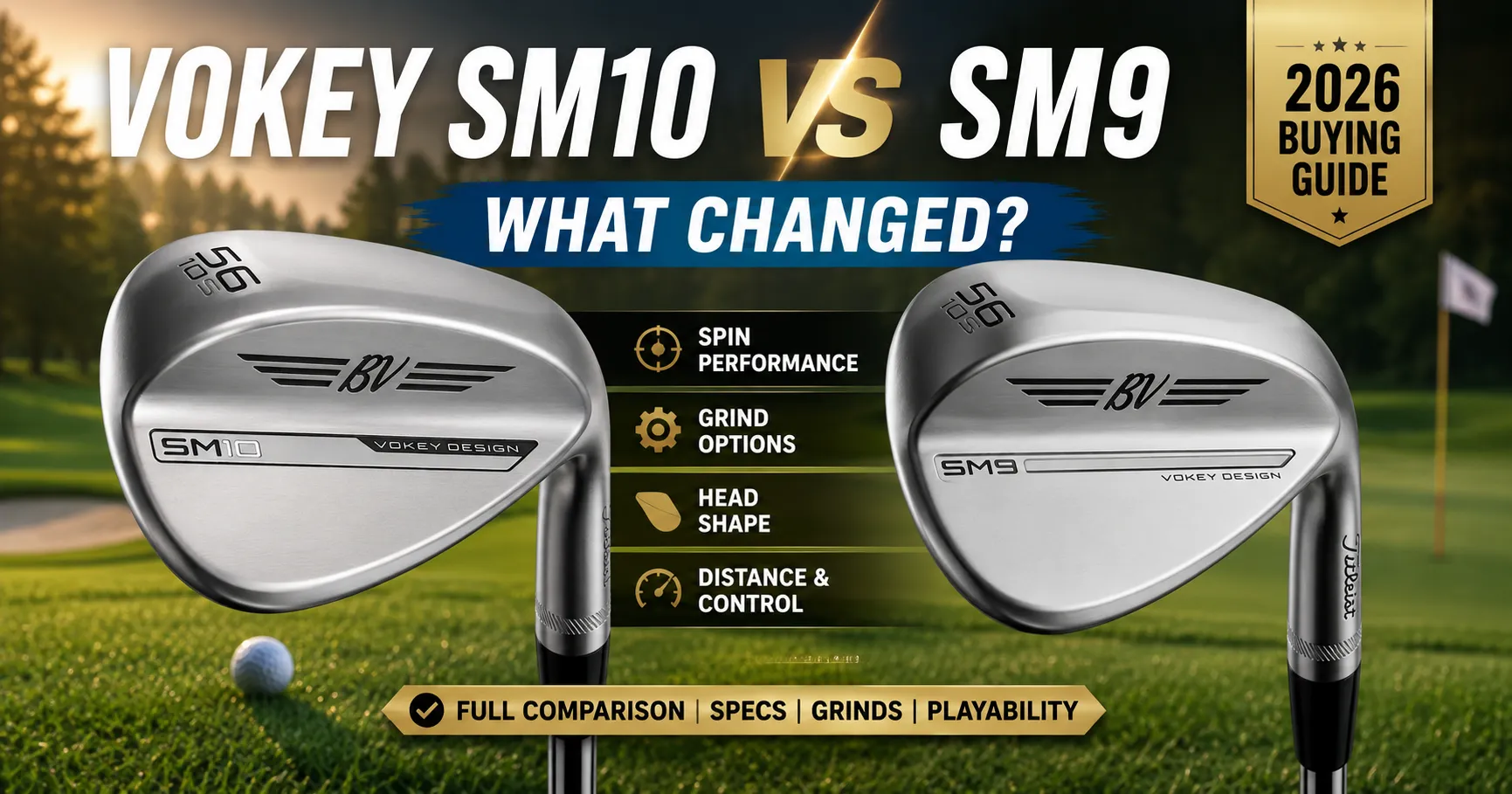
The SM10 keeps the SM9’s shape but swaps the L grind for the popular T grind, tightens the CG, and cuts sharper grooves for a touch more spin. New SM10s run $159 versus $149 for SM9, and with the SM11 out since February 2026, both now count as budget wedges.
I’m an 8-handicap who’s carried a Vokey SM9 56-degree S grind since 2022, and when the SM10 landed at my local shop in 2024, I bought a 54-degree M grind just to hit them side by side that summer. My dispersion on 60-yard pitch shots tightened from about a 10-foot average miss to roughly 7 feet, though a full season of extra reps deserves some of that credit too. This guide breaks down exactly what changed between SM9 and SM10, backs it up with real spin numbers instead of marketing copy, and tells you which one actually earns a spot in your bag now that the SM11 exists.
SM10 vs SM9 at a Glance
Here’s the short version before we get into the weeds.
| Spec | Vokey SM9 (2022) | Vokey SM10 (2024) |
|---|---|---|
| Grinds | F, S, M, K, L, D | F, S, M, K, T, D |
| Loft/bounce/grind combos | 23 | 25 |
| Loft range | 46° to 62° | 46° to 62° |
| CG position | Highest CG in Vokey history, more heel bias | Splits the difference between SM8 and SM9, closer to true center |
| Groove process | Spin Milled, tightened tolerances | Individually cut TX9 grooves per loft and finish, plus micro-texture between grooves |
| Finishes | Tour Chrome, Brushed Steel, Jet Black, Raw | Tour Chrome, Jet Black, Nickel, Raw |
| Launch price (steel) | $179.99 (March 2022) | $189 (March 2024) |
| Current model? | Two generations back | One generation back, since SM11 launched Feb. 2026 |
Twenty-three of the SM10’s 25 combinations carried straight over from SM9. The real news is what got swapped, not what got added.
What Actually Changed From SM9 to SM10
Vokey doesn’t rebuild a wedge from scratch every cycle. Bob Vokey’s team tends to nudge two or three things and leave the rest alone, and SM10 followed that pattern almost exactly.
The Grind Lineup: Farewell L Grind, Hello T Grind
The SM9’s L grind quietly disappeared from the retail lineup. In its place, Vokey brought the T grind out of WedgeWorks and made it a standard option at 58 and 60 degrees. The T grind had already become the second-most requested wedge on Tour behind the 50-degree/12-bounce F grind, so this wasn’t a gamble.
The T grind is the best low-bounce lob wedge Vokey has ever put in a retail rack, full stop. It isn’t forgiving, and it will punish a steep angle of attack on firm turf. But for a player who wants to open the face and slide it under a ball sitting on hardpan, nothing else in the Vokey catalog does that job as cleanly.
The SM10 also added a 54-degree M grind to the standard lineup, giving golfers a genuine low-bounce option at that loft for the first time. Here’s how the two grind lineups map onto each other if you’re planning a straight swap.
| SM9 Grind | Sole Design | Closest SM10 Match |
|---|---|---|
| F | All-purpose, full shots | F, unchanged |
| S | Narrow, versatile | S, unchanged |
| M | Shallow attack angle | M, unchanged, plus a new 54° option |
| K | Wide, cambered, forgiving | K, unchanged, plus a new low-bounce version added in 2025 |
| L | Narrow, low bounce, precision | T, direct replacement |
| D | Full sole, high bounce | D, unchanged |
Center of Gravity: Splitting the Difference
Every Vokey release comes with a CG story, and SM10’s is genuinely worth understanding before you buy. SM8 had the most forward CG Vokey ever built. SM9 pushed it to the highest point in the company’s history. SM10 landed between the two, and it also dialed back some of SM9’s heel bias, moving the CG closer to true center while keeping a slight heel lean on purpose.
What does that mean on the course? A more centered CG tends to reduce draw bias on full swing wedge shots, so a player who fights a hook with their gap wedge might notice straighter ball flight with SM10. It won’t fix a bad swing path. It just gives you a little less to fight.
Grooves: The Part Vokey Actually Improved
SM9 tightened its groove tolerances. SM10 went further, cutting each groove individually based on loft and finish, then adding a permanent micro-texture between the primary grooves. That texture isn’t a spray-on coating that wears off. It’s milled into the face and stays for the life of the wedge.
Does the SM10 Really Spin More? The Actual Numbers
Marketing copy claims more spin with every release. Independent fitting data from Golf Monthly’s testing team put actual numbers behind it. On a 50-yard pitch shot, the SM10 spun at roughly 6,750 rpm against about 6,700 rpm for the SM9, a difference of only 50 rpm that you’d never feel on the course.
The gap widened at 75 yards. There, the SM10 picked up nearly 200 more rpm than the SM9, and testers also noticed a visibly lower ball flight at that distance. If you play a lot of three-quarter wedge shots into firm greens, that’s the yardage where SM10 actually separates itself.
Inside 50 yards, you’re not buying a new wedge for spin. You’re buying it for the grind.
SM9 or SM10 in 2026: Why the Question Has Changed
Here’s the part almost every article on this topic misses. Titleist launched the SM11 in February 2026, which means both the SM9 and SM10 are now previous-generation wedges rather than current ones. Anyone comparing them today is really deciding how far back to go on price, not which one is newest.
SM11 standardized CG placement across every grind within a given loft, something SM9 and SM10 never did consistently. It also folded Scottie Scheffler’s major-winning 06K grind into the standard lineup. That’s a real upgrade if you’re buying new anyway. But at $199 and up, the SM11 costs $50 more than an SM9 and $40 more than an SM10, and that gap gets expensive fast once you’re buying two or three wedges at once.
| SM9 | SM10 | SM11 | |
|---|---|---|---|
| Status | Two gens back | One gen back | Current model |
| New price (steel) | ~$149 | $159 | $199 |
| Released | March 2022 | March 2024 | February 2026 |
Vokey SM10 vs SM9 Price Right Now: New, Certified, and Used
Prices have moved since either wedge launched, and none of the pages ranking for this topic reflect that. As of August 2026, here’s what you’ll actually pay.
| Condition | SM9 | SM10 |
|---|---|---|
| New (steel, US) | ~$149 | $159 |
| Titleist Certified (refurbished) | $99 to $119 | $119 to $139 |
| Average used, open market | ~$82 | $120+ |
| New (steel, UK) | Clearance, as low as £99.95 | £169 |
Titleist Certified is worth knowing about if you haven’t used it. Titleist inspects and refinishes its own returned and trade-in wedges, then sells them with a limited warranty, which is a meaningfully safer bet than a random eBay listing at a similar price.
Which One Should You Actually Buy?
If you’re deciding between a brand-new SM10 and a certified SM9 in 2026, buy the SM9 and put the $60 you saved toward a proper fitting instead. That’s not a knock on the SM10. It’s just where the value sits now that the SM11 occupies the top of the lineup.
Buy the SM10 instead if you specifically want the T grind, or if you play a lot of three-quarter wedge shots where that 75-yard spin gain shows up. Buy new SM11 only if you’re building out a full 14-club bag setup from scratch and want everything under warranty from day one.
One honest caveat. If you already carry a properly fit SM9 and you’re happy with your distance control, don’t upgrade just because a new number exists. A 50 rpm difference on a 50-yard pitch is not going to show up on your scorecard, and neither wedge will fix a strike that misses the grooves.
Loft gapping matters more than the generation number. If your gap wedge and your approach wedge are both sitting around 50 to 52 degrees, no amount of new tech in either SM9 or SM10 closes that yardage overlap. Fix the gapping first.
Frequently Asked Questions
Is there much difference between SM9 and SM10?
On paper, yes. In your hands, less than you’d expect. The CG moved toward center, the T grind replaced the L grind, and the grooves got a genuine spin upgrade at longer wedge distances. Most mid-handicap golfers won’t feel the CG shift on a normal Tuesday round, but better players who shape shots around the green will notice the lower flight from SM10 on partial swings.
Are Vokey SM9 forgiving?
Not particularly, and that’s fine. SM9 is a blade-style wedge with minimal offset, so forgiveness comes almost entirely from picking the right grind, not from any built-in head technology. The K grind’s wide, cambered sole is the closest thing to a forgiving option in the SM9 lineup. If you’re missing the center of the face regularly, the fix is a fitting and a wider sole, not a different generation of Vokey.
Is the Vokey SM10 the best wedge?
Not anymore. The SM11 became Vokey’s current flagship in February 2026, with a standardized CG across grinds and the 06K grind added to the standard lineup. SM10 is still an excellent wedge, and at $159 it’s arguably the best value in the Vokey range right now, but “the best” and “current” stopped being the same thing the day SM11 shipped.
What skill level are Vokey SM9 wedges for?
Vokey markets SM9 for every skill level, but the honest range is players around a 15 handicap or better who make contact between grooves two and five with some consistency. Below that, the precision and low forgiveness of a blade wedge tend to work against you more than the spin helps.
Bottom Line
The Vokey SM10 vs SM9 debate isn’t really about which wedge is better anymore. It’s about how much you want to spend to get a second-string T grind and a slightly more centered CG, now that neither one is Vokey’s current model. Get fit for the grind before you worry about the number on the back, check your club distance chart to make sure your lofts actually fill the gaps in your bag, and buy whichever generation is on sale when you’re ready.