
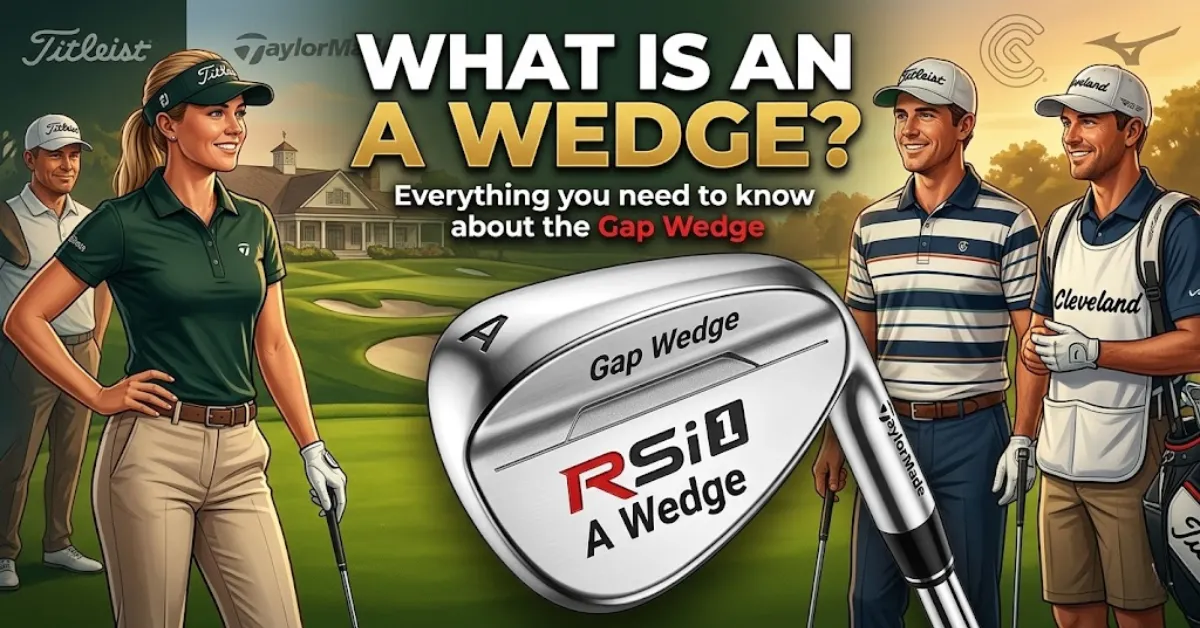
You’re 95 yards from the pin. Your pitching wedge will fly it 15 yards past the flag. Your sand wedge will leave you 10 yards short. That awkward no-man’s-land is exactly what the A-wedge — also called the approach wedge — was built to solve. The approach wedge loft sits between 48 and 52 degrees, placing it right in the gap between your pitching wedge and sand wedge. In this guide, Madknows breaks down what degree it should be, how far you can expect to hit it, and how to pick the right one for your specific bag.
What Is an A-Wedge in Golf?
The A-wedge is a golf club designed to fill the loft and yardage gap between the pitching wedge (PW) and the sand wedge (SW). Think of it as the club that handles the shots your other wedges can’t quite manage — not long enough for a full pitching wedge, not short enough for a comfortable sand wedge.
The “A” stands for Approach, because the club’s primary purpose is nailing accurate approach shots into the green from roughly 85 to 115 yards. It gives you a full, natural swing at those distances instead of forcing an awkward half-swing with another club.
Why It’s Also Called a Gap Wedge
You will see this club stamped with “A,” “AW,” or sometimes “G” or “GW” depending on the brand. All four mean the same thing. The term “Gap Wedge” became popular because the club literally fills the distance gap between the PW and SW. Other names you might hear include Attack Wedge and Utility Wedge — same club, different manufacturer’s marketing.
Quick brand reference:
- Titleist: loft stamped directly on the club (e.g., 50° or 52°)
- Callaway: often labeled “AW” or sold as a Jaws Raw wedge in your chosen loft
- TaylorMade: labeled “AW” or “GW”
- Cleveland: historically used “A-Wedge” labeling
- Cobra: typically “GW”
Why the Gap Has Grown — Modern Iron Loft Creep
Here is something the article in your bag’s original packaging won’t tell you: pitching wedges are not what they used to be. Twenty years ago, a standard PW was 48–50 degrees. Today, many game-improvement iron sets ship with pitching wedges lofted at 40–44 degrees. Manufacturers strengthen lofts to advertise more distance, but this creates a much wider gap between your PW and a standard 56-degree sand wedge.
That gap used to be 6–8 degrees. It can now be 12–16 degrees in a modern set — equivalent to two missing clubs. The A-wedge is not optional for most golfers anymore; it is a necessity.
A-Wedge Loft: What Degree Does It Come In?
The standard approach wedge loft range is 48 to 52 degrees, with 50–51 degrees being the most common across major brands. Some manufacturers push the upper end to 54 degrees for sets where the pitching wedge is on the weaker side.
Full Wedge Loft and Distance Comparison Table
| Wedge | Loft Range | Full Swing Distance (Avg Golfer) | Primary Use |
|---|---|---|---|
| Pitching Wedge (PW) | 40–48° | 100–130 yards | Longer approach shots, full fairway shots |
| A-Wedge / Gap Wedge (AW/GW) | 48–52° | 85–115 yards | Mid-range approaches, controlled pitches |
| Sand Wedge (SW) | 54–58° | 70–95 yards | Bunkers, short approaches, greenside play |
| Lob Wedge (LW) | 58–64° | 55–80 yards | Flop shots, high-stop shots near the green |
Note: PW lofts vary significantly. A game-improvement set (e.g., TaylorMade Stealth HD) may ship a PW at 41°. A players iron (e.g., Titleist T100) will be 46°. Always check your specific model’s loft spec before choosing your A-wedge.
A-Wedge Distance by Swing Speed
Your swing speed changes everything. Here is a more realistic distance guide:
| Swing Speed | A-Wedge Full Swing Distance |
|---|---|
| Slow (under 80 mph) | 70–90 yards |
| Moderate (80–95 mph) | 85–110 yards |
| Fast (95–105 mph) | 100–125 yards |
| Tour speed (105+ mph) | 115–135 yards |
The key takeaway: know YOUR number. Spend 20 minutes on the range hitting A-wedge shots, drop a few markers at your average, and trust that number on the course.
How to Choose the Right A-Wedge Loft for Your Bag
This is where most articles stop short. “Get a 50-degree wedge” is not a strategy. Here is a three-step process to find the exact loft you need.
Step 1 — Find Your Pitching Wedge Loft
Check the hosel or head of your PW. If there is no number stamped, search “[your iron model] pitching wedge loft” on Google. You want the exact figure — for example, “48 degrees.”
Step 2 — Find Your Sand Wedge Loft
Same process. Check the club or look up the spec. Most sand wedges are 54–56 degrees for average golfers.
Step 3 — Calculate the Gap and Choose Your A-Wedge Loft
Aim for 4–6 degrees of separation between each wedge. Here are practical examples:
| Your PW Loft | Your SW Loft | Recommended A-Wedge Loft |
|---|---|---|
| 44° | 54° | 49° or 50° |
| 46° | 56° | 50° or 52° |
| 48° | 56° | 52° |
| 42° | 52° | 47° or 48° |
If the gap between your PW and SW is more than 10 degrees, you might actually need two gap wedges or a lob wedge added to the mix.
Madknows tip: Take your iron set’s spec sheet to a club fitter. A 15-minute chat will confirm whether a 50° or 52° is the smarter pick for your distances and swing.
When to Use an A-Wedge (and When to Leave It in the Bag)
Approach Shots from 85–115 Yards
This is the A-wedge’s home base. When you are standing in the fairway with a full swing that fits this yardage, pull the A-wedge and commit. You should not be guessing distances or choking down on another club.
Chipping Around the Green
The A-wedge works well for chip-and-run shots where you want more roll-out than a sand wedge but more control than a pitching wedge. On firm, fast greens with a clear runway to the flag, it is often the smarter play than a lob wedge.
Tight Fairway Lies and Hardpan
Low-bounce A-wedges (4–8 degrees of bounce) perform well on tight, firm turf where a sand wedge’s wider sole would bounce off the ground and skull the ball.
Shallow Fairway Bunkers
If you are in a fairway bunker with a clean lie and the ball sitting up on the sand, the A-wedge can get you 90+ yards and into a better scoring position. This is not a shot for greenside bunkers — use your SW there.
When to Leave It in the Bag
How to Hit an A-Wedge: Technique for Distance Control
Setup and Ball Position
The Three-Quarter Swing for Better Accuracy
A full swing with an A-wedge is not always the answer inside 90 yards. Tour players regularly use a three-quarter swing — where the backswing stops when the lead arm is parallel to the ground — to take 10–20 yards off the full-swing distance while keeping the strike crisp and the trajectory consistent.
Practice this on the range: hit 10 balls with a full swing, then 10 with a three-quarter swing. Know both distances cold.
Adjusting for Different Lies
Tight lie / hardpan: Choke down half an inch on the grip. Keep the swing compact and focus on a descending strike. Do not try to help the ball up.
Fluffy / sitting-up lie: The ball will launch higher and fly shorter than usual. Take one more club or commit to a fuller swing.
Wet/soft turf: The ball will not spin back as much after landing. Plan for it to release more toward the hole.
A-Wedge vs. Pitching Wedge, Sand Wedge and Lob Wedge: Full Comparison
| PW | A-Wedge | SW | LW | |
|---|---|---|---|---|
| Loft | 40–48° | 48–52° | 54–58° | 58–64° |
| Distance (avg) | 100–130 yds | 85–115 yds | 70–95 yds | 55–80 yds |
| Bunker play | Poor | OK (fairway bunkers) | Excellent | Good (greenside) |
| Chip and run | Great | Good | Fair | Poor |
| Flop shot | No | No | Fair | Excellent |
| Ball stops quickly | No | Moderate | Yes | Yes |
Best A-Wedge Models to Consider in 2026
You do not need to spend a fortune to get a solid A-wedge, but knowing which models are worth the money saves time.
Titleist Vokey SM10 (50° or 52°)
The benchmark for tour-level performance. Available in multiple grinds and bounce options. If you want the most spin and shot-shaping control, this is it.
Callaway Jaws Raw
Raw face finish for maximum spin on partial shots. Excellent for golfers who play a lot of courses with firm greens. The raw face rusts over time, which actually increases friction.
TaylorMade Milled Grind 4 (MG4)
TaylorMade’s most precise wedge to date. The milled face delivers outstanding consistency on mid-distance shots and holds up well in wet conditions.
Cleveland RTX 6 ZipCore
The best value at this price point. Cleveland’s ZipCore technology lowers the center of gravity to promote better launch on partial shots. Ideal for mid-handicap players who want tour-caliber performance without the Vokey price tag.
Bounce and Sole Grind — What Actually Matters
Loft gets all the attention, but bounce is what determines how your A-wedge interacts with the turf.
Low Bounce (4–8 degrees)
Best for: Firm turf, tight fairway lies, shallow angle of attack, courses in dry climates Avoid if: You dig into the turf, play on soft courses, or take large divots
Mid Bounce (8–12 degrees)
Best for: Versatile, all-round performance on most courses. The best starting point for most amateur golfers.
High Bounce (12–16 degrees)
Best for: Soft turf, fluffy sand, steep angle of attack Avoid if: You sweep the ball and play on hard, links-style courses
Not sure which bounce you need? Look at your divots. Shallow divots = low bounce. Deep, steep divots = high bounce.
Do You Actually Need an A-Wedge?
For most golfers, yes. Here is the honest breakdown:
You need one if:
- Your PW and SW are more than 8 degrees apart in loft
- You regularly face shots from 85–115 yards
- You find yourself choking down on your PW or trying to swing easy with your SW
- You play more than 10 rounds per year
You might get by without one if:
- You carry a three-wedge setup (PW, SW, LW) and your PW loft is 48° or higher
- You mostly play par-3 courses or executive courses under 4,500 yards
- You are a beginner who is still developing consistent contact
According to real-world Shot Scope handicap data, better players (single-digit handicaps) consistently use a 50°–54°–58° wedge setup. The A-wedge is not a luxury; it is part of a structured short game.
Frequently Asked Questions About the A-Wedge
Most A-wedges are 48–52 degrees of loft. The most common loft is 50–51 degrees. The right degree for your bag depends on your pitching wedge loft — ideally there should be 4–6 degrees of separation between your PW and your A-wedge.
Yes. They are different names for the same club. Some brands stamp “A” or “AW,” others use “G” or “GW.” Both describe a wedge designed to fill the loft gap between a pitching wedge and sand wedge.
Loft and distance. A pitching wedge is typically 40–48 degrees and flies 100–130 yards. An approach wedge is 48–52 degrees and flies 85–115 yards. The A-wedge also tends to produce more spin and a higher, softer landing than a PW.
In shallow fairway bunkers with a clean lie, yes. For greenside bunkers, stick with your sand wedge — it has the loft, bounce, and sole design built specifically for sand play.
If your sand wedge is 54 degrees, an A-wedge at 49–50 degrees gives you even 4–5 degree spacing across all three wedges. That is the target.
Check the gap between your PW and SW first. If there is a 10–12 degree difference, you absolutely need an A-wedge. If your PW is 48° and your SW is 54°, a 6-degree gap is workable with just two wedges — but most golfers still benefit from the A-wedge on those mid-range approach shots.
Final Verdict
The A-wedge is not a complicated club. It exists to solve one specific problem: the gap between your pitching wedge and sand wedge that makes 90-yard approach shots feel like a guessing game. Get the right loft (check your PW loft first, aim for 4–6 degree spacing), understand your distances by swing speed, and practice the three-quarter swing for distance control.
Once you have those three things dialed in, the A-wedge becomes one of the most-used clubs in your bag.
Ready to complete your wedge setup? Check out the Madknows Best Golf Wedges guide where we test and rank the top options at every price point.