
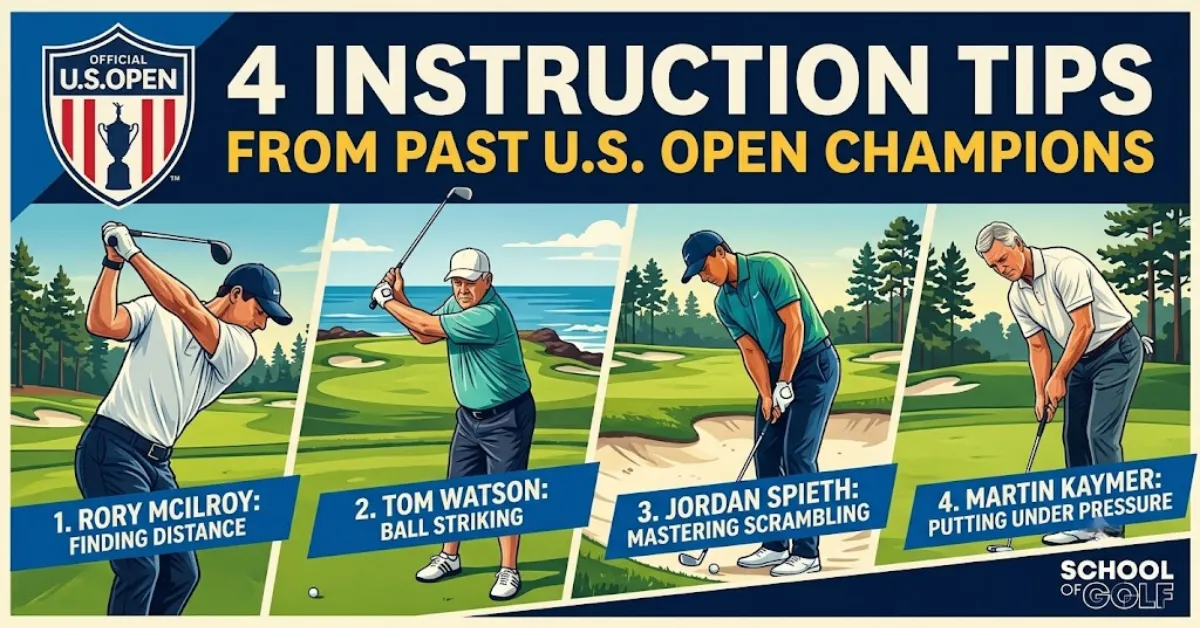
The U.S. Open returns to Shinnecock Hills this week, and if you’ve watched even one past edition of this tournament, you know it exposes weaknesses faster than any other major. I’m a 9-handicap, and the year I started taking U.S. Open champion tips seriously instead of just watching the highlights, my miss went from a two-way disaster off the tee to a predictable push-fade I could actually play with.
That’s the real value here. These aren’t generic “keep your head down” tips. They’re specific adjustments from four men who won golf’s hardest tournament, and every one of them still applies to your Saturday game.
We’re not going to make you watch four videos to get four sentences of substance. Here’s what each tip actually means, how to do it, and which one fixes the problem you’re probably dealing with right now.
Quick Answer: Hale Irwin’s grip-and-alignment routine, Johnny Miller’s “brush” swing thought for irons, Rory McIlroy’s long-iron strategy from his record 2011 win, and Ben Hogan’s one-piece takeaway are four of the most useful instruction tips from past U.S. Open champions. Each fixes a specific, common amateur problem – and all four apply directly to the firm, narrow conditions at Shinnecock Hills this week.
Hale Irwin’s Grip-First Fundamentals (Why a 45-Year-Old Won the U.S. Open)
Start with the basics, because Hale Irwin did – and it worked three times. Irwin won the U.S. Open in 1974, 1979, and 1990, and that last win came at age 45, a record for the oldest U.S. Open champion that still stands today.
His tip isn’t flashy. It’s grip, stance, alignment, and takeaway — in that order, every time, before every shot. Most amateurs check none of these. We pick a club, shuffle into a stance, and swing.
Here’s the part nobody explains: alignment errors compound. If your shoulders are even five degrees closed at setup, your brain will subconsciously adjust the swing path to compensate, and that adjustment is what produces the big miss — not the grip itself. Fix the alignment first, and the swing often fixes itself.
How to Check Your Grip and Alignment in 30 Seconds
Lay a club on the ground pointing at your target, then set a second club parallel to it along your toe line. Step into your normal stance and look down. If your feet aren’t parallel to that target line, you’ve found your problem before you’ve hit a single ball.
I do this drill for ten minutes before every range session now. It’s boring. It’s also the reason my iron shots stopped starting 15 yards right of where I was aiming.
If you already have a reliable pre-shot routine that includes alignment checks, this tip won’t add much – you’re already doing the work Irwin is describing.
Johnny Miller’s “Brush-Brush” Swing Thought for Cleaner Iron Contact
Johnny Miller’s final-round 63 at the 1973 U.S. Open at Oakmont remains one of the most famous rounds in golf history – a major championship record that stood for decades. His signature swing thought, often called “brush-brush,” is built around how the club interacts with the turf, not just the ball.
The idea is simple: feel like the club brushes the grass twice – once just before impact and once just after – rather than digging down at the ball. Most amateurs do the opposite. We try to “hit down” so aggressively that the club bottoms out before the ball, producing thin shots, chunks, or both on the same swing.
Picture a flat stone skipping across water instead of a hammer driving a nail. That’s the contact Miller is describing – shallow, brushing, through the ball rather than at it.
I tried this on the range using nothing but 7-irons for half an hour, and the difference in sound alone was obvious. A proper brush sounds like a soft thump followed by a divot taken after the ball. A dig sounds like a thud, often with no divot at all.
This swing thought works best on tight or firm turf — exactly what you’ll see in U.S. Open setups. On lush, fluffy fairway grass, the margin for error is bigger and you might not notice the difference as much.
Rory McIlroy’s Long-Iron Strategy From His Record 2011 Win
Rory McIlroy’s 2011 U.S. Open victory at Congressional wasn’t just dominant — it was a long-iron clinic. He won at 16-under par, still the lowest score relative to par in U.S. Open history, and a huge part of that was how he attacked the course with long irons into par-4s and par-5s.
His key swing thought for long irons centers on ball position and commitment to the turn through impact. Most golfers, facing a 4-iron or 5-iron, instinctively try to help the ball into the air by leaning back and scooping. Rory’s approach is almost the opposite: ball position stays consistent with his mid-irons, and he commits to a full rotation through impact, trusting the club’s loft to do the work.
The strategic piece matters as much as the swing piece. With long irons, Rory wasn’t aiming at flags — he was aiming at the widest, flattest part of each green, accepting a longer second putt in exchange for a dramatically lower chance of a big number.
If you’re playing a course with U.S. Open-style firm, fast greens this week, that strategy translates directly: with anything longer than a 7-iron in your hand, pick the fat part of the green over the flag almost every time. The two-putt from 40 feet beats the up-and-down from a bunker nine times out of ten.
Ben Hogan’s One-Piece Takeaway — Still the Best Tip Nobody Explains Properly
If you ask ten golfers for the best tip ever, at least a few will mention Ben Hogan — and for good reason. Hogan won four U.S. Opens (1948, 1950, 1951, and 1953), and his swing remains one of the most studied in golf history despite the fact that he played before modern video instruction existed.
Here’s the problem: most articles mention Hogan’s swing reverently and then explain nothing. The single most repeatable element of it is the one-piece takeaway — the idea that the hands, arms, shoulders, and club all move together as a single unit for the first 12 to 18 inches of the backswing, with zero independent wrist movement.
This is the tip I’d put above almost any other on this list, full stop. It’s the foundation that makes every other swing fix easier, because it removes the single biggest source of inconsistency for amateur golfers: an early, independent wrist hinge that changes the clubface angle before the swing has even really started.
To feel it, take a normal grip, then start your backswing by turning your lead shoulder away from the target while keeping your hands, arms, and the clubhead moving as one connected piece — like you’re turning a steering wheel with both hands locked at a fixed distance from each other. If you feel any “flick” or independent hand movement in that first foot and a half, you’ve broken the connection.
It won’t feel powerful at first. That’s normal — and honestly, if your current swing already relies on an early wrist set for feel (some better players genuinely do this on purpose), forcing a strict one-piece takeaway might feel restrictive rather than helpful.
How These Tips Apply at Shinnecock Hills This Week (2026 U.S. Open)
The 2026 U.S. Open runs June 18–21 at Shinnecock Hills Golf Club in Southampton, New York — the course’s sixth time hosting, and its first since Brooks Koepka’s win there in 2018. J.J. Spaun arrives as the defending champion after his win at a flooded Oakmont last year, and Shinnecock’s exposed, windswept layout with narrow fairways and firm, fast greens makes it almost a perfect stage for every tip above.
Tight lies reward Miller’s brush technique. Firm greens reward Rory’s “aim at the fat part” long-iron strategy. And Shinnecock’s demanding setup punishes any swing built on an early wrist flick — which is exactly what Hogan’s one-piece takeaway is designed to eliminate.
Quick Reference — Which Tip Fixes Which Problem
| Your Problem | Champion | Tip | Best Practiced On |
|---|---|---|---|
| Inconsistent alignment / starting shots offline | Hale Irwin | Grip, stance, alignment check | Range, with alignment sticks |
| Thin or chunked iron shots | Johnny Miller | “Brush-brush” contact feel | Tight-turf range mats |
| Big numbers on long-iron approaches | Rory McIlroy | Aim fat side of green, full rotation | Course, par-4/par-5 approaches |
| Early wrist flick / loss of swing connection | Ben Hogan | One-piece takeaway | Slow-motion practice swings, mirror |
I’ll be honest — Irwin’s grip-and-alignment check is the one most golfers think they’ve already mastered and skip. It’s also the one I see ignored most often on the course, including by better players than me.
Frequently Asked Questions
The 70/30 rule generally refers to weight distribution at setup — roughly 60% on the lead side and 40% on the trail side for irons, sometimes cited as closer to 70/30 favoring the lead foot for shorter shots like chips and pitches. There’s no single official source for this figure, and different instructors use slightly different ratios, so treat it as a starting feel rather than a strict measurement.
The 80/20 rule, also called the Pareto Principle, suggests roughly 80% of your scoring improvement comes from focusing practice on the 20% of skills that matter most — typically wedges, short irons, and putting from inside 10 feet. Most amateurs do the opposite: they spend most of their range time on the driver, the club that statistically affects scoring the least relative to practice time invested.
There’s no single universally agreed “best” tip, but Ben Hogan’s one-piece takeaway — covered above — is consistently cited by teaching professionals as one of the most foundational, because it addresses the root cause of multiple common swing faults rather than treating symptoms individually.
Shinnecock Hills rewards accurate, controlled ball-striking over raw power, given its exposed, often windy layout and firm, fast greens — the same conditions where the tips above (especially Miller’s contact feel and Rory’s conservative long-iron strategy) tend to matter most. Defending champion J.J. Spaun and players known for tight ball-striking and course management are typically the names worth watching in this kind of setup.
The Bottom Line
You don’t need all four of these tips at once. Pick the one that matches your current miss — Irwin if your alignment is off, Miller if your contact is inconsistent, Rory if long irons keep wrecking your scorecard, or Hogan if you want the foundational fix that makes everything else easier.
Take it to the range this week, while the U.S. Open is actually on TV and these names are fresh. For more on building the kind of pre-shot routine that makes Irwin’s fundamentals automatic, check out our pre-shot routine guide.