

Summer trips get decided in January – when you’re stuck indoors and already dreaming about fairways and long evenings – or they don’t happen at all. Playing a scratch golfer, I’ve made the mistake of booking the wrong destination for July and shown up to 102°F heat and fairways baked to concrete. Never again. The trips worth planning around are the ones where summer is actually part of the appeal: cool coastal air, mountain elevation, or northern latitude doing the work so the course is in perfect condition and you’re not soaking through your shirt by the third hole.
This list covers 12 destinations that earn their spot specifically because of summer. Not destinations that happen to be open in summer. The ones where July and August are the right time to go.
Quick Answer: The best summer golf trips in America are Bandon Dunes (Oregon), Pinehurst (North Carolina), Northern Michigan, Sand Valley (Wisconsin), and the Vail Valley (Colorado). All five deliver cool enough temperatures to play comfortably in July and August, multiple top-tier courses at one location, and enough off-course options to justify the flight. Budget at least 4 days minimum. Book 6–12 months out for the most in-demand tee times.
The At-a-Glance Comparison Table
Use this to pick your trip based on what actually matters – budget, group type, weather, and how far out you need to book.
| Destination | Avg July High | Green Fee Range | Best For | Book Ahead |
|---|---|---|---|---|
| Bandon Dunes, OR | 63°F | $145–$365 | Links purists, solo trips | 12 months |
| Pinehurst, NC | 89°F | $100–$325 | Golf history fans, buddies | 6 months |
| Northern Michigan | 79°F | $50–$225 | Budget groups, families | 3–4 months |
| Sand Valley, WI | 83°F | $85–$350 | Serious golfers, bucket list | 12 months |
| Vail Valley, CO | 77°F | $65–$285 | Mountain scenery, couples | 4–6 months |
| Lake Tahoe, CA/NV | 84°F | $75–$400 | Luxury, scenery chasers | 4–6 months |
| Ocean City, MD | 85°F | $50–$120 | Value, East Coast groups | 2–3 months |
| French Lick, IN | 85°F | $125–$250 | History, Midwest road trip | 3–4 months |
| Kohler, WI | 80°F | $175–$450 | Bucket list, premium groups | 9–12 months |
| Coastal Maine | 75°F | $55–$175 | Scenic road trips, casual | 2–3 months |
| Upper Michigan (U.P.) | 76°F | $45–$95 | Hidden gem seekers | 1–2 months |
| Bend, OR | 83°F | $100–$230 | Resort golf + outdoor lifestyle | 4–5 months |
1. Bandon Dunes, Oregon – The One Everyone Should Do Once (And Then Again)
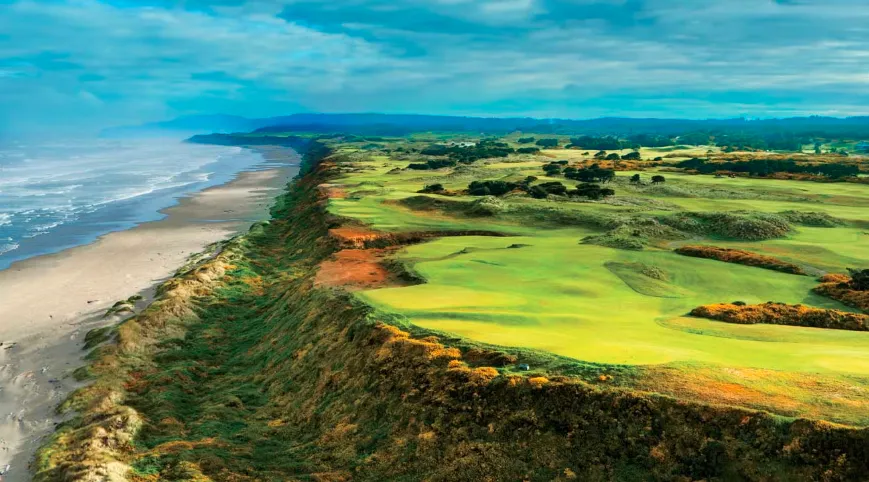
Bandon Dunes is not the best summer golf trip in America because it has the most courses, or the most amenities, or the best hotel pool. The Bandon is the best because it’s the only place in the country where you genuinely feel like you’re playing golf on the Dunes of Ireland — without the 10-hour flight and €250 green fees.
Five 18-hole courses (Bandon Dunes, Pacific Dunes, Old MacDonald, Bandon Trails, Sheep Ranch), plus the Preserve par-3 course and the Punchbowl putting course. You could spend a week there and not run out of course combinations worth playing. Pacific Dunes is my personal pick for best individual course in America I’ve ever walked — the way those fescue fairways thread along the cliff edge on holes 11 through 13 doesn’t look real until you’re standing on the tee.
Average July high: 63°F. You’ll want a fleece. That’s the point.
Green fees run from $145 (Bandon Trails, shoulder times) to $365 (Sheep Ranch peak). Budget $200–$250 per round as a working average. The resort operates on a caddie-only model for the main courses — no carts allowed — which adds $60–$85 per bag but is completely the right call for these tracks.
The honest warning: Bandon is remote. Closest commercial airport is North Bend, OR, which has limited flights. Driving from Portland takes about 4 hours. Fly-drive is the play, and the drive down the Oregon coast is worth it on its own. If you’re looking for nightlife, restaurants beyond the resort, or a beach vibe to mix with your golf, this isn’t your trip. Bandon is 100% about the golf.
Book tee times 12 months out. Not 11. Twelve.
Suggested stay: 4 nights minimum, 6 nights ideal. Plan 2 rounds per day on days 2 and 3.
2. Pinehurst, North Carolina – More Courses Per Acre Than Anywhere on Earth
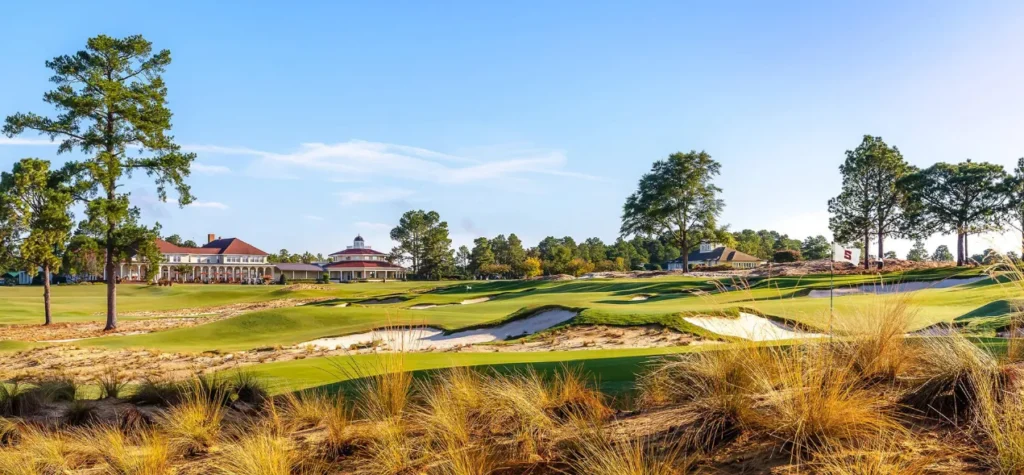
Pinehurst gets pigeon-holed as a fall destination. That’s underrated thinking. Yes, July highs average 89°F — you’ll want to play early and avoid the 1pm tee times in late July. But Pinehurst in summer means the sandhills are at their firmest and fastest, No. 2 is running out like a links course, and the short Cradle course plays perfectly in the evenings when temperatures drop into the mid-70s.
The resort now has 10 18-hole courses plus The Cradle short course. No. 2 — the Donald Ross masterpiece that hosted the 2024 U.S. Open and will host the 2029 U.S. Open — runs about $325 in peak season. Pinehurst No. 4, renovated by Gil Hanse in 2018, is genuinely underrated and plays at $200. The No. 8 course (a Rees Jones design) at $145 is probably the best value on property.
Down the road: Mid Pines and Pine Needles are both independently ranked Top 50 public courses in the U.S. Adding either to your Pinehurst trip without blowing the budget is easy since both are under $200 for a round.
Suggested stay: 4 nights. Two rounds at Pinehurst proper, one at No. 2 or No. 4, one at Mid Pines.
3. Northern Michigan – The Best Value Golf Region in America
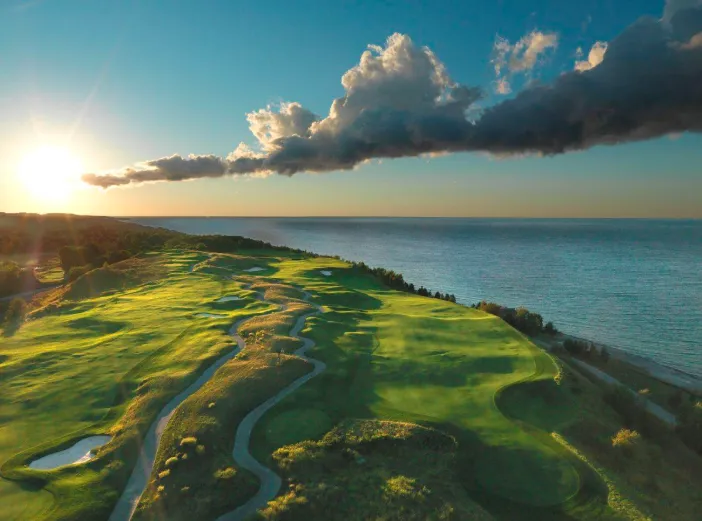
Nobody who hasn’t been to Northern Michigan believes you can play world-class golf for $75 a round. That’s their mistake. The Traverse City / Gaylord corridor in Northern Michigan has a higher concentration of standout public courses per square mile than anywhere in the country — and in summer, the average high sits around 79°F with enough breeze off Lake Michigan to keep it comfortable.
Arcadia Bluffs (two courses, the original ranked Top 20 public in the U.S.) sits on a bluff above Lake Michigan with views that’ll make you three-putt through distraction. Budget $150–$225 per round. Treetops Resort outside Gaylord offers 5 courses (81 holes total) with the famous Threetops par-3 course featuring the “Devil’s Drop” — a 145-foot drop off an elevated tee box. Rates at Treetops start around $65.
For something genuinely jaw-dropping that almost nobody outside Michigan knows: Greywalls at Marquette Golf Club in the Upper Peninsula deserves its own entry (and gets one — see #11 below), but it’s worth the extra 3-hour drive north to add to a Northern Michigan week.
Bay Harbor Golf Club in Petoskey routes across quarry cliffs, meadow, and lakeside terrain on three distinct 9-hole stretches called the Links, the Preserve, and the Quarry. The Links and Quarry combination is one of the most architecturally diverse 18 holes in the Midwest.
Suggested stay: 5–7 nights. Fly into Cherry Capital Airport (TVC) in Traverse City. Rent a car and work your way north.
4. Sand Valley, Wisconsin – The Midwest’s Bucket List
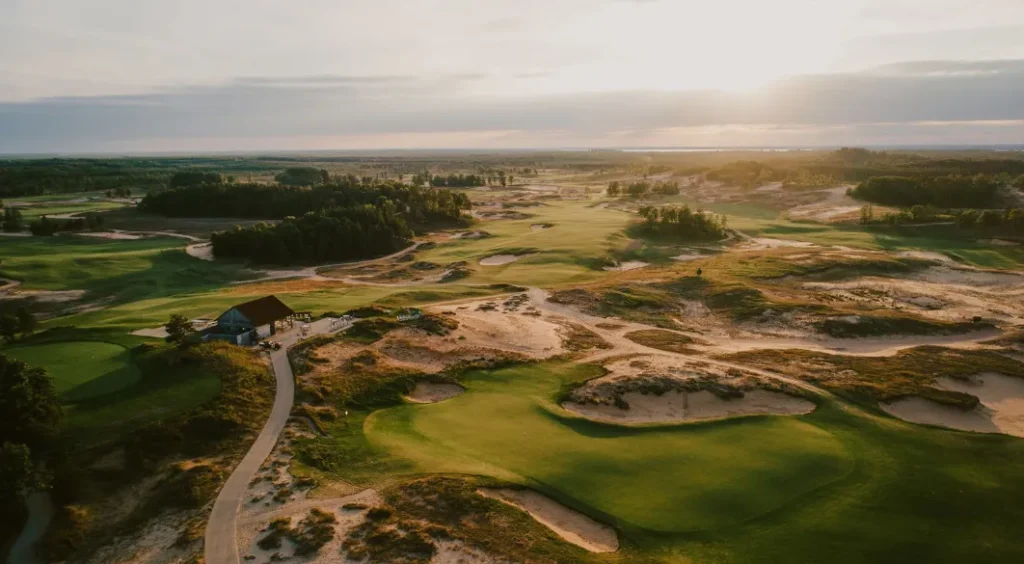
Sand Valley opened in 2017 and already operates multiple courses on a remote stretch of central Wisconsin sandhills, with new additions making it a legitimate multi-day destination. The main Sand Valley course and Mammoth Dunes are both ranked in Golf Digest’s Top 100 public courses in the U.S. The Sandbox is an 18-hole par-3 course worth an afternoon. And the Lido — a meticulous recreation of C.B. Macdonald’s legendary lost original — is the most talked-about golf course project of the last decade.
Summer highs hover around 83°F. The elevation of the property (it sits on an ancient glacial sand formation) keeps it a few degrees cooler than the surrounding flatlands, and there’s almost always a breeze working through the dunes. Fescue fairways drain fast and play firm, exactly the conditions you want for bounce-and-run golf.
Green fees range from $85 (Sandbox) to $350 (Sand Valley or Mammoth Dunes, peak weekend). The Lido is reservation-only with limited access — check the official site for current availability.
Sand Valley is fully booked for most summer weekends by November of the prior year. This one is a 12-month advance booking situation, not an exaggeration.
Suggested stay: 3–4 nights minimum. Fly into Central Wisconsin Airport (CWA) in Mosinee, about 50 minutes from the property.
5. Whistling Straits & Kohler, Wisconsin – When Budget Is Not the Priority
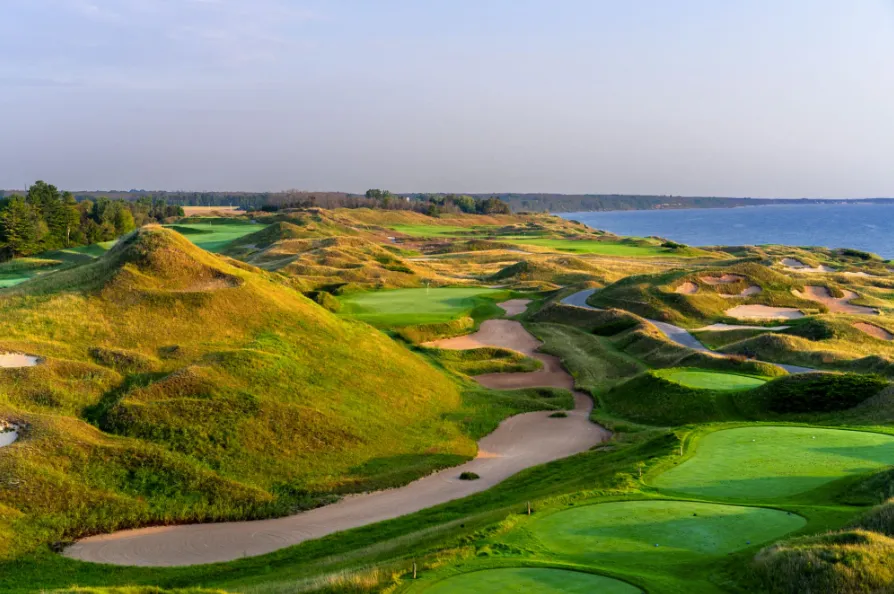
Forty-five minutes northeast of Sand Valley, Destination Kohler offers a completely different kind of Wisconsin summer golf trip. Whistling Straits — site of the 2021 Ryder Cup — and Blackwolf Run (two courses) collectively give you four world-class courses to attack. This isn’t a budget trip. Green fees at Whistling Straits run $175–$450 depending on season and Straits vs. Irish Course. Blackwolf Run’s River course (consistently ranked among the top 5 public courses in the state) runs $175.
The Straits Course routing along Lake Michigan over 960 acres of sculpted fescue dunes feels like links golf with a Wisconsin zip code. Fourteen of the 18 holes border the water. The signature hole is the par-3 17th — 223 yards over a ravine to a green guarded by 12 bunkers — which routinely produces the highest stroke average of any par-3 in Wisconsin.
Combining Kohler with Sand Valley on one trip is the definitive Wisconsin golf road trip. Five courses across two resorts, each completely different in character, within 50 miles of each other.
Suggested stay: 2 nights at Kohler, 3 at Sand Valley, fly into Milwaukee or Chicago O’Hare.
6. Vail Valley, Colorado – Mountain Golf That Actually Plays Great
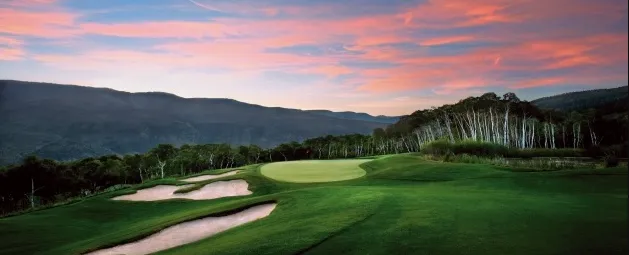
Mountain golf in summer has one big, underappreciated advantage: altitude. At 8,000+ feet in Vail, the ball flies 10–15% farther than at sea level. Your 7-iron carries like a 6-iron. That’s not marketing language — it’s basic physics, and it means you’ll hit shots that look and feel better than your handicap suggests.
Red Sky Golf Club in Wolcott (about 12 miles from Vail) has two courses — one by Greg Norman, one by Tom Fazio. Non-members can access both by booking through partnering hotels in the Vail/Beaver Creek corridor. The Norman course (Eagle Ranch) plays over rolling terrain between Eagle and Gypsum along the Colorado River; green fees run around $195–$285 depending on access arrangement. Both Red Sky tracks are closed in winter and don’t open until late May, which is exactly why summer is the correct time to visit.
Beaver Creek Resort’s private club has limited hotel-access tee times. Sonnenalp Golf Club in Edwards is another high-end private track open to guests of the Sonnenalp Hotel. The Vail Golf Club — a walkable municipal course at 8,200 feet — costs around $65–$90 and plays surprisingly well.
Average July high in Vail: 77°F. Afternoon thunderstorms are common June through August, rolling in around 2–3pm. Book morning tee times.
Suggested stay: 4 nights. Mix golf with hiking, rafting, or road-cycling the Vail Pass corridor.
7. Lake Tahoe, California/Nevada – The Most Scenic Golf in the Country
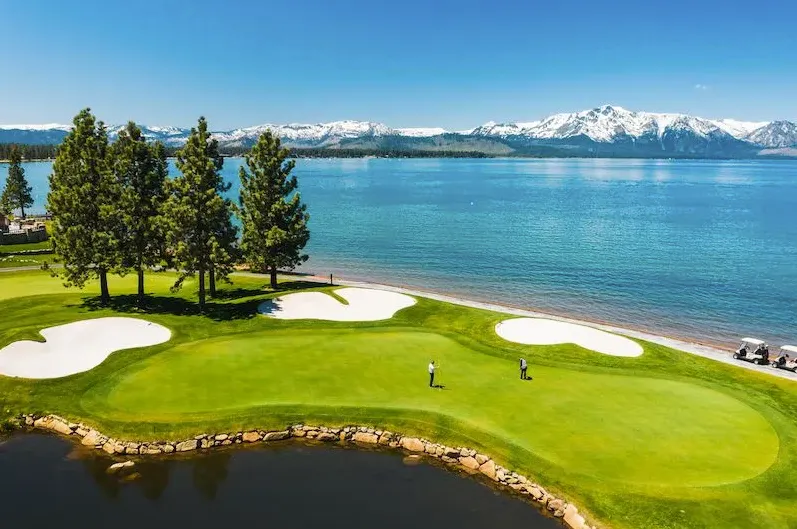
It’s not hyperbole: there may not be a more beautiful setting for golf anywhere in the country than the courses ringing Lake Tahoe. Edgewood Tahoe on the south shore — host of the American Century Championship celebrity tournament every July — plays directly along the lake’s edge. Greens fees run $250–$400 during summer.
On the north shore, Incline Village Golf Resort offers 36 holes across two courses (the Championship course and the Mountain course) with Sierra Nevada views from every hole. Old Greenwood and Coyote Moon in Truckee, California are both legitimate top-tier tracks: Old Greenwood (a Jack Nicklaus design) runs about $150–$225 in summer; Coyote Moon (tree-lined, elevation changes throughout) at $95–$175.
The honest admission about Lake Tahoe golf: the courses vary more in quality here than at destinations like Bandon or Pinehurst. Edgewood is genuinely excellent; the Lake Tahoe Golf Course (a California state park facility) is charming but often in inconsistent condition depending on winter snowpack and spring opening. Go with specific targets rather than assuming everything in the region is equally good.
Average July high in South Lake Tahoe: 84°F, though early morning rounds are cool enough that a light layer makes sense.
Suggested stay: 4–5 nights. Combine north and south shore across the trip.
8. Ocean City, Maryland – The East Coast Value Champion
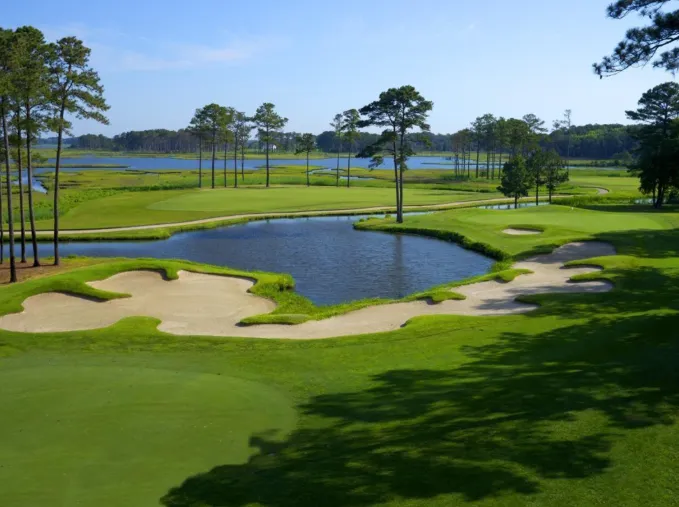
The top summer golf trips in America don’t all cost $300 a round. Ocean City, Maryland is genuinely underrated — accessible from Baltimore (2.5 hours), Washington D.C. (3 hours), Philadelphia (2.5 hours), and New York (4 hours), with 10 courses within easy driving distance.
Rum Pointe Seaside Golf Links, designed by P.B. Dye overlooking Assateague Island, plays with coastal winds and views of the Chesapeake Bay. Green fees: $75–$120. The Links at Lighthouse Sound (Arthur Hills design) winds through coastal marshlands with sweeping water views on 14 holes — $85–$115 in summer. GlenRiddle Golf Club offers the Man O’ War and War Admiral courses at $50–$80 each.
This is a trip for a group that wants good golf, reasonable green fees, access to a beach, and the option to eat crabs on the water at night. It’s not trying to be Pinehurst. That’s exactly why it delivers.
Average July high: 85°F. Play mornings, beach or boardwalk in the afternoon.
Suggested stay: 3 nights. Easily a drive-to destination for most of the Mid-Atlantic and Northeast.
9. French Lick, Indiana — The Midwest’s Most Underrated Golf Resort
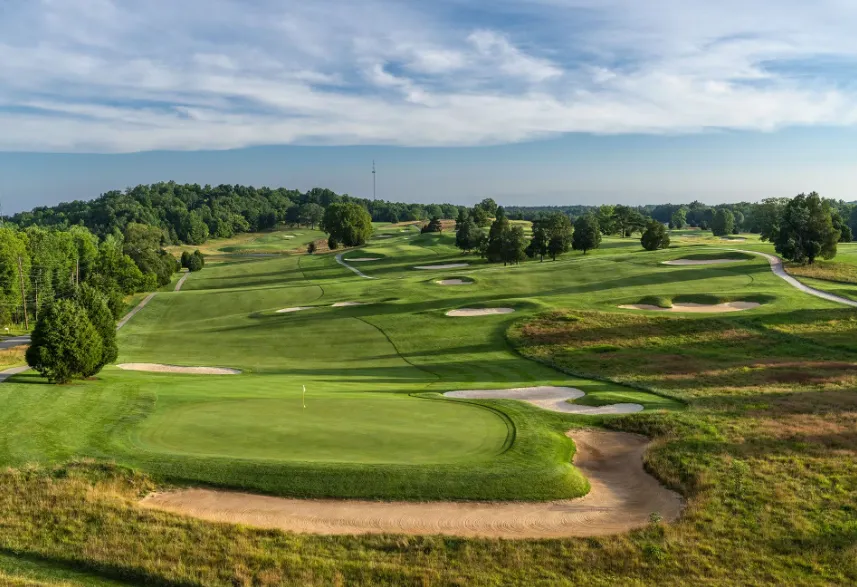
Most people have never heard of French Lick, Indiana. The ones who have usually know it as Larry Bird’s hometown. What they don’t know is that French Lick Resort – spread across 3,200 acres in the rolling hills of southern Indiana — has three hotels, a casino, a full spa, and three golf experiences that’d hold their own in any state.
The Pete Dye Course at French Lick is a savage track – one of the most brutally exposed and wind-affected designs Dye ever produced. It plays from the ridgelines and falls into valleys, and in any kind of wind it’ll take your ego apart quickly. Green fees run $200–$250. The Donald Ross Course (built in 1917, beautifully restored) plays much more forgiving at $125–$175, with that classic raised-crown green architecture Ross was famous for. Sand Creek – a 9-hole short course that debuted in 2025 – rounds out the options for a casual afternoon round.
Sultan’s Run in nearby Jasper (about 20 minutes away) partners with the resort for packaged rounds and is a legitimate Top-50-in-Indiana track at $65–$80.
Suggested stay: 3 nights minimum. Fly into Louisville, KY (1.5 hours away) or Evansville, IN (45 minutes).
10. Coastal Maine – The Scenic Road Trip That Requires Zero Hype
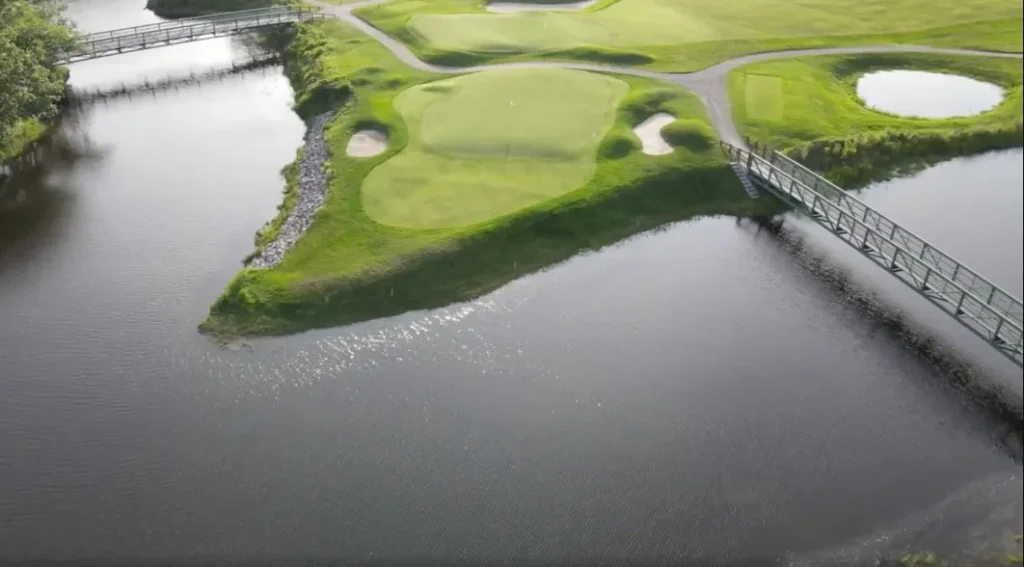
Coastal Maine doesn’t fit the formula of a traditional golf destination — there’s no single anchor resort, no cluster of ranked courses all within 10 minutes of each other. That’s exactly why it works as a summer trip.
Drive north from Portland and the golf unfolds as a genuine adventure. Dunegrass Country Club in Old Orchard Beach makes a solid first stop. The centerpiece is Samoset Resort in Rockport, where the 18th green sits literally on a breakwall jutting into Penobscot Bay with a lighthouse in the background. Green fees at Samoset run $95–$175 in summer. Boothbay Harbor Country Club — normally a private club — opens to overnight guests at the Boothbay Harbor Oceanside Golf Resort.
Average July high on the Maine coast: 75°F. Pack a windbreaker regardless.
The honest limitation here: don’t come expecting Wall-to-Wall championship golf. Maine rewards golfers who love scenic, historic courses and are happy to walk 18 holes while looking at the Atlantic. It will not satisfy someone who needs to play a Top-20 ranked course every day.
Suggested stay: 5–7 nights on a driving circuit. Portland in, Rockport out (or vice versa).
11. The Upper Peninsula of Michigan – The Hidden Gem That Belongs on Every Serious Golfer’s List
Greywalls at Marquette Golf Club belongs in the conversation for best public course in the United States. Every serious golf ranking puts it in the Top 40 public; most who’ve played it believe it belongs in the Top 15. It routes through a dramatic combination of rocky outcrops, pine forest, and iron-ore formation terrain that looks like nothing else in American golf. Green fees: $65–$95.
Getting there is half the experience. Marquette sits along the south shore of Lake Superior – 4.5 hours north of the Mackinac Bridge – and the drive through the Upper Peninsula’s forests is genuinely spectacular. Average July high in Marquette: 76°F.
Giants Ridge in Biwabik, Minnesota (a 3-hour drive west from Marquette through Wisconsin) can be combined into a cross-U.P. road trip: Greywalls plus The Quarry at Giants Ridge equals two of the most dramatically routed public courses in the upper Midwest on a single 6-day trip.
If you’re the kind of golfer who gets more excited by “has anyone else played this?” than by “it was on TV,” the Upper Peninsula is your answer.
Suggested stay: 3–4 nights in Marquette. Add Giants Ridge for a 6–7 night circuit.
12. Bend, Oregon – Resort Golf With Everything Else Built Around It
Bend earns its spot on this list because it’s the rare destination where the golf is genuinely excellent and the non-golf reasons to be there are equally compelling. The high desert terrain, world-class mountain biking, whitewater kayaking on the Deschutes River, and one of the most concentrated craft brewery scenes in the country mean everyone in your group has a reason to come — not just the golfers.
Sunriver Resort offers 63 holes across four courses, anchored by the Crosswater course — a Robert Cupp/John Fought design that crosses the Deschutes and Little Deschutes Rivers multiple times and consistently ranks among the best resort courses in the Pacific Northwest. Green fees for Crosswater: $150–$220 depending on season. Tetherow Golf Club (David McLay Kidd, 2008) plays through open sage and lava-rock terrain with the most dramatic undulating greens in the Pacific Northwest — either the most fun or most maddening experience in Oregon golf, depending on your perspective. Pronghorn’s Jack Nicklaus Signature course ($175–$230) fills out the premium tier.
Average July high in Bend: 83°F. The high desert climate means it’s warm but dry — a very different feel from 83°F on the East Coast. The elevation (3,600 feet) keeps evenings cool and afternoons comfortable if you stay in the shade.
Suggested stay: 4–5 nights. Fly into Redmond Airport (RDM), 15 minutes from Bend.
The Summer Golf Trip Booking Calendar: When to Lock In Each Destination
Most golfers wait too long. Here’s the reality by destination:
The biggest mistake golfers make: waiting until April to plan a July trip. By then, the best dates at Bandon and Sand Valley are completely gone, and you’re left trying to cobble together Tuesdays and Thursdays.
Frequently Asked Questions
Oregon and Michigan stand alone for summer golf in America. Oregon gives you Bandon Dunes and Bend — both world-class and both at their best when the rest of the country is baking. Michigan offers more top-100 public courses in summer than any other state: Arcadia Bluffs, Greywalls, Bay Harbor, and the Treetops complex all deliver in a season where the Great Lakes keep temperatures reasonable. Wisconsin (Sand Valley, Kohler, Giants Ridge nearby) runs third.
Bandon Dunes, Oregon (avg. 63°F) and Coastal Maine (avg. 75°F) offer the coolest playing conditions in July anywhere in the continental U.S. The Upper Peninsula of Michigan and Northern Michigan both average under 80°F with low humidity. Colorado’s mountain courses (Vail, Aspen area) stay in the mid-to-upper 70s. Any destination that averages above 88°F in July — including Pinehurst, Las Vegas, Scottsdale, and Myrtle Beach — requires early tee times and significant heat management.
Bandon Dunes Resort is the best summer golf resort in America for golfers who want pure course quality. Five top-50-ranked courses, a caddie culture, walking-only policy, and lodging all on-site make it the most complete golf experience in the country. For golfers who want course variety combined with non-golf amenities, Sand Valley in Wisconsin and Sunriver Resort in Bend, Oregon are the closest competitors in summer specifically.
Yes – with conditions. July in Pinehurst (Moore County, NC) averages 89°F during the day. The courses play best before 10am, when temperatures are in the low-to-mid 70s and the dew is still burning off. The upside: firm, fast conditions in summer make Pinehurst No. 2 play closest to how Donald Ross intended — the famous crowned greens repel approach shots that aren’t perfectly struck, and that’s at its clearest on firm turf. Avoid back-to-back late afternoon tee times in late July. Morning golf, afternoon at the pool.
Budget varies dramatically by destination. A 4-day trip to Ocean City, Maryland (driving, 3 rounds, mid-range lodging) can run $600–$900 per person. A 4-day Pinehurst trip (2 nights at the resort, 3 rounds including No. 2, flights from the Midwest) runs $1,200–$1,800 per person. A 4-night Bandon Dunes trip (4 rounds, lodge stay, caddies) runs $2,200–$3,200 per person all-in. Sand Valley comparable to Bandon at $1,800–$2,800. Set your budget first, then match the destination.
36 holes per day is possible but leaves most golfers physically cooked for day 2. At destinations with walking-only policies (Bandon Dunes), 36 holes in a day is genuinely tiring — factor in 8–10 miles of walking. For most golfers planning a multi-day trip, 18 holes per day with one 36-hole day is the sustainable formula. Don’t plan 36 holes every day and expect to play your best golf on day 3.
The Honest Summary: Which Trip Is Actually Right for You
Not every golfer should go to Bandon Dunes. That sounds like heresy, but the golfer who plays twice a year and wants a fun social trip with good food and nightlife nearby will have a better time in Bend, Oregon or Ocean City, Maryland than in a remote coastal Oregon resort where the whole point is the golf.
Here’s the honest breakdown:
The best summer golf trips in America work because the destination earns it in summer specifically – not despite the season, but because of it. Plan accordingly, book early, and tighten up your ball-striking before you go.