
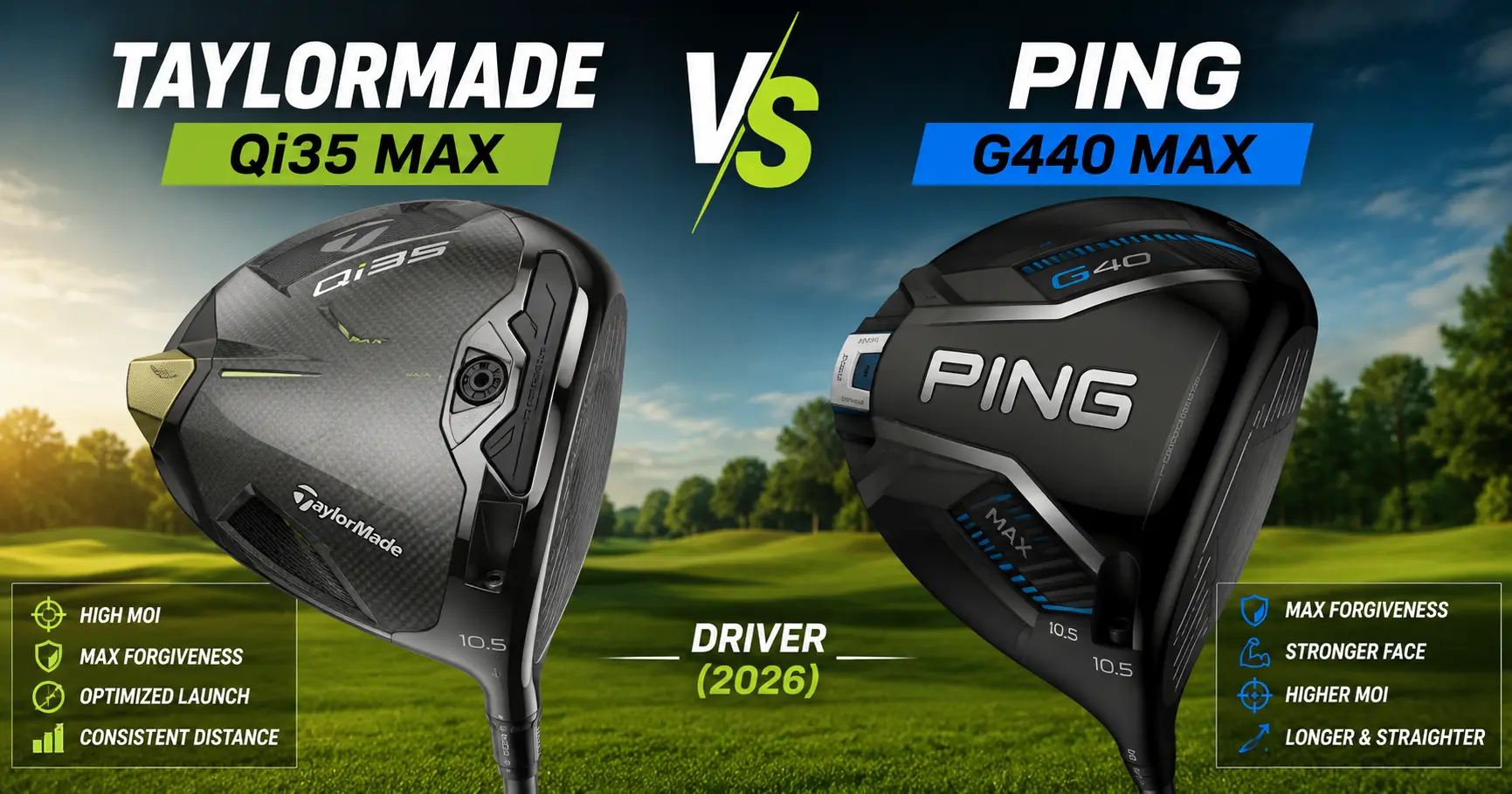
The PING G440 Max holds ball speed better on heel, toe, and low-face misses. The TaylorMade Qi35 Max edges ahead by a few yards on center strikes and gives you a cleaner, set-and-forget build. Both launched at $599.99 and both now sell for roughly $440–$460 at major retailers. If your miss is unpredictable, start with the G440 Max. If you catch it flush more often than not, the Qi35 Max rewards you more.
Buying a $600 driver comes down to one real question: what happens when you don’t hit it perfectly? The Qi35 Max chases ball speed first and lets forgiveness follow. The G440 Max chases forgiveness first and lets ball speed follow. That gap matters more than anything else on the spec sheet.
Qi35, Qi35 Max, Qi35 LS, or Qi35 Max Lite? Clear This Up First
TaylorMade’s current driver lineup has four separate heads: Qi35, Qi35 LS, Qi35 Max, and Qi35 Max Lite. When people search “Qi35 vs G440 Max,” most of them actually mean the Qi35 Max, since that’s the model that sits opposite PING’s forgiveness-focused G440 Max in price, positioning, and marketing. This guide compares the Qi35 Max to the G440 Max.
The two TaylorMade heads aren’t interchangeable, and the difference is worth knowing before you shop:
- The standard Qi35 carries two movable sole weights (13g and 3g) that let you shift the CG and dial spin up or down.
- The Qi35 Max drops that adjustability for a single fixed 34-gram tungsten weight, pushing MOI to TaylorMade’s “10K” mark and driving CG projection down to roughly 2.9mm (versus about 1.6mm on the standard head).
In plain terms: the standard Qi35 gives you more control, the Max gives you more built-in insurance against bad strikes. Both share the same $599.99 MSRP, so if adjustability matters more to you than maximum forgiveness, it’s worth hitting the standard Qi35 alongside the Max before you commit.
If you’re actually comparing the standard Qi35 to the G440 Max: independent testing found the standard Qi35 produced about 14 more yards of total distance and 12 more yards of carry than the G440 Max, thanks to its lower-spin flight, while the G440 Max still edged it on forgiveness, particularly on low strikes. That’s a real and useful data point — it just isn’t a Qi35 Max number, and shouldn’t be quoted as one. For the rest of this guide, “Qi35 Max” means the Max-tier head.
Qi35 Max vs G440 Max: Specs at a Glance
| Spec | TaylorMade Qi35 Max | PING G440 Max |
|---|---|---|
| MSRP | $599.99 | $599.99 |
| Release | January 30, 2025 | January 30, 2025 |
| Available lofts | 9°, 10.5°, 12° | 9°, 10.5°, 12° |
| Loft adjustability | 4° range via loft sleeve | ±1.5° via 8-position hosel |
| Head weight system | Fixed 34g tungsten weight | 29g three-position movable weight |
| MOI branding | “10K” (TaylorMade’s marketed figure) | Not separately branded for this model |
| Stock shafts | Fujikura AirSpeeder 50, Mitsubishi Diamana T+ 60 | PING Alta CB Blue 50, PING Tour 2.0 Chrome/Black 65, Project X Denali Red 60, Mitsubishi Tensei 1K Black 65 |
| Standard length | 45.75″ | 46″ (Alta CB Blue), 45.5″ (other stock shafts) |
| Crown material | Carbon (Infinity Carbon Crown) | Carbon (CarbonFly Wrap) |
| Successor | Qi4D Max (released January 2026) | None yet — same generation |
You can check both current spec sheets directly: TaylorMade’s Qi35 Max product page and PING’s G440 Max product page. Loft numbers only tell part of the story – if you want the fuller picture of how loft translates to launch and carry, our guide to driver loft walks through it.
What’s Actually Different Under the Hood
TaylorMade built the Qi35 Max around an aggressively low CG projection and a fixed, heavy tungsten weight. The idea is simple: rather than giving you multiple positions to fiddle with, TaylorMade puts all the mass where it does the most good and lets the head’s shape – plus the fourth-generation Carbon Twist Face – do the forgiveness work. TaylorMade calls the resulting zone of the face that still produces a good result on a mishit the “area of opportunity.”
PING takes a different route. The G440 Max’s Free Hosel design strips weight out of the hosel and heel area and pushes it to the perimeter, and its 29-gram movable back weight lets you shift even more mass rearward for stability or forward for a touch more speed. PING pairs that with its CarbonFly Wrap crown to save additional mass higher in the head, further lowering the CG.
Neither approach is more sophisticated than the other – they’re just solving the same problem (protect ball speed on a bad swing) from opposite directions. TaylorMade gives you a simpler, fixed setup that’s harder to get wrong. PING gives you more knobs to turn if you like to tinker.
Forgiveness: Why the G440 Max Wins the Bad-Miss Battle
Moment of inertia (MOI) measures how much a clubhead resists twisting when you catch the ball off-center. Higher MOI means a heel or toe strike loses less ball speed and drifts less off-line — it’s the biggest single factor behind what golfers call “forgiveness.”
PING’s engineering has centered on MOI for years, and it shows here. Independent hands-on testing consistently gives the G440 Max the edge over the Qi35 Max on off-center strikes, particularly ones caught low on the face, where ball speed drop-off is smaller with the PING head.
The Qi35 Max isn’t a weak forgiveness performer — its 10K MOI figure and low CG projection genuinely widen the usable area of the face. But side by side, testers land on the G440 Max as the more forgiving of the two. If you hit closer to eight fairways out of 14 than four, this gap won’t matter much day to day. If your miss is unpredictable and sometimes wild, the G440 Max’s forgiveness floor is the safer bet.
Distance and Feel: Where the Qi35 Max Pulls Ahead
Distance is where the story flips. On center strikes, testing has shown the Qi35 Max landing roughly one to three yards longer than the G440 Max, largely down to that low CG projection and the Carbon Twist Face’s energy transfer on good contact.
The trade-off shows up in feel. The Qi35 Max produces a lighter, higher-pitched crack that a lot of players moving on from older TaylorMade drivers describe as fast and explosive. The G440 Max has a denser, more muted sound — testers have specifically preferred it on off-center hits because it gives clearer feedback without feeling harsh. Neither is objectively better; it comes down to whether you want a driver that feels quick or one that feels solid.
Visually, the Qi35 Max has a sharper, more technical TaylorMade look, while the G440 Max takes a cleaner approach from above. That’s not a performance stat, but what inspires confidence behind the ball still affects how freely you swing.
Adjustability: A Fixed Weight vs a Movable One
This is one of the clearest, most underreported differences between these two drivers. The Qi35 Max ships with a single fixed 34-gram tungsten weight and a standard 4-degree loft sleeve. What you set at the fitting bay is what you play — full stop.
The G440 Max gives you meaningfully more to work with. Its 29-gram back weight moves across three positions (draw, neutral, and a stability-maximizing back setting), and its Trajectory Tuning 2.0 hosel offers eight positions covering ±1.5° of loft and up to 3° flatter lie — on top of a wide no-upcharge shaft menu that includes PING’s own Alta CB Blue and Tour 2.0 shafts alongside third-party options like Project X Denali Red and Mitsubishi Tensei 1K Black.
If you like to tinker, or you’re between settings and want to fine-tune shot shape over a season, the G440 Max gives you more room to work with. If you’d rather get fit once and never touch the driver again, the Qi35 Max’s simplicity isn’t a weakness — it’s the point.
The MOI Number Nobody Explains: G440 Max Isn’t PING’s Most Forgiving Driver Anymore
Here’s something that gets glossed over in most comparisons of these two drivers. TaylorMade markets the Qi35 Max explicitly as a “10K” driver, meaning its combined heel-toe and crown-sole MOI clears 10,000 g·cm². PING doesn’t market the standard G440 Max with that same “10K” label — and for good reason. PING intentionally positioned the standard G440 Max toward the middle of its lineup rather than at the extreme forgiveness end, reserving that territory for a separate model.
That model is the PING G440 K, which PING added to the lineup in January 2026 — a full year after the original G440 family launched. The G440 K is PING’s true highest-MOI driver, built around a Dual Carbonfly Wrap crown and sole and a heavier 32-gram adjustable backweight (four grams more than the previous-generation G430 Max 10K), pushing the CG lower and deeper than any PING driver before it. It’s the direct answer if maximum forgiveness above everything else is your priority. If you’re shopping the G440 Max specifically because you assumed it was PING’s max-MOI option, it’s worth hitting the G440 K too before you buy.
Qi35 Max vs G440 Max by Handicap
High handicappers: Lean G440 Max. Golfers with inconsistent strike patterns benefit more from a driver that protects poor contact than one that only shines when the strike is already efficient. The G440 Max’s 12° loft option also gives slower swing speeds a useful high-launch starting point, and its Alta CB Blue shaft lineup includes softer flex choices.
Mid handicappers: This is the closest call, and it comes down to your miss, not your index. Pick the G440 Max if your poor shots launch low, lose speed quickly, or drift too far offline. Pick the Qi35 Max if you already launch the ball well and want to squeeze out extra distance without giving up much stability. Our distance-by-handicap breakdown is a useful reference for where your carry numbers should realistically land before you decide.
Low handicappers: Both can work well here, but a golfer who wants the driver to punish misses less still has reason to favor the G440 Max, while a golfer who wants every last yard on a strike they already control has more reason to favor the Qi35 Max. Strike pattern, not skill level, is what actually separates the two for this group.
What You’ll Actually Pay Right Now
Both drivers launched at an identical $599.99 MSRP in January 2025. As of late August 2026, both are still selling at a discount — typically in the $440–$460 range at major retailers like Golf Galaxy, PGA Tour Superstore, and Carl’s Golfland, with used pricing (2nd Swing, Golf Avenue, eBay) running roughly $350–$460 depending on condition, loft, and shaft. Check current listings before you buy — golf retail pricing moves often, and both of these have been discounted since TaylorMade’s Qi4D line arrived.
That last point is worth knowing before you spend $450. TaylorMade released the Qi4D family — the direct successor to the Qi35 line — in January 2026, which means the Qi35 Max is now one generation behind TaylorMade’s current flagship. PING, by contrast, hasn’t released a full G440 replacement; the G440 Max remains PING’s current standard driver, sitting alongside the newer G440 K rather than being replaced by it. That’s a real asymmetry: buying the Qi35 Max now means buying a driver TaylorMade has already moved past, while buying the G440 Max means buying into PING’s active current lineup, both at a similar discount. That doesn’t make the Qi35 Max a bad buy — its underlying performance hasn’t changed — but it’s part of the calculation.
Who Should Buy the TaylorMade Qi35 Max
- You catch the center of the face more often than not and want every available yard on those strikes
- You’d rather set a driver once at a fitting and never adjust it again
- You’re coming from an older TaylorMade driver and already like that brand’s feel and sound
- Your typical miss runs low on the face rather than toward the heel or toe — exactly what the Qi35 Max’s CG placement is built to protect
Who Should Buy the PING G440 Max
- Your miss pattern is inconsistent and sometimes wild, and you want the forgiveness floor as high as possible
- You want to tinker with weight position and hosel settings over a season rather than set-and-forget
- You prefer a denser, more solid impact feel over a lighter, faster-sounding strike
- You want a 12-degree option with genuinely soft stock shaft choices
When Neither Driver Is the Right Answer
Two groups shouldn’t default to either of these without demoing something else first.
If maximum forgiveness is genuinely your top priority and price isn’t a constraint, hit the PING G440 K before you buy the G440 Max — it’s PING’s actual current highest-MOI driver, and the G440 Max was never designed to compete with it on that specific metric.
If you’re on a tighter budget or your swing speed sits in the 75–90 mph range, don’t overlook the previous generation. A G430 Max 10K or G430 LST in good used condition can be found well under $400 and still tests competitively against current drivers. We covered a similar case in our G430 LST review: last-generation drivers from both brands often perform close enough to current models that the price gap isn’t worth paying for most golfers.
Get Fit Before You Decide
Every reputable source on this matchup lands on the same closing point: the driver that produces better numbers on a launch monitor with your actual swing is the right answer, regardless of which brand’s marketing sounds more convincing. These two are close enough in overall performance that a demo session should carry more weight than any spec sheet — including this one.
Most fitting centers stock both models in multiple lofts and shaft combinations. Hit ten balls with each, compare carry distance, dispersion, and spin side by side, and let the data settle it. If you’re building out the rest of the bag around whichever driver you choose, our guide to pairing fairway woods by handicap covers how each driver’s fairway wood counterpart fits into that plan.
FAQ
Is the Qi35 Max better than the G440 Max?
Neither is better overall. The Qi35 Max produces slightly more distance on center strikes and a lighter, faster-feeling impact. The G440 Max is more forgiving on off-center strikes and gives you more adjustability. Which one is “better” depends entirely on how centered your strikes are.
What’s the difference between the Qi35 and the Qi35 Max?
The standard Qi35 has two movable sole weights for adjusting spin and CG, while the Qi35 Max has a single fixed 34-gram weight built for maximum forgiveness. Both share the same $599.99 MSRP — the Max sacrifices tunability for a wider forgiveness margin.
Is the PING G440 Max the same as the G440 K?
No. The G440 Max was part of PING’s original 2025 G440 launch and balances forgiveness with speed. The G440 K arrived in January 2026 as PING’s new highest-MOI model, built specifically for maximum stability over everything else.
Which driver is more forgiving on mishits?
The G440 Max, according to independent testing, holds ball speed and direction better on heel and toe strikes. The Qi35 Max is still forgiving by any reasonable standard, just not quite to the same degree on those specific misses.
Is the standard Qi35 longer than the G440 Max?
Yes, in the specific test most articles reference — about 14 yards of total distance and 12 yards of carry. That figure applies to the standard Qi35, not the Qi35 Max, whose center-strike advantage over the G440 Max is closer to one to three yards.
Should I buy the Qi35 Max or G440 Max in 2026, or wait for something newer?
Both are still legitimately competitive. The Qi35 Max has already been succeeded by the Qi4D family, while the G440 Max remains PING’s current standard driver. If having the newest technology matters specifically to you, look at the Qi4D Max. If you want strong performance at a discounted price, either of these two is a sound buy right now.
How much does a used Qi35 Max or G440 Max cost?
Roughly $350–$460 on the used market depending on condition, loft, and shaft, through retailers like 2nd Swing and Golf Avenue or on eBay. Both currently sell new for around $440–$460 at major retailers, down from their $599.99 launch price.
The Bottom Line
If you had to choose without ever hitting either driver, it comes down to one honest question: how centered is your strike, most of the time? Golfers who find the middle of the face reasonably often will get more out of the Qi35 Max’s extra ball speed. Golfers who miss more unpredictably will get more real-world value out of the G440 Max’s forgiveness. Both are sound purchases at their current street price, and neither is a driver you’ll regret owning — but at this level of parity, a 15-minute session on a launch monitor will tell you more than any article, including this one.