
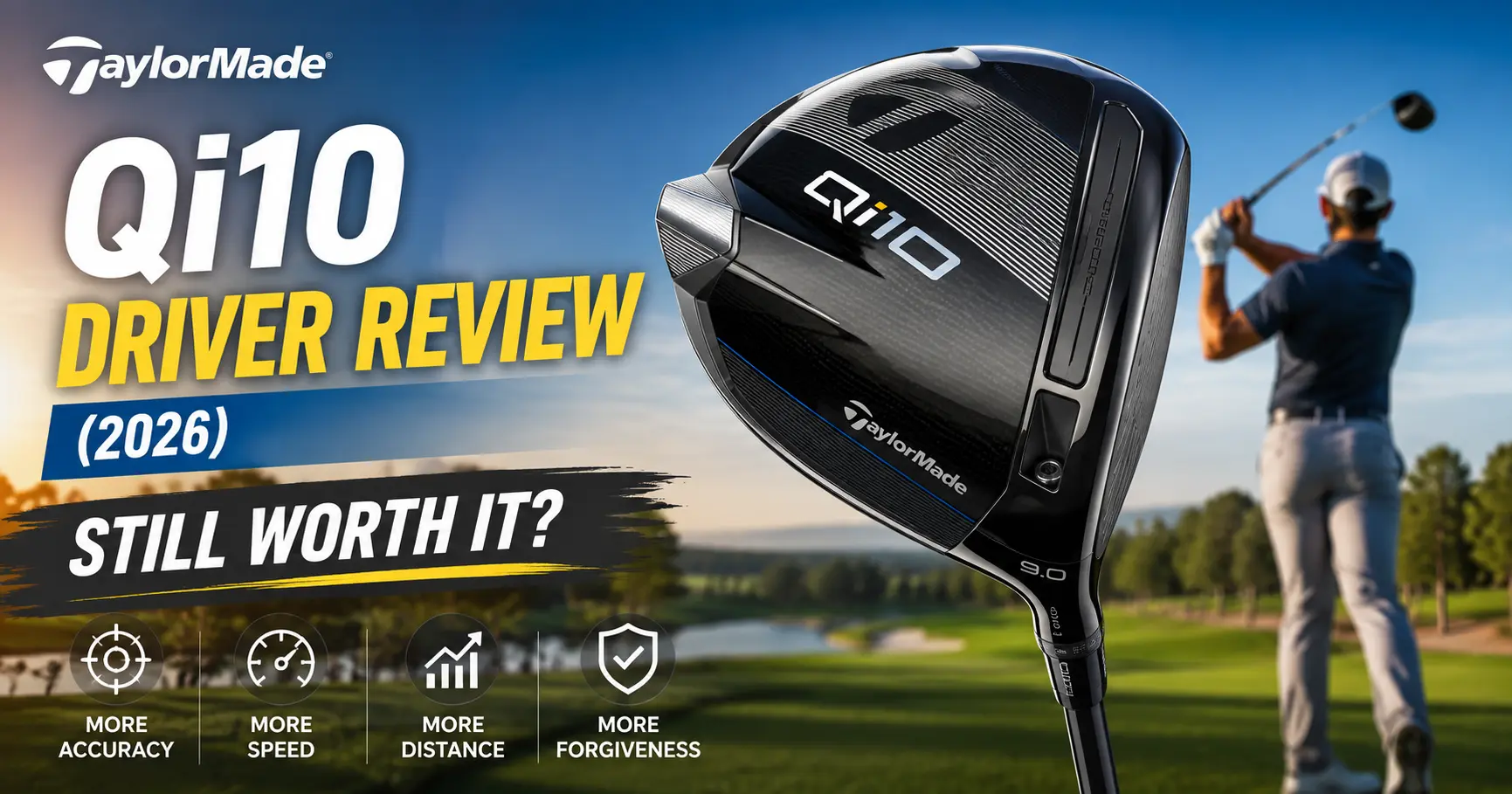
Quick Answer: The TaylorMade Qi10 is a genuinely great driver, and in 2026 it’s also a bargain. Independent testing shows it performs on par with the newer Qi35 for roughly $120 less, and used models now sell for $210 to $300. Skip it only if you need the Max’s extra forgiveness or the newer models’ adjustable sole weights.
TaylorMade launched the Qi10 driver in January 2024. Two newer models, the Qi35 and the Qi4D, have since taken over the top of TaylorMade’s lineup. That leaves the Qi10 sitting in an odd spot: still a genuinely excellent driver, but no longer the newest kid at the fitting bay.
Retailers have quietly cut its price by more than half in response, and independent testing from several reviewers confirms it hasn’t lost a step on the course. This TaylorMade Qi10 driver review covers what the club does well, where it falls short, and whether a driver two generations old is still worth putting in your bag.
What the TaylorMade Qi10 Actually Is
Qi10 stands for Quest for Inertia, TaylorMade’s push toward 10,000 g/cm² of moment of inertia (MOI), the resistance a clubhead has to twisting on off-center hits. Only the Max model in the family actually hits that number. The standard Qi10 measures closer to 8,500 MOI by Golfalot’s own testing.
Still high. Just not the flagship figure the name implies.
TaylorMade released three heads under the Qi10 name: the standard Qi10, the more forgiving Qi10 Max, and the low-spin Qi10 LS built for faster swingers. This TaylorMade Qi10 review focuses on the standard model, the one TaylorMade built to optimize distance and enhance forgiveness without going as big as the Max or as compact as the LS, according to TaylorMade’s own product page.
Three technologies do the actual work. The Infinity Carbon Crown covers 97% of the top of the clubhead, freeing up weight that TaylorMade shifts low and to the perimeter for stability. The third-generation 60X Carbon Twist Face uses 60 layers of carbon fiber instead of titanium, cutting weight from the face so that saved mass can go toward forgiveness elsewhere. A Thru-Slot Speed Pocket behind the face protects ball speed on strikes low on the face, the kind of miss that used to cost real yardage on older designs.
The blue face and black crown were a real departure from the Stealth 2’s red face, and it’s the right call. TaylorMade’s carbon-face drivers had started to look gimmicky by 2023. The Qi10 looks like a premium driver should.
TaylorMade Qi10 Driver Specs (Full Breakdown)
Here’s every spec that actually affects how the Qi10 plays, pulled from TaylorMade’s own spec sheet.
| Spec | Detail |
|---|---|
| Available lofts | 9°, 10.5°, 12° (12° right-hand only) |
| Loft adjustability | 4° sleeve, ±2° from stated loft |
| Clubhead volume | 460cc |
| Swingweight | D4 |
| Stock length | 45.75 inches |
| Stock grip | Golf Pride Z-Grip Black/Blue |
| Stock shafts | Fujikura Speeder NX TCS 60 (A, R, S), Mitsubishi Diamana T+ 60 (R, S, X) |
| Face | 3rd-generation 60X Carbon Twist Face |
| Crown | Infinity Carbon Crown, 97% coverage |
| Launch/spin category | Mid-high launch, mid-low spin, neutral bias |
Qi10 driver stock shaft options cover both ends of the swing-speed spectrum, from an A-flex Fujikura Speeder up through an X-flex Diamana, so most golfers can find a workable stock fit without paying an upcharge. Go with 10.5° if you’re not sure. It’s the loft most fitters land on for swing speeds between 85 and 105 mph, and the ±2° sleeve gives you room to fine-tune from there without buying a second head. If you want the full breakdown of how loft affects launch and carry across every club in the bag, we’ve got that covered separately.
How the Qi10 Performs on the Course
The numbers below are the part every Qi10 driver review should lead with, and most don’t.
Golfalot’s Trackman session, using Titleist Pro V1 balls, put the Qi10 at an average 133 mph ball speed, roughly 2 to 3 mph faster than either the Max or the LS in the same session. That speed came with the Qi10’s highest spin rate of the three-driver family, close to 2,500 rpm, and produced a 214-yard carry with a 239-yard total in that specific test.
Golfer Geeks ran a separate test with two very different golfers. Their scratch-level tester, swinging 118 mph, carried the Qi10 283.7 yards with a 304-yard total and a 10.8-degree launch angle. Their 8-handicap tester, swinging closer to 97 mph, found the same forgiveness pattern everyone else reports: center strikes were explosive, and heel or toe misses lost only a handful of yards instead of the 20-plus yards you’d expect from an older driver design.
Qi10 driver forgiveness is the actual selling point here, not the raw distance numbers. Plenty of drivers can post a great number on a flush strike. What separates the Qi10 is how little it punishes you for the swings that aren’t flush, and most of your swings on a real course won’t be.
It’s not a low-spin driver, and it doesn’t pretend to be. Golfalot’s testing put its spin rate above both the Max and the LS in the same session, which means faster swingers who already fight a high, ballooning flight should look at the LS instead.
Qi10 vs Qi10 Max vs Qi10 LS: Which One Should You Actually Buy
| Fact | Qi10 | Qi10 Max | Qi10 LS |
|---|---|---|---|
| Best for | Most golfers, mid handicap to low | High handicap, slice-fighters | Fast swingers, low-spin needs |
| MOI | ~8,500 | ~10,000 | Lower than Qi10 |
| Head shape at address | Standard, compact | Largest footprint in the family | Most compact, tour shape |
| Spin | Mid-low | Higher | Lowest of the three |
| Sliding weight | No | No | Yes, 18g |
| Notable tour user | Scottie Scheffler | Nelly Korda | Tiger Woods |
MyGolfSpy ran all three heads through its forum-tester program with six different golfers, and the standard Qi10 came out on top with average scores of 98 and 93 out of 100. That beats the Max’s 93 and 88, and the LS’s 86 and 91, in the same test. Their high-handicap tester actually found the Qi10 more forgiving in real play than the theoretically more forgiving Max, though his dispersion took a few weeks of use to tighten up.
If you’re choosing blind, start with the standard Qi10. It’s the model built to work across a genuinely wide range of swings, and it’s the one that scored best when real golfers, not marketing copy, made the call.
Qi10 vs Qi35 vs Qi4D: Should You Buy the Old Driver in 2026?
TaylorMade replaced the Qi10 with the Qi35 in January 2025, then replaced the Qi35 with the Qi4D in January 2026. That makes the Qi10 two full generations behind TaylorMade’s current flagship, and it’s the one question every 2026 buyer actually has that most reviews of this driver never answer, because most of them were written back in 2024, before either successor existed. A TaylorMade Qi10 vs Qi4D comparison always comes down to the same trade: price against adjustability.
Golfer Geeks tested the Qi10 head-to-head against the Qi35 across three separate range sessions, using the same shafts and lofts on a Garmin launch monitor. Their conclusion: the two drivers perform within a rounding error of each other on carry distance, ball speed, and launch. Their reviewer actually hit the Qi10 straighter and more consistently, and preferred its head shape at address. The Qi35 launched at $649. The Qi10 launched $50 cheaper, and now costs far less than that on the used market.
The Qi4D, TaylorMade’s current 2026 flagship, brings real changes: four movable sole weights instead of none, a redesigned face aimed at cutting spin variance on high and low strikes, and a shape that TaylorMade pulled back toward the Qi10’s more compact profile after golfers pushed back on the Qi35’s larger head. If you want the newest tech and don’t mind paying full flagship price, the Qi4D is the better club on paper.
For most golfers, that upgrade isn’t worth chasing. The Qi10 gives up some adjustability and a slightly older face design, and that’s about it. You’re not giving up forgiveness, distance, or sound. You’re giving up roughly $300 to $400 that would do more for your scores spent on a proper fitting session than on a new sole weight.
The one real case for skipping the Qi10 in 2026 is adjustability. If you already know you need to dial in a specific draw or fade bias with sole weights, the Qi10 doesn’t offer that. The Qi35 and Qi4D do.
Where to Buy the Qi10 in 2026 (Real Prices)
How much does the TaylorMade Qi10 driver cost in 2026? Expect to pay $265 to $450 new from retailers running clearance pricing, or $210 to $300 for a good used model. That’s down from its $599.99 launch price in 2024, now that two newer TaylorMade drivers sit above it in the lineup.
Every TaylorMade Qi10 driver price you’ll find right now falls into one of four channels, and the gap between them is bigger than most golfers expect.
| Where to buy | Condition | Approx. price (2026) |
|---|---|---|
| Major retailers running clearance | New | $265–$450 |
| Certified pre-owned (Callaway CPO, 2nd Swing) | Like-new, inspected, warrantied | $265–$300 |
| eBay, Golf Avenue, private sellers | Used, good to very good | $210–$300 |
| PGA Tour Superstore (UK) | New, promo pricing | Around £380 |
Shaft and loft matter more than which of these channels you buy from. A used Qi10 with a worn stock Fujikura Speeder performs the same as a new one, since the head is what actually drives ball speed and spin, not cosmetic wear on the shaft. Buy from a certified pre-owned seller if you want a warranty attached. If you’re chasing the lowest possible TaylorMade Qi10 driver used price, eBay and private-seller listings typically beat certified pre-owned by $20 to $40, as long as you’re comfortable inspecting the face yourself.
Paying full 2024 launch price for this driver in 2026 makes no sense. If a retailer quotes you anywhere close to $599.99, walk away and check a certified pre-owned seller instead.
Who the Qi10 Is Actually For (and Who Should Skip It)
Good fit:
- Mid-handicap golfers (roughly 8–20) who want one driver that’s genuinely good at everything, not just forgiving
- Anyone upgrading from a driver older than 2022, since the jump in forgiveness alone justifies the switch
- Budget-conscious buyers who still want a driver that finished on top of MyGolfSpy’s own six-golfer field test
Skip it if:
- You’re a fast swinger already fighting excess spin. Get the LS instead.
- You’re a high handicapper with a slice you haven’t been able to fix. The Max’s extra MOI will bail you out more often.
- You specifically want sole-weight adjustability to dial in a draw or fade bias. Only the Qi35 and Qi4D offer that in this family.
If you already own a Qi35 or a Qi4D, don’t buy a Qi10 to replace it. The upgrade path only makes sense in one direction, from something older into the Qi10, not from a newer TaylorMade driver backward.
If you’re cross-shopping brands and want a genuinely different, low-spin build for a fast swing, our Ping G430 LST review covers that alternative in detail.
Frequently Asked Questions
Is the Qi10 driver good for high handicappers?
Yes, with one caveat. The standard Qi10 is forgiving enough for most high handicappers, but TaylorMade built the Qi10 Max specifically for that group. If your miss is a bad slice you haven’t fixed yet, the Max’s extra MOI will save you more strokes than the standard Qi10 will.
How much does the TaylorMade Qi10 driver cost?
New clearance pricing runs $265 to $450 in 2026, down from its $599.99 launch price in 2024. Used models in good condition sell for $210 to $300 through certified pre-owned sellers or private listings.
What is the difference between the Qi10 and the Qi10 Max?
The Max hits TaylorMade’s full 10,000 MOI target and has the largest head in the family, built for maximum forgiveness on off-center hits. The standard Qi10 measures closer to 8,500 MOI, has a more compact head, and produced faster ball speeds in Golfalot’s own testing.
Is the TaylorMade Qi10 still worth buying in 2026?
Yes, for most golfers. Independent testing from Golfer Geeks found the Qi10 performs on par with the newer Qi35, and current used prices sit hundreds of dollars below what either the Qi35 or Qi4D cost new.
What loft should I use with the Qi10 driver?
Start at 10.5°. It’s the middle option of the three available lofts (9°, 10.5°, 12°) and works for the widest range of swing speeds. The 4° adjustable sleeve lets you move 2° in either direction from there once you’ve tested it.
Who plays the TaylorMade Qi10 on the PGA Tour?
Scottie Scheffler played the standard Qi10 through six wins in 2024, and according to Golf Monthly’s 2026 coverage, he was still gaming it well into 2026, even after TaylorMade released two newer models.
Final Verdict
The TaylorMade Qi10 earned its reputation honestly. It’s forgiving, it sounds great, and independent testers keep finding it holds up against drivers that cost hundreds more. Two years and two TaylorMade generations later, none of that has changed.
What has changed is the price. A driver that cost $599.99 in 2024 now sells for less than half that, and it’s still beating its own $649 successor in head-to-head testing. That combination, unchanged performance paired with a collapsed price, is rare in golf equipment, and it won’t last forever as remaining stock dries up.
That’s the full picture this Qi10 driver review set out to cover: real numbers, honest limitations, and a straight answer on whether the driver still holds up two generations later. It does.
If you’re filling out the rest of the bag around a new driver purchase, our guide to the best fairway woods by handicap covers the gapping clubs that pair naturally with this driver’s mid-high launch.