
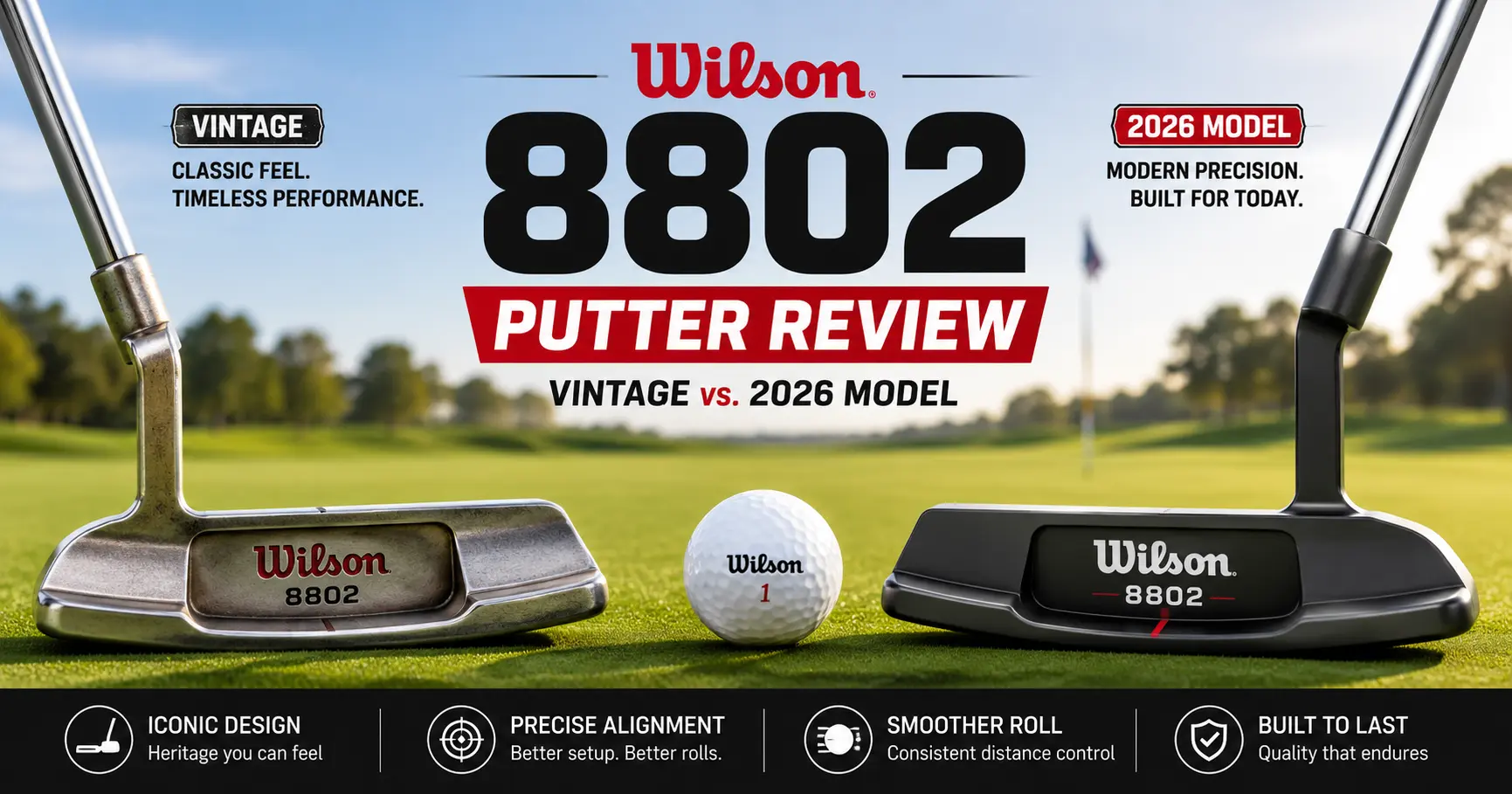
Quick Answer: The Wilson 8802 putter is a classic heel-shafted blade with zero alignment aids and full toe hang, built for golfers with a strong arc stroke. The current 2026 Wilson Staff Model version costs $349.99 new. Used models run $60 to $230 depending on age and condition. It punishes bad strikes and won’t suit straight-back putters.
Type Wilson 8802 into eBay right now and you’ll get 150-plus listings ranging from $39 to $2,000, half of them claiming to be the original. That spread alone tells you something the three main reviews of this putter never quite explain: there isn’t one Wilson 8802. A 1960s blade once carried Arnold Palmer’s name on the sole, a 2014 centennial reissue followed decades later, and the current 2026 Wilson Staff Model version now sells new for $349.99. Sort out which one you’re actually looking at, and the buying decision gets a lot simpler. This review covers all three versions, plus the fitting data, the used-market pricing, and the fake-spotting checklist nobody else bothers to write.
What Is the Wilson 8802, Exactly?
Strip away the history and the 8802 is a simple shape: a small, heel-shafted blade with a rounded flange, half a shaft of offset, and a face free of any alignment line, dot, or notch. Wilson mills the head from a solid block of 304 stainless steel, a softer alloy than the 303 steel most budget putters use, which is why the strike feels dense rather than clicky. The current Staff Model version carries a KBS Putter Steel shaft and a Wilson Staff Lamkin Deep Etched grip, built to order in lengths from 32 to 37 inches. Loft sits at 3 degrees and lie at 71 degrees, both fixed regardless of length.
None of that would matter much if the toe hang weren’t so extreme. Wilson’s own fitting chart lists it as Maximum, full 90-degree toe-down when you balance it on a finger, meaning the face rotates open on the backswing and closed through impact by design. That’s the whole personality of the putter in one spec.
A face-balanced mallet resists that rotation. The 8802 leans into it.
The Real History of the 8802 (Most Reviews Get This Wrong)
Every competing review credits Arnold Palmer as the putter’s designer and stops there. That’s only half the story, and Wilson’s own archives tell a more interesting one.
- 1940: Wilson launches the R46 Willie Hoare putter, an early broad-soled design by club maker Willie Hoare.
- 1950: Wilson renumbers its catalog. The R46 becomes stock number D8802.
- 1954: Wilson moves a separate Winsum putter, also a Hoare design, onto that same D8802 stock number.
- 1962: Arnold Palmer, then a Wilson staff player, has a blade built to his own specs. Wilson stamps it Designed by Arnold Palmer.
- 1963: Palmer leaves Wilson for his own equipment company. Wilson strips his name off the sole and renames the putter The Wilson 8802, reusing the old catalog number.
- 1984 and 1995: Ben Crenshaw wins two Masters titles with an 8802 he nicknamed Little Ben, a gift from his father for his 15th birthday.
- 1995: John Daly wins the Open Championship at St Andrews using the same head shape.
- 2014: Wilson reissues the 8802 for its 100th anniversary. This version keeps the original’s smooth face profile but switches to 304 stainless and adds double face milling.
- 2022 to today: The Wilson Staff Model 8802 launches as part of a four-shape Staff Model lineup, with a shaft-over-hosel neck, horizontal flywheel face milling, and a $349.99 retail price.
Here’s the detail every other article skips: the number 8802 didn’t start with Palmer. It belonged to a completely different Willie Hoare putter more than a decade before Palmer ever picked up a Wilson blade. Wilson simply recycled a stock number that happened to be free.
Palmer made the shape famous. He didn’t make the name.
Vintage Original vs. the 2026 Wilson Staff Model 8802
| Spec | Vintage Original (1960s–1980s) | 2014 Centennial Reissue | 2026 Wilson Staff Model |
|---|---|---|---|
| Face | Smooth milled, no pattern | Double-milled face added | Horizontal flywheel milling over a skim-milled face |
| Steel | 303 stainless, era-dependent | 304 stainless | 304 stainless |
| Shaft | True Temper fluted steel, right-handed only | True Temper Head Speed shaft | KBS Putter Steel |
| Grip | Period leather or rubber wrap | Lamkin 3GEN pistol, red | Wilson Staff Lamkin Deep Etched |
| Length options | 35 only | 35 standard | 32–37 custom, right and left hand |
| Launch price | Under $30 in the 1960s | $179–$180 | $349.99 |
| Typical used price now | $39–$400+, provenance-dependent | $80–$150 | $150–$230 |
Every one of the three competing reviews tests or references the current Staff Model without ever saying so directly, which leaves readers assuming a single, unchanging club. It isn’t. The face went from smooth to double-milled to flywheel-milled across three distinct eras, the steel got softer, and the price roughly doubled between the 2014 reissue and today’s version.
If you’re chasing the exact feel Crenshaw or Daly had in their hands, none of the current retail options will give it to you. You’d need an actual 1980s or 1990s original, and even those vary year to year.
Specs: The Official Fitting Data
| Spec | 2026 Wilson Staff Model 8802 |
|---|---|
| Loft | 3° |
| Lie | 71° |
| Length | 32–37 (custom) |
| Neck | Straight, shaft-over-hosel |
| Offset | 1/2 shaft |
| Alignment aid | None |
| Head weight | 335g–350g (source-dependent) |
| Toe hang | Maximum (full 90°) |
| Stroke type fit | Strong arc |
| Hand | Right and left |
| Shaft | KBS Putter Steel |
| Grip | Wilson Staff Lamkin Deep Etched |
| Steel | 304 stainless, milled |
| New price | $349.99 |
These specs come straight from official retailer fitting charts, not a single tester’s own measurements. Two independent listings give slightly different head weights, 335 grams and 350 grams, a gap small enough to be rounding or a running production tolerance, not a real spec change. Everything else lines up across every retailer selling the current version.
The number that actually matters for fitting sits in the stroke type row. Wilson’s own fitters classify this as a strong-arc putter, not a neutral or straight-back option, and that single line should decide whether you keep reading or move on to something else.
Who Should (and Shouldn’t) Play the 8802: The Stroke-Type Fit Test
A strong-arc stroke means the putter head swings noticeably inside the target line going back and again coming through, tracing a visible curve rather than a straight line. Golfers with that stroke naturally let the toe of a club rotate open and shut, and a maximum-toe-hang blade like the 8802 works with that motion instead of fighting it. Golfers with a straight-back-and-through stroke get the opposite experience: the putter wants to rotate on its own, and every rep turns into a fight to keep the face square by hand.
Here’s the problem nobody selling this putter volunteers upfront. If your stroke runs straight or only slightly arced, the 8802 actively works against your technique, not because it’s poorly made, but because Wilson built the toe hang for a completely different swing pattern. A face-balanced mallet will serve a straight-stroke player far better, no matter how much you love the vintage look. If you want to see how a fitter matches a straighter, more neutral stroke to a mallet instead, our breakdown of Lydia Ko’s putter setup walks through that fitting logic in real terms.
Quick fit check: hold the putter by the grip between your thumb and forefinger and let it hang freely. If the toe drops straight down toward the ground, you’ve got a strong arc and the 8802 fits your motion. If the face stays roughly level, or only tips slightly, walk away from this particular blade.
Looks and Feel at Address
Set the 8802 down and the first thing you notice is what’s missing. No sightline, no dot, no contrasting insert, nothing to tell your eye where the face points except the leading edge itself. That absence either feels liberating or it feels like standing over the ball with no safety net, and which camp you fall into says more about your confidence on short putts than it does about the club.
The strike itself is dense rather than sharp. Milled 304 stainless steel produces a heavier, quieter sound than the click you get from a face insert or a cast head, and the feedback runs in both directions. Center strikes feel almost buttery. Off-center strikes announce themselves immediately through the hands, well before the ball tells you anything about where it’s headed.
How It Performs on the Green
Blade putters give up something mallets don’t: moment of inertia. A modern high-MOI mallet resists twisting when you catch one off the heel or toe, which is exactly why so many amateurs putt better with an ugly modern mallet than a pretty vintage blade. The 8802 has almost none of that resistance built in. Catch one off-center and the face twists, the ball comes out with sidespin, and a six-footer becomes a three-putt in a hurry.
That’s not a flaw. It’s the entire point of playing a blade. Golfers who already strike the ball from the same spot on the face putt after putt earn a roll that a forgiving mallet can’t quite match, because less mass fights the face at impact. Golfers who miss the center regularly pay for it harder here than almost anywhere else in the bag.
Distance control suffers most on longer putts, where a mis-struck attempt loses ball speed unpredictably instead of rolling out true. For context on just how far modern putter design has moved in the opposite direction, our look at Lucas Glover’s L.A.B. putter fitting covers a putter built specifically to resist face rotation instead of encouraging it, the exact opposite philosophy from the 8802.
New vs. Used: Complete Price Guide for 2026
| Version / Condition | Typical Price (USD) | Where to Buy |
|---|---|---|
| New 2026 Wilson Staff Model 8802 | $349.99 | Wilson.com, Carl’s Golfland, PGA Tour Superstore, TGW |
| Used 2026 Staff Model, Average condition | $229.99 | 2nd Swing |
| 2014 Centennial reissue, used | roughly $80–$150 | eBay, trade-in retailers |
| Vintage original (1960s–1980s), player-grade | roughly $40–$120 | eBay |
| Vintage original, mint or tour-provenance | $200–$2,000+ | eBay, specialty auctions |
| Trade-in value toward a new purchase | around $101 average | Golf Avenue and similar trade programs |
New pricing is the easiest number to pin down, because every major retailer selling the current Staff Model 8802 lists it at the same $349.99. That’s roughly double what the 2014 centennial version cost at launch, and more than triple the original 1960s retail price adjusted for nothing but nostalgia. Used pricing gets messier fast: eBay alone carries well over 150 active 8802 listings running from $39 to $2,000, with condition, era, and seller honesty doing most of the work in that spread.
If you just want to try the toe-hang feel without spending real money, a played-in vintage original in the $50 to $100 range does the job. Budget for a regrip before you trust it on the course. If you want current build quality with a warranty and a shaft length that actually fits you, buy new or grab the 2nd Swing used listing and skip the vintage hunt entirely.
How to Avoid Buying a Fake Vintage 8802
Used listings for this putter are a minefield of reissues marketed as originals, refinished heads passed off as vintage, and outright mismatched parts sold as a matched set. A few checks before you pay:
- Read the sole markings carefully. A genuine 1964-onward original reads simply The Wilson 8802, with no version number, no original label, and no modern Staff Model branding. If the word original appears anywhere on the head itself, that’s a seller’s claim, not a manufacturer’s mark, and it usually means the opposite of what it says.
- Compare the finish. Original heads carry a satin or frosted chrome finish that ages to a soft, slightly dull gray. A bright, shiny, mirror-polished head on a putter claiming 60 years of age raises real doubt. Someone likely replated it, or you’re looking at a modern remake.
- Check the shaft. Vintage fluted steel shafts have proportions and step spacing that changed across decades. A shaft that looks too clean, too short, or mismatched to the head’s claimed era deserves a second look before you buy.
- Sanity-check the price against condition. A well-worn, honestly described original in the $40 to $120 range is completely normal. A rare original priced at $300-plus with vague provenance and stock photos deserves real skepticism.
- Ask for extra photos of the sole and hosel. Sellers with a genuine club rarely hesitate to provide them. Sellers padding a reissue as an original often post only one blurry angle, and that alone tells you plenty.
Frequently Asked Questions
Is the Wilson 8802 putter good for beginners?
Not really, and that’s worth saying plainly. A brand-new golfer usually mishits putts across the whole face while learning distance control, and the 8802 punishes exactly that kind of inconsistency harder than almost any mallet on the market. A forgiving, face-balanced putter with an alignment line builds confidence faster. Save the 8802 for once your strike gets more consistent.
How much is a Wilson 8802 putter worth?
It depends entirely on which version you own. The current 2026 Wilson Staff Model sells new for $349.99 and used for around $230. A played-in vintage original from the 1960s through 1980s typically brings $40 to $120, while rare, mint, or tour-provenance examples can clear $200 to $2,000 at auction. Trade-in programs like Golf Avenue average close to $101 for a standard putter trade.
What stroke type does the Wilson 8802 putter fit?
Wilson’s own fitting chart lists it for a strong arc stroke, meaning the putter head swings visibly inside the line on the backswing and again through impact. Golfers with a straight-back-and-through motion fight the toe hang instead of working with it. Check your stroke type before you buy, not after.
Who used the Wilson 8802 putter?
Arnold Palmer had an early version built to his specs in 1962, though Wilson pulled his name off it a year later. Ben Crenshaw won the 1984 and 1995 Masters with an 8802 he called Little Ben, and John Daly used the same head shape to win the 1995 Open Championship at St Andrews. Greg Norman and Phil Mickelson have both gamed the shape at various points too.
Is the Wilson 8802 putter still made?
Yes. Wilson currently sells it as the Staff Model 8802, part of a four-shape Staff Model putter lineup introduced in 2022 and still in production for 2026. It costs $349.99 new, comes in lengths from 32 to 37 inches, and ships with a KBS Putter Steel shaft.
How can I tell if my Wilson 8802 is an original?
Check the sole markings first. A real 1964-onward original reads only The Wilson 8802, with no original label and no modern branding. Compare the finish too. Vintage heads age to a dull satin gray rather than staying mirror-bright, and a suspiciously shiny 60-year-old head usually means a replate or a modern remake wearing an old name.
Final Verdict
The 8802 earns its reputation honestly. It’s one of the best-feeling blades ever milled, and the history behind it, Palmer, Crenshaw, Daly, is real rather than marketing spin. None of that makes it the right putter for most golfers walking into a pro shop today.
Buy it if you already have a strong arc stroke and enough confidence in your face control to live without an alignment line. Skip it if your stroke runs straight, your strikes wander across the face, or you just want the vintage look without the vintage demands. For more on matching loft and lie to your own stroke before you spend real money, our golf club lofts guide breaks down exactly how putter geometry affects your roll.