
I spent two seasons carrying a 3-wood, I couldn’t hit off the deck to save my life. Every time I pulled it on a par 5, I’d either top it 50 yards or block it into the right rough. My handicap was stuck at 12, and the 3-wood was the reason.
Then I started paying attention to what the guys on TV actually carry. Not the marketing. Not the “stock specs” on the shelf. The actual clubs in their bags.
Turns out, most amateur golfers are carrying the wrong fairway woods. The lofts are too low, the shafts are too long, and the gapping makes no sense. Here’s how to fix all of it—using what the pros actually do.
Quick Answer: The best fairway wood setup starts with a 4-wood (16.5°) and 7-wood (21°) for most amateurs—matching what PGA Tour players like Ryo Hisatsune carry. This gapping gives you 10-15 yards between clubs without the 3-wood’s difficulty. Add a 5-wood (18°) if you need more options, and play your shafts 0.5-1 inch shorter than retail for better control.
What the Pros Actually Carry – 5 Tour Fairway Wood Setups You Can Copy
Let’s start with the data. I pulled the fairway wood setups from five PGA Tour players. Not guesses. Actual bag reports.
Here’s what jumps out: most of these guys aren’t carrying a traditional 3-wood.
Hisatsune goes 4-wood and 6-wood—no 3-wood at all. Fitzpatrick’s “3-wood” is actually 14.5° (stronger than standard) but in a forgiving head. And a third of Titleist’s Tour staff are playing what was originally designed as a game-improvement club.
The old “you need a 3-wood” rule is dead. Tour players are optimizing for what actually works, not what looks cool in the bag.
Ryo Hisatsune — 4-Wood + 6-Wood
Hisatsune’s setup is the most interesting on this list. He carries a 16.5° 4-wood and a 21° 6-wood. No 3-wood. No 5-wood.
Why? He ranks 160th on Tour in spin rate and 60th in apex height. He needs clubs that launch the ball higher. The 4-wood and 6-wood give him that elevation without sacrificing distance.
“I am able to hit around 240 yards using this,” Hisatsune said of his 6-wood. “I can hit the ball higher, then stop the ball.”
Most amateurs don’t need a 3-wood. They need more loft. Hisatsune proved it.
Tommy Fleetwood — The Simple Setup
Fleetwood keeps it dead simple. He plays the ball just inside his front heel, grips down slightly on every club, and focuses on brushing the grass.
That’s it. No secret move. No complicated swing thought.
The grip-down part is crucial. By choking down, Fleetwood effectively shortens the club—giving him more control without losing significant distance. You can do the exact same thing with your fairway woods right now, without buying anything.
Titleist Staff Players — The GT1 3Tour Trend
This is the most telling stat in pro golf right now: 30 percent of Titleist fairway wood users on Tour are playing the GT1 model.
The GT1 was originally designed for slow-swing-speed, high-handicap golfers. It’s the most forgiving, highest-launching head in Titleist’s lineup. And Tour players are flocking to it.
Why? Because they’ve realized forgiveness matters more than “Tour look” when you’re hitting into a par 5 from 250 yards. The GT1 3Tour is 14.5° (half a degree stronger than standard) with a lower CG for a flatter flight. Same forgiveness. Better spin numbers.
If Tour players are choosing forgiveness over ego, maybe you should too.
The 4-Wood Is the Smartest Club in Your Bag (And Tour Pros Know It)
Here’s a statement that’ll get me hate mail from 3-wood loyalists: most amateur golfers should not carry a 3-wood.
The 3-wood is the hardest club in the bag to hit off the deck. Longer shaft, lower loft, less forgiveness. That’s a brutal combination for anyone who doesn’t practice three times a week.
The 4-wood (16.5°) solves all of it.
More loft = higher launch. Shorter shaft (typically 42.5″ vs 43.25″ for a 3-wood) = more control. More forgiveness = fewer topped shots and thin misses.
Hisatsune carries a 4-wood instead of a 3-wood. So do a growing number of Tour players. The 4-wood gives you 3-wood distance with 5-wood forgiveness.
If you’re choosing between a 3-wood and a 5-wood, skip both and get a 4-wood. It’s the best club nobody talks about.
Fairway Wood Gapping — How to Space Your Lofts Like a Tour Pro
Gapping is where most amateurs get it wrong. They buy a 3-wood and a 5-wood, then wonder why both go the same distance.
Here’s the gapping system Tour players actually use:
| Club | Loft Range | Typical Carry (amateur) | Purpose |
|---|---|---|---|
| Driver | 9°-10.5° | 220-260 yards | Tee shots |
| 3-wood | 13.5°-15° | 210-240 yards | Long approach, tight tee shots |
| 4-wood | 16.5°-17° | 200-225 yards | Replaces 3-wood for most players |
| 5-wood | 18°-19° | 185-210 yards | Long par 3s, second shots |
| 7-wood | 21°-22° | 170-195 yards | Replaces 4-iron/hybrid |
The key is 10-15 yard gaps between each club. If your 3-wood and 5-wood are only 8 yards apart, you’re wasting a bag slot.
Hisatsune’s 4-wood (16.5°) and 6-wood (21°) give him about 15 yards of gap. That’s perfect gapping.
Your move: Measure your actual carry distances with each fairway wood. If two clubs are within 10 yards of each other, change one of them. Either adjust the loft (if your club is adjustable) or swap it for a different wood.
Shaft Length — The One Setup Change Nobody Talks About
Here’s something every competitor article missed: Tour players play shorter fairway wood shafts than retail.
A stock 3-wood from the store is typically 43.25 inches. On Tour, many players play 42.5 to 43 inches. That half-inch difference is massive for control.
Fleetwood grips down on every fairway wood. That’s his way of shortening the club without changing the shaft. You can do the same thing.
Why does this matter? A shorter shaft gives you:
- More control over the clubface
- Better center-face contact
- Fewer topped shots
- More confidence at address
The downside? You might lose 3-5 yards of distance. But what’s better—a 230-yard shot that finds the fairway, or a 235-yard shot that finds the trees?
Try this: Next time you’re at the range, choke down one inch on your fairway wood. Take 10 swings. I bet you hit the center of the face more often. That’s the Tour secret nobody sells you.
Ball Position and Setup — What the Data Actually Says
Every fairway wood guide tells you to play the ball forward. But how forward?
The answer: Just inside your front heel. Not as far forward as your driver. But definitely not in the middle of your stance.
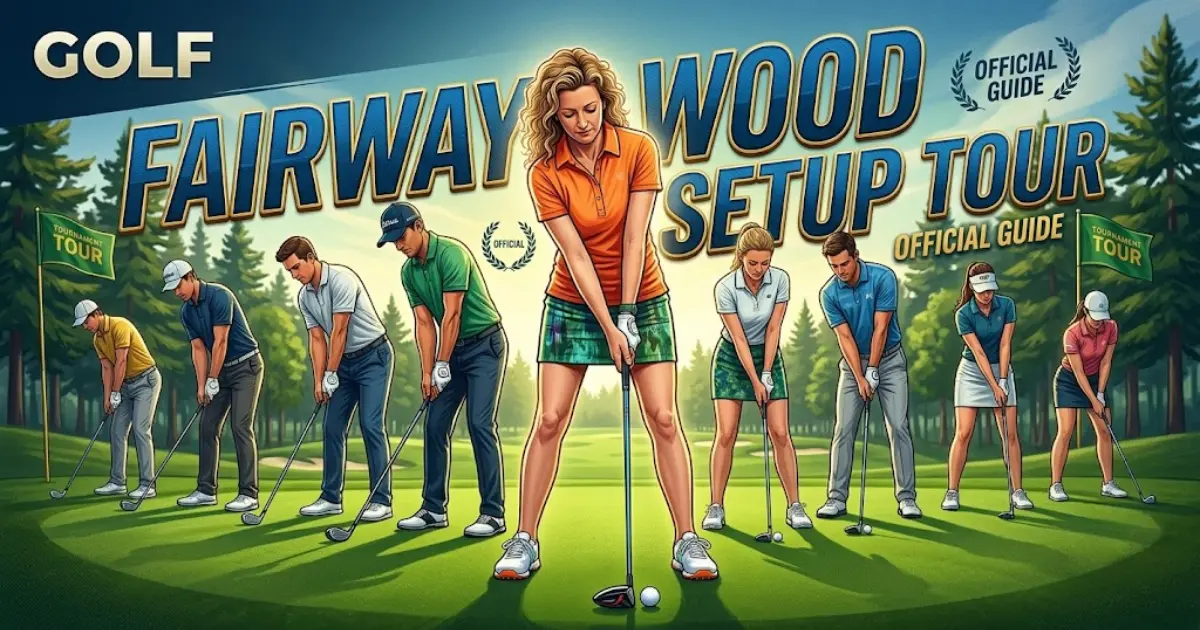
Here’s the exact setup checklist:
- Ball position: One to two inches inside your lead heel
- Stance width: Slightly wider than an iron, slightly narrower than a driver
- Spine tilt: Slight lean away from the target (not as much as driver)
- Weight distribution: 50/50 to start, shifting to front foot through impact
- Swing thought: Brush the grass—don’t dig
The biggest mistake I see? Golfers trying to “sweep” the ball by hovering the club or lifting it. That’s not what sweeping means. Sweeping means taking a shallow divot after the ball—not lifting the club through impact.
Fleetwood’s focus is “brush the grass, don’t dig”. That’s the swing thought that fixed my fairway woods.
The Swing Thought That Changed My Fairway Woods
I was a 12 handicap when I finally figured out fairway woods. The fix wasn’t a new club or a lesson. It was one swing thought.
“Brush the grass in front of the ball.”
Before that, I was trying to hit down on the ball like an iron. That’s a disaster with a fairway wood. The club’s sole is designed to glide through the turf, not dig into it.
I started picturing a paintbrush skimming the top of the grass. Not pressing down. Not scooping. Just brushing.
The first time I tried it, I flushed a 5-wood from 195 yards to 12 feet. I almost cried. That shot alone dropped my handicap from 12 to 9 over the next two months.
The same swing thought works for hybrids too. The goal is a shallow, sweeping motion—not the steep attack angle you use with irons.
Senior and Beginner Adjustments — Slower Swing Speed Setup
If you’re a senior golfer or a beginner, the “standard” fairway wood advice doesn’t apply to you. You need more loft, lighter shafts, and shorter lengths.
Here’s the slower-swing-speed fairway wood setup:
| Adjustment | Why |
|---|---|
| Skip the 3-wood entirely | Too low-lofted; you won’t get it airborne |
| Carry a 5-wood (18°) and 7-wood (21°) | Higher launch, more carry |
| Use senior or light flex shafts | More clubhead speed with less effort |
| Play the ball slightly more forward | Maximizes launch angle |
| Grip down 0.5-1 inch | More control, better contact |
The best fairway woods for slower swing speeds are lighter, higher-lofted, and more forgiving. Think 5-wood and 7-wood instead of 3-wood and 5-wood. You’ll get more carry, better stopping power, and fewer mishits.
“If you already hit your 5-wood more than 200 yards consistently,” you probably don’t need a 3-wood. And that’s fine. Most Tour players are moving away from 3-woods anyway.
How Much Should You Spend? New vs Used Tour-Inspired Fairway Woods
Here’s the honest truth: you don’t need to spend $600 on a new fairway wood to get a Tour-inspired setup.
New (2026 prices):
- Premium new fairway woods: $350-$600
- Last season’s models: $250-$400
- Direct-to-consumer brands: $200-$350
Used (2026 prices):
- 1-2 years old, good condition: $150-$250
- 3-4 years old, decent condition: $100-$180
- “Player’s condition” (minor wear): $80-$150
The sweet spot? Buy a used 4-wood from 2-3 seasons ago for $150-$200. Spend the money you save on a proper shaft fitting. That’s what actually matters.
What to look for used:
- Adjustable hosel (lets you change loft)
- Shaft that matches your swing speed (stiff for 95+ mph, regular for 80-95, senior for under 80)
- No major crown or face damage
I bought a used Callaway Epic Speed 4-wood for $140 two years ago. Still in my bag. Still performs like a $500 club.
Frequently Asked Questions
What fairway wood does Tommy Fleetwood use?
Fleetwood uses a 15° 3-wood with a standard setup—ball just inside the front heel, grips down slightly, focuses on brushing the grass. He keeps it simple and repeatable.
How do you hit a fairway wood like a pro?
Play the ball just inside your front heel, grip down half an inch for control, and focus on brushing the grass through impact—not digging or scooping. Maintain your posture through the swing and make a big hip turn on the backswing.
What is the best fairway wood setup?
For most amateurs, a 4-wood (16.5°) and 7-wood (21°) give you the best combination of launch, forgiveness, and gapping. Skip the 3-wood unless you have 105+ mph clubhead speed.
Should I use a 3-wood or 5-wood?
If you have to choose one, pick the 5-wood. It’s easier to hit, launches higher, and stops faster on greens. Most amateurs don’t have the swing speed for a 3-wood off the deck.
How do you hit a 3-wood off the fairway?
Play the ball inside your front heel, take a slightly wider stance, and focus on a shallow angle of attack. Don’t try to lift the ball—the loft does the work. Sweep the grass in front of the ball, not behind it.
What’s the difference between a 4-wood and a 5-wood?
A 4-wood is typically 16.5° loft with a 42.5″ shaft. A 5-wood is 18°-19° with a 42″ shaft. The 4-wood gives you about 10 more yards with slightly less forgiveness.
How do I know if I need more loft in my fairway woods?
If you’re struggling to get the ball airborne, hitting low screamers, or not holding greens on approach shots, you need more loft. Try a 5-wood or 7-wood instead of a 3-wood.
What shaft length should I play in my fairway woods?
Most amateurs should play 0.5-1 inch shorter than retail. A 42.5″ 3-wood (instead of 43.25″) gives you significantly more control with minimal distance loss. Choking down is a free way to test this.
Your Turn — One Setup Change to Make This Week
You don’t need to rebuild your entire bag overnight. Pick one change from this article and try it this week:
- Choke down one inch on your fairway wood
- Move your ball position to just inside your front heel
- Swap your 3-wood for a used 4-wood
- Add a 7-wood instead of a 4-iron
I’d start with #1. It costs nothing, takes five seconds, and you’ll see results immediately.
The Tour pros aren’t playing different clubs because they have better swings. They’re playing different clubs because they’ve optimized every variable—loft, length, gapping, setup. Copy what they do, not what the marketing says.