
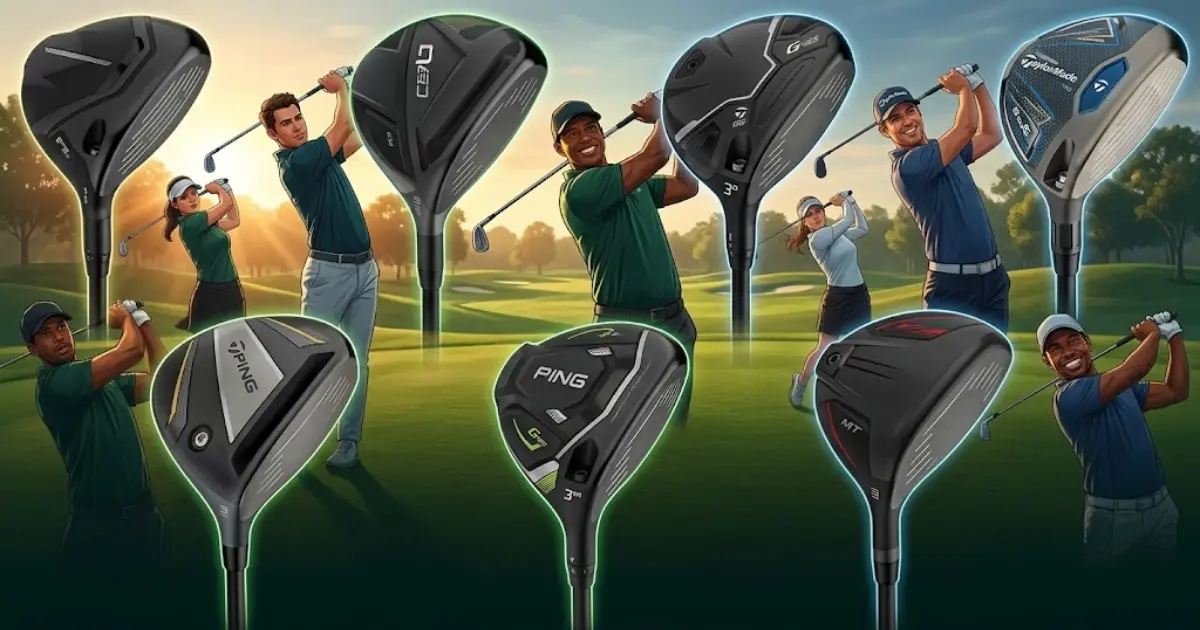
Topping a fairway wood feels different from topping an iron. It feels personal.
You catch it thin, the ball skitters forty yards low and right, and somewhere behind you a cart engine idles like it’s waiting for you to hurry up and be embarrassed somewhere else. Golf Digest’s testing crew hit hundreds of fairway wood shots this year on a Rapsodo launch monitor specifically to find which clubs stop that from happening, and the data points to a clear answer: shallower faces and lower, more forward weighting are doing almost all the work. Below are six of the easiest launching fairway wood picks worth your money in 2026, what they cost, and which one fits your swing speed instead of someone else’s.
If you haven’t settled on a fairway wood at all yet, our best fairway woods for every handicap guide is the wider starting point. This one’s narrower: easiest launch, full stop.
Quick Answer: The Callaway Quantum Max is the easiest launching fairway wood on the market, thanks to a shallow face and a low, forward center of gravity. Fighting a slice? The Quantum Max D adds draw bias. On a budget, the $150 Cleveland Launcher Halo XL Lite gets shockingly close for less than half the price.
Why Your Fairway Wood Feels Impossible to Launch
Here’s the uncomfortable truth: it’s usually not your swing. It’s the face.
A fairway wood is the longest, lowest-lofted club in your bag that you’re still expected to hit off the ground. Drivers get a tee. Irons get a steeper angle of attack. The fairway wood gets neither, and a tall-faced model makes that worse by sitting up at address in a way that screams “hit down on me” right before you do exactly that and watch the ball squirt sideways.
Shallow-faced, low-CG fairway woods are what most golfers actually mean when they search for an easy launching fairway wood, and they fix this by literally moving mass lower and farther forward in the head. That lowers the spot the ball compresses against, which raises launch angle without you changing a single thing about your swing. It’s the same reason a 5-wood is friendlier than a 3-wood at the same skill level — more loft, lower face, less margin for a bad day to turn into a worse one.
The other fix, free of charge: stop trying to help the ball into the air. A fairway wood has loft built in specifically so you don’t have to. Swinging easier and trusting the face almost always outperforms swinging harder and fighting it — a lesson that applies whether you’re carrying a fairway wood, deciding between a fairway wood instead of a hybrid, or just trying to get through 18 holes without three penalty strokes off the deck.
What Actually Makes a Fairway Wood Easy to Launch
Two variables matter more than the rest combined: face height and loft. Everything else — adjustable hosels, sole rails, carbon crowns — is a manufacturer’s way of fine-tuning those two things.
Face Height and Center of Gravity
Tall-faced fairway woods exist for a reason. Better players who hit down sharply need that taller face to control spin and trajectory off the tee. Most golfers reading this don’t have that problem; their problem is the opposite. A shallow face sits lower and flatter at address, which does two things: it builds confidence before you even start your swing, and it physically locates the center of gravity lower and farther back in the head.
That low-back CG placement is what launches the ball higher off a clean strike and off a mis-hit. Golf Digest’s testers logged Hot List Gold scores across the board for exactly this kind of design, and it shows up in real numbers — the Callaway Quantum Max produced 257 yards of carry at a 109.1 mph club speed on a Foresight GC3, distance that used to require a much less forgiving head shape.
Loft Is Doing More Work Than You Think
The easiest fairway wood loft to hit is 18 to 21 degrees — roughly a strong 5-wood — because it pairs enough loft to launch reliably off a slower or moderate swing with enough length to still feel like a real club instead of a glorified hybrid. Drop below 16 degrees and you’re back to fighting the same low-launch problem a 3-wood causes for anyone without tour-level speed.
This is also where most golfers under-club themselves out of habit. A 3-wood looks like the “correct” choice because it’s the lower number, but a 5-wood at 18 degrees will frequently out-carry a poorly struck 3-wood while being dramatically easier to find the center of the face with. If you’re searching for where the gap above a 5-wood goes, the Callaway Heavenwood sits in exactly that no-man’s-land between a 5-wood and a long iron, and it solves a similar problem from the other direction.
The 6 Easiest-Launching Fairway Woods You Can Buy Right Now
These are ranked on one thing only: how little skill it takes to get the ball airborne and keep it there. Not total distance. Not workability. Just launch.
Callaway Quantum Max — $400 This is the one Golf Digest’s testers scored a flat 5.0 and a Hot List Gold. The shallow face and a 30-gram floating tungsten bar sitting low and forward in the head do exactly what that combination is supposed to do: launch high, launch consistently, and forgive a mis-hit lower on the face better than almost anything else in this price range. The trade-off is real — the crown is busier-looking than a Titleist or PING, with a chevron alignment aid some golfers will find distracting. If a slice is the bigger issue than raw launch, the Quantum Max D swaps in heel-biased weighting to correct that ball flight specifically.
Titleist GT2 — $399 new, often $200–250 used GolfSidekick called this the single easiest fairway wood to launch on the market, and the spec sheet backs that opinion up: a shallow face built specifically for players with a sweeping swing, a 16-way adjustable hosel, and a center of gravity positioned to flatter low-face contact instead of punishing it. It’s also, frankly, the best-looking club on this list, which matters more for confidence at address than most golfers admit. The catch is availability — Titleist has since pushed GT1 and GT3 to the front of its current lineup, so GT2 stock is thinning at full price, even though it’s easy to find lightly used.
PING G440 Max — $385 PING builds the most forgiving fairway woods in golf almost as a house style, and the G440 Max doesn’t break that pattern. A low-profile face that reads more like a hybrid at address, a carbon-composite crown that drops the center of gravity, and a high-strength steel face that flexes more on off-center hits combine into a club that launches high even when you don’t catch it pure. One real trade-off worth knowing: that high launch comes with a touch less raw distance than a Quantum Max for golfers who genuinely don’t need the extra forgiveness.
TaylorMade Qi4D HL — $380 The standard Qi4D is built for average-to-above-average swing speeds; the HL (High Launch) variant pulls the center of gravity even lower and farther back specifically for golfers who need help getting the ball up rather than help keeping it down. The lighter rear skirt and wider sole channel toward the toe both push in the same direction — easier launch, more forgiveness on toe-side strikes, slightly less workability for anyone who wants to shape shots on purpose.
Cobra OPTM X — $369 Cobra’s middle child in the three-model OPTM lineup turns out to be the smartest pick for most golfers precisely because it doesn’t try to be extreme in either direction. A 33-way adjustable hosel (the most configurations on this list) and an 11g/3g movable weight system let you bias the head toward higher launch or lower spin depending on what’s actually missing from your game, rather than locking you into one fixed profile. Slower swingers see the clearest benefit here; very fast swingers will likely outgrow it and want the lower-spin Cobra OPTM LS instead.
Cleveland Launcher Halo XL Lite — $150–230, depending on retailer This is the one nobody puts a real price tag next to, and that’s the gap. MSRP sits at $229.99, but it’s been spotted as low as $149.98 at major retailers — for a club that brings genuine GlideRail sole technology (three rails that help the head glide through turf instead of digging into it) and an XL-sized, high-MOI head that launches nearly as easily as anything above it on this list. It’s lighter, which helps slower swingers pick up speed, and the trade-off shows up exactly where you’d expect: slightly less premium feel and sound at impact than the $400 clubs above it. For half the price, that’s an easy trade to make.
Side-by-Side Comparison
Here’s how all six easiest launching fairway wood contenders stack up next to each other.
| Club | Price | Loft Range | Head Size | Best Swing Speed | Best For |
|---|---|---|---|---|---|
| Callaway Quantum Max | $400 | 15°–27° | 160cc | Moderate–fast | Overall easiest launch |
| Titleist GT2 | $399 (new) | 15°–24° | 175cc | Moderate (sweeping swing) | Looks + forgiveness |
| PING G440 Max | $385 | 15°–24° | 170cc | Slow–moderate | Maximum forgiveness |
| TaylorMade Qi4D HL | $380 | 13°–26° | 165cc | Slow–moderate | Toe-strike forgiveness |
| Cobra OPTM X | $369 | 15°–24° | 170cc | Slow–moderate | Tunable launch/spin |
| Cleveland Halo XL Lite | $150–230 | 16.5°–19.5° | 175cc | Slow | Budget pick |
Match Your Swing Speed to the Right Loft
| Driver Swing Speed | Recommended Fairway Wood Loft | Why |
|---|---|---|
| Under 80 mph | 19°–21° | Lower speed needs more loft to get the same launch angle as a faster swing |
| 80–95 mph | 17°–19° | The sweet spot for most recreational golfers — enough loft to launch, enough length to still cover distance |
| 95–105 mph | 15°–17° | Speed starts doing the work loft used to have to do alone |
| Over 105 mph | 13°–15° | Plenty of speed to compress a lower-lofted face and still launch it high enough |
If you don’t know your swing speed offhand, most driving ranges with a launch monitor will give it to you in under five swings — worth doing once before you buy.
Frequently Asked Questions
The shallow-faced, low-CG models on this list are — that’s specifically what their design solves for. Deeper-faced, tour-style fairway woods are noticeably harder to hit cleanly off turf and are built for players who already strike the ball consistently.
Yes, and for plenty of golfers it’s a smarter tee shot than a driver. A fairway wood off the tee trades some distance for a much shorter, more controllable shaft and a higher likelihood of finding the fairway, which matters more than total yardage on tighter holes.
Sometimes, but be selective about which “cheap” you’re buying. A discounted name-brand model like the Cleveland Halo XL Lite at $150 still carries real, modern forgiveness technology. Bargain-bin clubs from brands that have quietly stopped innovating are a different story — they’re cheap because the materials and manufacturing are cheap too.
For most golfers, 18 to 21 degrees of loft is the easiest fairway wood to hit, since it provides enough trajectory to launch reliably on a moderate swing speed while still covering real distance. Drop much below 16 degrees and the club starts behaving like a low-launching 3-wood again, undoing the benefit.
For nearly every handicap level, yes. The extra loft on a 5-wood launches the ball higher with less swing speed required, and the shorter shaft makes it easier to find the center of the face consistently — both of which matter more to your scorecard than the small distance gap between the two clubs.
The Bottom Line
Every club on this list earns its spot, but they’re not interchangeable. If you want the single easiest launching fairway wood with no other considerations, the Quantum Max is it. If you’re fighting a slice specifically, the Quantum Max D or the Cleveland’s offset-friendly design solve that more directly than raw launch numbers do. And if $400 feels like a lot to spend solving a launch problem, the Cleveland Halo XL Lite proves you don’t have to spend it. Pick based on what’s actually wrong with your current shot, not on which name sounds the most premium – and if you’re still deciding between a wood and a fairway wood instead of a hybrid for that exact yardage gap, that’s the next thing worth settling.