
I bought a Ping G425 LST thinking I’d gain 10 yards. My swing speed was 108 mph. My spin rate was 3,200 RPM. And also my drives were ballooning like they had parachutes attached.
The LST dropped my spin to 2,400 RPM. I gained 12 yards of rollout. But I also started missing more fairways.
That tradeoff is the whole point of this article. Most fitters won’t tell you the full story.
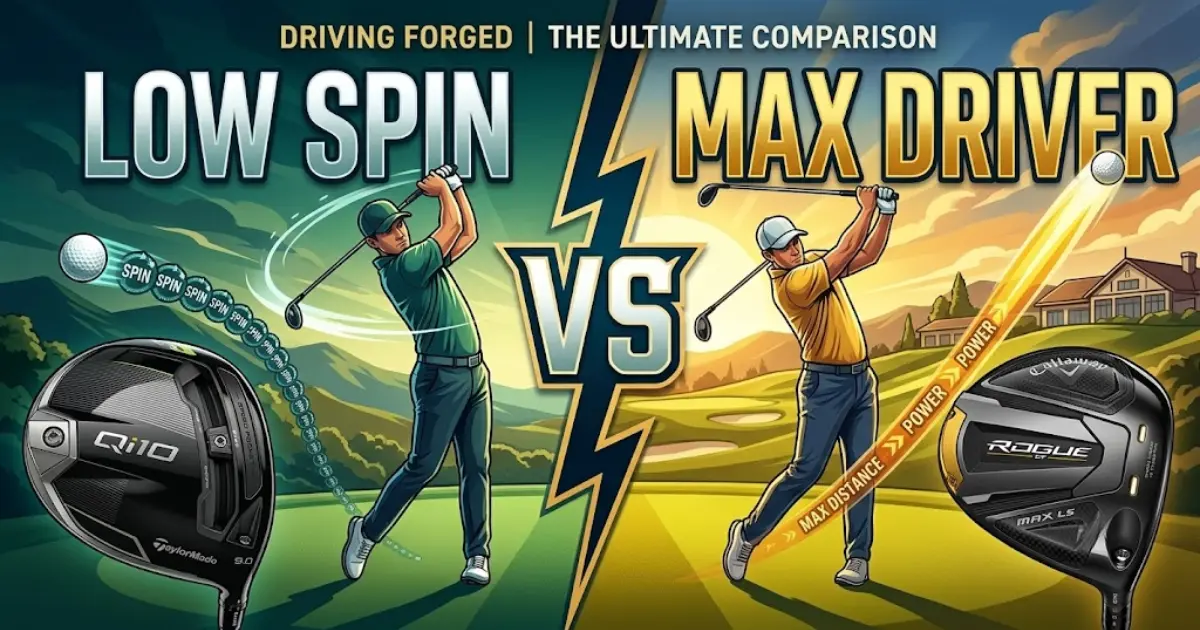
Quick Answer: A low spin driver cuts backspin for maximum distance. It works best if you swing over 105 mph and balloon the ball. A max driver prioritizes forgiveness on mishits. Most golfers should start with a max driver unless a launch monitor says otherwise.
What Actually Changes Between a Low Spin and Max Driver
The difference isn’t marketing. These are different clubheads built for different jobs.
A low spin driver moves the center of gravity forward, closer to the clubface. That forward CG reduces backspin by 500-800 RPM compared to a standard head. Less spin means a flatter ball flight with more rollout when the ball lands.
The tradeoff is lower moment of inertia. The clubhead twists more on off-center hits.
A max driver does the opposite. The CG shifts rearward. This increases MOI and resists twist on mishits. You get higher launch, more spin, and straighter shots when you don’t catch the sweet spot. But that rearward CG also adds spin. Sometimes 500+ RPM more than a low spin head.
The Center of Gravity Story
Here’s the physics in plain English. When you hit a golf ball, the clubface twists slightly. That twist adds spin. A forward CG reduces that twist at impact, which cuts spin. A rearward CG increases the effective loft at impact. That adds spin.
Think of it this way. Low spin drivers are precision tools. Max drivers are safety nets.
What “Max” Actually Means
Every major OEM now has a “Max” line. Ping G440 Max. TaylorMade Qi4D Max. Callaway Quantum Max. These aren’t just bigger heads. They’re engineered to push MOI as high as possible. The new Wilson Dynapower Max+ exceeds 10,000 MOI for the first time in that brand’s history.
That’s relevant because 10 years ago, a 5,000 MOI driver was considered ultra-forgiving. Now we’re double that.
Low Spin vs Max Driver: The Numbers That Matter
Here’s the comparison table nobody else has put together. Use this as your cheat sheet.
| Feature | Low Spin Driver | Max Driver |
|---|---|---|
| Spin rate | 2,000-2,600 RPM | 2,500-3,200 RPM |
| MOI (forgiveness) | 4,000-4,800 g/cm² | 4,800-10,000+ g/cm² |
| CG location | Forward, low | Rearward, low |
| Ball flight | Flat, penetrating | Higher, more carry |
| Rollout | 15-25 yards | 5-15 yards |
| Best swing speed | 105+ mph | 85-105 mph |
| Typical handicap | 0-10 | 8-25+ |
| Price (new 2026) | $550-$700 | $500-$650 |
| Price (used 2024-25) | $350-$500 | $300-$450 |
The spin gap is shrinking. New max drivers with 10K MOI spin only 200-300 RPM more than low spin models from the same brand. That’s a game-changer we’ll dig into below.
Who Actually Needs a Low Spin Driver?
Low spin drivers are for one specific player profile. High swing speed. High spin. Low handicap.
You’re a candidate if:
- Your swing speed is 105 mph or higher
- Your current driver spin rate is over 3,000 RPM
- Your drives climb too high and fall straight down with no rollout
- You consistently hit the center of the face
- Your handicap is single digits (or you’re working toward it)
You should NOT buy a low spin driver if:
- Your swing speed is under 95 mph
- You struggle to get the ball airborne
- Your miss is all over the face
- You’re a mid-to-high handicapper who just wants to hit more fairways
Here’s the honest truth. A low spin driver with a forward CG amplifies the gear effect on mishits. Hit it on the toe and you get a knuckleball that falls out of the sky. Hit it on the heel and you get a duck hook 40 yards left of where you aimed.
I learned this the hard way. The G425 LST gave me 12 more yards on my best strikes. But my average drive actually got shorter. My mishits were so much worse. I switched back to a max driver after six months. I started hitting 4 more fairways per round.
Low spin drivers are good for golfers with swing speeds over 105 mph who generate more than 3,000 RPM of backspin. If your drives balloon and fall straight down with no rollout, a low spin head can flatten your trajectory and add 10-15 yards of total distance.
Are Low Spin Drivers Harder to Hit?
Yes. Full stop.
The forward CG that reduces spin also reduces MOI. Lower MOI means the clubhead twists more when you miss the center. That twist changes the face angle at impact. It changes both the direction the ball starts and how much it curves.
On a max driver, a toe miss might still find the fairway. On a low spin driver, that same toe miss is probably in the right rough.
The gear effect is the culprit. When you hit toward the toe, the clubface opens slightly. The ball spins with a slice-inducing sidespin. A rearward CG resists that opening. A forward CG doesn’t.
Low spin drivers aren’t unplayable. But they demand better ball-striking. If you’re a 12-handicap who hits 5 fairways a round, a low spin driver will probably make that number go down.
The 10K MOI Revolution
This is where the conversation gets interesting.
For years, the tradeoff was simple. Forgiveness or distance. You couldn’t have both. The 10K MOI category changed that.
Ping started it with the G430 Max 10K in 2024. That driver spun only 250 RPM more than the low spin LST model. Wilson dropped the Dynapower Max+ with 10K MOI and ball-speed gains across the face. Callaway, TaylorMade, and Cobra now have models blurring the line.
Here’s what that means for you. You don’t have to choose as much anymore.
A 10K MOI max driver gives you near-low-spin performance with max-driver forgiveness. The Ping G440 LST actually outpaced the G440 K on forgiveness in Golf Digest’s robot testing. A low spin driver beat a max driver at its own game.
The gap is closing. If you’re on the fence, a 10K MOI max driver might be the answer.
2026’s Best Low Spin and Max Drivers
Let’s get specific. Here are the best options in each category for 2026 with real prices you can verify today.
Best Low Spin Drivers 2026
Ping G440 LST — $599 new, ~$450 used
The lowest spinning driver in Ping’s 2026 lineup. Robot testing at 95 mph showed 138 mph ball speed and 245+ yards total distance. Available in 9° and 10.5° with a three-position back weight.
TaylorMade Qi4D LS — $599 new
The lowest-launching, lowest-spinning model in TaylorMade’s 2026 family. Features the lowest center of gravity among the top low-spin drivers. Delivers minimal left curvature and very low spin.
Callaway Quantum Triple Diamond — $699 new
The lowest-spinning head in Callaway’s new family. Uses a 360-degree carbon chassis to free up weight and position mass forward. Compact, tour-style profile for faster swingers.
Best Max/Forgiveness Drivers 2026
Ping G440 Max — $549 new, ~$400 used
Ping’s most forgiving driver. Features a 29-gram back weight adjustable for draw, fade, or neutral shot shape. High MOI design with exceptional stability.
TaylorMade Qi4D Max — $549 new
The most forgiving driver TaylorMade has ever made. 10K MOI head shape delivers supreme stability on mishits.
Wilson Dynapower Max+ — $499 new
Wilson’s first 10K MOI driver. Exceeds 10,000 MOI while producing measurable ball-speed gains across the face. The straightest and most forgiving driver Wilson has ever made.
The “Best of Both Worlds” Option
Callaway Quantum Triple Diamond Max — $699 new
This sits in a gray area. Low spin DNA with max forgiveness. Of the four Quantum driver heads, it’s the one I’d recommend to the widest range of decent ball strikers. If you want speed but don’t want to be punished for every slight miss, start here.
The 5-Step Fitting Decision Flow
Stop guessing. Here’s exactly how to figure out which driver fits your game.
Step 1: Get your swing speed on a launch monitor.
Most golf shops have one. If you don’t know your number, you’re flying blind. Under 95 mph? Lean max. Over 105 mph? Consider low spin. In between? You’re in the gray area. Test both.
Step 2: Check your spin rate.
The ideal window is 2,200-2,700 RPM. If you’re over 3,000, low spin is worth testing. If you’re under 2,000, a max driver will help you keep the ball in the air.
Step 3: Evaluate your miss.
Scattered across the face? Max driver. Consistently center? Low spin becomes viable.
Step 4: Consider your handicap.
Over 12? Max driver. Under 8? Low spin is on the table. Between 8-12? Test both and let the numbers decide.
Step 5: Test both on a launch monitor.
Hit 10 shots with each. Compare average distance, not just your best strike. Compare dispersion. The club that gives you the tightest grouping with the best average distance is the winner.
Frequently Asked Questions
Who are low spin drivers good for?
Low spin drivers are good for golfers with swing speeds over 105 mph who generate more than 3,000 RPM of backspin. They’re also good for single-digit handicappers who consistently hit the center of the face and want maximum rollout. If your drives balloon and fall straight down with no rollout, a low spin head can flatten your trajectory and add 10-15 yards of total distance.
Are low spin drivers hard to hit?
Yes, they’re less forgiving on mishits. The forward CG that reduces spin also lowers MOI. The clubhead twists more on off-center strikes. A toe miss on a low spin driver will curve more and lose more distance than the same miss on a max driver. If you don’t consistently hit the center of the face, a low spin driver will expose your misses.
Is it better to have more spin on a driver?
Not automatically. The ideal spin rate is 2,200-2,700 RPM. Too much spin causes ballooning and kills rollout. Too little spin means the ball won’t stay in the air long enough to maximize carry. More spin isn’t better. Optimal spin is better. If you’re under 2,000 RPM, a max driver will actually help you. If you’re over 3,000, low spin is worth considering.
Is a low spin driver straighter?
No. Low spin drivers are actually less straight on mishits because of the lower MOI. They produce less curvature on well-struck shots. But on off-center hits, they curve more. Max drivers keep the ball straighter across a wider range of impact locations because the higher MOI resists twisting.
The Bottom Line
Most golfers should buy a max driver. The forgiveness advantage is massive. The spin gap to low spin models is shrinking every year. Unless you’re a single-digit handicapper with 105+ mph swing speed who consistently hits the center of the face, a max driver will help you score better.
The only way to know for sure is to get fitted. Hit both on a launch monitor. Compare the numbers. Let the data make the decision, not the marketing.
I’ve never met a golfer who regretted buying more forgiveness. I’ve met plenty who regretted chasing distance they couldn’t control.