
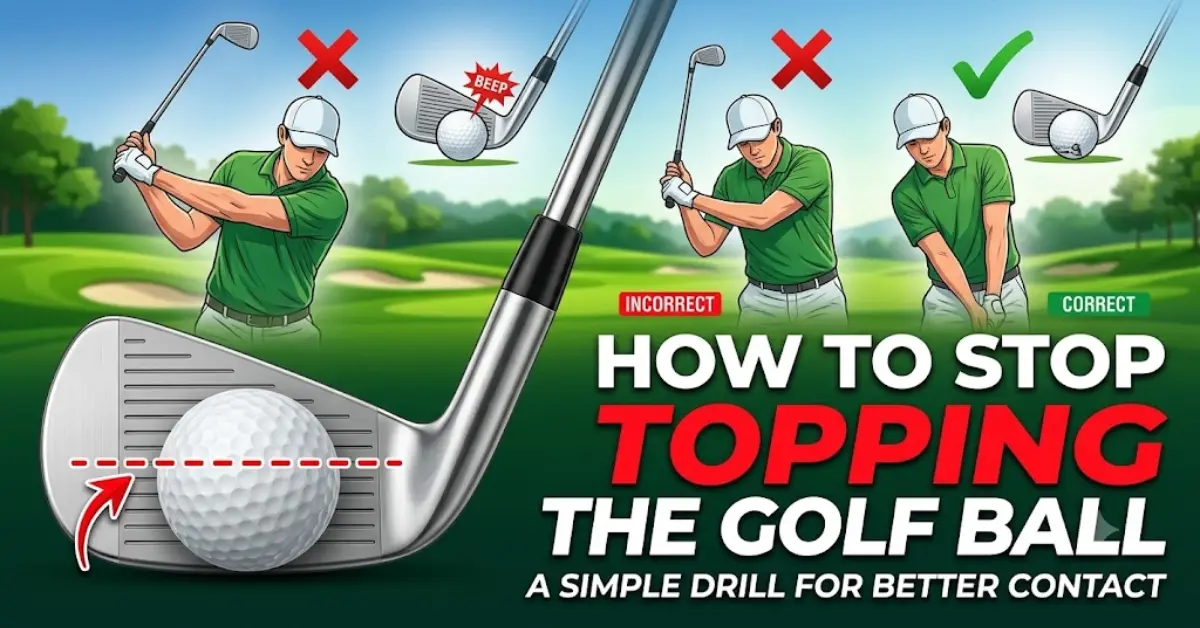
Three topped shots in a row. Sound familiar? You know exactly what you’re doing wrong the moment the ball skitters 30 yards along the ground, but you have no idea how to stop it. I’ve been there – stuck on a par-5 second shot with a 4-wood in my hand, watching my ball run 40 yards into rough because I caught it dead on the crown for the third straight hole. That day cost me six shots. What fixed it wasn’t some major swing rebuild. It was one specific posture check and a ball position adjustment I could make in 30 seconds.
This article covers the six root causes of topping, club-by-club fixes for irons, driver, fairway woods, and hybrids, a dedicated section for senior golfers, and three drills with exact measurements you can take to the range today.
Quick Answer: Topping the golf ball happens when your swing arc bottoms out too early, so the club is already rising when it reaches the ball and catches the top half. The two fastest fixes are checking your ball position for that specific club and stopping the scooping instinct – your loft does the lifting, not your hands.
Why You’re Topping the Ball (The Real Mechanical Reason)
Every golf swing moves in an arc. That arc has a lowest point – the moment the clubhead is closest to the ground. With irons, your lowest point should be 2–3 inches in front of the ball, so the club strikes the ball slightly before bottoming out and then brushes the turf. That’s what creates the divot in front of your ball position you see better players making.
Topping happens when your lowest point arrives too early. By the time your club reaches the ball, it’s already starting to rise – and instead of catching the equator or below, it catches the crown of the ball. The result is that thin, skidding shot that runs along the ground with zero height.
That “too-early low point” has six specific causes. Fix the right one for your miss, and topping stops almost immediately.
The 6 Root Causes of Topping – and How to Fix Each One
1. The Scooping Instinct (Biggest Cause for Amateurs)
Your brain watches a ball sitting on the ground and sends a message: lift it. So your hands flip through impact, wrists scoop upward, and instead of the club descending into the ball, it rises before it gets there. Caught the top half. Every time.
Golf is counterintuitive here. The clubface loft – not your hands – launches the ball. A 7-iron has 34 degrees of loft; it does not need your wrists to help. The fix is to actively feel your chest staying over the ball through impact and your weight shifting forward onto your lead foot. Drill your hands to lead the clubhead at impact – not follow it.
A useful image: imagine you’re trying to trap the ball between the clubface and the ground. Not scoop it. Trap it. That mental shift alone eliminates scooping for most mid-handicappers within one range session.
The “Reddit fix” you’ll see everywhere – “keep your head down” – is only half right. Keeping your head steady helps, but it doesn’t fix the scooping motion that’s actually causing the top.
2. Early Extension (Standing Up Through Impact)
Early extension means your hips drive toward the ball during the downswing, which forces your upper body to rise to get out of the way. Your spine angle changes, your chest lifts, and your swing arc rises with it. The club never gets down to where the ball is.
The fix is to feel your rear end staying back and your chest staying pointed at the ball through impact. One honest way to check this: hold your finish for two full seconds. If you’re up on your toes and your belt buckle is pointing at the sky, you extended early.
3. Wrong Ball Position for the Club You’re Hitting
Ball position directly controls where your swing arc meets the ball. Too far back in your stance and your arc bottoms out after the ball – you’ll top it or hit it fat. Too far forward and the club is already rising.
General positions that work for most players:
- Short irons (8, 9, PW): Center of stance
- Mid irons (5, 6, 7): One ball-width forward of center
- Long irons and hybrids: Two ball-widths forward of center
- Fairway woods: Three ball-widths forward of center
- Driver: Inside your lead heel
Move the ball one inch forward for the club you’re topping and check the result. That single change fixes more topped shots than any other adjustment.
4. The Reverse Pivot (Weight Going the Wrong Way)
A reverse pivot happens when your weight moves toward your lead foot on the backswing instead of staying behind the ball. Your body then compensates on the downswing by hanging back on your trail foot – which causes your arc to bottom out behind you, and the club to rise by the time it reaches the ball.
Check for this: at the top of your backswing, you should feel 70% of your weight on your trail foot. If you’re leaning toward the target at the top, you’ve reverse-pivoted. Focus on turning your lead shoulder down and back on the backswing while keeping your head still over the ball.
5. Looking Up Before Impact
This is the cause every beginner gets told about, and it’s real – but it’s often a symptom, not the root cause. Lifting your head early pulls your shoulders up, which raises your swing arc and causes a top.
The better cue than “keep your head down” is “watch the back of the ball until you hear the club make contact.” Picking a dimple on the back of the ball to focus on keeps your head neutral without forcing an unnatural locked-down position.
6. Arm Collapse at Impact
Your lead arm (left arm for right-handed players) should stay relatively straight through the impact zone – not rigid, but extended. When the elbow bends before or at impact, your effective club length shortens by 2–3 inches, which lifts the arc and creates a top.
The fix: practice half-swings with a deliberate focus on keeping your lead arm extended through the ball. The feeling should be of the clubhead brushing the ground after the ball, not flipping up and through.
How to Stop Topping the Golf Ball With Irons
Irons are where most golfers first experience topping, and the fix is almost always about producing a descending blow — the club moving slightly downward when it reaches the ball.
Hitting your irons consistently means the club must reach its lowest point 2 inches in front of where the ball was sitting, creating a divot on the target side of the ball position. If your divots are behind the ball, or you’re not making divots at all, you’re bottoming out early.
For a 7-iron, ball position should be one ball-width forward of center – not the middle of your stance, and not off your lead heel. From there, press your hands very slightly toward the target at address. That forward shaft lean pre-sets the angle you need at impact. Keep your weight 55% on your lead side throughout the swing, and feel your chest cover the ball through impact.
One drill that works immediately: using a 7-iron, tee the ball on a very low tee (1/4 inch maximum). The tee forces you to make slightly downward contact rather than scooping. Once you’re making consistent contact off the low tee, remove it and hit from the ground with the same motion.
For more on hitting your irons consistently, see our guide to hitting irons consistently.
How to Stop Topping the Golf Ball With Driver
Driver topping usually comes from one of three specific causes: tee height too low, ball position too far back, or a descending attack angle – the opposite of what you want with a driver.
Unlike irons, you want to hit slightly up on a driver, catching the ball on the upswing. That’s why the ball sits on a tee with roughly half above the top of the clubface at address. If you’re teeing the ball low or attacking downward, the club will already be moving up by the time it reaches the ball and catch the crown.
Three driver-specific fixes:
- Ball position: play the ball inside your lead heel – further forward than most golfers instinctively feel comfortable with
- Tee height: at least half the ball should sit above the crown of the driver at address
- Body tilt: your right shoulder (for right-handers) should sit lower than your left at address, promoting an upward attack angle
If you’re hitting a driver with under 10.5° of loft and regularly topping it, consider going to 10.5° or 12°. Slower swing speeds (under 90 mph) genuinely need more loft to launch the ball effectively. It’s not a crutch – it’s matching equipment to your swing.
For dedicated driver drills to reinforce these changes, our driver guide covers the tee drill and swing path work in detail.
How to Stop Topping the Golf Ball With Fairway Woods and Hybrids
Fairway woods are the hardest clubs for most amateur golfers to stop topping. The reason is specific: the combination of a long shaft, a shallow face, and the ball sitting on the ground all conspire against you. There’s no tee to help, the sweet spot is narrow vertically, and the scooping instinct is strongest here because the ball looks hardest to get up.
The fix for fairway woods is to treat them almost like a long iron rather than a driver. You’re not trying to sweep the ball – you want to catch it at the very bottom of the arc or slightly descending. Ball position should be three ball-widths forward of center, but no further. Your weight should start 55% on your lead side at address and stay there.
One important posture note for fairway woods: stand a touch taller and closer to the ball than you think you need to. Most topped fairway woods come from an “athletic” crouch that’s too deep – the knees bend too much, creating a position your body instinctively wants to spring out of during the swing. Straighten slightly. Your butt line should be close to in line with your heels.
Hybrids top for a slightly different reason. The hybrid has a higher center of gravity than a fairway wood and a shorter shaft, so it demands a more iron-like strike – meaning slightly descending. Play the hybrid two ball-widths forward of center (same as a long iron) and make sure you’re hitting the ball first, not the ground first. The hybrid is not a sweeper. Treat it like a 4-iron and it’ll reward you.
How to Stop Topping the Golf Ball for Seniors
This section exists because none of the top-ranked articles on this topic address the age-specific reason why topping gets worse after 50 – and it’s a real mechanical issue, not just a general “flexibility” problem.
After 50, hip rotation typically decreases by 20–30% compared to younger years. A shorter hip turn compresses your swing arc. The club bottoms out earlier in the downswing because your body isn’t rotating through as fully, which means the club is rising when it reaches the ball even though your positions look correct.
The fix is not “rotate more” – that advice just causes injury for a stiff hip. Two specific adjustments work for most senior golfers:
Widen your stance by 2 inches. A slightly wider base reduces the rotational demand on your hips while maintaining enough swing arc to reach the ball properly. Many senior golfers who widen their stance by 2 inches stop topping within one round, without changing anything else about their swing.
Swing at 80% tempo, not 100%. A rushed transition from backswing to downswing is where the shortened hip rotation causes the most damage. Slowing the transition by 20% gives the body time to clear through the ball properly. Distance barely drops — and topped shots almost disappear.
One equipment fix worth trying: if you’re playing steel-shafted fairway woods or hybrids, switch to graphite. Lighter graphite shafts allow more clubhead speed with less effort, which helps restore the swing arc that hip restriction has compressed. A senior-flex graphite shaft in a 5-wood does more work per unit of effort than a stiff steel shaft ever will.
3 Drills to Stop Topping — With Specific Measurements
These three drills target low-point control. You can use all three in one 30-minute range session.
Drill 1 – The Towel Drill (Low-Point Control) Place a towel 4 inches directly behind your ball. Swing through and hit the ball cleanly without touching the towel. If you hit the towel, your arc is bottoming out too early — exactly what causes a top. If you miss the towel and make clean contact, your low point is where it needs to be. Start with half-swings at 60% effort. Build to full swings only after you can miss the towel 8 out of 10 times with a 7-iron.
Drill 2 – The Double Tee Drill (Descending Blow) Tee your ball on a very low tee (1/4 inch). Push a second empty tee into the ground 6 inches in front of the ball, on the target line. Your goal: hit the ball and clip the second tee. With irons, a descending blow will naturally clip it. An upward scoop won’t reach it. Ten swings per session; aim for 8 out of 10 clips.
For driver specifically, reverse this: place the second tee 4 inches in front and aim to swing above it – confirming an upward attack angle on the driver.
Drill 3 – Feet-Together Swings (Posture and Balance Reset) Stand with your feet almost touching – 2 inches apart – and hit short irons at 50% effort. This narrows your base so much that any balance disruption, early extension, or head movement immediately causes a mishit. You can’t top a ball repeatedly with your feet together and poor posture; your body won’t let you.
Ten feet-together shots with a pitching wedge, then move to a 7-iron, then a 5-iron. Run this drill in slow motion first to identify exactly where your balance breaks down. This is the stop-topping-golf-ball-slow-motion drill you’ve seen on YouTube – the feet-together version forces the feedback without needing a camera.
Frequently Asked Questions
The fastest fix for iron topping is moving your ball position one ball-width forward of center and making sure your hands are slightly ahead of the ball at address. This forward shaft lean pre-sets a descending blow, so the club naturally contacts the ball before the ground. From there, keep your chest over the ball through impact instead of hanging back on your trail foot.
The 70/30 rule most commonly refers to a practice allocation strategy: 70% of your practice time goes to short-game shots (putts, chips, pitches, and wedge shots inside 100 yards), and 30% goes to full-swing work including irons, woods, and driver. The logic is that most amateurs lose more shots near the green than they do off the tee. In a separate context, some instructors use “70/30” to mean swinging at 70% effort on approach shots to prioritize center-face contact over maximum distance – and that applies directly to stopping topped shots, since swinging at 100% effort often rushes your transition and moves your low point unpredictably.
Senior golfers top the ball more often as hip rotation decreases with age, which compresses the swing arc and causes the club to bottom out before it reaches the ball. Two adjustments make an immediate difference: widening your stance by 2 inches reduces the rotational demand on your hips while restoring enough arc to strike the ball cleanly, and swinging at 80% tempo slows your transition so your body has time to clear through properly. Switching to lightweight graphite shafts in fairway woods and hybrids also helps, since less effort produces more clubhead speed and a fuller arc.
Rolling the arch of your foot over a golf ball is a commonly used self-massage technique for plantar fasciitis. The firmness of the ball provides direct pressure on the fascia tissue, which some people find relieves tightness. Results vary – it works for mild cases and as a temporary relief tool, but it doesn’t address the underlying cause. If you’re experiencing persistent heel pain on the course, a podiatrist can give you a more targeted treatment plan than any self-massage technique.
The Bottom Line on Topping
Topping the golf ball is almost always a setup or low-point issue – not a fundamental swing flaw that requires months of work to fix. For most golfers, the right ball position for the specific club, combined with forward shaft lean at address and a commitment to not scooping, solves 80% of topped shots within one range session. Seniors have a specific hip-rotation cause to address with stance width and tempo adjustments. And if you’re regularly topping one specific club – usually the 3-wood or hybrid – that club is telling you something about your posture setup that your irons are hiding.
Work through the drills with exact measurements above before booking a lesson. You might not need one.